

First, the conclusion
When looking at the legal system of each country, the first thing investors should think about is not whether it is a good country or a bad country.
The question is what capital costs and entry barriers are created for which industry by that system.
| Differences in legal systems | Conversion into investment opportunities |
|---|---|
| Strong ownership and contract protection | Discount rates for long-term investments tend to fall |
| Strict foreign investment regulations | May act as a barrier to entry and protect the interests of domestic companies |
| Licenses are heavy | New entry is difficult, but the value of existing businesses may increase |
| There are tax breaks | Funds go to factories, research and development, renewable energy, semiconductors, etc. |
| Frequent regulatory changes | Valuations tend to be suppressed even in high growth |
| Strong intellectual property protection | Pharmaceuticals, semiconductor design, software, and branded companies are easily evaluated |
Markets often view the legal system as "news."
However, in reality, the legal system enters into the formula for calculating corporate value. Sales growth rate, profit margin, investment recovery period, cost of capital, M&A exit, dividend return, etc. are all affected.
Even with the same profit growth, the profits of countries with stable systems tend to be valued higher. Conversely, the benefits of countries with strong risks of institutional change are discounted even if the numbers are good.
This is both the fun and the difficulty of international investment.
What's happening?
When it comes to global investment, it is no longer sufficient to simply "buy growing countries."
Supply chain restructuring, economic security, data regulations, foreign investment screening, decarbonization policies, industrial subsidies, and tax reform have all come together, and national legal systems have come to the fore more than ever before.
For example, in semiconductors, subsidies and export controls change investment destinations. Location of data centers is determined by power regulations, land use, and regulations on cross-border data transfer. In renewable energy, rules for feed-in tariffs, grid connections, and environmental permits determine project value.
In other words, just looking at a company's competitiveness is not enough.
Under which country's laws will competitiveness be demonstrated? If you overlook this point, you may have intended to invest in a growing market, but you end up buying regulatory risk.
The World Bank's Business Ready looks at each country's business environment through three pillars: regulatory framework, public services, and practical efficiency. The OECD's FDI Regulatory Restrictiveness Index measures legal constraints on foreign direct investment, such as restrictions on foreign investment, pre-screening, and rules regarding key personnel.
What these indicators show, apart from the growth rate, is that there is an ``institutional environment that allows business to truly operate.''
Impact on price formation
The legal system has a fairly direct effect on stock prices and corporate value.
The easiest to understand is the discount rate.
In countries where contracts are honored, the court system functions well, the rights of foreign capital are protected, and dividends and proceeds from sales are easily repatriated, investors can easily evaluate future cash flows at a relatively low discount rate.
Conversely, in countries where regulatory changes occur suddenly, where there are restrictions on capital movement, or where the treatment of foreign companies is unclear, the discount rate will be higher for the same profit. As a result, PER and EV/EBITDA tend to appear low.
What I would like to note here is that just because a stock has a low P/E ratio does not necessarily mean it is cheap.
If behind a low P/E ratio there are legal system risks, capital regulations, weak minority shareholder protection, compulsory price controls, and the risk of foreign capital withdrawal, the market has already factored that in.
Conversely, stocks from countries with stable institutions can trade at high multiples even if their growth rates are not that high. The market is buying not just the amount of profits, but also the probability that profits will reach shareholders.
This view is particularly valid for companies related to infrastructure, banking, telecommunications, electricity, pharmaceuticals, real estate, resources, and data. This is because the profits of these industries are determined by regulations and permits.
Beneficial area and risks
Differences in legal systems divide investment opportunities into several areas.
| Area | System conditions that make it easy to receive benefits | Risk |
|---|---|---|
| Semiconductor/manufacturing industry | Subsidies, tax credits, attracting foreign capital, speed of factory permits | Export control, geopolitics, subsidy dependence |
| Data centers/AI | Clarity of power supply, land use, and data regulations | Power restrictions, environmental regulations, and data cross-border restrictions |
| Pharmaceuticals/Bio | Intellectual property protection, drug pricing system, clinical trial rules | Drug price reductions, patent expirations, approval delays |
| Renewable energy | Feed-in tariffs, tax incentives, grid connection rules | Policy changes, connection delays, residents' opposition |
| Finance/Fintech | Licensing system, payment regulations, data usage rules | Strengthening regulations, capital regulations, AML response costs |
| Real estate and infrastructure | Ownership protection, land registration, transparency of permits | Rent regulation, expropriation, interest rate and tax changes |
What investors should be looking at here is not just whether regulations are lax or strict.
Even if regulations are strict, it can be beneficial for listed companies if the rules are clear and create barriers to entry for existing companies. Banking, telecommunications, electricity, and pharmaceuticals are typical examples.
Conversely, even in lightly regulated markets, if enforcement is unstable, the quality of profits will be seen as low. Even if book profits are made, collection, dividends, and M&A exits may be a long way off.
For investors, legal system analysis is not a moral judgment.
The task is to see which companies' profit margins are protected by this system, which companies' investment returns are delayed, and which industries are encouraged to receive capital inflows.
“High walls” created by the legal system are not necessarily a bad thing
A common mistake investors make is to simply avoid countries with more regulations.
Regulation is a cost. At the same time, it is also a barrier to entry.
For example, banking and insurance are highly regulated industries. Capital regulations, supervisory authorities, compliance, and licensing are heavy. New entrants are not easy. As a result, it is easier for existing players to maintain a certain revenue base.
Communication is similar. Frequency licenses, capital investment, and regulatory compliance are heavy. New entrants are difficult. Even if the market matures, existing companies tend to have cash flow.
In pharmaceuticals, the patent system and approval system create corporate value. It takes time and money, but if successful, the period of exclusivity supports profits.
In other words, regulation is both a risk and a mote.
Investment opportunities arise when the market has not yet fully valued the moat. On the other hand, when high profits that are protected by regulations are already factored into stock prices, valuations are likely to collapse simply due to policy changes.
Lower legal risk often means higher stock prices
Countries with stable legal systems give investors a sense of security.
However, peace of mind is not free.
In markets like the United States, Switzerland, Singapore, and Scandinavia, where contract protection, intellectual property, capital market systems, information disclosure, and minority shareholder protection are in place, good companies tend to be valued quickly and highly.
This is troubling for investors.
The lower the institutional risk in a country, the fewer stocks are cheap. This is because the stability of the legal system is already easily factored into valuations.
On the other hand, in emerging countries and markets undergoing system transition, even good companies may be left undervalued. The reason is that investors dislike institutional risk.
There's an opportunity here.
However, the opportunity is not to "buy it because it's cheap." It is necessary to determine whether the system is improving or worsening.
If the legal system improves, foreign investment regulations are relaxed, capital market transparency increases, and minority shareholder protection is strengthened, not only corporate profits but also the PER ratio itself can rise.
This rerating is strong.
On the other hand, if regulations and capital controls become stricter, the PER ratio will not increase even if profits increase. This is where the phenomenon of good numbers but sluggish stock prices occurs.
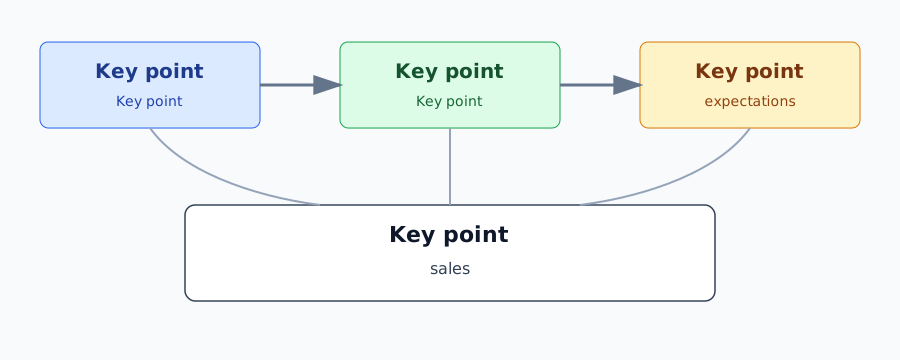
Diagram: How the legal system reaches corporate value
Checkpoints that investors should check
When looking at the legal systems of each country, it is not enough to look broadly.
It is necessary to incorporate this into a system that is directly related to the industry targeted for investment.
| Items to see | Things investors should check |
|---|---|
| Ownership | Will land, equipment, patents, and stock interests be protected |
| Contract Enforcement | Are contracts with business partners, debt collection, and litigation working |
| Foreign investment regulations | Are there any restrictions on investment ratio, preliminary screening, and recovery of funds upon withdrawal |
| Tax system | Do corporate taxes, dividend taxation, withholding taxes, and preferential treatment change investment returns |
| Permits | Will it be a barrier to entry in factories, communications, finance, pharmaceuticals, electricity, etc. |
| Intellectual Property | Will your patents, trademarks, software, and data be protected? |
| Capital Movement | Can dividends, sale proceeds, interest, and royalties be returned abroad |
| Policy change | Is the system likely to change due to elections, changes in government, or geopolitics |
As you can see from this table, legal system analysis is not just a job for lawyers.
For investors, the task is to read the quality of cash flow.
The ability of a company to earn money and the ability of investors to recover are different. The legal system makes the difference.
Summary
Differences in legal systems from country to country greatly affect investment opportunities.
In countries where property rights are protected, contracts are enforced, tax systems are stable, and foreign investment regulations are clear, discount rates for long-term investments tend to decline. As a result, blue-chip companies tend to have high valuations.
There are investment opportunities even in countries with complex regulations.
If licenses and foreign investment regulations become high barriers, existing companies may protect their profit margins. This is where the moat of regulated industry comes from.
It is even more difficult for countries in the process of system change.
As reforms progress, profit growth and PER rise will occur at the same time. Conversely, if regulations and capital movement restrictions become stricter, stock prices will be less likely to be valued even if profits increase.
Investors should look at more than just growth rates.
Under what law will this growth be generated, to whom will it belong, and with what probability will it return to shareholders?
Only by looking at this point can we begin to see the investment opportunities in each country in three dimensions.
source
- World Bank Group, Business Ready Reports
- World Bank Group, Business Ready
- OECD, FDI Regulatory Restrictiveness Index
- OECD, Foreign Direct Investment Regulatory Restrictiveness Index indicator
- World Justice Project, Rule of Law Index 2025
- WIPO, Global Innovation Index
- Confirmation date: 2026-05-26