

First, the conclusion
The recent sharp rise in Nikkato's performance is a bit shallow if it is explained solely by improved business performance.
The financial results are certainly good. In the fiscal year ending March 2026, sales will increase by 12.5%, operating income will increase by 67.9%, and net income will increase by 54.0% compared to the previous fiscal year. The ceramics business grew as market conditions for electronic components recovered, and profit margins improved due to higher factory utilization rates.
However, our plans for next year are not that bullish.
The company's forecast for the fiscal year ending March 2027 is sales of 11.000 billion yen, operating income of 1.100 billion yen, ordinary income of 1.150 billion yen, and net income of 800 million yen. Operating income will only increase slightly compared to the previous fiscal year.
In other words, the reason why the stock price soared is not so much the financial numbers themselves, but because the market has reconsidered the company as a "peripheral infrastructure for AI, semiconductors, and electronic components."
Now comes the difficult part.
The theme is strong. The company isn't bad either. Our finances are also sound.
But it's not in the middle of the AI theme. AI-related buying has occurred where the supply and demand for small-cap stocks is thin. That's why it rises quickly and peels quickly.
It's best not to mistake this sense of temperature.
Take a calm look at the distance from AI
If you call Nikkato an "AI-related stock," it is AI-related in a fairly broad sense.
The company doesn't make GPUs. Nor does it provide generative AI services. We are not a data center operating company.
In terms of the AI value chain, it is a company that is quite downstream, or rather near the manufacturing process.
| Layer | Main companies/products | Distance to Nikkato |
|---|---|---|
| AI favorite | GPU, AI semiconductor, generative AI model | Not directly |
| Semiconductor manufacturing | Semiconductor manufacturing equipment, inspection equipment | Indirectly nearby |
| Electronic components/materials | MLCC, battery materials, powder materials | Easily susceptible to demand spillover |
| Around the manufacturing process | Heat treatment containers, grinding balls, heating equipment | The company's main battlefield |
The company's official website lists the ceramics and engineering businesses as its pillars, with applications such as general electronic components, semiconductors, and environment/energy.
In addition, the company's ball products are used for crushing and dispersing electronic component materials and high-performance materials, and heating devices are used for continuous heat treatment of powder samples and sintering processes.
This is different from the flashy world of AI semiconductors.
However, it is necessary at the manufacturing site.
AI data centers will increase. Demand for semiconductors will increase. Demand for electronic components, power supplies, circuit boards, and materials will expand. Behind the scenes, the unglamorous processes such as crushing, dispersion, heat treatment, and firing also take place.
Nikkato is the company behind this.
Therefore, this purchase should not be viewed as `AI favorite buying'' but `looking at the base of the AI market''.
A company that is unassuming but difficult to exclude from the process
What makes Nikkato interesting is not its flashy growth story.
Rather, it's plain.
Industrial ceramics are used in places that require high temperatures, wear, corrosion, insulation, and chemical stability that metals and resins cannot withstand. Nikkato's product page also explains that ceramic tubes have excellent heat resistance, corrosion resistance, and electrical insulation.
The same goes for zirconia balls and alumina balls for crushing.
In the process of crushing and dispersing electronic component materials and high-performance materials, it is a problem if the media side wears out too much or the materials become contaminated. High-purity, wear-resistant ceramic components come into play here.
From an investor's perspective, companies like this are difficult to understand.
Even when I heard the product name, it didn't click. There are no consumer brands. There are no easy-to-understand dreams like generative AI.
However, once it enters the customer's production line, it is difficult to replace it easily.
Specifications, materials, shapes, thermal history, wear, yield, and usage for each customer. This is because of these fine adjustments.
This is the strength of niche material stocks.
Although it is not noticeable, it penetrates deep into the process.
Financial results are strong, but plans for next fiscal year are at a plateau
Check the latest financial results.
The results for the fiscal year ending March 2026 were quite good.
| Items | Results for the fiscal year ending March 2026 | Compared to the previous fiscal year | Company forecasts for the fiscal year ending March 2027 |
|---|---|---|---|
| Sales | 11,341 million yen | +12.5% | 11,000 million yen |
| Operating income | 1,071 million yen | +67.9% | 1,100 million yen |
| Ordinary profit | 1,146 million yen | +59.2% | 1,150 million yen |
| Net income | 776 million yen | +54.0% | 800 million yen |
| EPS | 64.90 yen | +53.9% | 66.92 yen |
In the ceramics business, sales increased due to a recovery in market conditions for electronic components. The engineering business also saw an increase in sales due to capital investment for automobiles and heavy equipment.
In addition, improved factory utilization rates pushed up profit margins.
However, the plan for the fiscal year ending March 2027 is for a slight decrease in sales and a slight increase in profits.
This is the point.
Even if stock prices soar on the AI theme, the company's plans are not yet "explosive growth." The market has factored in the theme first, and the company's numbers have not yet caught up.
The numbers are good. The problem is that we are not letting our expectations get ahead of us.
Risks of AI theme-driven valuation
In the Japanese stock market, when the words "AI," "semiconductor," and "data center" are mentioned, short-term funds can surge.
This isn't just large-cap stocks.
In fact, it is easier to see a price range in small-cap stocks.
Small-sized materials stocks on the TSE Standard, such as Nikkato, do not typically have large trading volumes. If there is a theme buy, the sell board will be thin and the stock price will rise suddenly.
However, stocks bought on a theme may also be sold on a theme.
What we want to see here is not the percentage of AI-related sales, but how the numbers will actually show up in the next quarter and beyond.
- Will demand for electronic component materials continue?
- Are semiconductor-related orders increasing?
- Can the factory operating rate be maintained at a high level?
- Can raw material and energy costs be passed on to prices?
- Will the plan for the fiscal year ending March 2027 be exceeded?
If stock prices move first without this confirmation, valuations will become theme-driven.
If the stock price rises above the 1,000 yen level, the PER will be in the 15x range compared to the company's expected EPS of 66.92 yen. If it was around 800 yen before the sudden rise, it would have been about 12 times as expensive, so the valuation has gone up a notch.
That in itself is not denied.
However, if the PER ratio is to rise, it is also necessary to confirm profit growth.
The market will not tolerate just being a ``good niche company.'' After the stock price rises, the standard of demand changes from "a good company" to "a company that shows growth in numbers."
Supply and demand structure of small-sized, low PBR, niche material stocks
This movement is also typical of the Japanese market for small-cap stocks.
Nikkato was in the PBR range below 1x before the sharp rise. The company's equity ratio is 75.0%, operating CF is in the black at 1.675 billion yen, and its finances are quite strong. Despite this, the market's attention was limited due to the material-related, BtoB, and low liquidity.
These brands are usually unremarkable.
There is not enough liquidity for institutional investors to buy in large quantities. It is difficult to convey the details of the business to individual investors. Stock prices are likely to be left at a low PBR.
When the big themes of AI, semiconductors, and electronic components are connected to this, a complete review begins.
| Elements | How they affect stock prices |
|---|---|
| Small stocks | Price range tends to increase when buying is concentrated |
| Low liquidity | Short-term funds tend to rise rapidly due to thin selling board |
| Low PBR | Easy to use as an excuse for repurchasing |
| Niche technology | Often talked about as a “hidden AI-related” |
| Company plans unchanged | Delay in confirming actual demand will cause a decline |
This is the essence of this time.
Funds from the AI market are pouring into peripheral components.
The receptacle for this was small-sized, low PBR, and niche material stocks.
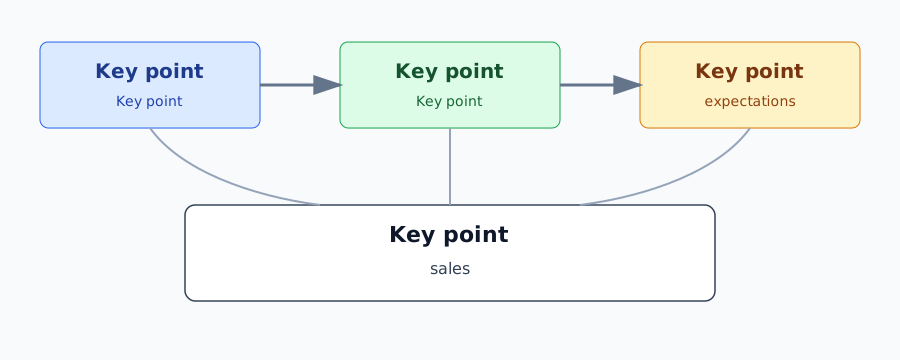
Diagram: Structure of Nikkato's sharp rise
Points to consider in the future
From here, it's more about numbers than themes.
| Key points | Why it's important |
|---|---|
| Ceramics sales in 1Q results | Will the recovery for electronic components continue |
| Factory utilization rate | Is the improvement in profit margin temporary? |
| Engineering orders | Looking at the sustainability of capital investment demand |
| Gross profit margin | Can raw material and energy costs be absorbed |
| Revised company plan | Have expectations for the theme changed to actual demand |
| Sustaining trading volume | Is it not just a matter of short-term supply and demand |
What is especially important is profit over sales, and occupancy rate over profit.
Ceramics companies' profit margins increase as volumes increase and factories operate. Conversely, when demand slows, profit margins tend to fall due to fixed costs.
Therefore, what we should be looking at in 1Q is not "AI-like explanations."
Ceramics business sales, gross profit, factory operating rate, and return of orders.
Summary
Nikkato's stop high is a typical example of the AI market spreading to peripheral material stocks.
However, the company is not an AI favorite stock.
It's not AI semiconductors, generative AI, or data center management. We are a niche materials and equipment company that is involved in manufacturing processes such as crushing, heat treatment, firing, and heating equipment.
That's where our strength lies.
It's unassuming, but difficult to remove from the process. Financials are solid. Profits will increase significantly in the fiscal year ending March 2026. It is true that there was room for review as a small material stock that had been neglected with a low PBR.
On the other hand, the company's plan for the fiscal year ending March 2027 is for a slight decrease in sales and a slight increase in profits. If the market buys up on AI themes first, then companies need to catch up in numbers.
The focus from here on isn't on thematic excitement.
How much will demand for AI, semiconductors, and electronic components fall on Nikkato's ceramics sales and profit margin?
If we can see this, we will move from a mere supply and demand market for small cap stocks to a sustained reassessment.
If this is not the case, this sharp rise will end up being just a ``niche material stock that jumped due to associations with AI.''
Nikkato is a good company. However, just because a company is good doesn't mean it will continue to rise. After a sharp rise, the question is not the theme but the actual demand.
Source
- Nikkato “Summary of Financial Results for the Fiscal Year Ending March 2026 [Japanese Standards] (Unconsolidated)”, disclosed on May 1, 2026
- Nikkato, Fiscal year ending March 2026 financial results briefing materials
- Nikkato, Easy to understand Nikkato
- Nikkato, Ball product information
- Nikkato, Heating device product information
- Yahoo! Finance, Nikkato Performance/Finance