
First, the conclusion
The recent stop high is not simply a reaction to "buying an AI company."
What the market is looking at is the possibility that parentheses will be revised as follows.
| Traditional view | Reassessment scenario |
|---|---|
| Fraud detection company for EC | AI security SaaS company |
| Small growth deficit-improving stocks | AI-related theme stocks |
| Stock income centered on O-PLUX | High unit price and automation with AI installed |
| Accumulation of implementation results | Horizontal expansion for major EC and financial services |
This is a fairly easy-to-understand material.
AI, security, EC fraud, bots, spoofing, and resale measures. The words that will make it easy to get money at the 2026 market price overlap neatly with the existing business in parentheses.
However, we must not forget that expectations are first. In the most recent first quarter of the fiscal year ending December 2026, sales were 216 million yen, operating loss was 23 million yen, and net loss was 23 million yen. Sales increased by 13.7% compared to the same period last year, and the deficit has narrowed, but it is not yet at the stage where it can be confirmed that the company will become profitable.
The numbers are starting to look better. The question is how far AI materials can increase the speed of improvement.
Direct material for stop height: Making Anycloud a wholly owned subsidiary
On May 27, 2026, Kakko announced its policy to acquire all the shares of Anycloud, which handles contract development of AI systems and applications, and make it a wholly owned subsidiary.
The points you should check are as follows.
| Item | Contents |
|---|---|
| Target company | Anycloud Co., Ltd. |
| Business details | Contract development of AI systems and applications |
| Acquisition details | Acquired all shares and made it a wholly owned subsidiary |
| Stock acquisition price | 247 million yen |
| Total acquisition cost | Approximately 277 million yen including advisory fees, etc. |
| Planned acquisition date | June 17, 2026 |
| Anycloud performance | Sales for the fiscal year ending May 2025: 158 million yen, operating income: 19 million yen, net assets: 76 million yen |
Considering the acquisition price alone, it is not an overly large deal.
Rather, what the market evaluated was not the size of the acquisition target, but the ease of understanding the combination.
Kakko originally provided fraud detection using AI and proprietary algorithms. By bringing in an AI development company, it is possible to add functions and develop new services in a manner similar to in-house production rather than outsourcing. The market reacted to that.
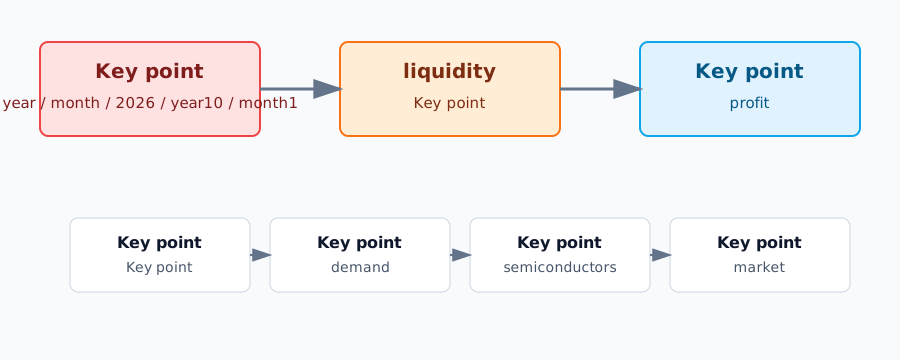
Illustration: How the market saw this material
Why was “AI security branding” effective?
E-commerce and Fintech fraud is much more complex than it used to be.
Credit card fraud, bot attacks, AI-generated accounts, spoofing, resale bots, unauthorized logins. Attackers are also becoming more automated and sophisticated, making it difficult to keep up with human visual checks alone.
Kakko's O-PLUX is a cloud service that detects fraudulent logins and fraudulent orders that occur in e-commerce in real time, and prevents fraudulent credit card use and malicious reselling. The official page also shows that negative data is shared among a total of more than 120,000 sites, and that it has been ranked No. 1 in domestic adoption for six consecutive years since 2019.
This area has good compatibility with AI.
Fraud patterns are not fixed. As the attacker changes, the detection model must also change. By bringing in a subsidiary with AI development capabilities, it will be possible to improve the false positive rate, increase detection speed, improve the sophistication of automatic screening, and respond to new fraud patterns. The market is buying it.
On May 22nd, an example of O-PLUX implementation on LIXIL's official mail order site "LIXIL Store" was also announced. The reduction in fraud damage by several million yen per month, the 97% block rate in trials, and the elimination of the operational burden of visual checks were indicators of the actual demand for O-PLUX.
The acquisition of Anycloud coincided with that. The order was good.
There is also a large supply and demand characteristic of small-cap stocks.
This sharp increase is difficult to explain based on performance evaluation alone.
Kakko has a small market capitalization, with only about 2.77 million shares outstanding. Recently, the trading volume has been in the thousands of shares on many days, and the stock is not well-stocked.
For small-sized growth stocks like this, the supply and demand situation suddenly tightens when materials emerge.
| Factors | How it affects stock prices |
|---|---|
| AI-related certification | Easy to get theme funds |
| Low floating stock | Prices tend to jump when buying is concentrated |
| Small market capitalization | Large impact of materials easy to see |
| SNS spread | Easy to collect short-term funds from individual investors |
| Deficit is improving | Price range tends to increase when expectations for profitability are high |
In other words, this time, `future expectations due to AI acquisitions'' and `the supply and demand market for small-cap stocks'' were running at the same time.
I would like to share this calmly. Changes in corporate value and price ranges due to short-term board thinness are two different things.
KPIs to watch in the medium term
In the short term, the stop high is a hot topic, but if you look at it over a six-month to one-year period, the focus becomes more practical.
What the market wants to see going forward is whether AI will really boost stock returns.
| KPI | Reasons to watch |
|---|---|
| Stock revenue of O-PLUX | Is the growth of existing mainstays continuing? |
| Timing of AI-powered feature releases | Speed of acquisitions being reflected in products |
| ARPU/unit price | Can prices be revised using AI functions |
| Churn rate/continuation rate | Is improving detection accuracy effective for customer retention |
| Major implementation examples | Will we see more results like LIXIL |
| ARR | Can we shift to SaaS growth instead of contract development |
Kakko's sales for the first quarter of the fiscal year ending December 2026 were 216 million yen, an increase of 13.7% compared to the same period last year. Stock revenue from fraud detection services is growing, and the deficit is narrowing.
This is a positive start, but the absolute amount is still small. Profit over sales, cash over profit. For small deficit growth, it is better to look at them in this order.
Risk: Possibility of ending up with AI theme stocks
AI materials are easy to buy. That's why selection is quick.
Even if the market views it as an "AI security stock," the next thing it looks for is implementation and numbers.
Please note the following points.
| Risk | View |
|---|---|
| Small scale of acquisition | This is a 277 million yen M&A, and it is not a deal that will immediately change business results |
| Contracted development has stopped | It is unconfirmed whether Anycloud's AI development capabilities can be converted into O-PLUX's SaaS revenue |
| PMI | Can you successfully integrate talent, development culture, and sales collaboration |
| Continued deficit | The parentheses are still in the operating deficit. The balance between growth investment and profitability is at stake |
| Overheated supply and demand | Profit-taking selling is likely to occur after the stop high |
| Selection of stocks announced by AI | Theme buying is likely to decline if there is no track record |
What's especially scary is that just the word ``AI'' will raise expectations, and the stock price will be the first thing to go by before the numbers are confirmed.
The material this time is good. However, for the stock price to sustain, it is necessary to actually show either the AI-equipped O-PLUX, price revision, large-scale introduction, or ARR expansion.
Investment stance
In the short term, price movements after the peak high tend to be driven by supply and demand.
Investors who were not able to buy in the first move will pursue the stock the next day and at the same time take profits from their short-term funds. Since the stock is thin, it is easy to see price ranges both above and below.
If we look at the medium term, we can narrow our focus to the following three things.
- After Anycloud becomes a subsidiary, which services will the AI function be included in and when?
- Will O-PLUX stock revenue and the number of companies introducing it increase?
- Can you see a path from reducing the deficit to becoming profitable?
If this can be confirmed, there is scope for Kakko to be reconsidered as an `AI security SaaS company'' rather than just a `fraud detection service company.''
On the other hand, if AI cooperation stops at news and does not show up in sales or ARR, it will end up being a temporary theme stock.
Summary
The high stop on parentheses (4166) can be seen as a move by the market to anticipate the creation of an AI security stock, triggered by Anycloud becoming a wholly owned subsidiary.
The acquisition price is not large. The scale of Anycloud's performance is not enough to cause a sudden change in Kakko's profits on its own.
However, the reason it was a strong material is because there is a clear compatibility between Kakko's mainstay fraud detection and AI development capabilities. Countermeasures against e-commerce fraud, bots, spoofing, and resale are areas that can easily be advanced with AI.
From here, we move from expected market prices to actual results.
Implementation of AI functions, higher unit price of O-PLUX, expansion of ARR, major implementation examples. If these things occur, this stop high will not just be a one-day indicator, but will be the first move for a reevaluation.
On the other hand, if the numbers don't follow, the enthusiasm for the stock as an AI theme stock will decline. As a small-cap stock, there is a price range, but when making investment decisions, you want to look at `recurring income'' rather than `theme.''
Source
This article was created based on publicly available information, company announcements, and stock price materials.
- Kakko "Notice regarding conclusion of stock transfer agreement for stock acquisition of Anycloud Co., Ltd.", timely disclosure, May 27, 2026
- [M&A Online "Kakko <4166> makes Anycloud, an AI system contract development company, a subsidiary" May 27, 2026] (https://maonline.jp//news/20260527c)
- Brackets "Fraud detection service O-PLUX"
- [Cacco "LIXIL Corporation introduces fraud detection service 'O-PLUX'" May 22, 2026] (https://cacco.co.jp/news/20260522_press/)
- Parenthesis "Summary of first quarter financial results for the fiscal year ending December 2026 [Japanese GAAP] (non-consolidated)", May 15, 2026