
First, the conclusion
Changxin Technology's IPO has a strong theme as a symbol of China's semiconductor independence.
However, if you look at it as an investment target, it cannot be said that it is safe because it is a national-level company. Rather, it will be a highly volatile project, involving memory market conditions, U.S.-China regulations, huge capital investment, HBM development, and supply and demand immediately after listing.
This project is at the intersection of #Chinese stocks and #semiconductors. Furthermore, since AI server investment is involved, it is easy to read in the context of #AI semiconductors.
When I think of Japanese stocks, I think of Tokyo Electron (8035), a semiconductor manufacturing equipment company, Lasertec (6920), an inspection equipment company, and Advantest (6857), a tester company. However, the domestic production of Chinese DRAM is not simply a tailwind for Japanese equipment stocks. Export regulations, customer restrictions, and geopolitical risks must also be considered.
Current status of IPO
Changxin Technology is aiming to list on the Shanghai Stock Exchange's Science and Innovation Board, the so-called Chinese version of NASDAQ.
On May 27, 2026, the company's IPO application passed the Kamikosho Market Launch Committee. The next steps are registration procedures with the China Securities Regulatory Commission, finalization of issuance conditions, determination of public offering price, and listing.
According to reports, the planned offering amount for this IPO is 29.5 billion yuan. It is said to be the second largest project after SMIC on the Science and Innovation Board.
| Item | Contents |
|---|---|
| Company | Changxin Technology Group Co., Ltd. |
| English name | ChangXin Memory Technologies |
| Main products | DRAM |
| Planned listing market | Shanghai Stock Exchange Science and Innovation Board |
| Planned offering amount | 29.5 billion yuan |
| Main uses of funds | Mass production line advancement, DRAM technology, frontline technology R&D |
At this point, the probability of an IPO itself has increased considerably. However, listing approval and investment attractiveness are two different things.
What kind of company is Changxin Technology?
Changxin Technology is one of the largest DRAM manufacturers in China.
DRAM is a memory semiconductor used in PCs, smartphones, servers, AI data centers, automotive electronic devices, etc. For many years, three companies, Samsung Electronics, SK Hynix, and Micron, were overwhelmingly powerful in the global market.
Changxin Technology is a Chinese company that is attempting to enter this oligopolistic market in earnest.
The company is not just a design company. It is an IDM-type DRAM manufacturer that handles research and development, design, manufacturing, mass production, and sales in-house.
If you're a fabless company, manufacturing is left to an external foundry. Since Changxin Technology has its own manufacturing capacity, capital investment is heavy. However, if mass production is successful, technology, production, and sales can be controlled all at once.
This weight is both a strength and a risk.
Hefei model and national capital
The Hefei model cannot be overlooked when talking about Changxin Technology.
Local governments, national capital, and industrial policy will work together to foster strategic industries. Hefei City is actively developing industries such as EVs, displays, and semiconductors, and Changxin Technology is one of the representative examples.
The strengths of this model are easy to understand.
- Easy to raise huge amounts of money
- Easier to proceed with factory construction
- Easy to support talent acquisition
- Easily aligned with national strategy
On the other hand, the degree of policy dependence is high. It is more like a national project-type company than a private growth company.
Investors need to take a calm look at this. Although policy support is strong, it does not exempt Japan from profitability and technological competition.
Impact of rapid business expansion
The reason why the market's attention has suddenly increased this time is because of its business results.
Multiple Chinese media outlets have reported that Changxin Technology's sales in the first quarter of 2026 were 50.8 billion yuan and attributable net profit was 24.762 billion yuan, based on the updated materials of the invitation manual. Sales have increased significantly compared to the same period last year, and net income has returned to the black.
| Item | 2026 1Q |
|---|---|
| Sales | 50.8 billion yuan |
| Attributable net profit | 24.762 billion yuan |
| Sales compared to the same period last year | +719.13% |
The numbers are pretty strong.
However, it is dangerous to get too carried away here. DRAM is a typical cyclical industry, and profits are greatly influenced by market conditions. If the demand for AI servers, the completion of inventory adjustments, and price increases combine, profits will rapidly expand. Conversely, if there is an oversupply, profits will suddenly disappear.
It is too early to conclude that the company has become a highly profitable company in the long term just from this first quarter.
Tailwind of AI memory demand
The biggest tailwind for Changxin Technology is the increased demand for memory due to AI.
As investment in generative AI, AI servers, and data centers expands, demand will grow not only for GPUs but also for DRAM, HBM, SSDs, and network equipment. Memory is the foundation of AI infrastructure, and as computing power increases, the importance of memory for temporarily storing data increases.
Currently, Changxin Technology has three overlapping themes.
| Theme | Viewing the market |
|---|---|
| Domestic production of semiconductors in China | Easily evaluated as a national strategy |
| AI memory demand | Tailwinds in DRAM prices and high-performance memory demand |
| Science and technology board large-scale IPO | Easy to attract the attention of Chinese domestic funds |
The theme is strong. That's why it's easy to get ahead of expectations immediately after listing.
DDR5 and HBM are mid-term turning points
DDR4 is not the only focus going forward.
What the market is really looking at is DDR5, LPDDR, high-performance DRAM for servers, and HBM.
HBM is a high-bandwidth memory essential for AI semiconductors, and SK Hynix, Samsung, and Micron are in fierce competition. How far Changxin Technology can catch up to this point will be a turning point in medium- to long-term evaluation.
However, HBM is not a problem that can be solved with funds alone.
What is needed is DRAM technology, advanced packaging, yield, thermal design, customer certification, and mass production stability. Semiconductors for AI have high quality requirements, and just being able to make them is not enough to get them adopted.
What Changxin Technology must prove is quality and reliability, not quantity.
The biggest risk is U.S.-China semiconductor regulations
Changxin Technology's biggest risk is U.S.-China semiconductor regulations.
Miniaturization and higher performance of DRAM require advanced manufacturing equipment, materials, EDA, inspection equipment, and maintenance systems. If the United States tightens export restrictions to China, it will affect development speed and yield improvement.
Risks can be organized as follows.
| Risk | What Happens |
|---|---|
| Equipment procurement constraints | Delay in transition to advanced processes |
| Maintenance constraints | Impact on operating rate/yield improvement |
| EDA/material constraints | Less freedom in design/manufacturing |
| Customer constraints | Difficult to recruit overseas customers |
| HBM difficulties | Unable to enter high value-added market for AI |
The more nationally strategic a company is, the more likely it is to be influenced by geopolitics.
This is the point where investors should be most cautious.
Memory market risk
When the economy is good, the DRAM industry makes profits all at once.
But when there is an oversupply, prices plummet. Even Samsung, SK Hynix, and Micron's profits will fluctuate significantly if the memory market worsens.
Changxin Technology is no exception.
Currently, demand for AI, demand for domestic production, and rising prices are all occurring at the same time. However, in the future, if companies increase production too much, AI investment slows down, inventories pile up, or DRAM prices fall, profits will drop significantly.
It is easy to misunderstand memory stocks by simply adding profits from boom times to their PER.
Stock price overheating risk after IPO
The biggest thing to watch out for after listing is an overheated initial price.
Changxin Technology has strong factors such as domestic production of Chinese semiconductors, AI memory, state support, large-scale IPO, and high-growth financial results.
This combination tends to attract short-term funds.
However, if expectations are too high, adjustments will be large if there is even a slight weakness in the subsequent financial results. If the assumed market capitalization increases, the supply and demand after listing will become heavier.
IPOs are not decided solely by whether the company is a good company. There are times when ``at what price to buy'' becomes almost everything.
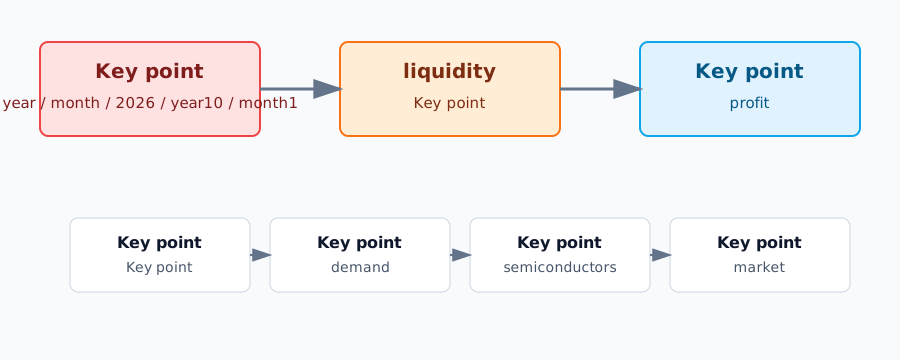
Diagram: Changxin Technology's evaluation axis
Points to watch in the future
The key point to look at after listing is not the buzz but the ability to execute.
| Highlights | Reasons to watch |
|---|---|
| Registration approval by the China Securities Regulatory Commission | Final step towards IPO implementation |
| Public price and market capitalization | To what extent are expectations factored in |
| Initial price formation and trading volume | Superheating degree of short-term supply and demand |
| Mass production and customer adoption of DDR5 | Confirmation of technical capabilities |
| HBM development status | Divergent evaluation as an AI memory company |
| DRAM price | See sustainability of profits |
| US regulations | Constraints on technology upgrades |
What is especially important is to determine whether the current profits are a temporary boost due to rising DRAM prices, or whether they represent sustained growth supported by technological capabilities and customer adoption.
Final judgment
Changxin Technology's IPO is a symbolic event for China's semiconductor industry.
The company is one of China's largest DRAM manufacturers, a strategic company that receives state support, and a growing company that will benefit from the demand for AI memory. As a major IPO for a science and technology board, it is natural that it will attract attention from the market.
However, it is not an easy investment target.
There are geopolitical risks, technological differences, memory market fluctuations, overheating stock prices, and huge capital investment burdens. Changxin Technology is a symbol of China's semiconductor independence, and at the same time, it is also a super-large, high-risk stock that is burdened by the memory cycle and US-China tensions.
What should be looked at after listing is not the topicality.
Technical capabilities, mass production capabilities, customer recruitment, and profit continuity. Only after these four points are confirmed can Changxin Technology be evaluated from a `domestic production theme stock'' to a `global DRAM company.''
Source/Reference materials
- Shanghai Stock Exchange, “Results of the 27th Deliberation Meeting of the Science and Technology Board 2026”, May 27, 2026
- Changxin Science and Technology Group Co., Ltd., “Invitation Manual for Public Issuance of Heads and Present Science and Innovation Boards (Seminar Draft/Updated Materials)”, May 2026
- Caixin Global, ChangXin Clears Key Hurdle for Record STAR Market IPO
- BiJingnet, Changxin Technology and Innovation Board IPO Passing, Recruitment Fee 295 yen
- Sina Finance and Economics, Changxin Technology 1 Season 719.13%
- Confirmation date: 2026-05-28