

First conclusion: stocks that move based on supply and demand and projects, not performance stocks
Kitahama Capital Partners is not a stable growth stock in the general sense.
It is not a recurring billing SaaS, nor is it a manufacturing industry that accumulates profits in the same way every fiscal year. In terms of its nature, it is similar to an investment company where profits move significantly when investment projects, business development, and thematic projects are completed.
As a result, market views tend to be quite short-term.
| What the market is looking at | How it affects stock prices |
|---|---|
| New investment projects | It is easy to speculate about future profits |
| Partnerships and joint ventures | Easily searched for as theme stocks |
| Data centers, renewable energy, and AI infrastructure | Low-value stock funds are likely to respond |
| Capital increase/stock acquisition rights | Easily viewed as upward selling pressure |
| Continuing deficits and worsening operating CF | Selling quickly when expectations fade |
In other words, it is not a stock that can be honestly evaluated based solely on PER and PBR.
What the market is buying is not so much the current profit, but the expectation of ``what will happen in the next IR''. If you make a mistake here, you can easily be swayed by the wildness of price movements.
Why are the prices so volatile?
The biggest reason is the supply and demand characteristic of low-ranked stocks.
Stocks priced in the 20 yen and 30 yen range seem easier for individual investors to participate in. Because you can own a number of shares for a small amount of money, short-term funds can be gathered all at once if the topic spreads on social media or bulletin boards.
For low-ranking stocks, even a price movement of just a few yen can cause large fluctuations.
For example, if a stock with a stock price of 25 yen goes up to 30 yen, the increase will be 5 yen, but the rate of increase or fall will be 20%. This is why it is easy to attract short-term funds.
However, the same structure also works during a downturn.
After being bought with high expectations, the progress of the project cannot be seen, there are concerns about capital increase, the deficit continues, and there are no follow-up reports on IR. When this happens, buying becomes thinner and selling becomes more likely to occur all at once.
Low-ranking materials stocks also rise quickly. It also collapses quickly.
Illustration: The composition of the market in 2134
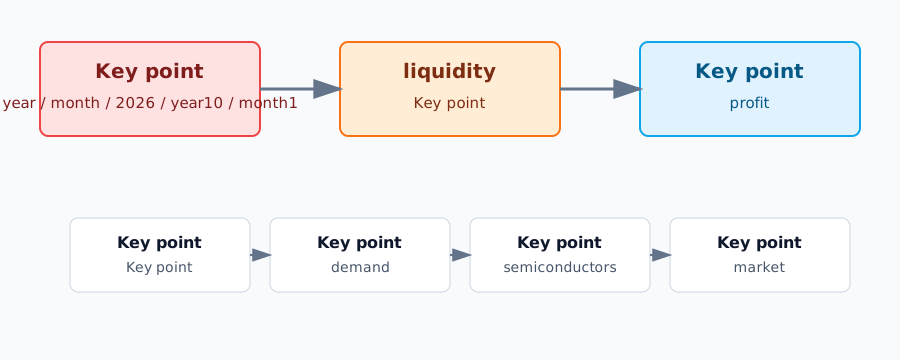
Themes expected by the market
The theme that is easy to see in the current 2134 market is not just real estate investment.
Investors are likely to respond to areas where it is easy to receive funds at 2026 market prices, such as data centers, clean energy, AI-related infrastructure, renewable energy, and regional revitalization.
These kinds of stocks are not based on being quietly evaluated based on their main business P/E ratio, but rather on whether the story will expand with the next disclosure.
It's easy to see whether this is good or bad.
When words like "data center," "AI infrastructure," and "renewable energy" come up, it's easy to look for low-priced stocks. On the other hand, if the content of the disclosure appears to be solely about raising funds, concerns about dilution will increase.
The market is looking at whether a theme will turn into profit rather than the theme itself. At least medium- and long-term funds should look at that.
Latest financial results: Sales have increased, but profits and cash are still poor
Looking at the full-year financial results for the fiscal year ending March 2026, there are quite a few quirks.
| Item | Fiscal year ending March 2026 |
|---|---|
| Sales | 1.910 billion yen |
| Operating income | -982 million yen |
| Ordinary profit | -1.177 billion yen |
| Net income attributable to owners of parent company | -1.239 billion yen |
| Operating cash flow | -1.615 billion yen |
| Investment cash flow | -1.428 billion yen |
| Financial cash flow | +3.332 billion yen |
| Ending balance of cash and cash equivalents | 544 million yen |
| Equity ratio | 77.0% |
Sales have increased significantly compared to the previous year. However, the operating loss was 982 million yen. The net loss also reached 1.239 billion yen.
What is important here is profit over sales, and cash over profit.
Even if sales increase, the market will not feel relieved if operating CF is negative by more than 1.6 billion yen. The positive financial CF of 3.332 billion yen also makes us aware of the company's dependence on financing.
Of course, if you look only at the equity ratio of 77.0%, you can see that the company has strong financial standing. However, it is not just accounting equity that the market is wary of when it comes to low-ranking stocks. This includes financing, additional procurement, dilution, and project recovery.
In other words, this is how to read the financial statements.
Sales have increased. However, it is still difficult to say that the company is generating cash through its main business.
Forecasts for the fiscal year ending March 2027 are high, but confirmation of achievement is required
The company's outlook for the fiscal year ending March 2027 is quite large.
| Item | Company forecast for the fiscal year ending March 2027 |
|---|---|
| Sales | 12.374 billion yen |
| Operating income | 2.085 billion yen |
| Ordinary profit | 2.066 billion yen |
| Net income attributable to owners of parent | 1.80 billion yen |
| EPS | 3.28 yen |
Looking at these numbers alone, the plan is to quickly turn the company from a deficit in the previous fiscal year into a surplus.
If they can really achieve an operating income of 2 billion yen, the current market evaluation will change dramatically. There is room to change the view from a low-value stock to a profit-earning company that collects projects.
However, the market may not yet fully trust it.
The reason is simple: the difference from the previous year's results is too large. Sales went from 1.910 billion yen to 12.374 billion yen, and operating loss went from 982 million yen to operating profit of 2.085 billion yen. This is more like a jump based on the assumption that the project will be completed, rather than a normal improvement.
Therefore, what really influences future stock prices is quarterly progress.
- Are sales actually increasing?
- Is the profit margin close to the company's forecast?
- Is operating CF improving?
- Are you able to handle projects without relying on financing?
- Are concerns about dilution receding?
Unless this can be confirmed, stock prices are likely to sway between expectations and doubts.
The biggest risk is instability of earnings
The difficulty with 2134 lies in its earnings outlook.
If a company has stable stock earnings, investors can easily tolerate some losses and upfront investments. If you have continuity indicators such as monthly sales, number of contracts, cancellation rate, and ARR, it will be easy to create future plots.
However, in the case of Kitahama Capital Partners, its performance tends to fluctuate greatly depending on the success or failure of investment projects and the timing of returns.
This is also an attractive feature as an investment company. If a large-scale project is decided, there is room for immediate profits.
At the same time, it is also a weakness. If projects are delayed, sales and profits will be affected. Funds go out first and are recovered later. What the market hates is this time lag.
For low-ranking stocks, this time lag is strongly reflected in the stock price.
The moment IR comes out, it will be bought. However, if the track record does not catch up, the sales will turn to ``Is it just expectations again?''
Can you change from an investment company to a profit-making company?
The biggest theme for 2027 is quite clear.
Is it possible to change from an “investment company” to a “profitable company”?
Here are five things the market really wants to see.
| Points to check | How to view |
|---|---|
| Actual profit recording | Has the project turned into an accounting profit |
| Improving operating CF | Is cash increasing in addition to profits |
| Recurring revenue | Isn't it just a one-time profit? |
| Large-scale project recovery | Is the upfront investment recovered |
| Reducing dependence on dilution | Is it possible to break away from a structure that relies on stock issuance |
If we can achieve results here, our view of low-ranked stocks will change.
On the contrary, there are many disclosures but no profits, sales are made but no cash remains, and financing continues. When this happens, the stock price tends to remain a theme stock.
The market will no longer buy based on words alone. Actual profit is required.
Checkpoints when looking at short term
From a short-term perspective, supply and demand tends to outweigh business results.
In particular, you should look at the following:
| Short-term check | Meaning |
|---|---|
| Rapid increase in trading volume | Confirmation of inflow of short-term funds |
| Continuous positive line | Is the supply and demand market continuing |
| New IR | Continuation of materials |
| SNS spread | Concentration of individual investor funds |
| Disclosure related to capital increase | Confirmation of upward selling pressure |
| Large commercial shadow line | It is likely to be the first move of ceiling formation |
In low-priced stocks, there are situations where supply and demand trumps the quality of the materials.
However, stocks that rose due to supply and demand alone will fall due to supply and demand alone. It's best to take a very close look at this.
If you're going to own a stock, I think it's a stock that you should first think about where expectations may fall short, rather than relying on the material.
Current position
Currently, Kitahama Capital Partners is neither a stable dividend stock nor a profitable growth stock.
Its market position is as a low-priced materials stock with extremely high risk and high volatility.
However, that's not to say it's not worth watching at all. If the company sees a large return to profitability as expected, operating CF improves, and concerns about dilution subside, the stock evaluation will change.
The problem is that confirmation takes time.
We are still in a phase where expectations are outweighing actual results.
Summary
Kitahama Capital Partners (2134) is a stock that is likely to move based on investment projects, themes, IR expectations, and low stock supply and demand.
Although sales increased in the fiscal year ending March 2026, there was an operating loss of 982 million yen, a net loss of 1.239 billion yen, and an operating cash flow of 1.615 billion yen. Looking only at this aspect, it is still difficult to say that the company is a company with stable profits.
On the other hand, the company's forecast for the fiscal year ending March 2027 is large, with sales of 12.374 billion yen and operating profit of 2.085 billion yen. If this becomes a reality, the market perspective will change.
In the end, the points at issue in 2134 boil down to one thing.
Can we move from IR to actual profits?
As a low-ranking materials stock, its price movements are likely to continue to be rough going forward. When looking at a company over the medium to long term, it is more important to check whether profits and cash are actually starting to appear, rather than looking at low stock prices.
Source
This article was created based on the target company's disclosure materials and financial statements on this site.
- "Summary of Financial Results for the Fiscal Year Ending March 2026 [Japanese Standards] (Consolidated)", Kitahama Capital, Disclosure date: 2026-05-15