
First, the conclusion
The axis from which to view the skylark is quite clear.
From sales growth to maintaining profit margins and customer numbers.
Up until now, restaurant stocks have been going through a phase that can be easily explained by a post-coronavirus recovery in customer numbers, price increases, inbound tourism, and a return to demand for eating out. If sales returned, stock prices would easily react.
But Skylark is no longer that early recovery stock.
It is a mature restaurant group with a large network of stores in Japan, including Gusto, Bamiyan, Shabuha, Jonathan, Yumean, and Shisan Udon. Investors won't be surprised if sales increase by just a few percentage points. Rather, we look at whether the sales were generated by raising prices, whether the number of customers remains, and whether the company is really able to absorb the labor and raw material costs.
The numbers are good. The problem is quality.
Outlook for the first quarter of the fiscal year ending December 2026
On the surface, things look pretty set for the first quarter of the fiscal year ending December 2026.
| Item | 1Q of December 2026 | Year-on-year comparison |
|---|---|---|
| Sales | 121.3 billion yen | +8.6% |
| Business profit | 9.1 billion yen | +10.6% |
| Operating income | 8.9 billion yen | +17.0% |
| Net income | 5.5 billion yen | +27.0% |
The company explained that same-store sales increased by 5.3 billion yen, and new stores and business format conversions increased sales by 5.4 billion yen.
What we want to see here is how far we have been able to counteract inflation. According to the company's explanation, the 2.7 billion yen impact from inflation was offset by a total of 3.5 billion yen due to existing store growth and cost reduction measures, as well as new stores and business format conversions.
This is not bad news for investors. This is because it shows the company's ability to absorb cost increases, not just by raising prices and increasing sales, but also by reducing costs and changing business formats.
However, this is where things get tricky for restaurant stocks.
It is too early to conclude that we have ``beat inflation'' based on just the first quarter. Labor costs, food costs, logistics costs, and energy costs may take effect after a delay. Skylark itself believes that the impact of inflation is accelerating due to the destabilizing situation in the Middle East.
That's a good financial statement. However, for the market to become bullish, it would want to make sure that profit margins do not collapse in the next quarter.
Why the number of customers is the most important metric
When looking at same-store sales in restaurant stocks, looking at sales alone has little meaning.
Roughly speaking, sales are the product of the number of customers and the average spend per customer.
| How to grow | How to be perceived by the market |
|---|---|
| Increase in number of customers + increase in average spend per customer | Quite strong. Selected even if price is increased |
| The number of customers remains unchanged + the average spend per customer increases | Still within an acceptable range. Next monthly confirmation required |
| Decrease in number of customers + increase in average spend per customer | Be cautious. It is easy to see dependence on price increases |
| Decrease in number of customers + average price per customer | Weak. Questions arise about brand power and demand |
The cumulative total of Skylark's existing stores from January to April 2026 is 106.3% of sales, 101.1% of customers, and 105.2% of average customer spend.
If you look at this number alone, it's still pretty sticky. While the average customer spend has increased, the cumulative number of customers has also exceeded the previous year. Even if you raise prices, you still have customers. In this state, it is easy to evaluate not only the security of the company as a preferred stock, but also its competitiveness as a major restaurant company.
However, if you look at it by month, there is a slight difference in temperature.
| Month | Existing store sales | Number of existing store customers | Average customer spend |
|---|---|---|---|
| January | 110.3% | 105.6% | 104.4% |
| February | 105.7% | 100.2% | 105.5% |
| March | 102.3% | 97.4% | 105.1% |
| April | 107.3% | 101.4% | 105.8% |
| Cumulative | 106.3% | 101.1% | 105.2% |
The number of customers in March was 97.4%, which is something investors should be a little concerned about. It returned to 101.4% in April, so it may be temporary, but if it returns to below 100%, our view will change.
The average price per customer has remained at around 105%. So a big part of sales growth is the price factor. The price factor itself is not bad. The question is whether the number of customers will follow.
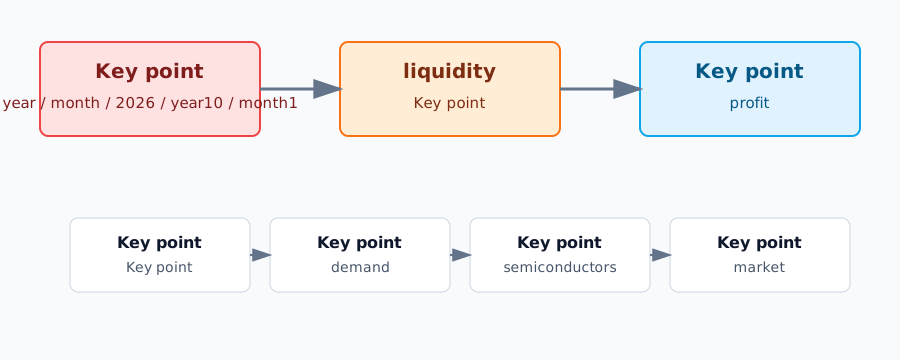
Illustration: Order of viewing Skylark
What supports premium PER?
Skylark is viewed a little differently than ordinary restaurant stocks.
For individual investors, shareholder benefits are important. Shareholders with 100 or more shares will receive shareholder benefits that can be used at group stores, with the end of June and the end of December as record dates. For 100 to 299 shares, the amount is 4,000 yen per year, and for 1,000 or more shares, it is 34,000 yen per year.
This preferential treatment also affects the short-term supply and demand of stock prices.
For the June rights, demand for physical holdings, preferential treatment, cross transactions, etc. will be more likely to enter. Therefore, there are situations where it is supported not only by business results but also by event supply and demand.
However, this is double-edged.
Even if the stock looks solid until the rights are acquired, buying for preferential treatment tends to come to an end after the rights are ex-purchased. If we look at the short term, we need to consider the supply and demand towards the end of June separately from the ex-rights period thereafter.
In the medium to long term, the profits of the core business that supports the benefits are more important than the benefits themselves. The premium on preferred stocks tends to remain as long as profit margins are maintained. On the other hand, if profit margins collapse due to a slowdown in customer numbers or increased costs, it becomes difficult to support stock prices through perks alone.
Points seen in competitive comparison
Skylark has a different rating compared to Saizeriya and Toridoll even though they are the same restaurant.
Saizeriya is a brand that is easy to compare due to its low price, high rotation rate, and strong operation. Rather than being able to withstand price increases, we are looking at how much profit we can make while maintaining low prices.
In addition to Marugame Seimen's domestic earning power, Toridoll has high expectations for overseas growth. In other words, rather than a mature stock in the domestic and restaurant industry, the company is sometimes seen as more of a global growth stock.
Skylark is somewhere in between.
It has a large domestic store network and many brands. The price range is also wide. Although it has defensive qualities, it is not a stock to be bought solely for its dramatic growth story.
That's why it looks like this:
| Comparison axis | Questions asked in Skylark |
|---|---|
| Price competitiveness | Will you be able to maintain the frequency of store visits even after the price increase |
| Profit margin | Can you absorb labor and raw material costs |
| Store opening/conversion | Can profitability be increased with Shisan udon, shabuha, etc. |
| Preferential supply and demand | Will the support of individual investors continue |
| Expectations for growth | Can we produce materials that exceed the sense of maturity in Japan |
The market is looking for Skylark to have ``unbreakable strength'' rather than flashy growth.
Bullish scenario
The conditions for being bullish are pretty clear.
Same-store sales growth will be maintained based on the number of customers, and the business profit margin will remain unchanged even in the second quarter. If this is confirmed, the market will begin to recognize the conservativeness of the full-year plan.
The company's plan for the full year ending December 2026 is sales of 490 billion yen, business profit of 36 billion yen, operating profit of 33.5 billion yen, and profit attributable to owners of the parent company of 19.5 billion yen.
Progress in the first quarter was approximately 24.7% in sales, 25.2% in business profit, 26.6% in operating profit, and 28.3% in net profit. It's dangerous to ignore seasonality and make simple judgments, but at least it's hard to say that we're off to a bad start.
Furthermore, if openings and format conversions for Shabuha and Shisan Udon raise profit margins, this will be evaluated as an improvement to the company's portfolio, rather than just a recovery in existing stores.
In the bullish case, the flow is as follows.
| Conditions | Views on stock prices |
|---|---|
| Existing store customer count maintained at over 100% | Resistance to price increases was evaluated |
| Business profit margin maintained/improved | Inflation resistance confirmed |
| Appears to be positive in 2Q | Expectations for upward revision for the full year |
| Supported by June preferential supply and demand | Short-term push is likely to be shallow |
In this case, Skylark will not be viewed as a ``preferred stock'' but as a major restaurant company that will not lose customer numbers even under inflation.
Bearish scenario
The bearish scenario is the same place to look.
If the number of customers declines and same-store sales are maintained solely on customer spending, the market will cool considerably.
The scary thing about eating out is that sales may be delayed and deteriorate. Immediately after a price increase, the average price per customer increases, so sales may appear strong for a while. However, if the frequency of store visits decreases, campaign costs and personnel costs increase, and raw material costs continue to rise, profit margins will start to feel strange.
In the case of Skylark, due to the popularity of preferential treatment, there are times when the stock price does not fall drastically right away. However, the more premium a stock is, the more sensitive it is to disappointment in its profit margin.
In a bearish case, it is likely to collapse in the following order.
- Number of customers continues to fall below 100% on a monthly basis
- Sales growth appears to be dependent on price increases
- Business profit margins remain flat or decline.
- Expectations for full-year upward revision disappear
- It will no longer be possible to support yourself with preferential premiums alone.
The scary thing here is not that the financial results themselves will be in the red. Rather, even though sales and profits have increased, the company has fallen short of market expectations.
``The stock price is heavy even though the financial results are not bad'' is a common scenario with restaurant stocks.
How do you view the supply and demand for June rights?
In the short term, the record date for benefits and dividends at the end of June cannot be ignored.
The record dates for Skylark's shareholder benefits are the end of June and the end of December. At the June market price, it will be easier for individual investors who are conscious of preferential treatment to buy. When stock prices fall, some investors are likely to buy based on preferential yields.
However, it is better not to view the supply and demand before rights acquisition as a medium-term trend.
The preferential purchase will end once the event has passed. Adjustments after ex-rights do not occur because of poor performance, but tend to occur due to the nature of supply and demand.
Practically speaking, we would like to separate the firmness until the end of June from the push after the rights ex-rights period. If you are buying in the medium to long term, it is easier to make a calm decision if you check the number of customers and profit margins after the rights have expired and pick up on the trends, rather than rushing to chase right before the rights are due.
Checklist for investors
When making a Skylark investment decision, I would like to check the following in the following order.
| Check items | Reasons to watch |
|---|---|
| Number of customers at existing stores | Are people still choosing customers even after the price increase |
| Average customer spend | Is sales growth dependent on price |
| Business profit margin | Is it able to absorb inflation? |
| Cost reduction measures | Does it work continuously rather than temporarily |
| Business format change | Will Shisan udon, shabuha, etc. contribute to profit margin |
| June and December preferential supply and demand | Read about short-term stock price support and ex-rights |
| Comparison of peers | Is Saizeriya inferior to Toridoll |
Personally, I think the monthly "number of existing store customers" is the earliest signal.
Sales can appear strong with a lag. It is difficult to see profit margins until quarterly results are released. But customer numbers can give you an early indication of whether consumers are still coming after a price increase.
Investment stance by time axis
| Time axis | View |
|---|---|
| Short-term | June rights acquisition demand and supply are likely to be firm, but be careful of adjustments after rights ex-rights |
| Mid-term | Phase to confirm business profit margin and customer number maintenance in 2Q financial results |
| Long term | Verifying whether it is a mature growth stock that can maintain store visit frequency even under inflation |
The short term is supply and demand.
We expect an upward revision in the medium term.
In the long term, it depends on the profitability and the stickiness of the number of customers.
Skylark is not a stock whose evaluation changes in one shot like a theme stock. This is a stock that we look at monthly, financial results, preferential supply and demand, and the progress of business conversion.
Summary
Skylark HD is being evaluated as a mature restaurant stock that is being tested for its ability to respond to inflation, rather than just a premium stock.
In the first quarter of the fiscal year ending December 2026, we are off to a good start, with sales and profits increasing, with sales of 121.3 billion yen, business profit of 9.1 billion yen, operating profit of 8.9 billion yen, and net profit of 5.5 billion yen. The company also explained that it returned 3.5 billion yen against the 2.7 billion yen impact of inflation.
However, what the market will see from now on is not sales.
Will the number of customers at existing stores be maintained? Will the business profit margin collapse? Will there be enough performance expectations to support stock prices even after June's preferential supply and demand situation?
The cumulative total for existing stores from January to April 2026 is 106.3% of sales, 101.1% of customers, and 105.2% of average customer spend. As long as this balance is maintained, Skylark's premium will likely remain.
On the other hand, if the number of customers drops below 100% and sales growth depends only on the average spend per customer, investors will immediately begin to doubt your profit margin.
Number of customers rather than sales. Profit margin rather than number of customers.
If you're going to watch Skylark, I think it's better not to miss that part.
Source/Reference materials
- Skylark Holdings "Summary of Financial Results for the First Quarter of the Fiscal Year Ending December 2026 [IFRS] (Consolidated)", Disclosure date: 2026-05-13
- Skylark Holdings “Top Message (Updated May 2026)” May 13, 2026
- Skylark Holdings “Monthly Performance April 2026”, confirmation date: 2026-05-28
- Skylark Holdings “Shareholder Benefit Plan”, confirmation date: 2026-05-28