
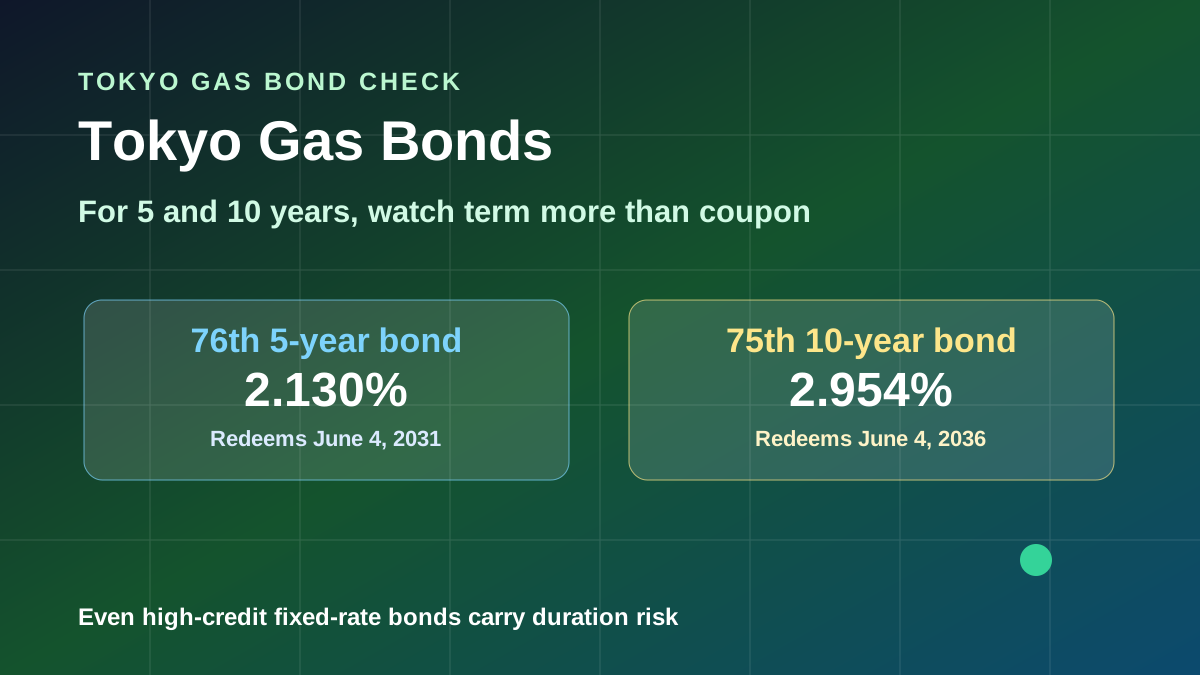
| Item | 75th unsecured bond | 76th unsecured bond |
|---|---|---|
| Term | 10 years | 5 years |
| Total issue amount | 30 billion yen | 16.6 billion yen |
| Coupon | 2.954% per year | 2.130% per year |
| Approximate after-tax coupon | About 2.354% | About 1.697% |
| Payment date | June 4, 2026 | June 4, 2026 |
| Maturity date | June 4, 2036 | June 4, 2031 |
| Interest payment dates | June 4 and December 4 every year | June 4 and December 4 every year |
| Use of proceeds | Redemption of short-term corporate bonds | Redemption of short-term corporate bonds |
The first point to confirm is that these are not 20-year bonds.
The terms confirmed in Tokyo Gas' official announcement are for a 10-year bond and a 5-year bond.
Therefore, this article discusses corporate bond investing in a rate-normalization phase through the difference between 5-year and 10-year terms, rather than through an ultra-long 20-year bond.
The issues investors need to examine are quite clear.
Tokyo Gas credit risk is easy to view as relatively low
↓
But corporate bonds are not deposits
↓
Price fluctuation during rate increases differs between 5-year and 10-year bonds
↓
Check whether after-tax yield is worth the inflation and capital lock-up
Even with a high-credit-quality infrastructure company such as Tokyo Gas, corporate bonds are not principal-guaranteed products.
For the 10-year bond in particular, investors should be more conscious of early-sale risk during rate increases than of credit risk.
This article is not a recommendation to buy or sell any specific bond. Corporate bonds carry credit risk, price fluctuation risk, and liquidity risk. Before making any investment decision, check the prospectus, pre-contract documents, selling-company materials, tax treatment, and the issuer's financial condition.
Basic Terms: 2.954% For 10 Years And 2.130% For 5 Years
Tokyo Gas' 75th and 76th unsecured bonds are both unsecured bonds with a pari passu clause among bonds.
The terms are as follows.
| Item | 75th bond | 76th bond |
|---|---|---|
| Term | 10 years | 5 years |
| Total issue amount | 30 billion yen | 16.6 billion yen |
| Coupon | 2.954% per year | 2.130% per year |
| Payment amount | 100 yen per 100 yen of bond amount | 100 yen per 100 yen of bond amount |
| Payment date | June 4, 2026 | June 4, 2026 |
| Maturity date | June 4, 2036 | June 4, 2031 |
| Redemption method | Lump-sum redemption at maturity | Lump-sum redemption at maturity |
| Interest payment dates | June 4 and December 4 every year | June 4 and December 4 every year |
| Use of proceeds | Redemption of short-term corporate bonds | Redemption of short-term corporate bonds |
The coupon difference between the 5-year and 10-year bonds is 0.824 percentage points.
| Comparison | Difference |
|---|---|
| 75th 10-year bond: 2.954% | |
| 76th 5-year bond: 2.130% | |
| Coupon difference | 0.824 percentage points |
This is not simply a story of "the 10-year bond is better."
The 10-year bond pays a higher coupon in exchange for locking money for longer than the 5-year bond.
In bond investing, that length of time is itself a risk.
How Much Remains After Tax?
Coupon rates are shown before tax.
Because interest is usually subject to Japan's 20.315% tax, it is better to look at the actual income after tax.
On a simple calculation, the approximate after-tax coupon rates are as follows.
| Bond | Pre-tax coupon | Approximate after-tax coupon |
|---|---|---|
| 75th 10-year bond | 2.954% per year | About 2.354% |
| 76th 5-year bond | 2.130% per year | About 1.697% |
For a 1,000,000 yen investment, the annual interest image is as follows.
| For a 1,000,000 yen investment | Annual interest before tax | Approximate annual interest after tax |
|---|---|---|
| 75th 10-year bond | 29,540 yen | About 23,539 yen |
| 76th 5-year bond | 21,300 yen | About 16,973 yen |
The 10-year bond's after-tax yield in the low 2% range looks attractive for a domestic corporate bond.
However, how far the after-tax yield exceeds inflation is a separate question.
Tokyo Gas Has High Credit Quality, But Not Zero Risk
Tokyo Gas is an energy infrastructure company centered on city gas.
Tokyo Gas' official ratings page shows a long-term debt rating of AA+ from R&I, A1 from Moody's, and A+ from S&P Global Ratings. JCR's ratings list also shows Tokyo Gas with a high rating.
The visible credit quality is strong.
For the full fiscal year ended March 2026, Tokyo Gas reported revenue of 2.8347 trillion yen, operating profit of 197.6 billion yen, and profit attributable to owners of parent of 226.8 billion yen. Its equity ratio was 44.1%, and operating cash flow was 451.8 billion yen.
Looking only at these figures, this is not a situation where investors need to price in strong credit anxiety.
Still, because these are corporate bonds, credit risk does not disappear.
When looking at Tokyo Gas, investors should keep the following points in mind.
| Issue | Why it matters |
|---|---|
| LNG prices and foreign exchange | They can affect procurement costs and earnings |
| Electricity and gas systems | Regulation and tariff changes can affect profitability |
| Decarbonization investment | Long-term capital spending burden may increase |
| Disaster and infrastructure risk | Special risks as energy supply infrastructure |
| Overseas business | Resource development and overseas investments can fluctuate |
Tokyo Gas bonds stand out precisely because credit risk looks low.
However, "high credit quality" and "principal guarantee" are different things.
It is better not to confuse the two.
The Real Focus Is Interest-Rate Risk
The largest issue in this bond issuance is interest-rate risk rather than credit risk.
For the 75th 10-year bond in particular, if market rates rise after purchase, the price is more likely to fall if the bond is sold before maturity.
The basic bond-price logic is simple.
Market rates rise
↓
Already-issued fixed-coupon bonds become less attractive
↓
Early-sale prices tend to fall
If the bond is held to maturity, investors can wait for par redemption unless the issuer defaults.
But 10 years is long.
During a decade, unexpected cash needs such as home purchase, education costs, elder care, job changes, inheritance, illness, or business funding can easily arise.
If a sale becomes necessary at that time, principal loss is more likely to surface in a rate-rising environment.
The difference between the 5-year and 10-year bonds is not just coupon.
| Comparison item | 5-year bond | 10-year bond |
|---|---|---|
| Coupon | Lower | Higher |
| Capital lock-up | Shorter | Longer |
| Price movement when rates rise | Relatively smaller | Relatively larger |
| Inflation resilience | Weak because coupon is lower | Stronger than the 5-year bond |
| Early-sale risk | Exists | Needs more attention |
Choosing the 10-year bond requires a fairly strong assumption that it will not be sold before maturity.
What The Comparison With NEC Capital Bonds Shows
A recent corporate bond that may have caught individual investors' attention is NEC Capital Solutions' 31st bond.
The NEC Capital bond is a four-year domestic corporate bond with a 2.36% coupon, rated A by JCR and A- by R&I.
Placed alongside Tokyo Gas bonds, the picture looks like this.
| Issue | Term | Coupon | Visible credit quality | Main risk |
|---|---|---|---|---|
| NEC Capital Solutions 31st bond | 4 years | 2.36% | A-grade level | Look at credit risk somewhat more closely |
| Tokyo Gas 76th bond | 5 years | 2.130% | High rating | Coupon is somewhat lower, but credit quality is easy to view as strong |
| Tokyo Gas 75th bond | 10 years | 2.954% | High rating | Rate risk and capital lock-up are larger |
The key point is not to rank bonds by coupon alone.
The NEC Capital bond has a shorter term than the Tokyo Gas 5-year bond, yet a higher coupon.
That reflects differences in issuer credit risk, industry, sales target, supply-demand conditions, and issuance terms.
The Tokyo Gas 10-year bond has a higher coupon than both the Tokyo Gas 5-year bond and the NEC Capital 4-year bond.
However, a large part of that additional return is compensation for the 10-year length.
In bond investing, credit risk and interest-rate risk should be separated.
Shorter term with higher coupon
→ Look more at credit risk and issuer characteristics

Longer term with higher coupon
→ Look more at interest-rate risk and liquidity
The Tokyo Gas 75th bond is less a product for buying credit anxiety and more a product for accepting a 10-year fixed rate.
Whether It Beats Inflation Is A Split Question
The next point to examine is inflation.
If inflation is simply subtracted from the after-tax coupon, the picture is as follows.
| Assumption | 75th 10-year bond, about 2.354% | 76th 5-year bond, about 1.697% |
|---|---|---|
| Inflation rate 1.0% | Real plus about 1.35% | Real plus about 0.70% |
| Inflation rate 1.5% | Real plus about 0.85% | Real plus about 0.20% |
| Inflation rate 2.0% | Real plus about 0.35% | Real minus about 0.30% |
| Inflation rate 2.5% | Real minus about 0.15% | Real minus about 0.80% |
This is not a strict real-yield calculation. It is a simple comparison between after-tax coupon and inflation.
The Bank of Japan has a 2% price stability target, and the Statistics Bureau's consumer price index fluctuates month by month.
The 5-year bond's after-tax coupon of about 1.697% makes the real return somewhat difficult if inflation stays around 2%.
The 10-year bond's after-tax coupon of about 2.354% at least appears positive if inflation is around 2%.
However, no one can accurately forecast prices over the next 10 years.
Long fixed-rate bonds are weak when inflation becomes stronger than expected.
Who It May Suit
The evaluation of Tokyo Gas bonds changes considerably depending on the investor's objective.
| Investor or money type | How to view it |
|---|---|
| Surplus funds unused for around five years | The 76th 5-year bond is easier to consider |
| Money that can be held without selling for 10 years | The 75th 10-year bond can also be an option |
| Money seeking higher interest than deposits | Candidate if corporate bond risk is understood |
| Money intended to reduce equity weight | Easy to use as a cushion asset |
| Emergency savings | More natural to keep in deposits, not corporate bonds |
| Money seeking growth through the new NISA | Corporate bonds are not substitutes for equity assets |
For investors in the asset-building phase, moving a large amount of long-term growth capital into a 10-year fixed corporate bond deserves caution.
Money invested in equity investment trusts through the new NISA and money used to seek fixed interest through corporate bonds have different roles.
On the other hand, investors who already hold enough risk assets and want to shift part of the portfolio toward stable income may find a use for them.
Corporate bonds of a high-credit-quality infrastructure company such as Tokyo Gas are easier to think of as components for reducing overall portfolio volatility, rather than as products for seeking capital gains.
Caution: These May Not Be Retail Products
Tokyo Gas' 75th and 76th bonds are ordinary unsecured corporate bonds for which the official announcement shows lead managers and total issue amounts.
They are not necessarily corporate bonds sold to individual investors in 100,000 yen denominations.
In other words, it is more natural to use them as a case study for reading domestic corporate bond market interest-rate levels than to treat them as products individual investors can easily buy under the same terms.
The comparison set should be organized as follows.
| Comparison | Points to examine |
|---|---|
| Japanese government bonds for individuals | Sovereign credit, floating rate, cash-out rules |
| Time deposits | Principal protection, interest rate, term |
| Retail corporate bonds | Minimum denomination, sales allocation, issuer risk |
| Bond funds | Diversification, NAV fluctuation, fees |
| Stocks and investment trusts | Long-term growth, price fluctuation, inflation resilience |
Rather than looking only at Tokyo Gas bond coupons and concluding "this is what to buy," it is more practical to use the fact that 5-year and 10-year yields have risen this far as material for asset allocation.
Conclusion: With Tokyo Gas Bonds, Watch Term More Than Credit Quality
Tokyo Gas' 75th and 76th unsecured bonds are a clear reference point for viewing Japan's domestic corporate bond market in 2026.
The 75th bond has a 10-year term and a 2.954% annual coupon.
The 76th bond has a 5-year term and a 2.130% annual coupon.
Tokyo Gas' credit quality is easy to view as high.
That is exactly why investors should pay more attention to term and interest-rate risk than to credit risk.
Three decision points are enough.
1. Can you assume no early sale for 5 or 10 years?
2. Is the after-tax coupon enough for inflation and capital lock-up?
3. Are you misunderstanding corporate bonds as substitutes for deposits or NISA investing?
The 5-year bond has a lower coupon, but the capital lock-up is relatively shorter.
The 10-year bond has a higher coupon, but is more exposed to price fluctuation when rates rise.
What Tokyo Gas bonds show is not the simple idea that high-rated corporate bonds are safe.
In a world with interest rates, even bonds issued by high-credit-quality companies carry interest-rate risk when the term is extended.
Bond investing is not a game of picking up the highest coupon. It is a transaction where investors decide for how many years, to which issuer, and at what yield they will lend their money.
This article is a general explanation of the terms and risks of Tokyo Gas' 75th and 76th unsecured bonds and is not a recommendation to buy or sell any specific financial product. Corporate bonds carry credit risk, price fluctuation risk, and liquidity risk. Before making any investment decision, check issuer materials, selling-company materials, the prospectus, tax treatment, fees, and cash-out conditions.
Related Articles
- Should You Buy NEC Capital Solutions' Corporate Bond? Coupon, Credit Risk, And Inflation Resilience For The 31st Bond
- Should You Buy Tohoku Electric Power's Retail Bond? Coupon, Risks, And Key Points For The 584th Bond
- What Is The Interest Rate Market? Government Bonds, Mortgages, And Deposit Rates Through A New Theory Of Price Formation