
Second, Middle East risk has re-emerged. Around the Strait of Hormuz, U.S. forces shot down an Iranian drone and attacked coastal surveillance radar facilities. Iran was also reported to have launched ballistic missiles toward Kuwait and Bahrain. Crude oil is not necessarily rising in a straight line, but a supply-risk premium can return easily in this environment.
Third, Friday, June 12 is major SQ day. In a week when futures can drive large price swings, the market must also digest U.S. rates, Middle East headlines, U.S. CPI, and speculation around a SpaceX listing. Any significant capital rotation toward a potential SpaceX listing could temporarily affect flows into AI and technology-related equities. For short-term traders, this is an easy market to push around. For cash-equity investors, chasing the first move is likely to be hazardous.
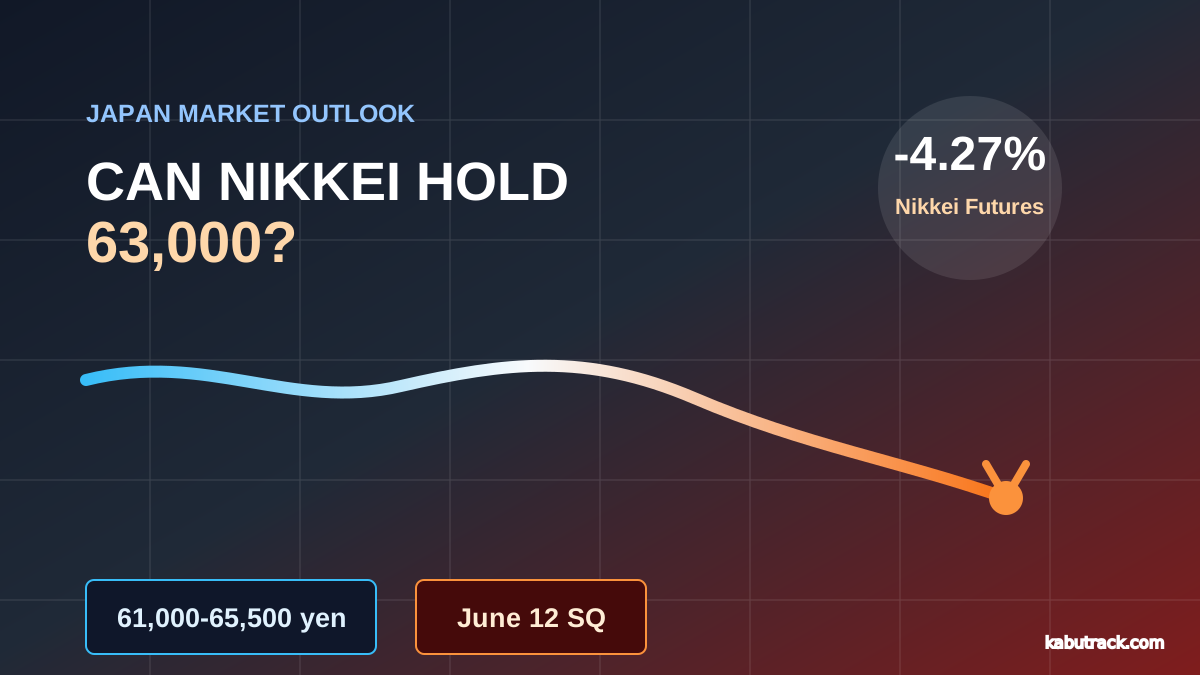
My base range for the Nikkei Average this week is:
Expected range: 61,000 to 65,500 yenThis is no longer the simple market we saw last week, where buying AI and semiconductor names could lift the whole index. Unlike U.S. markets, the Nikkei remains heavily influenced by a relatively small group of high-priced technology and semiconductor stocks. That concentration makes U.S. technology sentiment unusually important for Japanese index performance.
The first question this week is whether the Nikkei can hold 63,000 yen. If it breaks, the focus shifts to whether long-term money steps in around 62,000 yen, and then near 61,000 yen.
There is no need to declare that the bull market is over.
But the market's temperature has changed. This is not a week for aggressively chasing upside. It is a week for measuring where the selling stops.
What Changed Over the Weekend?
Until last week, the tone in Japanese equities was very strong.
AI, semiconductors, electric wires, heavy electricals, defense, and banks all had themes. The Nikkei Average stayed near its highs. Yen weakness also provided support, and foreign investors were more willing to buy. At least on the surface, the market was in risk-on mode.
But the atmosphere changed in the U.S. market on Friday, June 5.
After the strong U.S. May employment report, long-term U.S. yields rose and technology stocks were sold. According to AP's market summary, the S&P 500 fell 2.6%, the Nasdaq Composite dropped 4.2%, and the Dow Jones Industrial Average lost 695.15 points. Selling was especially severe in large-cap growth names tied to AI and semiconductors.
The uncomfortable point for Japanese stocks is that there is not just one reason for the decline.
If the issue were only U.S. rates, banks, insurers, and value stocks might provide support. If it were only Middle East risk, money might rotate toward resources, defense, and trading companies. If it were only SQ week, the market might stabilize after the event passes.
This time, all of these are arriving at once.
Rising U.S. yields pressure technology stocks. Middle East risk reduces risk tolerance. SQ week can amplify futures selling. In this kind of environment, even stocks with positive company-specific news can be dragged down by the index.
At the start of the week, the first question is how much of the 63,820 yen overnight futures close the cash market will price in.
If panic selling appears immediately after the open and the market then resists further declines, that is still acceptable. The bigger problem would be if the market cannot recover after the open and selling spreads broadly into TOPIX names. In that case, it would be better to view the move not merely as futures-led selling, but as the beginning of cash-equity risk reduction.
This Week's Nikkei Average Range
My expected range for the Nikkei Average this week is:
61,000 to 65,500 yen| Level | Interpretation |
|---|---|
| Around 65,500 yen | Likely rebound ceiling if U.S. stocks recover and Middle East risk calms |
| 65,000 yen | A key level for judging whether the market can return to last week's bullish tone |
| 64,000 yen | First rebound-check line after the overnight futures plunge |
| 63,000 yen | Psychological level the market wants to defend early in the week |
| 62,000 yen | Level to watch for exhaustion of futures-led forced selling |
| 61,000 yen | Downside guide if Middle East risk worsens or U.S. CPI surprises higher |
Personally, I think the market needs time to confirm the downside before immediately returning to a bullish stance early in the week.
Nikkei futures have already fallen to 63,820 yen. That level likely forced out part of the bullish positioning built up through last week. Whether the market runs further down from here or sees a short-covering rebound is hard to judge from only the first 30 minutes after Monday's open.
The three things to watch are:
- Whether cash-equity buying appears around 63,000 yen
- Whether selling spreads beyond semiconductors into large TOPIX names
- Whether foreign exchange provides support through yen weakness, or shifts into risk-off yen buying
The Nikkei Average is heavily influenced by high-priced technology names. After the Nasdaq falls more than 4%, we need to watch Tokyo Electron, Advantest, and SoftBank Group to understand the index's true strength.
This is a week for looking for stocks that stop falling, not simply stocks that go up.
Focus 1: The U.S. Jobs Report Broke the "Waiting for Rate Cuts" Trade
The May U.S. employment report changed the market's view quite significantly.
Nonfarm payrolls rose by 172,000. Consensus expectations were around 90,000, so this was a strong number. April was also revised up from 115,000 to 179,000. The unemployment rate was unchanged at 4.3%.
After this data, the market had to revise the idea that "the U.S. economy is weakening, so the Fed will cut rates."
This is where the equity story becomes more complicated.
The stock market had been buying a convenient combination: economic growth holding up reasonably well while interest rates decline. But if employment is strong, the Fed does not need to rush into rate cuts. If inflation remains sticky, high rates can last longer. If U.S. CPI also comes in strong, talk of renewed rate hikes can remain in the market.
In this environment, high-PER growth stocks are especially vulnerable.
For Japanese stocks, the reaction is likely to look roughly like this:
| Area | Impact | View |
|---|---|---|
| Semiconductors / AI | Negative | Directly exposed to Nasdaq weakness and rising rates |
| Growth stocks | Negative | Higher discount rates pressure valuations |
| Banks / insurers | Neutral to slightly positive | Higher rates help, but risk-reduction selling can still hit them when stocks fall |
| High-dividend stocks | Relatively resilient | Yield and earnings stability can be reassessed |
| Domestic defensives | Relatively resilient | But watch raw-material costs and yen weakness |
It is also a little dangerous to simplify bank stocks as "buys because rates are rising."
Higher U.S. rates can help financial stocks, but they also reduce overall equity-market risk tolerance. If concerns over credit costs and overseas economic weakness intensify, banks will not be immune. This week, banks are less likely to be the market's offensive leaders and more likely to serve as a thermometer for how well the broader market is holding up.
Focus 2: Middle East Risk Is More About Risk Tolerance Than Crude Oil Alone
The Middle East situation again became a market concern over the weekend.
U.S. Central Command was reported to have shot down an Iranian drone headed toward the Strait of Hormuz and then attacked coastal surveillance radar facilities in southern Iran. There were also reports that Iran launched ballistic missiles toward Kuwait and Bahrain, many of which were intercepted by U.S. forces.
The key point here is not to look only at crude oil prices.
Even if oil does not spike in a single day, rising tension around the Strait of Hormuz can lead markets to reduce risk assets. Japanese stocks are especially exposed because Japan is an energy importer, the yen is weak, foreign investors actively trade futures, and the index has a high weighting in semiconductor-related names.
Middle East risk tends to affect Japanese stocks through four channels:
| Channel | Impact on Japanese stocks |
|---|---|
| Crude oil / LNG prices | Cost concerns for utilities, airlines, restaurants, and retailers |
| Inflation expectations | Headwind for growth stocks through higher U.S. rates |
| Risk-off behavior | Futures selling, yen buying, and profit-taking in cash equities |
| Defense / resource themes | Short-term money can flow into selected stocks |
Resource and defense stocks may outperform at the start of the week.
But chasing them too aggressively is risky. Stocks that surge on headlines can quickly give back gains if ceasefire talks or negotiations resume. Defense-related names also look very different depending on whether they are treated as long-term themes or short-term flows over several days.
This week's Middle East risk should be viewed less as a crude-oil story and more as a factor that reduces the market's risk tolerance.
Focus 3: Watch Futures-Led Volatility During Major SQ Week
Friday, June 12 is the SQ calculation date for June Nikkei 225 futures and options.
For overseas readers less familiar with the Japanese market, SQ is the settlement process for stock-index futures and options. Major SQ weeks often amplify volatility because of derivatives positioning, hedging flows, and forced adjustments.
SQ in March, June, September, and December is major SQ. Supply-demand pressure can grow around the cash market open, and futures-led moves often begin early in the week.
This time, the overnight futures plunge has arrived on top of that.
The frightening thing about SQ week is that explanations often come after the move. In reality, price action may be driven by position adjustments, options gamma, or unwinding of arbitrage trades, while the market later explains it with "U.S. rates," "Middle East risk," or "CPI." Those factors are real, but the price range can be amplified by positioning.
This week, pay particular attention to:
- Whether futures short-covering appears after Monday's gap-down open
- Whether option-linked selling increases below 63,000 yen
- Whether position adjustments are mostly complete by Thursday, the day before SQ
- Whether cash-equity buying returns on Friday afternoon after SQ passes
SQ week can create opportunities for short-term traders.
But cash-equity investors are in a different position. In an external environment like this, it is more realistic to wait for stocks where selling has been exhausted than to chase the opening move.
Sector Strategy: Separate Havens From Buy-the-Dip Candidates
This week, it is better not to view sectors through a single directional lens.
Simple labels such as "resources because of geopolitical risk," "banks because rates are rising," or "AI as a dip-buying opportunity" could lead to being shaken around. The important distinction is between stocks that are bought as temporary havens and stocks worth watching after they are sold.
Areas That May Outperform
| Sector | Examples | View |
|---|---|---|
| Resources / energy | INPEX, Japan Petroleum Exploration, trading companies | Easier for crude oil and natural gas supply-risk premiums to appear |
| Defense / heavy industry | Mitsubishi Heavy Industries, Kawasaki Heavy Industries, IHI | Short-term money tends to react to geopolitical headlines |
| High-dividend / defensives | Telecoms, pharmaceuticals, food | Relative havens during index declines |
| Banks / insurers | Megabanks, major non-life insurers | Higher rates help, but selection matters in a full risk-off market |
These areas may be bought, but that does not mean they are "safe."
Resource and defense stocks in particular can see quick profit-taking after a strong open early in the week. Jumping in after reading the headline can make an investor the exit liquidity for short-term traders.
Areas to Watch for Pullbacks
| Sector | Examples | View |
|---|---|---|
| AI power / electric wires | Fujikura, Sumitomo Electric, Furukawa Electric | Structural theme remains strong, but wait for broad-market pullbacks |
| Semiconductor equipment | Tokyo Electron, Advantest, Disco | Sensitive to U.S. rates and Nasdaq weakness |
| Data-center infrastructure | Heavy electricals, air conditioning, power supply, optical components | Medium-term theme remains, but short-term overheating needs to cool |
| Growth stocks | SaaS, internet, IP-related names | Hard to be aggressive before earnings confirmation when rates are rising |
The AI infrastructure theme has not broken.
But a strong theme and buying at Monday's open are two different things. For electric-wire names such as Fujikura and Sumitomo Electric, and semiconductor names such as Tokyo Electron and Advantest, the setup may become clearer after forced selling appears early in the week.
This is a week to prepare to buy good stocks at better prices.
Rather than becoming bullish when prices are rising, it is better to decide which stocks should remain on the list when they fall.
Key Events This Week
This week, U.S. inflation indicators and Middle East headlines are likely to move the market more than domestic events.
| Date | Japan events / indicators | Overseas events / indicators |
|---|---|---|
| Monday, June 8 | Revised Q1 GDP (8:50) | Crude oil, FX, and U.S. rate reaction to weekend Middle East developments |
| Tuesday, June 9 | May money stock (8:50) | U.S. April trade balance |
| Wednesday, June 10 | May domestic corporate goods price index (8:50) | U.S. May CPI |
| Thursday, June 11 | International securities transactions data (8:50) | U.S. May PPI |
| Friday, June 12 | June major SQ calculation date | Watch potential SpaceX-listing-related rotation and U.S. technology flows |
The biggest event this week is U.S. CPI on June 10.
Because it comes right after a strong employment report, a strong CPI would be very unwelcome for the market. Sticky inflation, delayed rate cuts, rising U.S. yields, and Nasdaq selling would directly hit Tokyo.
Conversely, if CPI is calm, the view that early-week selling went too far may emerge.
PPI on June 11 is also important. If corporate-side price pressure remains, CPI alone may not provide enough reassurance. Ahead of the June 16-17 FOMC meeting, this will be a week of recalibrating rate expectations.
Earnings to Watch This Week
Earnings are stock-specific catalysts, but this week's announcements will take place in a weak broader market. Even good earnings can be dragged down by the index. Conversely, stocks with low expectations can rebound if bad news is fully priced in.
| Date | Stock | View |
|---|---|---|
| Monday, June 8 | Gakujo (2301) | Q2 earnings. With weak market tone early in the week, initial supply-demand may matter more than the numbers |
| Wednesday, June 10 | ANYCOLOR (5032) | Full-year earnings. Focus on outlook, shareholder returns, and inventory valuation treatment |
| Thursday, June 11 | Visional (4194) | Q3 earnings. Can growth expectations be maintained under headwinds for growth stocks? |
| Friday, June 12 | Kobe Bussan (3038) | Q2 earnings. Watch yen weakness, raw materials, price pass-through, and same-store defensiveness |
ANYCOLOR will attract a lot of attention.
However, in a rising-rate environment, investors are stricter toward growth stocks. Even strong earnings can be sold if next-year guidance or shareholder returns disappoint. The market will look not only at revenue growth, but also margins, inventory, cash, and capital returns.
Kobe Bussan is important in a different sense.
In an environment where yen weakness and raw-material inflation are in focus, it is a stock that can measure the defensive strength of low-price retail and food distribution. Is price pass-through progressing? Are customer numbers holding up? When the broader market becomes volatile, domestic-demand numbers like these receive more attention.
Investment Stance: Watch What Remains After Tuesday, Not Monday's First Move
This week's investment stance is quite simple.
Do not judge too much from Monday's first move.
Because overnight futures have fallen sharply, selling is likely to lead at the start of the week. Some stocks will probably open much lower. But whether that selling is genuine risk reduction or only temporary futures-led capitulation will not be clear from the first day alone.
What matters is which stocks remain resilient from Tuesday onward.
- Stocks that rebound with volume after falling
- Large caps that can finish near the day's low-to-high reversal
- Stocks where earnings expectations remain despite market weakness
- Not only defense, resources, and high-dividend names, but also where the true AI infrastructure leaders stop falling
What I would avoid is buying everything simply because it has become cheaper.
This week's decline may not be just profit-taking. U.S. rates, the Middle East, SQ, and CPI are arriving at the same time. A stock that looks cheap today could fall further after the next U.S. CPI release.
Keep a slightly higher cash ratio, and if buying, do it in stages. Prefer later in the week over the very start, and pay more attention to the close than the open. That is what I want to watch this week.
In a sharp market selloff, the patience to wait for a second leg can sometimes matter more than the courage to buy first.
Risk Scenarios
This week's downside risks are quite clear.
| Risk | What could happen |
|---|---|
| U.S. CPI upside surprise | Higher U.S. yields, continued Nasdaq decline, semiconductor selling |
| Worsening Middle East situation | Crude oil, FX, and defense stocks become volatile; index turns risk-off |
| SQ-related futures selling | Break below 63,000 yen could extend toward 62,000 yen |
| Shift to yen strength | Export-stock support weakens and index rebound slows |
| U.S. technology flows tied to a potential SpaceX listing | Profit-taking may hit AI, space, and semiconductor-related names if capital rotates toward new supply |
There is also an upside scenario.
That would require the Middle East situation to calm, U.S. CPI to come in below market expectations, and pre-SQ selling to be bought back. In that case, the early-week decline could be filled quite quickly.
Even then, I would watch for selling on rebounds around 65,500 yen. A rebound immediately after a sharp fall can look powerful, but it takes time before everyone feels comfortable buying again.
Conclusion
The week of June 8, 2026 will test the strength of the Japanese stock market's recent bullish trend.
Nikkei 225 futures plunged to 63,820 yen in weekend overnight trading. Stronger-than-expected U.S. employment data pushed back rate-cut expectations, and rising U.S. yields directly hit technology stocks. Middle East risk and major SQ week add to the pressure.
My expected range for the Nikkei Average this week is 61,000 to 65,500 yen.
The market is likely to begin by confirming the downside, with 63,000 yen as the first key level. If that breaks, 62,000 yen and then the 61,000 yen area should be kept in mind. On the other hand, if U.S. CPI calms down and Middle East risk does not worsen, buying back toward SQ is possible.
Resources, defense, and high-dividend stocks are havens. AI power infrastructure and semiconductors are pullback candidates. Still, rather than rushing into the market early in the week, I would prefer to see where selling is exhausted.
It is not yet time to declare that the market has broken.
But the tide has shifted. This is a week to watch where selling stops, not just what to buy.
Sources and References
- Kabutan: Nikkei 225 futures overnight close down 2,850 yen at 63,820 yen
- AP: How major US stock indexes fared Friday 6/5/2026
- Livedoor News / Kyodo: U.S. May payrolls increase by 172,000, unemployment rate 4.3%
- CNN.co.jp: Iran attacks toward Strait of Hormuz and Gulf region, U.S. forces intercept
- BLS: Consumer Price Index release schedule
- BLS: Producer Price Index release schedule
- Federal Reserve: FOMC meeting calendars
- Cabinet Office: National Accounts / GDP statistics
- Bank of Japan: Release schedule
- Ministry of Finance: Schedule for international securities transactions data
- Japan Exchange Group: Special Quotation (SQ)
- Kabutan: Next week's earnings schedule, including Kobe Bussan, Visional, ANYCOLOR