
This article is a general organization based on information disclosed and reported from June 15th to 16th, 2026, and existing financial results memos on this site. It is not a recommendation to buy or sell individual stocks. Stock investments are subject to risks such as price fluctuations, loss of principal, liquidity, downturn in performance, dilution, interest rates, foreign exchange, geopolitics, and deterioration in market conditions.
First, separate the materials
When reading Terra Drone's stock price reaction, it is better not to lump all materials together.
There were at least four materials that the market saw between June 15 and 16.
| Materials | Contents | Issues seen by investors |
|---|---|---|
| 1Q results | Sales of 1.010 billion yen, operating loss of 434 million yen | Financial results continued in the red on a standalone basis. It is hard to say that the financial results are strong |
| Ukraine defense-related | Expansion of the field of interception and reconnaissance drones | Expectations for full-scale entry into the defense equipment market |
| UTM | Developing a traffic management system centered on Unifly | Expectations for the future "air traffic management" platform |
| Approximately 14.5 billion yen raised | Stock acquisition rights through third-party allotment | Tug of war between dilution concerns and growth investment |
Normally, a company with loss-making earnings and stock acquisition rights financing would be easily sold.
Particularly with growth stocks, existing shareholders brace themselves just because the number of shares may increase in the future. This is especially true if the company is not yet profitable.
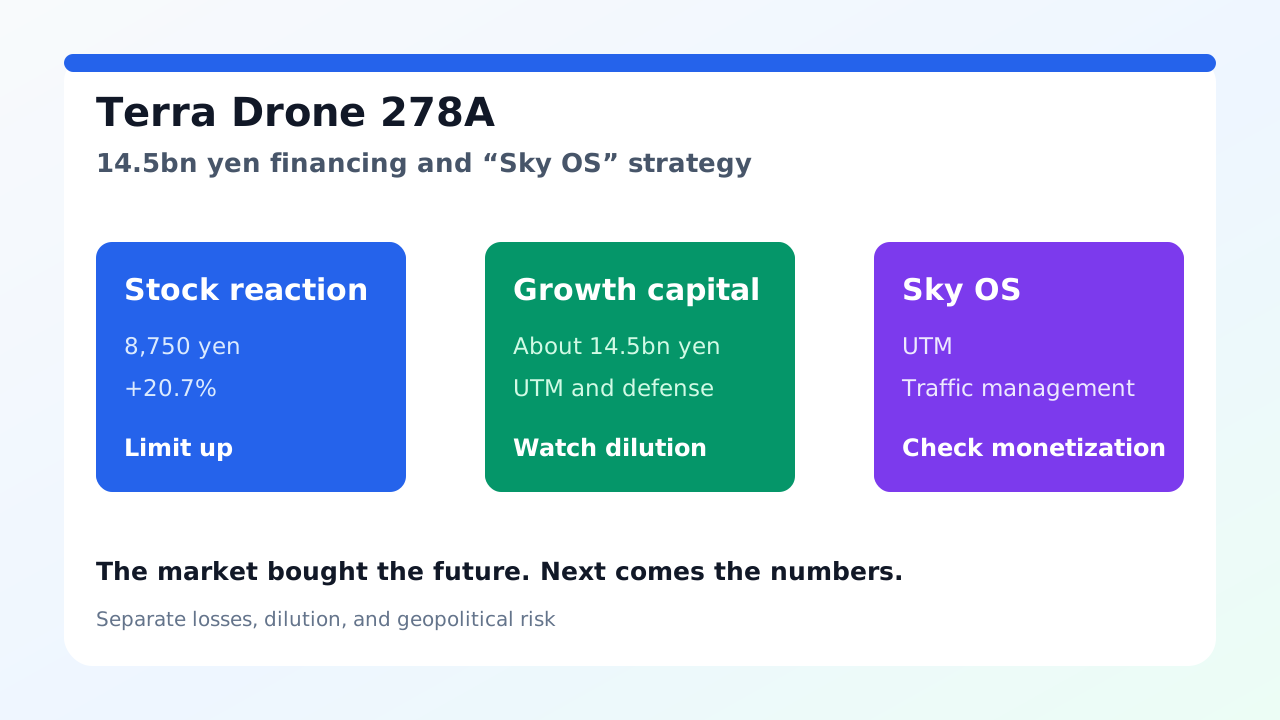
Still, this time, the stock was bought to the full price limit. In other words, the market may have focused more on the use of the proceeds and the time horizon of the business than on the dilution itself.
However, this is not a matter of assuming that this is a ``correct evaluation.'' First, let's break down what caused stock prices to react.
Why was the 14.5 billion yen raise not just a selling point?
This time, what you should read most carefully is finance.
Terra Drone announced the issuance of stock acquisition rights from the 18th to the 27th through third-party allotment. The total amount raised is said to be approximately 14.5 billion yen.
Stock acquisition rights involve dilution risk for existing shareholders. This disclosure also makes reference to the number of potential shares and dilution rate.
The reason why the market was not all about selling, however, lies in the company's design and use of funds as shown in supplementary materials.
The company explains that, unlike regular MS warrants, the lower limit exercise price is set higher in stages, making it easier to exercise and dilute the warrants when the stock price rises. The discount rate is also explained as 5%.
In short, the company explains, ``Rather than raising funds by siphoning off funds while pushing down stock prices, the design is to link stock price increases and fund raising.''
It is possible that the market took this point seriously.
However, it's not just a good story.
| Perspective | Points that can be read positively | Points to note |
|---|---|---|
| Use of funds | Can be used for growth investments such as UTM, defense, and M&A | There is no guarantee that profits will be made as planned |
| Exercise design | Design and explanation linked to rising stock prices | Possibility of not being able to raise the full amount if stock prices do not increase |
| Dilution | Can be absorbed if corporate value increases through growth investment | Increase in number of shares dilutes existing shareholders' equity |
| Financial durability | Able to secure investment capacity ahead of losses | Additional financing risk remains if deficits persist |
This is quite important.
This financing is neither simply `bad because it's dilution'' nor `good because it's a growth investment.'' For a while, the market was leaning toward the latter. However, if defense/UTM orders and KPIs are not visible a few quarters later, the same material becomes a burden.
Financing for growth stocks is determined based on sales, gross profit, and operating CF after the funds are used, not at the moment of financing.
If we look only at the financial results, we are still in the red.
In the existing financial results memo on this site, Terra Drone's first quarter financial results for the fiscal year ending January 2027 are given a neutral evaluation.
Terra Drone's financial results memo for the first quarter of the fiscal year ending January 2027
The main numbers are as follows.
| Item | 1Q of the fiscal year ending January 2027 | Comparison with the same period last year/view |
|---|---|---|
| Sales | 1.010 billion yen | +6.6% |
| Operating income | -434 million yen | Deficit |
| Ordinary profit | -325 million yen | Deficit |
| Quarterly net income attributable to owners of parent company | -249 million yen | Deficit |
| Full-year operating profit forecast | -1.658 billion yen | Deficit forecast |
| Equity ratio | 68.1% | Still has financial strength |
Sales are increasing. However, the sales growth rate is in the single digits, and the company remains in the operating deficit.
It is difficult to explain a limit-up move based on these numbers alone. In fact, normally, we would want to confirm that profits matter more than sales, and cash matters more than profits.
While Terra Drone has themes such as industrial drones, surveying, inspection, UTM, and defense, it is not yet at the stage where it can silence the market with profits. I want to take a cold look here.
The recent rise is more like a movement in which the market collectively reevaluated the strategic information that came out around the same time as the earnings results, rather than buying the earnings results themselves.
Terra Drone is not just a company that makes drones
When looking at Terra Drone, there is a misconception that I would like to clear up first.
It is quite difficult to evaluate the company if you only look at it as a company like DJI that mass-produces aircraft and wins price competition. Hardware has heavy development costs, inventory and sourcing burdens, price declines, and competition from overseas competitors.
Rather, the evaluation of Terra Drone is based on the operations before and after the drone flies, and the mechanism for managing the flight.
Terra Drone revenue layers
├─ 1. Industrial DX: surveying, inspection, field software
├─ 2. UTM: traffic management for drones and flying cars
└─ 3. Defense: interception, reconnaissance, surveillance, and other unmanned defense solutions
Industrial DX is the area that creates current sales. They enter sites where there are labor shortages and safety management issues, such as construction, civil engineering, infrastructure inspection, and petroleum/chemical plants.
UTM is often talked about as a future favorite. The subsidiary, Unifly, develops an operation management system for drones and flying cars, and company materials describe it as having been introduced in more than 8 to 10 countries, depending on the time and materials. Canada's NAV CANADA introduces flight approval through Unifly's UTM system and pay-as-you-go per flight request.
Defense is an area where markets have responded strongly in recent months. Since March 2026, the company has been building on its entry into the defense equipment market, cooperation with Ukrainian companies, and interception and reconnaissance drones.
In other words, the company's story is closer to `controlling low-altitude operations and security'' than `selling drones.''
There is a possibility that this place was bought.
What makes it different from other drone-related stocks?
If you lump them together with "drone-related stocks," it's easy to misread them.
Domestic drone companies have a variety of businesses, including aircraft development, contract development, government projects, demonstration experiments, and inspection services. Terra Drone is different from UTM in that it strongly emphasizes overseas expansion.
| Comparison items | Terra Drone | Types commonly found in general drone companies |
|---|---|---|
| Main battlefield | Industrial DX, UTM, defense | Aircraft sales, commissioned development, demonstration experiments |
| Earnings timeline | From on-site services to future flight management | Sales tend to be on a project-by-project basis |
| Competitive axis | Software, flight management, overseas results | Aircraft performance, price, delivery results |
| Investor expectations | Standardization of low-altitude infrastructure | Domestic drone demand, defense/inspection demand |
| Risks | Long time to profitability, regulatory dependence, dilution | Price competition, project continuity, burden of mass production |
Terra Drone's strength lies in its focus on how to manage the sky rather than the aircraft itself.
However, this is also a weakness. UTM is subject to national and aviation authorities, regulations, airspace management, and connectivity to existing aviation infrastructure. Even if you have a track record of implementation, it does not necessarily mean that you will quickly accumulate high profit margins.
The market is easy to buy stories. However, as a business, it will be a long battle.
UTM is a "sky OS", but you can't buy it just by dreaming
UTM cannot be overlooked in the medium- to long-term story of Terra Drone.
UTM is an abbreviation for Unmanned Aircraft System Traffic Management, which refers to the operation management system for drones and flying cars. In short, it is a traffic management infrastructure that allows aircraft to fly safely at low altitudes.
The idea is that, just as smartphones have an OS, drones and flying cars will need a common platform to manage their operations.
Smartphones
↓
iOS / Android
↓
The platform that lets apps run safely

Low-altitude airspace
↓
UTM
↓
Traffic management infrastructure that lets drones and flying cars fly safely
The company's UTM business page explains that Unifly's system has been introduced in more than eight countries, and that Canada's NAV CANADA has realized pay-as-you-go charges for each flight request. Furthermore, the Besomar-related announcement on June 15, 2026 also mentioned the implementation results of Group UTM in 10 countries around the world. In this article, based on the differences in wording in company materials, we will categorize them as ``8 to 10 countries.''
This part is why investors want to call it a "sky OS."
If the number of low-altitude aircraft increases in the future for logistics, inspection, security, disaster response, flying cars, and defense applications, a system will be needed to manage who flies where. Therefore, if you stick to a standard system, there is a possibility that you will be able to earn a steady income.
However, it is still a "possibility".
UTM involves national aviation regulations, air traffic control agencies, airspace management, demarcation of responsibility, cybersecurity, and accident response. Even if it can be introduced, how much profit margin it will generate, how long contract renewals will continue, and whether it can be rolled out horizontally in each country are different issues.
I'm sure the market still doesn't fully trust this.
That's why when looking at Terra Drone, you want to follow the following KPIs.
| KPI | View |
|---|---|
| Countries that have introduced UTM and number of institutions that have introduced it | Are we progressing from demonstration to full-scale implementation |
| UTM sales composition | To what extent is the shift away from industrial DX sales |
| Pay-as-you-go/continuous billing ratio | Is it stockable? |
| Defense-related orders | Are there any projects that are close to being recorded as sales rather than being announced? |
| Operating deficit range | Is growth investment too heavy |
| Operating CF | Are accounting sales converted into cash |
| Progress of dilution | How the exercise of stock acquisition rights affects stock prices and supply and demand |
Defensive factors are strong, but contribution to performance should still be viewed carefully
What stood out in this stock price reaction was material related to Ukrainian defense drones.
Terra Drone announced on June 15, 2026 that it has begun preparations to establish a joint venture with Ukrainian fixed-wing UAV manufacturer Besomar to provide reconnaissance drones. At the same time, it also announced the reconnaissance drone "Terra C1."
According to a company statement, the Terra C1 is a fixed-wing UAV with a three-hour flight time, an operating radius of 50-110 km, and 10x optical zoom. The aim was to combine it with the interception drones `Terra A1'' and `Terra A2'' to create a multi-layered unmanned defense solution that covers everything from reconnaissance and surveillance to interception.
I understand that this material is easy to buy on the market.
Defense, drones, Ukraine, low-cost interception, unmanned. The theme is very strong. What's more, collaboration with companies that have technology and operational data close to actual environments is more likely to expand investors' imaginations than mere research and development news.
However, we still need to be cautious when reading the company's results.
The company explains that the preparations for establishing a JV with Besomar and the announcement of Terra C1 will have only a minor impact on its consolidated results for the fiscal year ending January 2027. In other words, the company is not showing that it will significantly boost short-term financial results.
Defense-related matters take time due to ordering, delivery, certification, government procurement, export control, local conditions, and payment terms. Although the theme attracts attention, the path to recording sales is not straight.
The market bought the theme first. From this point on, it is time to see whether the theme turns into sales and profit.
Risks are dilution, geopolitics, and time horizon
Terra Drone's stock price tends to fluctuate wildly due to its strong theme.
There are four main risks to consider with this material.
1. Dilution risk
When stock acquisition rights are exercised, the number of shares increases. Even if it is designed to be exercised when stock prices rise, the fact remains that existing shareholders' equity will be diluted.
If the corporate value increases significantly through financing, it can be absorbed. If it doesn't grow, it will look heavy later on.
2. Risk of continued deficit
The operating loss for the first quarter of the fiscal year ending January 2027 is 434 million yen, and the operating loss for the full year is expected to be 1.658 billion yen.
Deficits themselves are not bad. The question is whether the deficit will lead to future sales, gross profit, and operating CF.
3. Geopolitical risk
Defense projects related to Ukraine are subject to local conditions, international support, export controls, contract partners, and political decisions.
Even if there are technological expectations, whether it can be consistently profitable as a business is another matter.
4. Timeline for UTM monetization
Flying cars and daily drone logistics will only become a big market once systems and social implementation progress.
If investors' expectations run too far ahead, they will be brought back to reality at quarterly results. This is the difficulty with growth stocks.
What to see in the next financial results
If we follow the current material, the items we should look at in the next financial results are quite clear.
□ Are the number of UTM introductions, countries and institutions increasing?
□ Do you have a feel for UTM's sales composition and recurring charges?
□ Are defense projects not only announced but also approaching order amounts and sales?
□ Is the operating deficit within the company plan?
□ Is there a deterioration in operating CF and working capital?
□ What is the status of exercise of stock acquisition rights and progress of dilution?
When the stock price is strong, what you should be looking at is not the stock price itself, but whether the materials are turning into KPIs.
Conclusion
Terra Drone's limit-up move on June 16, 2026 is difficult to explain with financial results numbers alone.
In the first quarter of the fiscal year ending January 2027, sales were 1.010 billion yen and operating loss was 434 million yen. As for deficit growth, we are still at the stage of looking at profitability and financial durability first.
Even so, the reason why the stock price reacted is probably because the market read the expansion of the defense business, the platform nature of UTM, and the approximately 14.5 billion yen worth of financing as a growth investment.
However, here's where it gets difficult.
While raising 14.5 billion yen will be a powerful weapon, it will also come with dilution. Although the defense material is strong, the company considers the impact on short-term performance to be minor. UTM is attractive as a "sky OS", but it takes a long time to contribute to profits.
Terra Drone is not a stock to bet on current profits. This is a stock to watch to see if low altitude infrastructure, defense drones, and industrial DX will really lead to profits.
What I want to check next is not the stock price, but the actual profits from introducing UTM, defense-related orders, operating deficit, operating CF, and the exercise status of stock acquisition rights.
The market bought the future this time. From the next financial results, we can see how close the future is to the numbers.
Source
This article was created based on Terra Drone's published materials on June 15, 2026, the company's official news, the first quarter financial results report for the fiscal year ending January 2027, and existing individual financial results memos on this site.
- Terra Drone “Financial Results for the First Quarter of the Fiscal Year Ending January 2027 [Japanese Standards] (Consolidated)”, June 15, 2026
- Terra Drone "Notice regarding the issuance of the 18th stock acquisition rights to the 22nd stock acquisition rights (with exercise price revision clause) and the 23rd stock acquisition rights to the 27th stock acquisition rights through third-party allotment", June 15, 2026
- Terra Drone “Supplementary Explanatory Materials on Funding”, June 15, 2026
- Terra Drone “Starting preparations to establish a JV with Ukrainian fixed-wing UAV manufacturer Besomer to provide reconnaissance drones and announcing “Terra C1””, June 15, 2026
- Terra Drone “UTM business”
- FISCO “Terra Drone (278A) Stock Price Information”, June 16, 2026