
Related articles
- What is a pension? Basics of National Pension, Employees' Pension, and Old Age Pension
- Easy-to-understand explanation for beginners of the difference between Employees' Pension and National Pension
- What is the Category 3 insured person system? Explaining the spouse pension, abolition debate, and household impact
- What is disability pension and survivor pension? Basics of public pensions, not just old-age pensions
What is Category 2 insured person?
Japan's public pension system has three types of insured persons as part of the National Pension.
| classification | Main target | Main participation system |
|---|---|---|
| Category 1 insured person | Self-employed people, freelancers, students, unemployed people, etc. | national pension |
| Category 2 insured person | Company employees, civil servants, etc. | National pension + Employees' Pension |
| Category 3 insured person | Spouse supported by category 2 insured person | national pension |
Category 2 insured persons are those who are enrolled in Employees' Pension Insurance through their workplace.
Although company employees appear to be covered only by the Employees' Pension, in reality, by enrolling in the Employees' Pension, they are also treated as members of the National Pension.
Category 2 insured person
= Join Employees' Pension
= Also enrolled in the national pension

old age pension
= Old-age basic pension + Old-age Employees' Pension
This is where you tend to stumble in the first place.
As a general rule, self-employed people and freelancers enter the National Pension System as Category 1 insured persons. In principle, company employees and civil servants are covered by both the National Pension and the Employees' Pension as Category 2 insured persons.
“Category 2 insured person” and “Category 2 Employees' Pension insured person” are different.
It's a little detailed, but there are some points that can be confusing when reading pension materials.
The "Category 2 insured person" covered in this article is a type of insured person under the National Pension.
On the other hand, in the Employees' Pension system, there are classifications such as "Category 1 Employees' Pension Insured" and "Category 2 Employees' Pension Insured." This is similar to the classification of organizations implementing Employees' Pension, such as private company employees, civil servants, and private school teachers.
| words | meaning |
|---|---|
| National pension category 2 insured person | People who enroll in Employees' Pension, such as company employees and civil servants |
| Category 2 Employees' Pension Insured | Classification on the Employees' Pension side regarding national public servant mutual aid association members |
When articles about general household budget management and retirement funds refer to ``Category 2 insured person'', they often refer to the National Pension's Category 2 insured person. This article also uses the term in this sense.
Person who becomes Category 2 insured person
The main category 2 insured persons are company employees and civil servants.
Representative examples include:
- Full-time employee of a private company
- civil servant
- private school teachers
- Part-time jobs that meet certain conditions
- People under the age of 70 who are enrolled in the Employees' Pension System
The Japan Pension Service describes Category 2 insured persons as employees under the age of 70, such as company employees and civil servants, who are members of the Employees' Pension Plan.
Please note that those who are 65 years old or older and are eligible to receive pension benefits such as the Old Age Basic Pension based on old age or retirement are not considered Category 2 insured persons.
In other words, if you work for a company, you are not necessarily number 2 regardless of your age. Treatment varies depending on your age, place of work, working hours, and requirements for joining the Employees' Pension Plan.
Benefits of category 2 insured person
Category 2 insured persons have major benefits in terms of household finances.
1. Old-age Employees' Pension will be added
For Category 1 insured persons, the public pension after retirement is basically the old-age basic pension.
Category 2 insured persons receive an Old-age Employees' Pension in addition to the old-age basic pension.
| Participation category | Main pensions after retirement |
|---|---|
| Category 1 insured person | old age basic pension |
| Category 2 insured person | Old age basic pension + Old-age Employees' Pension |
| Category 3 insured person | old age basic pension |
The Old-age Employees' Pension changes depending on the period of participation and the remuneration during active years. The longer you have been a member of the Employees' Pension Plan and the longer your standard remuneration is high, the easier it is for your future Employees' Pension portion to increase.
However, if you are enrolled in the Employees' Pension Plan, this does not mean that you will always have sufficient funds for retirement. The amount you need will change depending on housing costs, retirement benefits, spouse's pension, medical/nursing care costs, and price increases.
2. Split the insurance premium 50-50 with the employer
Employees' pension insurance premiums are paid in half by the employee and the employer.
As of June 2026, the Employees' Pension insurance premium rate is 18.3%.
For example, if the standard monthly salary is 300,000 yen, the calculation is as follows.
| Item | calculation | amount |
|---|---|---|
| Employees' Pension premium | 300,000 yen × 18.3% | 54,900 yen |
| Pay by the person himself/herself | 54,900 yen ÷ 2 | 27,450 yen |
| Employer burden | 54,900 yen ÷ 2 | 27,450 yen |
What appears on your pay slip is mainly your own expenses. Therefore, the burden on the system may appear to be lighter than the actual burden.
However, the company's share is personnel costs for the company. Social insurance premiums are a cost that cannot be ignored when looking at salaries, bonuses, recruitment, pricing, and profit margins.
3. Eligible for disability Employees' Pension and survivor Employees' Pension
If you subscribe to the Employees' Pension, you will not only be covered in old age, but will also have greater protection in the event of disability or death.
The following systems are typical.
- Disability Employees' Pension
- Survivor Welfare Pension
The National Pension includes a basic disability pension and a basic pension for survivors. However, if you are enrolled in the Employees' Pension, additional benefits from the Employees' Pension will be provided if the requirements are met.
This is very important for household finances.
Pensions are often associated with retirement, but for the working generation, they also provide protection against the risk of not being able to work due to illness or injury, or the risk of the person supporting the household passing away.
How is insurance premium determined?
Employees' pension insurance premiums are not simply "take-home pay" or "actual monthly income" multiplied by 18.3%.
The basics are the standard monthly remuneration and standard bonus amount.
| Item | Content |
|---|---|
| Standard monthly remuneration | Monthly salary, etc. applied to a certain grade |
| Standard bonus amount | Insurance premiums are calculated based on the bonus amount. |
| insurance premium rate | Employees' pension is 18.3% |
| How to pay | Split 50/50 between the person and the employer |
Employees' pension insurance premiums are deducted every month from your pay slip. Unlike national pension insurance premiums for self-employed people, you do not have to pay by yourself using a payment slip or direct debit.
What you should keep in mind here is that the higher your insurance premiums are, the more likely your future Employees' Pension will be to increase, but your take-home pay during your active years will decrease.
Social insurance premiums are not something that is ``just collected'' like a simple tax. This is an insurance premium that will lead to future pensions, disability, and survivor benefits. However, there are some realities that affect your take-home pay.
It's better to see both.
Relationship between category 2 insured person and category 3 insured person
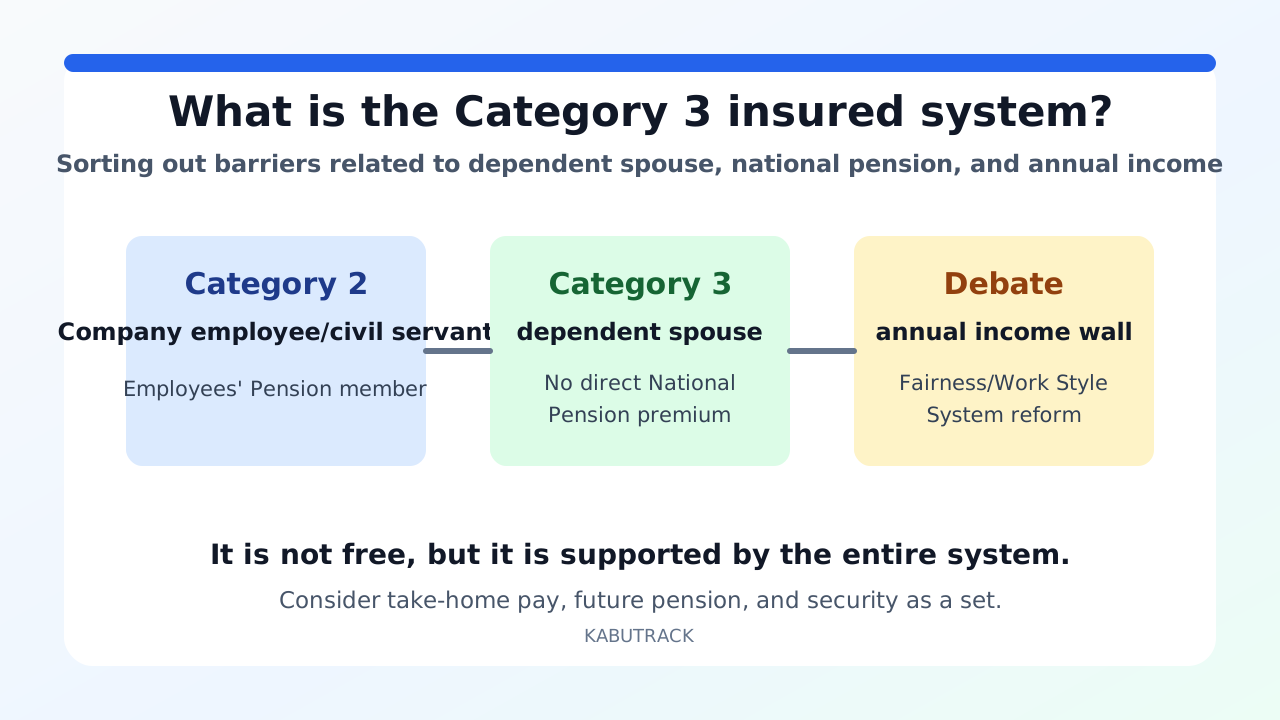
The third insured person is the dependent spouse of the second insured person.
In other words, the Category 3 insured person system is strongly linked to the Employees' Pension System in which Category 2 insured persons participate.
Category 3 insured persons do not pay national pension insurance premiums directly. However, the basic pension is supported by the entire Employees' Pension system and the national treasury.
At a glance, the structure is as follows.
Category 2 insured person
  ↓ Employees' Pension premiums
business owner
  ↓ Employer burden
Overall Employees' Pension system
  ↓
Also supports the basic pension of category 3 insured persons.
For this reason, when discussing the review of the Category 3 insured person system, the fairness of the burden on Category 2 insured persons and companies will be an issue.
The spouse of a self-employed person cannot be classified as Category 3, but may be required to pay National Pension Insurance premiums as Category 1. For dual-income company employees, each spouse pays the Employees' Pension premiums. On the other hand, Category 3 insured persons do not pay national pension insurance premiums directly.
The system had a rational starting point, but now that the number of dual-income households has increased, the outlook for burdens and benefits is being questioned.
With the expansion of social insurance coverage, the number of Category 2 insured persons is likely to increase.
In recent years, social insurance coverage has been expanded to include part-time workers.
Even people who have been working as dependents on their spouses may enroll in Employees' Pension and health insurance and become Category 2 insured persons depending on their working conditions.
The Ministry of Health, Labor and Welfare has explained that with the pension system reform in 2025, the company size requirements for part-time workers will be gradually reduced and eliminated over 10 years, and wage requirements will also be abolished within three years of the promulgation of the law.
The conditions that we would like to see from now on to the future are as follows.
| conditions | way of seeing |
|---|---|
| Regular working hours per week | More than 20 hours? |
| Company size requirements | be gradually reduced and abolished |
| wage requirements | The requirement for a monthly payment of 88,000 yen or more will be abolished. |
| Student or not? | Please note that students are not covered by employee insurance. |
| Employment prospects | Are you expected to work beyond a certain period of time? |
This can't be resolved simply by saying, ``I can't work because I'm a dependent.''
If you enroll in social insurance, you will have to pay insurance premiums, which may reduce your short-term take-home pay. On the other hand, there are more benefits such as Old-age Employees' Pension, disability Employees' Pension, survivor Employees' Pension, health insurance injury and sickness allowance, and maternity allowance.
It is more realistic to consider whether or not to be excluded from dependent status based not only on take-home pay, but also on working hours, future pensions, health insurance coverage, and family structure.
How should I think about household finances?
Being a Category 2 insured person provides the foundation for building funds for retirement.
However, this is not to say that you don't have to do anything because you have a foundation.
1. Check the Nenkin regular mail
Check your enrollment history and estimated pension amount in the regular Nenkin mail you receive every year.
For Category 2 insured persons, the future pension amount will change depending on changes in workplace and salary. The numbers change depending on job changes, reduced working hours, leave of absence, and retirement timing.
2. Calculate by work style on Nenkin Net
The expected amount of your pension will change depending on whether you continue working in your current way, work after age 60, or retire early.
It's faster to do a trial calculation on Nenkin Net than to judge by feeling.
3. Consider corporate pension, iDeCo, and NISA separately
Category 2 insured persons have an Employees' Pension, but that alone does not necessarily provide enough funds for retirement.
As an additional part, we will check the following systems and assets.
- corporate pension
- Corporate DC
- iDeCo
- New NISA
- retirement allowance
- deposits and savings
Employees' pension is the second tier of public pension. It will be easier to organize corporate pensions and iDeCo if you think of them as additional benefits on the outside.
4. Separate investments from livelihood defense funds
New NISA and iDeCo are systems that are useful for asset formation, but investment products are subject to price fluctuations.
Even if you have an Employees' Pension, it is dangerous to invest money that will be used in the near future or an emergency fund. It is important to separate the roles of livelihood defense funds, insurance, public security, and long-term investments.
Perspectives that investors need to know
Employees' pensions are not only an individual's retirement system, but also a company's cost structure.
In particular, the expansion of social insurance coverage is a theme that is likely to have an impact on the following industries.
- retail industry
- restaurant industry
- nursing care
- logistics
- human resources services
- Labor-intensive services such as cleaning and security
For companies with a high ratio of part-time workers, as the number of employees eligible for social insurance increases, the employer's burden will also increase.
When looking at financial results, you want to check not only sales growth, but also the following items.
| Items to see | reason |
|---|---|
| Labor cost rate | Are labor costs, including social insurance premiums, rising? |
| SG&A expense ratio | See increases in recruitment costs, education costs, and welfare costs |
| gross profit margin | Are you able to pass on cost increases to prices? |
| Profit per store/base | Are you able to absorb the increase in personnel costs? |
| Part-time ratio | Is it likely to be affected by expanded application? |
Expanding social insurance coverage means expanding security for working people. For companies, it can also be a weapon for securing human resources.
However, for companies with thin profit margins, an increase in insurance premiums will have a gradual effect. Even if sales are increasing, operating profit margins will be difficult to increase unless personnel costs and social insurance premiums are absorbed. Investors should look here.
common misconceptions
Misconception 1: Company employees only receive Employees' Pension benefits.
Company employees and civil servants are treated as enrolling in the national pension at the same time as enrolling in the Employees' Pension. In retirement, if you meet the conditions, you will receive both the old-age basic pension and the Old-age Employees' Pension.
Misconception 2: The company’s burden has nothing to do with you.
Although it is difficult to see only the amount borne by the individual on the pay slip, the portion borne by the employer is also part of the company's personnel expenses. It concerns wages, hiring, pricing, and profit margins.
Misconception 3: If you enroll in the Employees' Pension, you will always have enough funds for retirement.
Employees' pensions are a strong foundation, but the pension amount changes depending on the period of participation, remuneration, and retirement date. There are housing costs, medical costs, nursing care costs, and price increases, so you need to check your estimated amount.
Misconception 4: Part-time workers are not Category 2 insured persons.
Even if you are a part-time employee, if you meet the conditions regarding your working hours and workplace, you may be eligible to enroll in the Employees' Pension and Health Insurance and become a Category 2 insured person. With the expansion of social insurance coverage, this coverage is likely to expand.
Myth 5: Participating in social insurance will only reduce your take-home pay.
Short-term take-home pay may be reduced. However, there are some aspects in which future Employees' Pension benefits, disability/survivor benefits, and health insurance benefits will increase. You need to look at take-home pay and insurance separately.
Conclusion
Category 2 insured persons refer to people who are enrolled in the Employees' Pension Plan, such as company employees and civil servants.
When you join the Employees' Pension, you are also treated as a member of the National Pension, and when you retire, both the Old Age Basic Pension and the Old Age Employees' Pension are involved. Compared to Category 1 insured persons and Category 3 insured persons, the major difference is that there is an added benefit to the Employees' Pension.
The Employees' Pension insurance premium rate is 18.3%, split equally between the person and the employer. If the standard remuneration is 300,000 yen per month, the individual will have to pay 27,450 yen. Although it looks like a burden on your payslip, it is also an insurance premium that provides insurance for your old age, disability, and survivors.
From now on, with the expansion of social insurance coverage, it will be easier for part-time workers to become Category 2 insured persons. From a household budget, it is important to look at take-home pay and security, and from an investor's perspective, it is important to look at the labor cost ratio and profit margin as a set.
Source
This article was created based on publicly available information from the Japan Pension Service and the Ministry of Health, Labor and Welfare as of June 16, 2026. Pension systems, social insurance participation requirements, insurance premium rates, and pension amounts are subject to change, so please check with your workplace, Japan Pension Service, pension office, social insurance labor consultant, etc. before actual procedures and household financial decisions.
- Japan Pension Service “Types of public pension systems and systems to join” Updated date: April 3, 2023
- Japan Pension Service “Category 2 insured person” Update date: November 22, 2023
- Japan Pension Service “Welfare Pension Insurance Premium Table”
- Ministry of Health, Labor and Welfare “Expansion of eligibility for pension social insurance”
- Ministry of Health, Labor and Welfare “Responding to the annual income barrier”