
Related Reading
- SoftBank Group (9984): AI Infrastructure Rally And Market Valuation
- NVIDIA (NVDA) Full Analysis: The Core Stock Of AI Infrastructure Capitalism
- Can Nokia Become An AI Infrastructure Stock? AI-RAN And 6G Strategy
What Happened First
On June 19, 2026, Jio Platforms Limited, a subsidiary of Reliance Industries, filed its DRHP.
The key terms visible from the DRHP are as follows.
| Item | Detail |
|---|---|
| Issue structure | Fresh issue only; no offer for sale by existing shareholders |
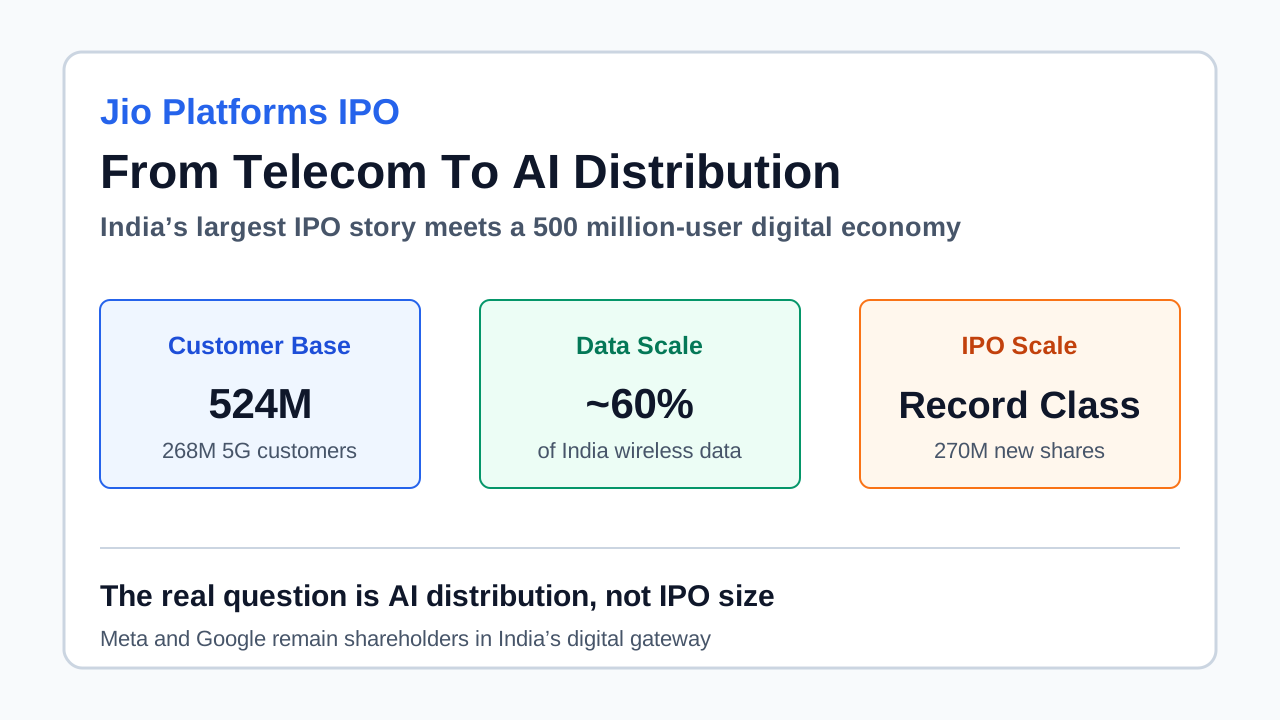
| Planned issue size | Up to 270 million shares |
| Face value | 10 rupees per share |
| Fundraising amount | Price not yet set. Media reports center around 320 billion to 400 billion rupees |
| Use of proceeds | Up to 275 billion rupees for repayment or prepayment of RJIL borrowings; the rest for general corporate purposes |
| Planned listing | NSE and BSE |
| Book-running lead managers | Kotak Mahindra Capital, Morgan Stanley India, BofA Securities India, Axis Capital, BNP Paribas, Citigroup, Goldman Sachs India, and others |
The important point is that existing shareholders are not selling.
Meta, Google, KKR, Vista, Silver Lake, Mubadala, General Atlantic, ADIA, and other investors that put money into Jio in 2020 are not using this IPO as an exit, at least based on the DRHP. Structurally, this is an IPO meant to strengthen Jio’s balance sheet.
From an investor’s point of view, that is not a bad setup. It is easier to understand than a listing dominated by early backers rushing for the exit. Still, a large part of the proceeds is earmarked for debt repayment. That means this is not simply growth capital being thrown entirely into AI or new businesses.
Why It Could Become India’s Largest IPO
The final IPO size for Jio Platforms has not been determined. The issue price will be set through book-building.
Even so, the reason the market is talking about an “India record” is straightforward. Hyundai Motor India’s 2024 IPO raised about 278.6 billion rupees. If Jio lands in the 320 billion to 400 billion rupee range, it would exceed that.
On the numbers alone, it is certainly big.
But in market terms, this is also a test of whether Indian equities can pull global money back in. For years, India has been viewed as a market with growth, but also a market that is expensive. Now Jio is coming to market with a 500 million-plus customer base, Meta and Google on the shareholder register, and an AI narrative layered on top.
It is hard to imagine no demand. The real question is how much of that demand is already embedded in the price.
Reliance Industries’ own share-price reaction has not been pure excitement. Reports said the stock closed lower in India on the DRHP filing day, even though it later saw buying on IPO expectations. In other words, the market likes the potential value-unlocking story, but it is still trying to price Jio on a standalone basis.
That is the interesting part. The event is large, but the stock-market read is not simple.
For Reliance shareholders, the real focus may not be the IPO itself. It is whether Jio’s standalone market value can narrow the conglomerate discount that has long attached to Reliance. When petrochemicals, retail, telecom, digital, and AI all sit under the same parent, investors naturally apply a discount. If the market assigns a high value to Jio on its own, some of that discount may peel away.
But that will not happen in a straight line. Even if Jio lists at a rich valuation, that does not automatically translate one-for-one into Reliance’s share price. The parent still carries other capital spending, energy-market exposure, and holding-company complexity. What the market really wants to know is not just “what is Jio worth,” but whether Reliance as a whole starts to look different.
From a supply-demand perspective, the IPO structure looks relatively clean. There is no offer for sale by existing shareholders, so it does not look like an exit deal for Meta, Google, or the other 2020 investors. It also does not force the market to absorb a large block of selling shareholders immediately after listing.
Still, a deal this large is heavy. If the issue exceeds 300 billion rupees, it cannot be absorbed by domestic retail demand alone. The key will be how seriously overseas institutions show up, and whether long-only capital is willing to pay the offer price. The first-day price action will be a thermometer not only for Jio, but for global money’s appetite for Indian equities.
Why Mukesh Ambani Could Break The Telecom Market
It is hard to understand Jio without Mukesh Ambani. Reliance Industries was originally a giant in petrochemicals, refining, and energy. Ambani used that cash generation and balance-sheet strength to shift the group’s center of gravity toward telecom, retail, and digital businesses.
Jio changed India’s telecom market in 2016. Free voice calls, free or extremely cheap data, and a nationwide 4G-first rollout. This was not a normal new entrant. Jio did not start by trying to optimize profit. It took users and traffic first, then looked to recover value later through ARPU and adjacent services.
For competitors, that was painful. Prices fell, consolidation accelerated, and the Indian telecom market moved toward a structure centered on Jio and Bharti Airtel. The Jio IPO is also an event where the market is being asked to put a price on part of the “next Reliance” that Ambani built by connecting oil, retail, and telecom.
Why Meta And Google Bet On Jio
Meta and Google’s investments were not just financial investments.
In 2020, Meta invested 5.7 billion dollars in Jio Platforms and took a stake of about 9.99%. The aim was to connect WhatsApp, Facebook, Instagram, JioMart, and small merchants inside one of the world’s largest smartphone and telecom markets. Meta and JioMart later rolled out an end-to-end shopping experience on WhatsApp, from product browsing to purchase.
Google invested 4.5 billion dollars in the same year and acquired 7.73%. Its angle was Android, Google Play, low-cost smartphones, and Google Cloud. Google and Jio wanted to bring affordable devices and internet access to Indian users who had not yet moved fully into smartphones.
Put simply, Meta was looking at the entry point for communication and commerce. Google was looking at the entry point for Android and cloud. Jio’s strength is not only the telecom line itself. It is the gateway to consumption, payments, advertising, cloud, and AI services built on top of that line.
Treating Jio As Just A Telecom Company Is A Little Outdated
Jio is a telecom company. That part is true.
But if that is all one sees, the meaning of this IPO is easy to miss.
Based on the DRHP and related reports, Jio’s scale looks like this.
| Metric | Figure |
|---|---|
| Total customers | 524.4 million |
| 5G customers | 268.5 million |
| FY26 data traffic | 241 exabytes |
| Share of India’s wireless data traffic | About 60% |
| Fixed broadband customers | 27.1 million households |
| Q4 average monthly data usage | 42.3GB per customer |
| Monthly churn | 1.67% |
India’s population, smartphone adoption, video consumption, UPI payments, online education, e-commerce, and small-business digitization all sit on top of connectivity.
Jio controls a very thick part of that connectivity layer. When one company carries about 60% of India’s wireless data traffic, this is no longer just an ordinary carrier story. It starts to look like a national nervous system.
At this scale, the telecom network is not just infrastructure. It becomes a customer interface. Who controls the smartphone entry point? Who captures cloud demand from small businesses? Who distributes AI assistants? The story expands that far.
Profitability: From Low-Cost Disruptor To High-Margin Platform
Jio was once the company that broke India’s telecom market with extremely low pricing. It gathered users with cheap data, shook out competitors, and took scale.
Now investors are looking at the next phase.
Jio’s main FY26 numbers are as follows.
| Item | FY26 |
|---|---|
| Revenue | 1,468.853 billion rupees |
| EBITDA | 762.554 billion rupees |
| EBITDA margin | About 51.9% |
| Profit after tax | 300.491 billion rupees |
| ARPU | 214 rupees |
| EBITDA less cash capex | 420.71 billion rupees |
| Net leverage | 0.36x EBITDA |
An EBITDA margin above 50% is a strong number for a telecom company. In an ordinary case, that alone would be enough to carry the story.
But the lens for Indian telecom stocks is a bit more skeptical. Jio’s ARPU is 214 rupees. That is not a bad number. But Bharti Airtel posted 257 rupees in Q4 FY26, and the gap is still clear.
When investors compare Jio and Airtel, they are not only comparing subscriber counts. Jio’s customer base is overwhelming, but Airtel is ahead on unit revenue. Jio is moving from a phase of “how many users can it add?” to “how much can it earn per user?”
This is where it gets difficult. Tariff increases would raise ARPU. But Jio’s strength also came from using affordability and scale to take the market. Raise prices too quickly, and it may touch the low-cost brand image or political optics. But if ARPU does not rise, the valuation gap with Airtel becomes harder to close.
Personally, I would rather watch ARPU than subscriber additions, and cash more than ARPU. Even with 500 million users, shareholder value does not follow if capex is too heavy. In Jio’s case, EBITDA less cash capex improved from 14.49 billion rupees in FY24 to 420.71 billion rupees in FY26. That change is meaningful. Frankly, that may matter more than the AI narrative right now.
I am half-positive, half-cautious on FWA. Fixed wireless access is an attractive tool for spreading home broadband quickly. But in telecom, a contract gained does not automatically become profit. Devices, installation, network quality, churn, and customer acquisition costs all matter. The more rollout shifts into less dense areas, the longer the payback period can become.
Subscriber growth alone is not enough. The question is whether home broadband can produce sticky ARPU and cash. After the IPO, those numbers will be watched closely.
Why Jio Is Better Understood As An AI Distribution Platform
What makes Jio’s listing interesting is that AI sits beyond the telecom layer.
The phrase “AI national infrastructure” is useful for the headline, but it sounds a little political in English. For investors, the cleaner frame is probably this: Jio is an AI distribution platform. It supports people’s daily lives and corporate activity through telecom networks, cloud, payments, enterprise digital services, and AI assistants. It is not classical infrastructure like power or roads. It is digital-era living infrastructure built around smartphone screens, data networks, cloud, and AI.
Reliance has positioned Reliance Intelligence as a new growth engine and has referenced partnerships with Google, Meta, and NVIDIA. Jio itself also highlights AI assistants, an AI enterprise suite, AI-powered autonomous platforms, and a proprietary deep-tech stack for 5G, FWA, and AI services as part of its growth strategy.
But this needs some sorting out.
The AI data centers themselves may sit partly in Reliance-side intelligence businesses or related entities, rather than directly inside Jio Platforms. RIL’s materials also explain that AI data centers are on the Intelligence business side, not JPL.
So it would be rough to call the Jio IPO simply an “AI data-center company listing.”
Jio’s essence is closer to AI distribution. It has more than 500 million customers, enterprise connectivity, cloud, JioPC, MyJio, fixed-line access, FWA, and services for small and midsize businesses. The question is whether AI agents and enterprise AI services can be placed on top of that distribution network.
Compared with a GPU company like NVIDIA, Jio is unusual. It is not a company that sells huge amounts of GPUs. It does not manufacture cutting-edge chips. If one gets that wrong, the Jio AI story becomes sloppy very quickly.
Still, the reason the market wants to attach an AI premium to Jio probably comes back to its 500 million-plus customer base. AI may be harder to distribute than to build. At least in India, that debate has begun.
What Jio owns is not the GPU itself, but the distribution infrastructure that can deliver AI to users and enterprises. Add Reliance Group’s data-center plans and its relationships with Meta, Google, and NVIDIA, and the shape becomes clearer. It is not a clean AI stock. But it is a company that can distribute AI.
That is why the market is starting to view Jio not merely as a mobile carrier, but as a digital base for AI distribution.
The Sovereign AI Angle
AI in India has a different set of difficulties from AI in the United States or China.
There are many languages. Income levels vary widely. The digital divide between cities and rural areas remains large. There are many small businesses, but IT budgets are limited. Expensive overseas AI cloud services cannot simply be dropped into the country and expected to spread everywhere.
Jio is aiming for an India-specific AI distribution network.
Indian data, Indian languages, Indian price sensitivity, and operating tools for Indian small businesses. That is where the term “sovereign AI” starts to matter. It is a structure where one of the country’s largest private telecom and digital companies may help carry national digital sovereignty, data sovereignty, and AI sovereignty.
It may sound a little grand, but if a company with 500 million telecom customers makes AI assistants a default layer, this is no longer just an app story. It becomes a social implementation story.
Of course, dreams alone do not support a stock price. How much can AI agents lift ARPU? How much gross profit can enterprise AI suites create? How far can JioPC and cloud services become paid services? That is where things become harder.
Opportunities For Japanese Companies
Jio’s listing is not just an India-market story. It also matters for Japanese companies.
First, the positive side.
| Japanese company / area | Potential upside |
|---|---|
| NEC | Possible collaboration in 5G/6G, Open RAN, network integration, and telecom-infrastructure exports |
| Fujitsu | Potential complementarity in telecom infrastructure, enterprise DX, AI, and cloud operations |
| NTT DATA Group | Large-scale SI, cloud migration, and business-application integration for Indian and global enterprises |
| SoftBank Group | Indirect thematic overlap through AI investing, Arm, telecom, and AI ecosystems |
| Trading houses / data-center-related firms | Potential projects in power, cooling, equipment, investment, and surrounding infrastructure in India |
For NEC and Fujitsu, Jio can be both a competitor and a major customer or partner candidate. Telecom infrastructure is shaped by national regulation, local operations, and cost constraints. In some cases, partnering with a local giant is more realistic than trying to capture all of India independently.
For SI companies such as NTT DATA, the spread of Jio’s AI cloud and enterprise services could create surrounding demand in system implementation, migration, security, and operations. That said, this is not a simple story where “if Jio grows, Japanese firms automatically profit.” Margins will depend heavily on who controls the project.
Risks For Japanese Companies
There is also a negative side. If anything, this may be the more realistic one.
| Japanese company / area | Risk |
|---|---|
| Rakuten Symphony | Competition in telecom-platform exports, Open RAN, and cloud-native telecom infrastructure |
| Domestic cloud / data-center operators | Price pressure if Jio/Reliance expands low-cost AI cloud into Asia |
| SI and telecom-equipment vendors | Jio’s in-house stack could change how hardware, operations, and software are split |
| Telecom carriers | Low-cost, large-scale, AI-integrated models could become the standard in emerging markets |
Rakuten Symphony is the name that stands out.
Rakuten has tried to commercialize the cloud-native telecom platform built through its own mobile business. Jio, meanwhile, is trying to take its Made-in-India 5G stack, network automation, AI services, and fixed wireless access overseas as a deep-tech stack.
They look like they are on the same field.
And Jio brings more than 500 million customers, huge traffic volumes, and real operating experience inside India. It also has cost competitiveness. For Rakuten Symphony, this is not just a technical competitor. It is a competitor with scale, capital, and political backing.
The same logic applies to cloud and data centers. If Jio/Reliance builds low-cost AI cloud in India and expands it across nearby Asian markets, Japanese firms cannot rely on “high quality” alone. AI infrastructure is ultimately a combined fight over power, land, cooling, GPU procurement, operating efficiency, and customer acquisition cost.
Jio IPO Still Has Real Risks
The story is compelling.
Whether investors are willing to pay for it is a different question.
The scariest issue is price. The point is not that Jio is a bad company. It is the opposite. That is exactly why investors need to ask whether “good company, so buy at any price” will work. With 500 million users, AI, Meta, Google, and India growth in the same story, valuation can naturally become rich.
What the market really wants to see is not only how complete Jio is as a telecom company, but whether it has a second growth curve. The subscriber base is already huge, and 5G adoption has advanced meaningfully. The next question is whether AI and enterprise services can lift ARPU.
Jio’s numbers are strong. But the market is not blindly bullish. Looked at only as a telecom business, it may already be moving toward maturity. After listing, the stock may trade in a tug-of-war between AI expectations and telecom-stock valuation.
The other issue is growth capex. 5G, FWA, satellite, AI, cloud, and enterprise services all cost money. Net leverage has come down, but the next investment cycle is not light. AI is a market-friendly word, but using AI does not automatically make money. In the end, investors will need to check ARPU, churn, enterprise contracts, cloud usage, and the paid conversion of AI services.
That is the part worth keeping in mind, rather than being pulled in by the headline “India’s largest IPO.”
To be a little harsh, Jio may already be too big. Investors like growth companies, but when a company already has more than 500 million customers, the question becomes: what grows next? If this were judged only as a telecom business, it could be valued like a maturing company.
That is why the market is looking at AI. Conversely, if AI monetization falls short of expectations, the high expectations can be revised. The Jio IPO is a growth story, but it is also an event that tests whether enough growth is still left.
Final View: Jio IPO Is A Test Of India’s Tech Re-Rating
Jio Platforms’ IPO is a major event for India’s capital market.
A fresh issue of 270 million shares. No offer for sale by existing shareholders. 524.4 million customers. Around 60% of wireless data traffic. FY26 revenue of 1,468.853 billion rupees, EBITDA of 762.554 billion rupees, and PAT of 300.491 billion rupees. The numbers are strong.
But the truly interesting part lies beyond the numbers.
Jio has moved from being a mobile carrier to becoming an entry point into India’s digital economy. The next question is whether it can become social infrastructure for distributing AI. That is where investor expectations sit.
Still, AI data centers, Reliance Intelligence, and the revenue perimeter of Jio Platforms must be read separately. The theme is large. That is exactly why a sloppy reading can be dangerous.
For Japanese companies, Jio may become a partner, a competitor, and a price-setter in Asia’s AI and telecom markets. NEC, Fujitsu, NTT DATA, SoftBank, Rakuten - none of them can treat Jio as a distant Indian company for much longer.
Jio IPO is not just an India stock-market headline.
It is the capital market trying to decide whether India can shift its valuation story from “the world’s factory” to “a global AI and telecom infrastructure market.”
FAQ: Common Questions About Jio IPO
Has the Jio Platforms IPO size been finalized?
No. The DRHP shows a fresh issue of up to 270 million shares, but the issue price will be determined through book-building. Media reports point to a possible size of around 320 billion to 400 billion rupees, but the final amount can change until pricing is completed.
Will existing shareholders such as Meta and Google sell?
Based on the DRHP, this IPO is a fresh issue only, with no offer for sale by existing shareholders. Meta, Google, and other investors are expected to retain their stakes at the time of listing.
Is Jio an AI data-center company?
Jio is important as an AI user interface and AI distribution platform, but the AI data centers themselves partly sit on the Reliance Intelligence or broader group side. Investors should separate the revenue scope of Jio Platforms from Reliance Group’s overall AI strategy.
Is Jio positive or negative for Japanese companies?
Both. NEC, Fujitsu, and NTT DATA may find areas for collaboration. At the same time, Rakuten Symphony and cloud or data-center-related companies may face competitive pressure from Jio’s low-cost, large-scale external strategy.
Sources
- SEBI, “Jio Platforms Limited Draft Red Herring Prospectus” (published June 19, 2026; checked June 22, 2026)
- Moneycontrol, “Jio Platforms files for India’s largest ever IPO of $4 billion” (June 19, 2026)
- Mint, “Jio Platforms IPO could trump NSE’s as India’s biggest ever” (June 19, 2026)
- ETTelecom, “Jio Platforms Board Approves DRHP for Upcoming IPO” (June 19, 2026)
- Financial Express, “Jio files for India’s biggest IPO, eyes Airtel-sized valuation” (June 19, 2026)
- Reliance Industries, “Financial Reporting / Investor Presentations” (checked June 22, 2026)
- Bharti Airtel, “Quarterly and Annual Results” (checked June 22, 2026)
- Meta, “Facebook Invests $5.7 Billion in India’s Jio Platforms” (April 21, 2020)
- Meta, “Introducing the First End-to-End Shopping Experience on WhatsApp with JioMart in India” (August 29, 2022)
- Google, “Bringing internet access to millions more Indians with Jio” (August 5, 2020)
- Google, “A new Android smartphone and 5G partnership with Jio” (June 24, 2021)
- Rest of World, “How Mukesh Ambani won India’s mobile data price war” (September 1, 2020)
Disclaimer
This article is for informational and investment-learning purposes only. It does not recommend or solicit the purchase or sale of any specific stock, foreign equity, IPO, investment trust, or ETF. IPO terms, issue price, listing timing, regulatory review, exchange rates, company performance, and business plans may change. Please make investment decisions based on your own risk tolerance, investment horizon, diversification, and the latest official materials.