
First, the conclusion
Oshi travel-related stocks are not just a theme based on travel demand.
Rather, what investors should be looking at is a cycle in which IP generates real movement, which in turn spreads to goods, exclusive experiences, licenses, and digital touchpoints.
JR Tokai's ``Oshi Tabi'' policy stands out in this theme, but as an investment target, the story does not end with JR Tokai. Our business is not limited to transportation companies, but includes IP holders, hotels, theme parks, event management, station stores, and retailers.
For railway companies, in addition to fare revenue, the focus is on whether they can create demand during off-season, weekdays, and in rural areas. For IP holders, the more their works and characters are consumed not only on screen, but also at stations, towns, hotels, theme parks, and event venues, the greater the depth of licensing and product sales.
However, it is not possible to simply say, ``Push travel is growing, so there is a uniform tailwind for related stocks.'' This is because each company has a different share of profits.
JR Tokai has connections with Shinkansen usage, EX services, tourism materials, stations and hotels. Bandai Namco HD and Toei Animation are in the upper reaches of IP. Sanrio has global characters, licenses, and theme parks. The Sony Group has a wide entertainment network including anime, music, games, and distribution.
Even with the same ``Oshi Tabi'', the places where sales drop are quite different.
Why Oshi Travel is an investment theme
The reason why travel is becoming an investment theme is not so much the travel itself, but the fact that multiple revenue streams are triggered by travel at the same time.
The starting point is IP monetization. As the worldview of characters and works spreads to stations, trains, towns, hotels, and stores, the number of points of contact with goods, merchandising rights, events, distribution, and games increases. It will be more than just an advertisement, it will be an experience that fans will spend their time and travel expenses to participate in.
Railway companies are being talked about non-fare and peripheral revenues. In addition to fare income, it can be expanded to travel products, inside stations, hotels, e-commerce, app membership, digital stamp rallies, etc. If the domestic population decreases, the number of ``natural passengers'' will decrease. Therefore, rather than just waiting for demand for transportation, transportation companies are moving toward creating the purpose of transportation itself.
Inbound is also a must. Japanese anime, games, and characters have reached overseas fans as well. As the number of visitors to Japan increases, there will be more room to send them not only to Tokyo, Osaka, and Kyoto, but also to regions associated with the works and characters.
Although often overlooked, it also has a strong compatibility with regional revitalization. Pilgrimages to sacred places and content tourism can create reasons to visit even lesser-known areas. It is difficult for local governments to monetize their profits alone, but when railways, lodging, product sales, and IP holders work together, it becomes easier for listed companies to retain a portion of their profits.
Differences between recommended travel, sacred place pilgrimage, and content tourism
First, I would like to separate the words. In investment articles, if you mix this up, stock selection becomes rough all at once.
| Concept | Main starting point | Points of profit generation | How to read as an investment theme |
|---|---|---|---|
| Pilgrimage to sacred places | Fan-led | Local food, transportation, and retail | There is a lot of enthusiasm, but it is difficult for companies to plan profits in advance |
| Content tourism | Local governments, regions, producers | Tourist attraction, local consumption, facility visits | Good compatibility with regional revitalization, but may not be directly linked to profits of listed companies |
| Favorite travel/IP economic zone type | Companies, transportation operators, IP holders | Fares, limited experiences, product sales, licenses, member contact points | Easy for companies to design experiences and revenue routes |
`Oshitabi-related stocks'' as an investment theme are not limited to `Oshitabi'', which is a registered trademark of JR Tokai. It is more accurate to look at the situation by including listed companies that can monetize travel, stay, and purchases based on IP.
The point is that we are moving from an incidental pilgrimage to sacred places where fans move on their own to a stage where companies design the purpose of their travel.
What's happening?
JR Tokai's top message explains this theme quite clearly. It's easy to understand if you just look at it as an entrance.
In the context of increasing profits, the company explains that it is promoting initiatives to create its own purpose for travel, citing ``Oshi Tabi'' and charter vehicle packages, and by collaborating with areas along the railway lines, other companies, and content holders such as anime, games, and movies. Furthermore, the sales increase effect from these new demands is estimated to be over 100 billion yen in fiscal 2024, and the company aims to increase sales even further in fiscal 2025.
This is important. The company writes in the IR context that it "creates a purpose for travel."
Traditionally, railway companies have been largely passive, depending on population, commuting, business trips, and tourist numbers. However, in a push trip type project, the journey itself becomes an event. Limited content on the Shinkansen, boarding certificate, limited goods, digital stamp rally, and local excursions. Combining these elements transforms a ride from `riding to get to a destination'' to `the ride itself becomes an experience.''
This change is not small. This is because they are less likely to get caught up in price competition, and it is easier for fans' enthusiasm to increase customer spending and sales.
Structural change
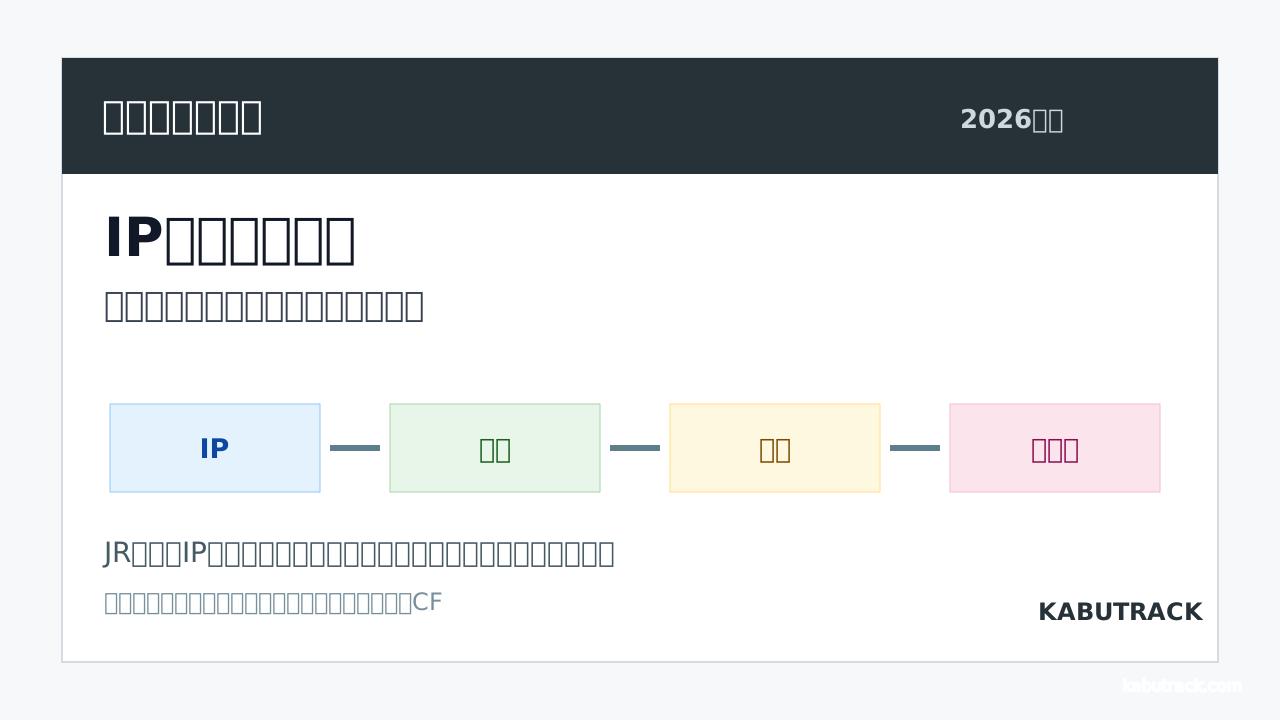
Roughly speaking, the profit structure of Oshi Tabi is as follows.
IP/collaboration announcement
↓
Generation of transportation demand
↓
In-car limited content, boarding certificate, digital project
↓
Local excursion, lodging, eating and drinking, purchasing goods
↓
License income to IP holders, fan contact for next project
From an investor's perspective, I would like to divide this into two parts.
The transportation/regional side collects fares, travel products, station commerce, hotels, and app member contact points. JR Tokai is also developing EX services and tourism materials, and is moving toward bundling transportation and reservation lines rather than one-off collaborations.
IP holders have a slightly different view. For companies like Bandai Namco HD, Toei Animation, Sanrio, and the Sony Group, the more their works and characters are consumed in the real world, the more likely they are to have a ripple effect on commercialization, events, distribution, games, and licensing.
Even in the same collaboration, railway companies can see the number of users and unit price, and IP holders can see the depth of fan contact and licenses. The market prefers the latter. This is because strong IP has low additional usage costs and is easy to see high profit margins.
However, here's where it gets difficult.
With IP-related stocks, there are many times when you can see whether the numbers will rise in the next financial results, rather than the moment the news comes out. It is not uncommon for people to not buy a collaboration just by announcing it, but to evaluate it only after confirming its contribution to operating profit. The market looks at it rather coldly.
Why will it remain as a theme in 2026?
The background is a recovery in the flow of people both domestically and internationally. But that's not all.
According to JNTO, the number of foreign visitors to Japan in 2025 was 42,683,600, the highest ever. According to the Japan Tourism Agency's Inbound Consumption Trends Survey, preliminary figures indicate that the consumption amount for foreign tourists visiting Japan in the calendar year 2025 will be 9,455.9 billion yen, an increase of 16.4% from the previous year, which is the highest ever for a calendar year.
Of course, an increase in the number of visitors to Japan does not automatically lead to an increase in travel brands. However, Japanese anime, games, characters, music, and movies are easily linked to the purpose of visiting Japan. There is scope to send customers not only to Tokyo, Osaka, and Kyoto, but also to Gifu, Shizuoka, Nara, Kyushu, and regional theme parks.
It's not just the ``famousness of the destination'' that comes into play here. With IP, you can create a reason to visit stations and towns that you would normally pass through. As Japan's population declines and demand for commuting to work and school alone becomes difficult to grow, it is becoming increasingly important for transportation companies to create their own travel destinations.
The market is still skeptical because it is difficult to predict how much profit will remain for each company. The number of visitors to Japan and the level of enthusiasm for SNS are easy to understand. However, in order to remain a listed company's operating profit, it is necessary to include everything from fares, accommodation, product sales, licenses, advertising, and membership.
Tailwind from market size
At present, it is difficult to confirm the official market size based on Oshijyo only. So here we look at the peripheral market numbers as a thermometer.
A series of articles in the Ministry of Finance's public relations magazine ``Finance'' states that the market size of 16 major otaku fields has expanded from 673 billion yen in 2020 to 1.09 trillion yen in 2024, based on estimates by the Yano Research Institute. Although it does not completely match Oshikatsu itself, the range of consumption areas that are easily connected to Oshikatsu is increasing, such as anime, idols, doujinshi, 2.5-dimensional musicals, and figures.
The character business is also big. Yano Research Institute predicts that the domestic character business market size will be 2,777.3 billion yen in 2024 and 2,849.2 billion yen in 2025. Furthermore, the same survey found that the development of character specialty stores and the movement toward "service provision + product sales" are becoming more active. This coincides with the trend of Oshi-tabi expanding not only to sales of goods but also to experiential consumption.
Looking more broadly, documents from the Cabinet Secretariat and Cabinet Office estimate that Japan's content market size will be 13.1 trillion yen in 2022. JETRO's regional analysis report states that the global licensing retail market in 2023 will be worth $356.5 billion, of which the entertainment and character sector will be worth $147.6 billion.
In other words, Oshi-tabi is not a small travel boom, but rather lies at the intersection of tourism, characters, licensing, content export, and real events. The market size numbers seem to be on the high side, so we shouldn't be overconfident, but the depth of the surrounding market is difficult to ignore as an investment theme.
Beneficial area
JR Tokai (9022): Railway platform that creates a purpose for movement
JR Tokai is the easiest stock to understand when it comes to understanding this theme.
It has a huge transportation infrastructure called the Tokaido Shinkansen, which serves as a tourist route to Tokyo, Nagoya, Osaka, Kyoto, Nara, Shizuoka, and other destinations. Oshi-tabi can be read as a measure to increase people's motivation to use the Shinkansen.
In the full-year financial results for the fiscal year ending March 2026, sales were 2 trillion 6.2 billion yen, operating income was 830.1 billion yen, and net income was 552.8 billion yen. Operating profit margin is also high at 41.4%. The numbers are already strong. That's why the evaluation of the company as a whole doesn't change just because of a recommended trip.
What investors should look at is how long new demand will continue. The fact that JR Tokai itself estimates the revenue increase effect due to new demand in fiscal 2024 to be over 100 billion yen is helpful. However, the company also has heavy investment themes such as the Chuo Shinkansen, safety investments, equipment renewal, and countermeasures against inflation. It is more realistic to view push travel as an auxiliary engine that improves the quality of transportation revenue, rather than as the main driver.
Bandai Namco HD (7832): A company that turns IP in all directions
Bandai Namco HD is close to the upper stream of Oshitabi.
In its Integrated Report 2025, the company has set a medium- to long-term vision of ``Connect with Fans,'' showing how it will connect in all directions with IP fans, partners, shareholders, employees, and society. As for investment themes, the focus will be on the ability to develop IP into products, games, cards, facilities, and events, such as those related to Gundam, The Idolmaster, Tamagotchi, and Dragon Ball, rather than transportation or events themselves.
It goes well with Oshi-tabi. This is because it is easy to translate the worldview of characters and works into trains, towns, stores, and limited edition goods.
However, Bandai Namco is already valued as an IP company. The operating profit margin for the full year ending March 2026 is 14.1%, and operating CF is 164.7 billion yen. Not all profits are as light as the term IP company might give the impression. Toys, cards, games, and amusements also carry inventory and development costs. Things to look at are the bias in sales by IP, inventory risks for cards, toys, and games, overseas expansion, and the profitability of physical stores and amusement facilities.
Toei Animation (4816): A stock that looks at the quality of license revenue
Toei Animation is easy to understand as an anime IP holder.
In the full-year financial results for the fiscal year ending March 2026, sales were 93.6 billion yen and operating income was 31 billion yen. Although sales and profits decreased, the operating profit margin was 33.1% and operating CF was 16.9 billion yen. Rather than an anime production company, it is easier to see the company as a company with strong IP copyright revenue.
Oshi trip-type projects are compatible with the stage of the work, character shows, limited goods, and excursions for overseas fans. On Toei Animation's IR page, financial results for the fiscal year ending March 2026, supplementary financial results, and financial data are published, making it easy to follow developments by copyright, overseas, and work.
The risks are clear. There are waves for each work. Even if you have a strong IP, the outlook for the quarter will change depending on the timing of distribution, gaming rights, and merchandising rights. The market likes high profits, but once expectations are disrupted, adjustments are quick.
Sanrio (8136): A company that turns global characters into points of contact with reality
Sanrio is a little unique among Oshi-tabi-related companies.
Characters such as Hello Kitty, Kuromi, Cinnamoroll, and Pompompurin are less dependent on the broadcast cycle of a particular work. It has many real-world connections, including Sanrio Puroland, Harmonyland, stores, licensing, digital, and overseas expansion.
In the fiscal year ending March 2026, sales will be 194 billion yen, operating profit will be 77.8 billion yen, and operating profit margin will be 40.1%. The company says this is the fifth consecutive year of increased sales and profits, marking a new record high. Growth in licensing and product sales can be seen in Japan, as well as growth in the licensing business in Europe and Asia.
This stock not only has strong themes but also strong numbers. That's why it's difficult. Being a good company and having a good investment timing are two different things.
The market already sees Sanrio as not just a general merchandise company, but a global IP company with a high ROE. From now on, we want to see how long the multiple character strategy will last, how profitable overseas licensing will be, and whether theme park, game, and LBE investments will overheat.
Sony Group (6758): A huge entertainment network that brings together anime, music, and games
The Sony Group may seem a little far from the word Oshi-tabi, but it cannot be ignored as a content provider.
In its May 2026 Corporate Strategy, Sony explained entertainment, IP, and creation technology as priority areas, and positioned anime as a growth area. It also shows that the number of paid members of Crunchyroll has exceeded 21 million worldwide as of the end of March 2026.
Furthermore, Aniplex is involved in a wide range of activities, including the planning and production of animation works, games, distribution, theaters, program sales, merchandising licenses, figures and goods, EC, and stages and events. From a content supplier's perspective, Sony has a fairly wide range of services.
However, considering the market capitalization and profit scale of the Sony Group as a whole, individual travel plans are unlikely to be a factor in moving stock prices. What we need to see is how the cross-development of anime, games, music, and movies will support the profitability and continuity of the entertainment business.
Distinguish by profit margin and operating CF
Actually, this is the most important part. Oshi-journey is a theme that ``people move,'' but what the stock market ultimately looks at is not sales, but profit margins and operating CF.
JR Tokai's operating profit margin for the full year ending March 2026 is 41.4%, and operating cash flow is strong at 748.1 billion yen. However, high profit margins for railway companies are inextricably linked to huge capital investments. Considering the Chuo Shinkansen, safety investments, and renewal investments, accounting operating profits do not directly turn into free cash.
On the IP side, Toei Animation has a high operating profit margin of 33.1% and Sanrio has a high operating profit margin of 40.1%. Licensing revenue has relatively light additional costs, so it tends to remain in operating cash flow. On the other hand, Bandai Namco HD's operating profit margin was 14.1%. Even IP companies are affected by inventory, development costs, and promotional costs because they own toys, cards, games, and facility management.
This is often overlooked, but even if product sales increase, if inventory accumulates, CF will slow down. Even if hotel sales increase due to event expeditions, it will be difficult to make a profit if labor costs and utility costs rise first. Licensing revenue is relatively likely to remain in CF, but when the production cycle breaks down, the outlook for the next fiscal year suddenly changes.
I'm taking this very seriously. It's easy to just list stocks related to Oshi Travel, but if you look at the profit margin and operating cash flow, even though they have the same theme, they look quite different.
Headwind area
There are also obvious headwinds to this theme.
The first thing to look at is the IP expiration date. Although the fan base is strong, the popularity of each work changes. Projects that rely on specific IP can be big if they are successful, but if they are unsuccessful, inventory, event costs, and promotional costs remain.
I'm also tired of collaboration. If there are too many limited edition goods, raffles, stamp rallies, collaboration cafes, and event trips, it will be hard for fans to keep up with their wallets and time. The higher the heat output of the fan, the more money will be spent, but if the billing design seems excessive, there will be opposition.
Furthermore, the local community has the capacity to accept it. Lack of accommodation, congestion, traffic lines, etiquette issues, resale, copyright management. If the region and railway company cannot absorb the enthusiasm of the IP, the project will not last long.
In the stock market, the biggest risk is leading expectations. IP, inbound tourism, regional revitalization, promotion. Everything is easy to talk about. Themes that are easy to talk about tend to be the first to take advantage of stock prices.
The numbers will come later. If you forget this, even a good theme can easily be overpriced.
KPIs that investors should look at
If you want to look at stocks related to Oshi Travel, just the excitement on social media is not enough. I have the impression that the market is looking at which account the amount of energy has fallen into, rather than the amount of energy itself.
For railway companies, look at non-regular revenue, tourism demand, member contact points such as EX services, and travel product sales. Are the number of passengers who ride with a purpose, rather than just commuters, increasing? Without understanding this, it is difficult to distinguish this from a simple recovery in the flow of people.
On the lodging and regional side, we want to look at not only occupancy rates but also ADR and average customer spend. Even if the venue is fully booked at the time of the event, if the price increase does not pass and personnel costs only increase, this is a weak investment theme. Station building sales and local excursions are also indicators of post-transfer consumption.
In product sales, inventory and gross profit are more important than sales of limited edition goods. Even if it appears to be selling well, CF will slow down if additional production is miscalculated or discounts occur. For IP holders, track license revenue, commercialization rights, overseas ratio, and dependence by work. On the digital side, we would like to see whether app membership, digital stamps, ride certificates, and CRM are driving repeat visits.
PER and PBR should come last. The first thing to check is non-regular revenue, ADR, average price per customer, license revenue, merchandising rights, overseas ratio, operating profit margin, and operating CF. The more a stock is based on theme expectations, the slower the reaction will be if the next financial results do not show these numbers.
Comparison of representative stocks
| Stock | Position | Issues for investors | Main risks |
|---|---|---|---|
| JR Tokai (9022) | Transportation infrastructure, travel management side | New demand creation, non-regular revenue, EX service collaboration | Chuo Shinkansen investment, inflation, regulations, demand cycle |
| JR East (9020) | Railways, in-station areas, and Suica economic areas in the metropolitan area and eastern Japan | MaaS, in-station consumption, local tourism, lifestyle solutions | Safe and stable transportation, capital investment, electricity and labor costs |
| JR West Japan (9021) | West Japan Tourism, Sanyo Shinkansen, Keihanshin Metropolitan Area | Kansai, Hokuriku, and Setouchi sightseeing excursions, digital tickets | Post-expo reaction, interest rates, repair costs, and expected value adjustment |
| JR Kyushu (9142) | Kyushu Tourism, Hotels, Real Estate/Station Buildings | Is it possible to turn railway traffic into real estate/hotel profits | Construction costs, interest rates, fluctuations in hotel demand |
| BANDAI NAMCO HD (7832) | IP multifaceted development | IP axis strategy, product/game/facility development | Overemphasis on works, inventory, hit reaction |
| Toei Animation (4816) | Anime IP holders | Copyright income, overseas expansion, revenue by work | Work cycle, anticipated advance, distribution/game rights fluctuations |
| Sanrio (8136) | Global character IP | Multiple characters, overseas licenses, theme parks | High expectations, brand exhaustion, investment recovery |
| Sony Group (6758) | Across anime, music, and games | Crunchyroll, Aniplex, game IP, music IP | The scale of the business is large and the contribution to the theme tends to be diluted |
| Oriental Land (4661) | Theme park type IP experience | High unit price experience, goods, number of visitors, unit price | Personnel costs, capital investment, weather, expected multiple |
| Kyoritsu Maintenance (9616) | Hotels and accommodations | Can you afford special trips, event expeditions, and inbound accommodation? | Personnel costs, utility costs, occupancy rate, store opening investment |
The most important thing about this table is not which stock is the best. The difference is in the nature of earnings.
JR companies are the recipients of demand creation and transportation/station consumption. IP holder is the holder of revenue rights. Sanrio and Oriental Land are operators of character contact points and experience value. Kyoritsu Maintenance receives accommodation demand. Simply separating out where the profits will be left will greatly simplify your perspective.
Risk scenario
In a bearish scenario, the push trip remains a one-shot campaign.
Fans are active, but demand wanes once the event period ends. Limited goods sell well, but there is no continued licensing income or member contact points. Although railway companies spend on promotional expenses, their ability to increase demand during weekdays and off-season periods will be limited.
On the IP holder side, there will be a backlash if there is too much reliance on popular works. The numbers don't look pretty when you combine the backlash from the previous year's hit titles, the timing of distribution rights and game rights, and a slowdown in overseas demand.
Another risk is that expectations run first.
Inbound, anime, promotion, regional revitalization. All of them make it easy to create a market story. However, if the story takes stock first and operating income and operating CF do not follow in the quarterly results, profit-taking will occur even if the news is good.
I want to look at this calmly. Oshi travel is an interesting theme, but unless the numbers fall, the market will not continue.
Summary
The essence of Oshi travel-related stocks is not travel consumption, but a profit design that starts with IP and combines travel, stay, product sales, licensing, and digital contact points. JR Central is an easy-to-understand entry point, but investment themes extend to JR companies, IP holders, lodging, theme parks, and retail.
In Japanese stocks in 2026, inbound tourism recovery, domestic population decline, and expansion of the IP economy are all occurring at the same time. That's why I would like to see Oshi-tabi as a structural theme that cuts across transportation, tourism, and entertainment, rather than a short-term buzzword.
However, the market does not last solely on stories. If the push moves, people will move too. The question is whose operating income and operating CF increased as a result of the move. Stocks that cannot confirm this are likely to be pushed to take profits even if good news emerges.
Three points investors should keep in mind
When looking at Oshi Travel related stocks, I would like to narrow it down to the following three points.
| Points | Things to check |
|---|---|
| Will it end as a one-off event? | Do the collaboration, app membership, local itineraries and return visits continue after the campaign? |
| Where does the profit remain? | Check not only fare income, but also licenses, merchandise gross profit, hotel ADR, in-station sales, and operating CF |
| Are expectations priced in too much? | Look at stock price indicators and operating profit margins to see if good news is already reflected in stock prices |
To be honest, Oshijyoku is quite interesting as a theme. However, the more interesting the topic, the more it is talked about in the market. That's why, in the end, we don't look at whether the fans have moved, but rather whether we have profits and cash left over. Without this calmness, investment decisions are likely to be erratic even when the theme is good.
Related pages
- 9022: Central Japan Railway Company Medium- to Long-Term Investment Analysis
- 9020: East Japan Railway Company Medium- to Long-Term Investment Analysis
- 9021: West Japan Railway Company Medium- to Long-Term Investment Analysis
- 9142: Kyushu Passenger Railway Medium- to Long-Term Investment Analysis
- 7832: BANDAI NAMCO Holdings medium- to long-term investment analysis
- 4816: Toei Animation Medium- to Long-Term Investment Analysis
- 8136: Sanrio medium- to long-term investment analysis
- 6758:Sony Group Medium- to Long-Term Investment Analysis
- 4661: Oriental Land Medium and Long Term Investment Analysis
- 9616: Kyoritsu Maintenance Medium- to Long-Term Investment Analysis
- [Investment value analysis of Kyushu Passenger Railway (9142): JR Kyushu's strengths and risks in diverting railway CF to urban development] (/strategy/2026/07/03/jr-kyushu-urban-development-cashflow.html)
- Will facial recognition ticket gates become a huge market? Suica, Japan's lag, next-generation MaaS based on China's AI infrastructure competition
- What is Nintendo getting from USJ? How to increase IP value through ticket price revision
source
- JR Tokai “Top Message” (Confirmed on July 4, 2026)
- JR Tokai “Oshi-tabi Official Website” (Confirmed on July 4, 2026)
- JR Tokai "Summary of Financial Results for the Fiscal Year Ending March 2026" (Confirmed on July 4, 2026)
- [JNTO "Number of foreign visitors to Japan (estimated for December 2025)"] (https://www.jnto.go.jp/news/press/20260121_monthly.html) (announced on January 21, 2026)
- [Japan Tourism Agency "Inbound consumption trend survey 2025 calendar year (preliminary report) and October-December period (first preliminary report)"] (https://www.mlit.go.jp/kankocho/news02_00071.html) (announced on January 21, 2026)
- [Market size and growth trend of "Oshikatsu" in the November 2025 issue of the Ministry of Finance's public relations magazine "Finance"] (https://www.mof.go.jp/public_relations/finance/denshi/202511/pageindices/index37.html) (confirmed on July 4, 2026)
- Yano Research Institute “Conducting a survey on character business (2025)” (confirmed on July 4, 2026)
- [Cabinet Secretariat "Council for the Realization of New Capitalism (26th)" Material 1 "Basic Materials"] (https://www.cas.go.jp/jp/seisaku/atarashii_sihonsyugi/kaigi/dai26/gijisidai.html) (April 17, 2024)
- [JETRO "Commercialization business expanding in Asia, boosted by the popularity of anime"] (https://www.jetro.go.jp/biz/areareports/2024/be07507437869e1b.html) (September 25, 2024)
- BANDAI NAMCO Holdings “Financial Results/Briefing Materials” (Confirmed July 4, 2026)
- BANDAI NAMCO Holdings “Integrated Report 2025” (confirmed on July 4, 2026)
- Toei Animation "Financial Results" (Confirmed on July 4, 2026)
- Sanrio “Financial Highlights” (Confirmed July 4, 2026)
- Sanrio “Mid-term Management Plan” (confirmed on July 4, 2026)
- Sony Group Corporate Strategy 2026 (published on May 8, 2026)
- Sony Music Group "Aniplex Co., Ltd." (confirmed on July 4, 2026)