
Bottom Line First
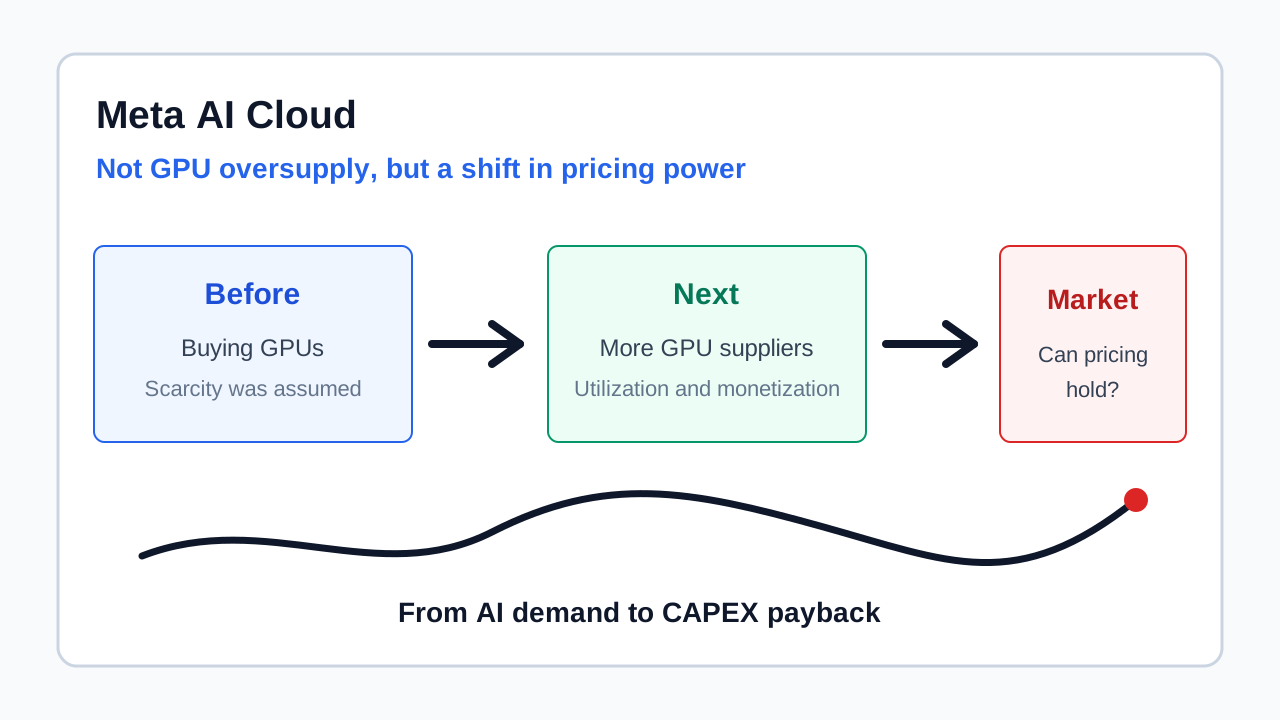
It is too early to call the recent semiconductor selloff an "AI bubble collapse."
That said, it has become increasingly careless to value semiconductor stocks, HBM stocks, and data-center-related names on the simple assumption that "GPUs will be scarce forever."
As of July 2026, investors following semiconductor stocks should focus on three questions.
| Question | What the market disliked | What investors should monitor |
|---|---|---|
| More suppliers | Whether large GPU holders such as Meta enter external sales | GPU cloud pricing, utilization at neo-cloud providers |
| CAPEX durability | Whether Big Tech investment plans remain intact | CAPEX outlooks at Meta, Microsoft, Alphabet, and Amazon |
| Shifting bottlenecks | Whether the bottleneck moves from GPU scarcity to power, cooling, HBM, and operating efficiency | HBM prices, power contracts, data center utilization |
At least for now, investors are not rejecting AI demand itself. Demand remains large. The problem is that the broad trade of "AI demand is strong, so anything GPU-related can be bought" is becoming harder to justify.
The numbers are good. The issue is what was already priced in.
To be honest, that discomfort existed even before the Meta report. Semiconductor stocks were strong. AI investment was strong. Yet stock-price reactions to good news were no longer as straightforward as before. The Meta report may have simply given a name to that slightly duller market response.
What Investors Had Priced In: Four AI Premiums
What came under pressure was not AI demand itself.
What came under pressure was the "scarcity premium" embedded in AI-related stocks.
From 2024 to 2026, AI-related equities priced in four assumptions at the same time.
| Premium priced into stocks | Why it supported valuations | What is now being questioned |
|---|---|---|
| Prolonged GPU scarcity | Stronger pricing power for GPU makers and GPU holders | More suppliers could push rental prices lower |
| Prolonged HBM scarcity | Higher margins for memory, equipment, and materials | If GPU investment slows, HBM expectations may soften |
| Expanding AI CAPEX | Big Tech investment lifts semiconductor demand | If CAPEX cannot be monetized, investment growth may stop |
| Improving cloud margins | GPU cloud runs at high price and high utilization | Price competition would hit margins first |
The market is not saying, "AI will not be used."
What is being revised is the optimistic assumption that GPU scarcity will persist for years and suppliers will remain structurally strong.
AI Infrastructure Should Be Viewed as a Four-Layer Market
Reading the Meta Compute report as a Meta-only story is too narrow.
The important question is which layer of the AI infrastructure market is losing pricing power.
GPU makers
↓
Cloud providers / GPU cloud
↓
AI companies / model developers
↓
Enterprise and consumer AI services
The news was not primarily about the GPU maker layer. It was about the cloud layer.
The price NVIDIA charges for GPUs and the price CoreWeave or a major cloud provider charges to rent GPU hours are different things. What short-term investors disliked first was not the idea that NVIDIA's selling price would collapse tomorrow. It was the scenario in which GPU rental prices fall, GPU cloud margins weaken, and future CAPEX and GPU demand eventually slow.
Once that transmission path is separated, semiconductor stock moves become easier to interpret.
Lower GPU rental prices
↓
Lower cloud margins
↓
Longer payback periods for GPU cloud operators
↓
More cautious new CAPEX
↓
Lower expectations for GPU, HBM, and semiconductor equipment demand
That is the order in which the pressure works. Before GPU selling prices themselves move, rental pricing and utilization become the market thermometer. Without watching that layer, semiconductor stock moves become harder to read.
What Is Happening Around Meta Compute
According to multiple reports, Meta is considering a cloud business that would offer AI compute capacity and AI models to external companies. The reported initiative has been referred to as "Meta Compute."
Meta has not officially announced detailed service terms, so this article treats the plan as a reported initiative.
This is where judgment should be held back for now. It is still unclear whether Meta Compute is about "monetizing excess GPUs" or a serious entry into AI cloud. That distinction matters. If it is the former, the impact may be limited to pricing adjustments in parts of the GPU rental market. If it is the latter, margin assumptions for neo-cloud companies and incumbent cloud providers may need to be revised more deeply.
In its first-quarter 2026 results, Meta raised its full-year 2026 capital expenditure outlook to $125 billion to $145 billion. The previous range had been $115 billion to $135 billion. Looking only at the top end, $145 billion is an aggressive figure.
The company cited higher infrastructure hardware costs and data center costs needed to support future capacity. AI model investment, data center capacity, and infrastructure costs are all expanding at the same time. When a company builds out infrastructure at this scale, it is natural that utilization and payback eventually become central questions.
The point should not be misunderstood: Meta's current business is not weak. In the first quarter of 2026, revenue was $56.311 billion, up 33% year on year; operating income was $22.872 billion, up 30%; and operating margin was 41%. The advertising business remains very strong. Quarterly capital expenditures were $19.84 billion, and free cash flow was $12.39 billion. Precisely because Meta still has strong earnings power, a $145 billion annual CAPEX range becomes something the market debates seriously.
This is the tricky part. The selloff was not about weak earnings. It was closer to this: even a company with a powerful core business like Meta is now being judged on how well it can recover its AI infrastructure investment.
So Meta is not only a company investing heavily in AI infrastructure. It is also becoming a company that must answer how that infrastructure will be monetized. The report brought that question into the market a little earlier than expected.
In early July, U.S. markets saw broad profit-taking in AI and semiconductor stocks. Axios reported that the Philadelphia Semiconductor Index, or SOX, fell 6.3% at the start of the third quarter, with selling also hitting KLA, Lam Research, Applied Materials, Micron, and others. Of course, it would be crude to attribute the entire selloff to the Meta report. AI-related stocks had been very strong, and a reversal in momentum likely played a role.
This distinction matters. The Meta Compute report may have been the trigger, but it does not fully explain the decline across the SOX index. High valuations in AI stocks, quarter-start profit-taking, rate and macro concerns, and worries about increased GPU cloud supply all overlapped. Rather than one news item breaking the market, it is more natural to see the report as a convenient selling catalyst against already elevated expectations. Tying the whole SOX decline only to Meta would oversimplify the story.
So who was selling?
Short-term momentum investors were probably looking first at the speed of the semiconductor rally. SOX had been strong, AI data-center names had been broadly bought, and reactions to good news were beginning to look less responsive. Then came the idea that a huge buyer might also become a supplier. That was enough of a reason to take profits.
Investors focused on neo-cloud names had a more direct concern. What they were buying was not just GPU scarcity itself, but the margin story that high rental prices and high utilization would persist. If a player like Meta enters the supply side, that assumption starts to wobble.
Long-only institutions, on the other hand, probably did not abandon AI demand overnight. It is more likely that they began reassessing CAPEX quality. The question shifts from "who is buying GPUs?" to "who can recover the investment in those GPUs?" That is where attention moved.
Then who might buy?
Capital that still believes in AI demand may shift away from simply chasing GPU makers and toward the surrounding infrastructure: power, cooling, optical communications, networking, and operating software. Investors may become more skeptical of the GPU premium while still believing in the broader AI data center investment cycle. In that sense, Japanese infrastructure-related stocks can become a natural place for that capital to look.
What Stocks Disliked: The Largest Buyer Potentially Becoming a Supplier
Until now, Meta has been viewed as a major customer in AI infrastructure.
It buys GPUs, signs cloud contracts, and secures compute capacity for its own models, recommendation systems, advertising products, and AI agents.
But if Meta begins selling AI compute capacity externally, the market view changes.
Previous market perception
Meta = a massive buyer creating GPU demand

Newly considered market perception
Meta = a potential GPU cloud supplier
This difference is larger than it first appears.
If the story were simply that GPU demand would increase, semiconductor stocks would benefit directly. But if the story is that there will be more GPU cloud suppliers, it could become a headwind for GPU rental prices, cloud-provider margins, and the growth expectations embedded in neo-cloud stocks.
For investors who had priced in sustained high margins at neo-cloud companies, this was likely an uncomfortable development. The market was reacting not to physical GPU inventory, but to the pricing power of AI compute capacity.
The AI Trade Is Moving From "Owning GPUs" to "Making GPUs Earn"
Viewed more broadly, the rules of the AI infrastructure market may be starting to shift.
For the last few years, the AI trade was a game of "whoever owns GPUs wins." GPU makers, HBM, semiconductor equipment, optical communications, and power infrastructure were all bought widely, but the underlying expectation was the same: compute capacity was scarce, so suppliers had power.
The next phase may be a game of "how well can those GPUs be monetized?" The Meta Compute report points to this change in the evaluation framework.
From here, investors will not look only at GPU holdings. They will look at utilization, rental prices, customer retention, power costs, cooling efficiency, and cloud operating gross margins. If any one of those weakens, the market view of CAPEX changes.
After that comes the competition to generate profits from AI services themselves. That part is still harder to see. It will not be enough to say that AI features have been added or users have increased. The market will want ARPU, ad pricing, software gross margins, and efficiency gains. Only when those show up in the numbers will investors have more confidence.
If this point is missed, the AI infrastructure trade gets reduced to a false binary: are GPUs still scarce, or are they already in surplus? Reality is messier. Areas of scarcity and areas of price competition can emerge at the same time.
GPU Cloud and GPU Utilization: Are GPUs Really in Surplus?
It is too crude to say that GPUs are already in surplus.
In AI data centers, not every GPU runs at 100% all the time. Large-scale model training has peaks, and inference demand varies by time of day and by service. Hardware is deployed in large blocks, so gaps inevitably emerge between demand forecasts and actual usage.
For a company, selling that gap is rational. At the very least, any finance team would prefer to recover something from idle GPUs rather than leave them unused.
If unused GPU hours can be rented externally, the data center no longer has to be only a cost center. Instead of recovering CAPEX only through advertising or AI products, the infrastructure itself can generate revenue.
This is where AWS comes to mind.
Strictly speaking, AWS was not simply a business built by renting out leftover e-commerce servers. It was a business that turned Amazon's large-scale infrastructure operating capability, developed for retail, payments, logistics, search, and advertising, into cloud products that external companies could use.
That shift transformed Amazon's earnings structure. In Amazon's first-quarter 2026 results, AWS revenue was $37.6 billion and operating income was $14.2 billion. Against Amazon's total operating income of $23.9 billion, AWS is a major profit pillar. A high-margin external platform emerged from the internal infrastructure of a retail company. It is natural that some investors think of AWS when they look at Meta's news.
Meta may have a similar idea.
Meta has a massive AI compute base supporting ad delivery, recommendations, Instagram, Facebook, WhatsApp, and generative AI models. If that base can be sold externally rather than used only for internal services, AI infrastructure can move from being a cost to being a revenue-producing asset.
Of course, it is not guaranteed that Meta can become another AWS. AWS has built general-purpose cloud services, databases, storage, developer ecosystems, and enterprise support. GPU cloud is not a market where simply lining up compute resources is enough.
Still, the lens changes. Meta's AI CAPEX can be read not only as a heavy cost, but also as a possible investment in a future external platform. That is the most interesting part of the report.
But GPU cloud is harder than ordinary cloud.
GPU generations change quickly. Power and cooling constraints are severe. Customers do not only want chips for rent. They need networking, storage, software, operational support, security, and availability.
That is why there is still a large gap between "some GPUs are idle" and "this becomes a high-margin cloud business."
The Key KPI for AI Infrastructure Is Not GPU Count, But Utilization
From here, the central KPI for AI infrastructure companies is not GPU count. It is utilization.
Even if a company owns one million GPUs, a 50% utilization rate weakens return on invested capital. Conversely, a company with fewer GPUs can still win on capital efficiency if it maintains high utilization through long-term contracts and operates power, cooling, and networks efficiently.
When looking at GPU cloud pricing, hourly rental rates alone are not enough.
| Price metric to watch | What it shows | Caveat |
|---|---|---|
| Hourly rates for H100, H200, B200, and similar GPUs | Short-term rental supply and demand | Spot prices can fall quickly, and latest-generation GPUs differ from older ones |
| Long-term lease pricing | Real demand and bargaining power from large customers | Profitability varies by contract length, minimum usage, and whether power costs are included |
| Effective price | Monetization after utilization is considered | High headline prices do not help if idle time is high |
| Gross margin | Strength as a cloud business | Must absorb depreciation, power, cooling, maintenance, and network costs |
The question is no longer just "how many GPUs do you have?" It is "how much of that capacity can you fill?"
That is close to the real meaning of the GPU oversupply debate. The issue is not physical GPU inventory alone. It is how much compute can be sold against the capital invested. The valuation framework for AI infrastructure is shifting from units owned to utilization achieved. It is hard to say the market has fully priced this in yet.
Counterargument: Does Meta Really Have Excess GPUs?
It is worth laying out the counterargument.
Even if Meta sells AI compute externally, that does not necessarily mean the company has a permanent excess of GPUs.
There are three possible counter-scenarios.
| Counter-scenario | What it means | How to read it for markets |
|---|---|---|
| A gap between training cycles | The peak of large-scale training has temporarily declined | Not a collapse in GPU demand, but utilization smoothing |
| External sales of older GPUs | Existing GPUs are being monetized before next-generation GPU deployment | Latest-generation scarcity may persist while older rental pricing falls |
| External sales as a strategic option | Not full commercialization yet, but price discovery and customer development | Profit contribution from cloud remains unknown |
This counterargument matters. Without it, the story quickly becomes only about "too many GPUs."
Even if GPU cloud prices fall, the meaning differs depending on whether this is an AI demand peak or a pricing adjustment in older GPUs. It is possible that B200 and next-generation GPUs remain scarce while rental prices for older GPUs decline.
So GPUs should not be treated as one single category.
Latest-generation GPUs, older GPUs, training workloads, inference workloads, short-term rentals, and long-term contracts all need to be separated.
How GPU Rental Prices Feed Through to Semiconductor Stocks
Semiconductor stocks did not sell off because AI demand suddenly disappeared.
What holders of semiconductor stocks feared was the removal of the premium that had supported the AI trade over the past several years. The important distinction is between GPU selling prices and GPU rental prices.
The price NVIDIA charges cloud providers for GPUs is not the same as the price cloud providers charge AI companies for GPU hours. The former is a chip price. The latter is a service price that includes power, cooling, networks, depreciation, operating support, and utilization.
The first concern was not an immediate collapse in GPU selling prices.
It was a decline in GPU rental prices.
From there, the pressure spreads.
GPU rental prices
↓
Cloud margins
↓
CAPEX payback period
↓
New AI data center investment
↓
GPU, HBM, and semiconductor equipment demand
Seen in this sequence, the semiconductor selloff becomes easier to understand. Before AI demand disappears, the market first questions cloud-layer profitability. If cloud profitability is questioned, the next wave of GPU purchases is questioned. If the pace of GPU purchases is questioned, expectations for HBM and semiconductor equipment also decline. The SOX index had been supported by the expectation that GPU scarcity would last for years. The report may have been received not as proof of oversupply, but as a small crack in that expectation.
Stocks that had been bought on expectations are most vulnerable to profit-taking at this point.
Still, there is a nuance here. A decline in GPU rental prices and a slowdown in HBM demand do not necessarily happen at the same time. If rental prices for older GPUs fall while demand for HBM used in the latest GPUs remains strong, the impact on memory makers is not straightforward. After the market sells the group as a basket, selection by generation and use case may still follow.
Meta Is Not Alone in Monetizing AI Infrastructure
SoftBank, Oracle, and OpenAI's Stargate should be viewed in the same context.
In a September 2025 announcement, OpenAI said that with Oracle and SoftBank it was moving forward with new AI data center sites in the United States, with the overall Stargate plan targeting roughly 7 gigawatts of planned capacity and more than $400 billion of investment over the next three years. Oracle, in a 2026 article on AI infrastructure, also discussed multiple campuses with OpenAI and the need to address power, cooling, and local infrastructure.
What is happening here is not just a GPU purchasing race.
Capital
↓
Power, land, and cooling
↓
GPU, HBM, and networks
↓
Cloud operations
↓
AI models and AI services
How much of this entire stack a company can coordinate will have a major impact on how AI infrastructure companies are valued.
Meta is interesting because it has massive demand through advertising and social networks, while also potentially becoming a supplier by selling AI compute externally. That gives it a different position from companies such as SoftBank and Oracle, which are primarily leaning into the infrastructure side that serves external AI demand.
That is why the Meta Compute report made the market harder to classify. This is not simply an "AI company rents cloud capacity" story. It is the possibility that a giant platform with its own AI demand could productize its own cloud supply.
The First Pressure Point Is Likely Neo-Cloud
The companies most exposed to the harshest interpretation of this news are emerging cloud providers that specialize in renting GPUs.
Neo-cloud companies are very strong when GPUs are scarce. Securing GPUs has value in itself, and customers are willing to pay high prices to obtain compute capacity.
But the picture changes when suppliers increase.
If Meta, SoftBank, xAI, the existing AWS / Azure / Google Cloud platforms, and specialist neo-clouds all compete for the same customers, buyers will begin comparing price and service quality. Simply having GPUs will no longer be enough to differentiate.
From here, the market will ask about broader operating strength.
- Can the company reliably secure the latest GPUs?
- Is effective performance strong when HBM, networks, and storage are included?
- Does it have software that supports customers' model operations?
- Can long-term contract pricing be maintained?
- Can fixed costs be absorbed if utilization falls?
Neo-cloud stocks have been bought less on GPU scarcity alone and more on the expectation that high utilization and high pricing will persist. Once the scent of price competition enters the story, stock prices can move first.
The issue is not whether a company owns GPUs. It is whether it can keep those GPUs busy and rent them at high prices. IPO expectations and growth narratives may no longer be enough. A company that fills utilization with long-term contracts and a company exposed to volatile spot pricing will be viewed very differently, even if both are called GPU cloud providers.
For Japanese Stocks, Look Beyond Semiconductors to AI Data Center Infrastructure
For Japanese equities, it would be too rough to conclude simply that "semiconductor stocks are at risk."
The better question is which layer of AI infrastructure still has earnings opportunities.
| Area | Examples to watch | What investors should confirm |
|---|---|---|
| GPU, HBM, semiconductor equipment | Tokyo Electron, Kioxia, semiconductor materials and equipment names | Whether AI investment is translating into orders and margins |
| Optical communications and networks | Fujikura (5803), Furukawa Electric (5801), Sumitomo Electric (5802) | Data center interconnects, optical fiber, copper prices, room to expand production |
| Power, substations, controls | Hitachi (6501), Mitsubishi Electric (6503), and others | Substation equipment, UPS, power controls, social infrastructure orders |
| Cooling, pumps, air conditioning | Daikin Industries (6367), Ebara (6361), and others | Liquid cooling, HVAC, pump demand, project profitability, service revenue |
| Fire prevention and safety systems | Nohmi Bosai (6744), and others | Data center safety standards, maintenance contracts, linkage with construction projects |
| AI operations and SI | System operations, cybersecurity, AI implementation support companies | ROI for AI users, recurring revenue, operational burden |
If AI infrastructure investment ends, the headwind is broad.
But if the market is simply maturing, there are still ways to win. Capital may shift from companies that make GPUs to companies that help GPUs run efficiently, cool them, power them, connect them with optical networks, and keep the facilities operating safely.
This is where Japanese equities can offer a more original angle.
In the U.S. market, names such as NVIDIA, Meta, Oracle, and CoreWeave dominate the discussion. In Japan, the companies that physically enable AI data centers may be easier to analyze than the GPU itself. Electric-wire and optical-communications names such as Fujikura, Furukawa Electric, and Sumitomo Electric; cooling and pump names such as Daikin and Ebara; and power and control names such as Hitachi and Mitsubishi Electric offer a different window into AI CAPEX than semiconductor stocks alone.
That said, some of these stocks have already been bought on expectations. A theme can be right while the stock price is no longer cheap. The next things to watch are order backlog, margins, capital investment burden, raw material prices, and how clearly management links AI data center demand to numbers.
Rather than asking whether the semiconductor trade is over, investors should ask where the leadership in the semiconductor-related trade is moving next.
The Case Against Calling It Overinvestment
There are also reasons why it is still hard to call AI infrastructure investment excessive.
AI services are still near the beginning of broad adoption. AI agents, generative AI search, workflow automation, video generation, robotics, drug discovery, and advertising optimization all require large amounts of compute.
There is also the possibility that lower compute costs increase usage. This is close to the Jevons paradox often discussed in AI infrastructure. If GPU prices fall, inference workloads and enterprise AI deployments that are currently uneconomic may suddenly expand.
Lower GPU cloud prices are negative for supplier margins in the short term. But over the medium term, they may increase AI usage.
Demand has not disappeared. If anything, there is still demand that could grow if compute becomes cheaper.
Risks That Cannot Be Ignored
The risks are also clear. This part should be viewed coldly.
First is model compression and improvement in inference efficiency. If the same performance can be achieved with fewer GPUs, demand can still grow while the pace of new GPU purchases slows.
Second is the speed of GPU generation turnover. AI data centers are becoming less like long-lived real estate and more like fast-depreciating capital equipment. Older GPUs may not be rentable at high prices indefinitely.
Third is power and cooling. Even with enough GPUs, data centers cannot run without power contracts, substations, cooling, land, and construction capacity. If these lag, CAPEX can rise on paper while monetization is delayed.
Finally, there is customer ROI. If enterprises cannot confirm real revenue growth, cost reduction, or productivity gains from AI adoption, spending on cloud GPUs will be restrained. AI implementation is moving from a dream to something measured by return on investment.
KPIs Investors Should Watch
Whether this news ends as temporary profit-taking or becomes a turning point in the AI investment cycle will depend on fairly clear KPIs.
| KPI | What to watch | Bearish signal |
|---|---|---|
| Big Tech CAPEX | Investment plans at Meta, Microsoft, Alphabet, and Amazon | No further increases, delays, contract revisions |
| GPU cloud pricing | Rental prices for H100, H200, B200, and similar GPUs | Price declines and utilization declines happening together |
| HBM prices and margins | Commentary from SK hynix, Micron, and Samsung | Failure to maintain premium pricing |
| Data center utilization | Speed of ramp-up at new data centers | Supply increases while usage fails to catch up |
| Neo-cloud orders | Long-term contracts, cancellations, customer concentration | Market concerns over dependence on large customers |
| Japanese equipment and component orders | Semiconductor equipment, materials, and power equipment orders | Capital rotates away from semiconductor names into non-chip AI infrastructure |
The most easily missed point is not CAPEX itself.
It is how much of that CAPEX is being converted into revenue and profit.
The market will reward not "companies investing heavily," but "companies that can recover heavy investments."
A Simple Map of Winners and Losers
By player type, the impact of this news can be summarized as follows.
| Player | Impact | What to watch |
|---|---|---|
| Meta | Positive: potential new revenue source | Whether AI CAPEX can be converted into external revenue |
| GPU cloud users | Positive: more choices | Whether usage costs for H100, H200, B200, and similar GPUs decline |
| AI service companies | Positive: lower compute costs | Whether lower inference costs improve gross margins |
| GPU cloud providers | Negative / mixed: more price competition | Utilization, long-term contracts, ability to absorb power and cooling costs |
| GPU makers | Negative / mixed: premium compression risk | Whether cloud-side CAPEX slows |
| HBM makers | Negative / mixed: need to watch supply and demand | Whether GPU investment pace and HBM pricing hold up |
| Power, cooling, and network companies | Positive / mixed: demand remains but selection increases | Whether AI data center projects translate into orders and margins |
This table shows that the news is not a simple swap of winners and losers.
For AI service companies, lower GPU rental prices can be positive. For GPU cloud providers, they create margin risk. For GPU makers and HBM makers, the focus is less on demand itself and more on the next CAPEX decision by cloud providers.
Growth in AI demand and rising semiconductor stocks will not necessarily move in a straight line from here. Investors need to look through cloud economics and utilization. Without that middle layer, it is easy to miss why a good theme can still produce sluggish stock prices.
Related Pages
- The Core of the AI Semiconductor Bubble: How Far Can Tokyo Electron (8035) Grow by 2027?
- Kioxia (285A): Buy or Wait? Latest Shareholder Structure and AI NAND Downside Risk
- Fujikura (5803) Analysis 2026: From AI Data Center Favorite to an Expectations-Check Market
- Reading the CATL and AI Power Infrastructure Theme Through Batteries and Grid Storage
- Japanese Equity Themes to Watch Toward 2027: AI, Semiconductors, and Defense as Triple Policy Themes
- How a U.S. Stock Selloff Affects Japanese Equities: Nikkei Futures, USD/JPY, and Semiconductor Stocks
Conclusion
The report that Meta may enter AI cloud is not a sign that AI demand is ending.
It is closer to a sign that the AI infrastructure market is moving into a new phase. From 2023 to 2025, securing GPUs was almost directly rewarded by the market. In 2026, investors are beginning to look at something slightly different: not just whether a company owns compute capacity, but whether it can run that capacity at high utilization and convert it into profit.
Of course, it is still unclear whether Meta Compute can become a major profit pillar like AWS. It may remain a partial monetization of excess GPUs, or it may expand into a full AI cloud business. To judge that, investors will need to watch Meta's own disclosures, GPU cloud pricing, long-term contracts, utilization, and CAPEX payback.
Even so, the assumption investors revised is clear. The view that "GPUs will remain scarce forever and suppliers will stay strong indefinitely" has received its first meaningful challenge. The AI market is not over. What may be starting to end is the loose belief that "owning GPUs is enough to make money."
Semiconductor investors need to adjust to the same framework. Theme strength alone is not enough. Pricing power, GPU utilization, and AI CAPEX payback now matter. GPU makers, cloud providers, AI service companies, and power / cooling / network companies need to be analyzed as separate layers. Otherwise, investors may misread the next winners and losers.
The Meta Compute report may be remembered as an event that forced the market to confront this change in evaluation criteria. At the very least, the lens for the AI infrastructure trade is beginning to move from "how much compute can be bought?" to "how much can that compute earn?"
Sources
- Meta Platforms, Meta Reports First Quarter 2026 Results
- Amazon.com, Amazon.com Announces First Quarter Results
- OpenAI, OpenAI, Oracle, and SoftBank expand Stargate with five new AI data center sites
- Oracle, Oracle AI Infrastructure in 2026 and Our Commitment to Local Communities
- TechCrunch, Meta, like SpaceX, looks to turn excess AI compute into cash
- Axios, Why AI and semiconductor stocks stumbled
- Tom's Hardware, Meta reportedly plans to rent out its AI compute
- Checked: 2026-07-03