
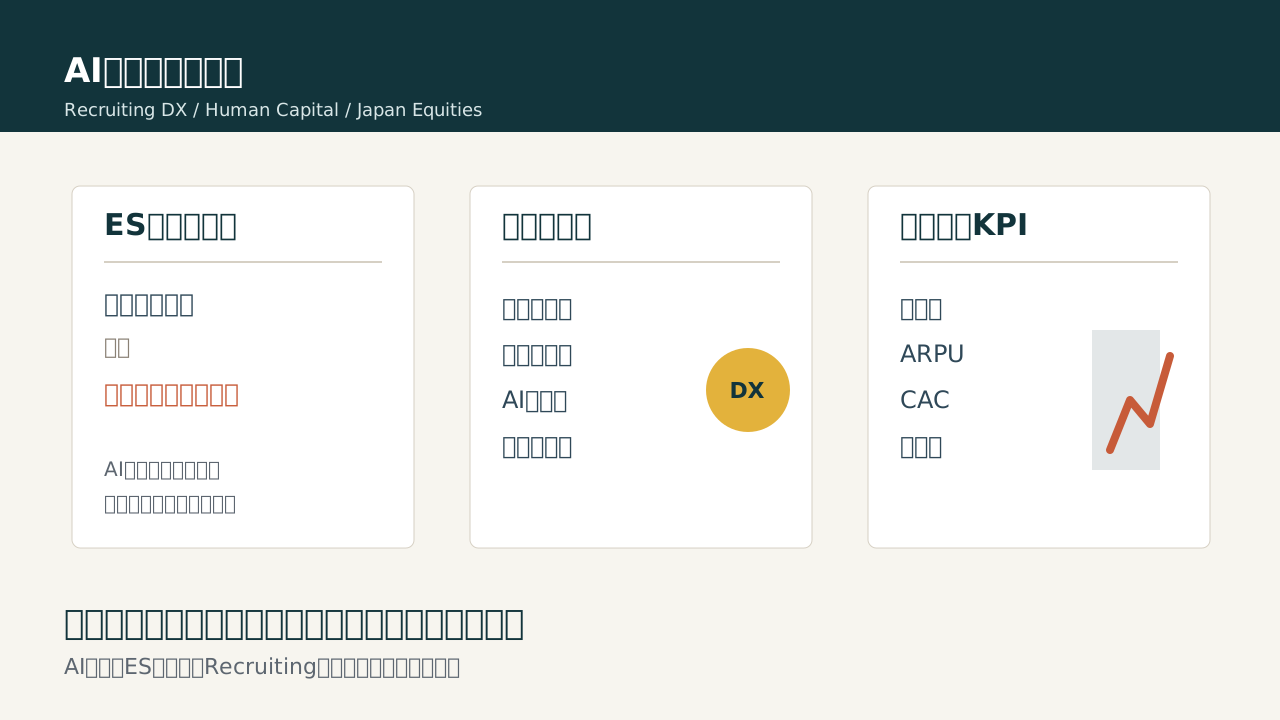
First, the conclusion
AI agents will not “eliminate” science-related recruitment, but will change what companies look for in science-based human resources.
Since AI supports everything from drafting an ES, verbalizing motivation for applying, researching companies, answering questions and answers for interviews, and even basic code generation, it is no longer possible to make a difference based on the student's output alone. Companies' concerns will shift from `can we produce beautiful results'' to `how can we use AI, what areas should we suspect, and which workplace constraints can we correct?''
What investors should be looking at is not whether AI will increase the number of applicants. The question is how far a recruitment platform can lower a company's evaluation costs and improve its closing rate, ARPU, CAC, and churn rate.
It's better to cool down a bit here. Even if a company announces AI interview support or AI recruiting functions, the stock price will not continue to rise just because of that. Human resources DX is likely to be viewed with high expectations, and in the end, evaluation will only be made after orders, profit margins, stock sales, and churn rates are confirmed.
What is happening in AI job hunting/AI recruitment?
The use of AI by job hunters is no longer a unique behavior.
According to Mynavi's 2026 Graduation Survey, the rate of AI usage in job hunting was 66.6%. According to Mynavi's 2027 Graduation Survey, 84.9% of students used AI in job hunting. Applications have also expanded to include ES revision, ES creation, interview preparation, self-analysis, and industry research.
According to Caritas Job Hunting's 2027 graduate student monitor, 84.3% of respondents said they "often use" or "have used AI" in their job hunting. Regarding specific usage situations, ES measures accounted for the highest rate at 75.9%, followed by self-analysis, company research, industry research, and interview preparation.
What we can see from this is that it is not simply a case of students ``cheating'' with AI. AI has become popular as a tool to reduce the workload of job hunting. From a student's perspective, using it to summarize corporate research, elaborate on ES, and answer questions during interviews is a natural way to improve efficiency.
On the other hand, companies have not yet caught up in their selection process. In Gakujo's 2026 graduate recruitment activity survey, 72.7% of respondents said they would not take any countermeasures if students used generated AI for ES. Among the selection policies implemented and considered on the assumption that the number of students who create ES using generative AI will increase, 33.3% of respondents said they ``placed more emphasis on interviews.''
In other words, change is still in a transitional period. Although students' use of AI has suddenly become the majority, companies are already at the stage where they are refocusing their evaluation designs to emphasize interviews.
What investors are actually concerned about is not that AI will increase the number of applicants. If the number of applications increases too much, the screening costs for companies will actually increase. Recruitment DX is truly valuable not when it inflates the population, but when it reduces the number of candidates to look at, improves the quality of interviews, and reduces rejections and mismatches.
Structural change
The structural changes occurring in science recruitment are not a uniform decrease in the number of hires, but rather a divergence in training models.
Companies that expand their hiring based on AI believe that AI can raise the initial productivity of new hires. AI will assist up to a certain level in creating code templates, organizing specifications, identifying test cases, and pre-processing data analysis. For these companies, it would be more rational to bring young people who can use AI into the field as soon as possible, rather than reduce the number of junior human resources.
Other companies are narrowing down the number of people they hire. Simple implementation and research can easily be replaced by AI, so rather than spending time on initial training, we carefully select students who are strong in upstream design and understanding customer issues. Here, rather than being a science major, we are looking at whether a research topic can be translated into business or product questions.
With membership-based recruitment, which is common in Japanese companies, there are cases in which the content of assignments and training is changed without significantly changing the overall number of hires. In addition to maintenance and operations, science personnel will be allocated to AI utilization, data infrastructure, security, business reform, and on-site improvements.
What all patterns have in common is that `people who can write code'' alone will not be able to differentiate themselves, and `people who can design what should be solved by AI'' will become more valuable.
ES is not neutralized, but its role changes
The value of ES will not be zero. However, we have reached a time when it is quite difficult to consider ES seriously as a final evaluation material.
When generative AI is introduced, the smoothness of sentences, the order of their structure, and the impression of words become homogenized. Particularly when recruiting for large companies, applicants use similar prompts, similar company research, and similar correction services. As a result, ES becomes more like a `list of hypotheses to be tested in an interview'' than `proof of writing ability.''
What companies should look at is not the text itself, but the resolution of the experience behind the text. What hypothesis did you use in your research? What did you change from the failed experiment? Which constraint did you give priority to when your team had a conflict? Beautiful sentences created by AI may not survive such deep digging.
There is also an opportunity here for recruitment AI tools. Merely detecting ES using AI is weak. Rather, it would be more valuable to connect the ES, research outline, interview log, aptitude test, and intern evaluation, and organize the points that the interviewer should dig into. What corporate recruiters want is not only the ability to determine whether the product is AI-generated or not, but also a supplementary tool that can improve the accuracy of the assessment within the limited interview time.
However, placing too much emphasis on AI interviews and automated evaluations may reduce students' motivation to take the exam. Mynavi's 2026 Graduation Survey found that while students are relatively accepting of companies using AI in selection evaluations when it comes to aptitude tests, they are more resistant when it comes to interview evaluations. When it comes to AI recruitment, companies that can balance not only efficiency but also candidate experience will become stronger.
Rather than arguing that science majors are unnecessary, we should improve the sophistication of AI human resources and scientific human resources.
Generative AI is good at searching, summarizing, combining known knowledge, and reproducing patterns. Of course, this ability alone can significantly replace some of the traditional junior roles. But what companies really want are people who can handle questions that don't yet have answers.
Science personnel who are most likely to be evaluated in this situation are those who can design experiments and verifications. In fields such as physics, chemistry, biotechnology, semiconductors, manufacturing, and energy, model proposals cannot always be used as is. After understanding equipment constraints, material variations, quality standards, safety standards, regulations, and yield rates, it is necessary to develop a procedure for hypothesis verification.
People who can design questions are also strong. The quality of the output changes greatly depending on what you ask the AI, what data you input, and what conditions you fix. This is not just a prompting technique, but is close to the ability to connect business issues and technical issues.
There is also likely to be a shortage of human resources who can audit output. There is a difference between having the code work and being able to operate it safely. Areas for human review will remain, including security, copyright, privacy, quality assurance, and accountability. In fact, the more widespread its use, the greater the burden of auditing and governance.
The last one is muddy domain knowledge. AI proposals will be in vain if you don't know the constraints of the field, such as manufacturing lines, research and development, medical care, construction, logistics, financial screening, etc. Human resources who can adjust AI in the language of the workplace are closer to profits for a company than human resources who can only use AI.
Beneficial area
When considering the benefits of recruitment DX, we want to separate job advertisements, human resources introduction, direct recruiting, engineer dispatch, and recruitment SaaS.
| Domain | Changes caused by AI agents | KPIs you want to see | Typical examples |
|---|---|---|---|
| Direct Recruiting | The quality of scouting is being questioned as candidate data and company requirements are compared in detail | Scout response rate, interview rate, contract rate, ARPU | Gakujo (2301), Recruit HD (6098) |
| High-class/specialist introduction | AI makes candidate search more efficient, but the final persuasion and requirements definition tend to be left unattended | Referral unit price, sales per consultant, contract rate | JAC Recruitment (2124) |
| IT/Web recruitment media | Focus on matching accuracy and reduction of selection burden on companies rather than application volume | Number of paying customers, success fee unit price, retention rate | Atrae (6194) |
| Young and educational human resources services | As selection measures advance with AI, the effectiveness of interviews, training, and retention support will be questioned | Number of employment decisions, training continuation rate, gross profit rate | Jake (7073) |
| Engineer dispatch/R&D outsourcing | While routine work will be affected by AI, there is room for advanced R&D and on-site staffing to increase unit prices | Operating rate, number of engineers, unit price, recruitment cost | Meitec GHD (9744) |
| HR Tech/Talent Management | Expanding scope for utilizing human resources data, including post-hiring placement, training, and even signs of turnover | ARR, churn rate, number of companies implementing the system, operating profit margin | Visional (4194), Plus Alpha Consulting (4071) |
| Around new graduate direct recruiting | AI makes student search and scouting more efficient, but it is difficult to evaluate unless the acceptance rate and hiring decision rate remain | Scout response rate, number of decisions, CAC, operating profit margin | i-plug (4177) |
Recruit HD is more of a platform for not only domestic recruitment but also global recruitment and matching. The company's revenue cannot be explained solely by recruiting new graduates from Japan; it is comprised of multiple businesses, including HR technology, job advertising, matching, and domestic and international human resources services. The KPIs seen here are not the introduction of AI itself, but the impact on advertising efficiency, matching accuracy, and operating profit margin. Due to the large scale of the company, it is difficult to say that ``we have added AI functionality'' alone will be a factor in the stock price.
Academic information is an area for new graduates and young people, and the issue is how to monetize the transition from a navigation type to a direct recruiting type. However, there is a strong impression that the market is looking at profit margins rather than sales. Even if you add AI functions, if selling, general and administrative expenses only increase, the evaluation will not continue. In this theme, improvements in scout response rate, contract efficiency, and operating profit margin come first rather than the word "AI."
For professional and managerial job introductions like JAC Recruitment, we look at the closing rate rather than the number of registrants. Even if the search for candidates can be made more efficient, the value of human intervention tends to remain in matters such as the company's temperature, the candidate's intention to change jobs, and compensation negotiations, which are not written in the job posting. While it is easy for the market to evaluate this structure of high unit prices and high gross profits, when the number of job openings decreases due to an economic recession, the contract rate declines first.
Visional is a stock that combines high-class recruitment and HR tech like HRMOS. This is a good company, and the market knows it. We can see not only BizReach's growth, but also HRMOS's ARR, churn rate, ARPU, and how to suppress losses in the incubation area.
I would like to see Plus Alpha Consulting in the context of talent management rather than recruitment itself. How do we allocate the people we hire, train them, and prevent them from leaving? There is a possibility that the second half of recruitment DX will come to this. However, as a SaaS stock, you can look at not only the growth rate, but also the operating profit margin and churn rate.
The themes surrounding direct recruiting for new graduates like i-plug are easy to understand. The problem is that as a small-scale growth company, it is easy to get ahead of expectations. Even if sales increase, if the CAC of student acquisition and business development remains heavy, the market will not be able to wait for much longer.
Engineer dispatch services like Meitec GHD run the risk that AI will reduce the value of simple design and coding assistance. However, demand for temporary staffing and contract work remains in the fields of manufacturers' R&D investment, semiconductors, mobility, industrial equipment, and AI implementation. It's all about occupancy rate and unit price here. If the number of engineers does not increase due to recruitment difficulties, sales will be difficult to increase even if there is demand.
Headwind area
Models that are likely to face headwinds are those that simply collect a large number of applications and pass them on to companies.
If ES is mass-produced using AI, even though the number of applications will increase, the cost of evaluation for companies will increase. It becomes difficult to explain the value of paid-for-posting navigation systems based solely on the function of creating a population. What companies want is not the volume of applications, but the priority of candidates to interview, the risk of rejection, and the likelihood of success after being assigned.
Another headwind is the dispatch of engineers for routine work. If AI speeds up the creation of specifications, unit tests, simple code corrections, and the creation of research materials, it is easy to reduce the number of man-hours required for low-cost work. If staffing companies can use AI to increase per-person productivity, it will lead to improved profit margins, but there is also the possibility that client companies will ask them to lower unit prices.
Recruitment SaaS is also not a panacea. Even if AI functionality is added, it will not take root unless personnel data is organized, evaluation items are standardized, interviewers' input habits, personal information management, audit logs, and bias countermeasures are taken care of. Even if initial adoption progresses, if the site does not use it, the churn rate will not decrease.
This theme tends to lead to high expectations. The words AI, recruitment, science personnel, and DX are easily picked up in the market, but the actual profit contribution is reflected in modest KPIs. Even with good news, if the utilization rate of AI functions and the contract closing rate do not change, the stock price reaction will be slow.
What's scary about the market from here on out is the pattern of people buying stocks just because of the headline about AI adoption, only to be disappointed with the subsequent financial results. Orders have increased, but SG&A expenses have also increased; ARR has increased but ARPU has fallen; and although the number of companies implementing the service has increased, the churn rate has not decreased. This kind of financial results have the slowest reaction among theme stocks.
Summary for investors: KPIs to watch in recruiting DX stocks
If you look at stocks related to AI recruitment, you can narrow down the indicators you want to keep. Contract rate, ARPU, CAC, SaaS ratio, AI function usage rate, churn rate. These six.
The first thing to look at is the response rate and interview rate, not the number of scouts sent. It would be easy to just increase the number of scouts using AI, but that would lead to candidate fatigue. Correctly match the candidate's research content, job orientation, work location, compensation conditions, and growth areas to see if the response rate is increasing.
Next, the closing rate and the cost per introduction. Even if the unit price of science, engineer, and AI personnel increases, if the contract rate decreases, it will not lead to profits. With referral-based services like JAC, you want to check sales per consultant and profit margin as a set.
ARPU is also important. Will the recruitment platform be able to make AI functionality a paid option, or will it lead to an increase in the unit price of existing plans? If you are simply adding features for free, it can easily seem like an upfront expense.
CAC, or customer acquisition cost, cannot be overlooked. If AI improves the efficiency of selecting sales leads, preparing business negotiations, creating proposals, and upselling to existing customers, sales expenses will be less likely to increase in proportion to sales growth. On the other hand, if you're just increasing advertising costs and sales personnel to sell AI functions, it looks like an expensive feature addition rather than recruitment DX.
I would also like to see the SaaS/stock revenue ratio. When the economy worsens, performance-based referral fees tend to fluctuate. If recurring charges such as platform usage fees, recruitment management, interview support, aptitude tests, and talent pool management grow, the outlook for profits will stabilize.
The final consideration is the usage rate and degree of adoption of AI functions. Do company human resources personnel and interviewers actually use candidate summaries, question drafts, interview memo organization, evaluation sheet creation, and rejection risk analysis? If this moves, it will have an effect on the churn rate, upsells, and operating profit margin.
Risk scenario
The biggest risk is that even if a company spends a budget on recruitment DX, recruitment results do not improve. Even if you introduce AI functions, if the evaluation criteria of interviewers vary, the accuracy of assessment will not improve. If personnel data remains dirty, AI recommendations will also become rough.
The deterioration of the candidate experience cannot be ignored either. If AI interviews and automated judgments are pushed too strongly, top-performing employees may feel that the company treats them poorly and leave the company. Recruitment DX will harm the recruitment brand if it does not balance the efficiency of the company with the satisfaction of candidates.
There are also regulatory and governance burdens. Since hiring involves life opportunities, the reasons for AI evaluation, bias, personal information, and accountability are likely to be questioned. The more the reasons for rejection are automated using AI, the higher the audit costs and risk of controversy.
For companies expanding overseas, AI regulations also become a cost. The EU's AI Act adopts a risk-based regulatory system, and AI in the recruitment and employment field is likely to be burdened with accountability, human oversight, record management, and bias management. This is a supporting point in articles focusing on Japanese stocks, but it is difficult to ignore for HR tech companies with overseas customers.
In the stock market, thematicization itself becomes a risk. If you are initially bought just because of the word AI adoption, you will be disappointed when the contract rate and profit margin cannot keep up with the quarterly results. Situations where the stock price does not grow even though the numbers are not bad occur in this theme as well.
Summary
AI agents will not simply reduce recruitment of science majors. Rather, it is pushing the abilities required of science personnel from task execution to question design, verification, auditing, and domain implementation.
Rather than ending ES, its role will change. Sentences prepared by AI can serve as an entry point for digging deeper into interviews. Rather than looking at whether or not AI was used, companies will now look at what the student thought about using AI and where he or she applied his or her own judgment.
The essence for investors is to distinguish whether a recruiting DX company is one that increases the number of applicants or one that lowers the cost of identifying companies. From here, the difference will be more in the contract rate, unit price, ARPU, CAC, stock ratio, and degree of adoption of the AI function than the signboard of AI.
Related pages
- Recruit Holdings (6098)
- JAC Recruitment (2124)
- Securities (2301)
- Atrae (6194)
- Jake (7073)
- Meitec Group Holdings (9744)
- Visional (4194)
- Plus Alpha Consulting (4071)
- i-plug(4177)
source
- Mynavi Career Research Lab “[2026 Graduates Career Intention Survey April <AI Use in Job Hunting>] (https://career-research.mynavi.jp/research/20250526_96625/)” (Published on May 26, 2025, confirmed on July 5, 2026)
- Mynavi Career Research Lab “[2027 Graduates Career Intention Survey April <About the use of AI for job hunters>] (https://career-research.mynavi.jp/research/20260526_110798/)” (Publication date: May 26, 2026, confirmed July 5, 2026)
- Caritas Co., Ltd. “[Survey of employment awareness of 27 graduating students as of January 1st] (https://www.career-tasu.co.jp/press_release/12138/)” (Publication date: January 16, 2026, confirmed July 5, 2026)
- Gakujo “[Interim summary of students scheduled to graduate in March 2026/employment front] (https://service.gakujo.ne.jp/jinji-library/report/26sokatsu-report/)” (confirmed on July 5, 2026)
- Visional “Summary of financial results for the third quarter of the fiscal year ending July 2026 [Japanese GAAP] (consolidated)”, disclosure date: June 11, 2026
- Plus Alpha Consulting “Summary of Financial Results for the Second Quarter (Interim Period) of the Fiscal Year Ending September 2026 [Japanese Standards] (Consolidated)”, Disclosure date: May 13, 2026
- i-plug “Summary of Financial Results for the Fiscal Year Ending March 2026 [Japanese Standards] (Consolidated)”, Disclosure date: May 14, 2026
- Technopro Holdings “IR Information” (confirmed July 5, 2026)
- European Commission “AI Act” (verified July 5, 2026)
- European Commission “Guidelines for providers and deployers of AI high-risk systems” (verified July 5, 2026)
Note: TechnoPro Holdings has a stock code of 6028 and is listed as delisted on December 9, 2025 in the official IR. Although it is useful as a comparative company for dispatching engineers, it has been excluded from the representative examples in the main text as a listed Japanese stock as of July 5, 2026.