
First, the conclusion
Japanese tea's GI registration is not the type of material that will cause stock prices to jump on the same day. Rather, it would be more natural to see this as news that the legal foundation for protecting brands will become even stronger, making it easier to export and create high value-added products.
Honestly, my feeling here is that it's a good story, but it won't bring immediate profits. Rather than the name of the system, the market is looking at whether there will be changes in product unit price, overseas sales, promotional efficiency, and mail-order customer unit price.
Still, it has meaning. For the first time, Japanese tea was produced in Japan and became a national GI. This will make it a little easier to price tea leaves and beverages, and will help prevent counterfeit products and strengthen explanations overseas. It's not a quick fix for sales, but it can help extend the lifespan of a brand.
what is happening
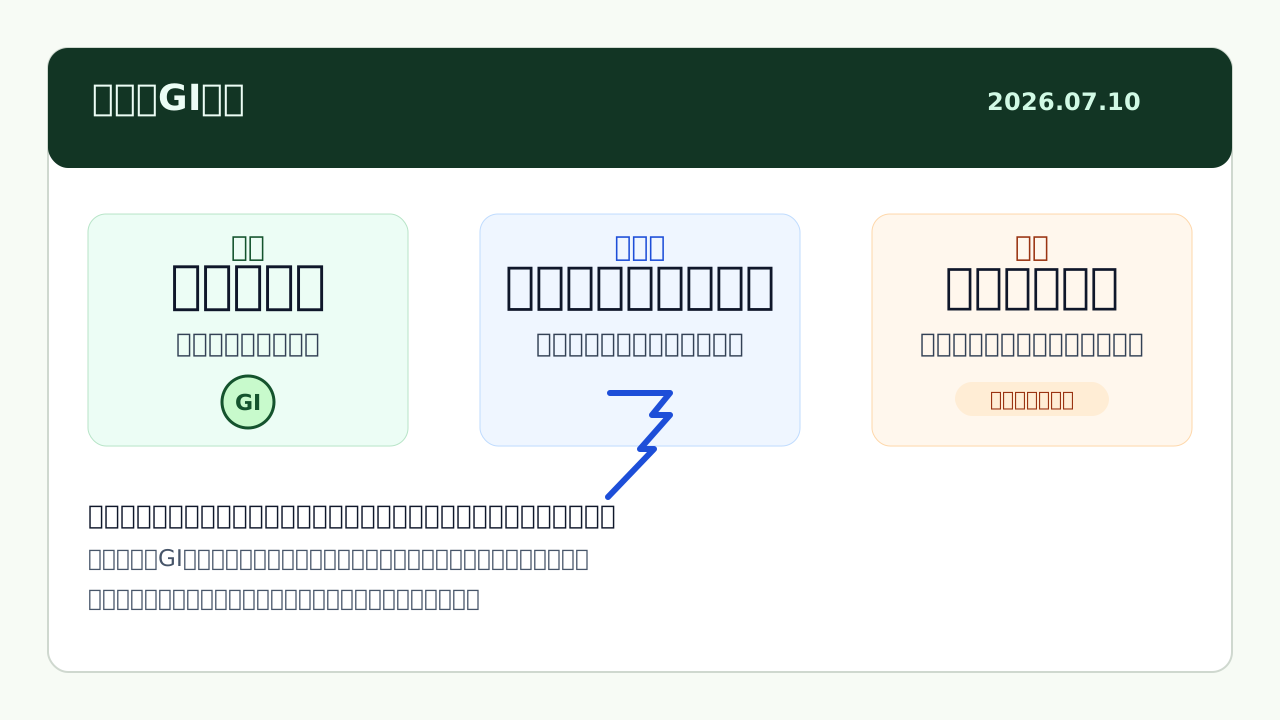
On July 10, 2026, the Ministry of Agriculture, Forestry and Fisheries newly registered GI for "Japanese tea," "Lake Hamana eel," and "Kaga lotus root." With this registration, the number of GI registered products in Japan has increased to 170.
The gist of the system is simple. Protect names that have been developed under the natural conditions and cultural background of the region as intellectual property. Registered products can use the GI mark, which is a stronger proof of authenticity than simply indicating the country of origin.
The interesting thing about Japanese tea is that the registered production area is Japan. The idea is to go beyond protecting the regional name and create an international brand for the genre of Japanese tea itself. This is a good match for a system designed with overseas demand for matcha and green tea in mind.
structural change
What investors should be looking at is not whether GI will directly increase sales. It works more modestly and more slowly. The main goal is to gradually change the presentation of packaging, business negotiations, exports, cross-border e-commerce, wholesale explanatory materials, and the brand website, thereby increasing unit prices and gross profit margins.
Japanese tea brands are often thought to be strong enough in Japan, but overseas it is still easy to confuse the brands `Japan Tea,'' Japanese green tea,'' and `Matcha.'' The inclusion of GI will make it easier to explain to business partners and retailers who want to avoid counterfeit products. This is where practical improvement is more effective than advertising copy.
That's why the stock market treats this story more as a medium-term pricing strategy than as a short-term theme. The quality of the system alone is not enough. It's only when you get into product design and sales that you start talking about profits.
Beneficiary area
| Brand name | form of benefit | Points to see | market temperature |
|---|---|---|---|
| 伊藤園(2593) | Right in the middle of Japanese tea. Brand protection and overseas promotion are the most straightforward | Overseas sales ratio, unit price of tea beverages, operating profit margin | Although this is a direct benefit, brand expectations are already high. |
| サントリー食品(2587) | Tailwind for green tea beverage brand promotion | Penetration of volume, promotional expenses, and price revisions in the green tea category | It's not a big deal for the company as a whole, but it can be used as a marketing material. |
| コカ・コーラBJH(2579) | Improving explanation power for green tea categories such as “Ayataka” | Green tea sales volume, vending machine/mass sales mix, and price support | There is a direct benefit, but it is not the main cause of profit improvement. |
| ティーライフ(3172) | Easy to get into the premium context with mail order health tea | Regular purchase rate, average price per customer, advertising efficiency | Niche, but the theme is relatively clean |
| しずおかFG(5831) | Regional economic associations in Shizuoka | Local tourism, food and beverage, and distribution funding needs | I can make an association, but it's a long way from profit. |
Itoen is the easiest to understand. Since the main focus is on Japanese tea itself, the words of GI are used directly in the product description. It can be used for both brand defense and attack.
Suntory Foods and Coca-Cola BJH are in the beverage industry rather than the tea industry. Therefore, GI is not directly profitable. However, the explanatory power of the category will improve, making it a little easier to promote premium green tea.
Tea Life is a small product, but with mail order, it is important to have a reason to buy a ``slightly better tea'', so it is easier to differentiate the brand. On the other hand, because we are not a company that competes solely on price, a context like GI's is a good fit.
Shizuoka FG is easily mentioned because of the local association of Lake Hamana eel. However, as a bank stock, we are only looking at whether the regional economy will expand. I'm not talking about a jump in lending or profits from GI alone.
headwind area
First, system news rarely translates into business results. The market is looking at `numbers'' rather than `good news.'' Even if GI becomes a hot topic, stock prices will not continue unless commercialization and export practices take action.
Second, major beverage companies have higher raw material, logistics, and promotional costs than GI. Even if the green tea category is strong, profits can easily be cut if there are delays in raw material procurement or price revisions. GI may be a tailwind, but if you forget the cost, the story becomes lighter.
Also, the association with regional finance is quite indirect. Even if the brand value of Lake Hamana eel and Kaga lotus root increases, this does not immediately translate into loan balances or fee income. The market is looking at it calmly.
KPIs that investors should look at
ITO EN's main focus is on overseas sales ratio, unit price of tea beverages, cost of raw tea leaves, and operating profit margin. If GI is truly effective, there should be a change in the growth of overseas and high value-added products.
Suntory Foods and Coca-Cola BJH will look at volume in the green tea category, retention after price revisions, and efficiency of promotional expenses. This is the stage where we look not only at whether the product sells, but also how much profit remains.
The highlights of Tea Life are its subscription rate and advertising efficiency. Even if there is a benefit from GI, it is meaningless in mail order unless the average customer spend and retention rate drop.
What should be looked at in common is whether GI's logo and expressions are included in actual products, overseas business negotiations, packaging, and EC explanations. If you don't get involved in the field just because of the system, your theme will have a short lifespan.
risk scenario
The most common mistake is that the theme gets popular first, and the products and numbers don't follow. Japanese tea GI is a strong headliner, but sales and product development are needed to turn it into a profit.
The other is a case where branding overseas does not progress as expected and GI ends up in the domestic news. Even if the word "Japanese tea" is well-known, it will take time for the price to become premium.
It is also best not to overextend associations with regional brands. Lake Hamana eel and Kaga lotus root are easy to understand as materials for regional revitalization, but they are not directly linked to the profits of listed stocks. If you short-circuit here, you will misjudge the theme stocks.
summary
Although this GI registration is news about agricultural policy, in the stock market it is primarily read as news about brand design. It's not something that will increase sales today, but it will gradually strengthen our pricing and defense lines.
In order of direct benefits, Ito En is the most straightforward, followed by major beverage companies, and third is mail-order tea. Regional finance like Shizuoka FG may be an association, but only indirectly.
The market doesn't follow this kind of theme quickly. However, if product packaging, overseas business negotiations, unit prices, and sales promotion efficiency are affected, it will gradually become more effective. It's worth looking into it.
Related pages
- 伊藤園(2593)銘柄分析
- サントリー食品インターナショナル(2587)銘柄分析
- コカ・コーラ ボトラーズジャパンホールディングス(2579)銘柄分析
- ティーライフ(3172)銘柄分析
- しずおかフィナンシャルグループ(5831)銘柄分析
source
- Ministry of Agriculture, Forestry and Fisheries “Register three products including Japanese tea as geographical indications (GI)” (July 10, 2026)
- Ministry of Agriculture, Forestry and Fisheries “List of registered products” Geographical indication (GI) protection system (confirmed on July 10, 2026)