
Progress has been made in the listing process, not in corporate value.
With CSRC confirming SHEIN's overseas listing filing on July 10, the long-suspended Hong Kong IPO has finally moved to the next stage. Anxiety over the continued suspension of procedures on the Chinese side has subsided. So far, it's positive material.
However, it is too early to predict that the IPO will be a success based on this news alone.
Institutional investors who participate in IPOs are starting to look at the question, not `Can a company be listed?'' but `At what profit level and at what price can this company be valued?'' Compared to the days when you could rely on de minimis tax exemption, the prerequisites have changed considerably. Tariffs, logistics costs, advertising costs, regulatory compliance. Will the company still be able to achieve both growth and cash generation amidst the sudden increase in factors that reduce profit margins? The success or failure of an IPO is increasingly determined by this.
Please note that the CSRC notification does not constitute listing approval by the Hong Kong Exchange. The IPO price and date have not been determined. If the listing cannot be completed within 12 months from the notification date, the filing materials will need to be updated.
Listing plans moved to the US, London, and Hong Kong
SHEIN was reported to have filed for a private listing in the United States in 2023, but faced growing political headwinds over its supply chain, human rights, data, and regulatory compliance as a Chinese company. After that, the focus shifted to London and then to Hong Kong.
Simplifying this transition to ``he fled to Hong Kong after being rejected by the United States and Britain'' misses the point of the capital market. The reality is that we have been searching for a location that can simultaneously satisfy the disclosure requirements of each listing location, overseas listing management on the Chinese side, the Chinese supply chain that supports most of our business, and the political and regulatory risks in Europe and the US.
The choice of Hong Kong was not unnatural in itself. This was a realistic option considering its compatibility with China's system and distance from the supply chain.
However, institutional investors are more concerned about the impact on profit margins than the listing location itself. As long as a company generates sales overseas, listing in Hong Kong does not mean that regulations in the US and Europe will be relaxed. In the end, what determines a company's value is not where it is listed, but how much money it can make in a changed business environment.
What we learned and what we didn't know about the July 10th CSRC document
The facts that can be confirmed from the CSRC notification are clear.
| Things to check | Content |
|---|---|
| issuer | SHEIN Global Holdings Limited |
| Listed place | Hong Kong United Trading Post |
| Issuance limit | 341,613,000 shares of overseas listed common stock |
| notification date | July 10, 2026 |
| deadline | Within 12 months from the date of notification. If you wish to continue without completion, please update the materials. |
| After listing | Report to CSRC management system within 15 business days of completion |
The important issue price, offering ratio, procurement amount, market capitalization, and listing date are not yet known. The market is reporting an IPO scheduled for September to October, with a valuation of $40 billion to $50 billion, but the terms are not set by the company or exchange.
The upper limit on the number of issued shares alone cannot predict dilution or the use of funds. If the focus is on new stocks, it is easy to explain it as a growth investment. The impression will change if the sale is strong. IPO participants are wary of deals in which no funds enter the company and only existing shareholders cash out.
The difficult thing about an IPO is that the price desired by the company, existing shareholders, and new investors are difficult to match. The company wants to bring the valuation closer to the past valuation. Existing shareholders have waited so long and want to sell as high as possible. Since new investors cannot see the profits after tariffs, it is difficult for new investors to enter the market unless it is cheap. There is this tug-of-war behind the $40 billion to $50 billion range.
If the terms are set in the low $40 billion range, it may be easier to attract investor demand. On the other hand, given the $100 billion expectations talked about in the private market, it's a pretty bittersweet ending for existing shareholders.
However, just because it's less than half the price from its peak, it doesn't mean it's cheap. Whether $40 billion is high or low cannot be determined just by looking at the valuation. Even if a company appears to be a growing company based on its sales ratio, it is a different story if the sales ratio is high. In the case of SHEIN, I would first look at operating income rather than sales, and free cash flow rather than operating income. The numbers after the system change are still insufficient to give a high multiple based solely on the growth rate at the time of IPO.
HKEX examinations focus not only on financial figures but also on disclosure of control structure, related party transactions, supply chain management, and regulatory risks. Just because a company has passed the CSRC does not mean that the issue of listing examination has disappeared. It's better to look at this separately.
In the first place, what profit should you buy at what multiple?
The core of SHEIN is not just finding trends quickly. The system is such that each SKU is first introduced in small lots of 100 to 200 items, and additional products that are in demand are produced based on customer response. Compared to traditional apparel that is mass-produced and distributed to stores, this design makes it easier to reduce unsold items and discount disposal.
It's not difficult to start with 100-200 points. The difficult thing is to monitor reactions from tens of thousands of SKUs, produce additional products in a short period of time that will sell, and still keep logistics costs and returns down. Just explaining that the first lot is small only tells the half of the story.
This model becomes stronger as it connects product planning, in-app demand understanding, ordering with suppliers, and logistics in a short cycle. Even if small-lot tests fail, losses are limited and funds and production capacity are focused on successful products. In addition to low prices, inventory turnover and demand forecasting are the sources of competitiveness.
Institutional investors participating in IPOs are not concerned about the smallness of the initial lot itself. The question is whether this system is really reflected in inventory days, discount rates, return rates, and operating cash flow. The stories of `nearly zero excess inventory'' and `automatic ordering using AI'' are appealing, but they cannot be verified unless the numbers are visible in the prospectus. If small batch production is really good, it comes down to working capital and cash.
The tax-free model has already changed
The biggest change is that the premise that small-value imported goods can be shipped directly to consumers duty-free has collapsed.
Effective May 2, 2025, the United States has suspended de minimis tax exemption for eligible shipments of $800 or less originating from China and Hong Kong. In the same year, the suspension was expanded to cover the entire world. Therefore, in the United States, we are not yet at the stage where tax exemptions may be abolished in the future. After the system change, it is now time to see how SHEIN can raise prices, reorganize its distribution network, local inventory, and product mix to protect its gross profit.
In the EU, from July 1, 2026, a provisional tariff of 3 euros will be imposed on small shipments of less than 150 euros. Taxation is not levied on a per-package basis, but on different product categories in the customs classification. Under the permanent system, which is envisaged for 2028, the 150 euro tax exemption standard will be abolished and replaced with regular customs duties.
The lower the unit price of a product, the heavier the fixed burden of a few euros will be relative to the product price. If SHEIN bears the burden, the gross profit margin will fall, and if it is passed on to consumers, the price difference will narrow. It is possible to combine multiple products, store inventory in a local warehouse, or increase the number of higher-priced products. However, in any case, the capital efficiency will be different from the conventional small-lot direct shipment model from China.
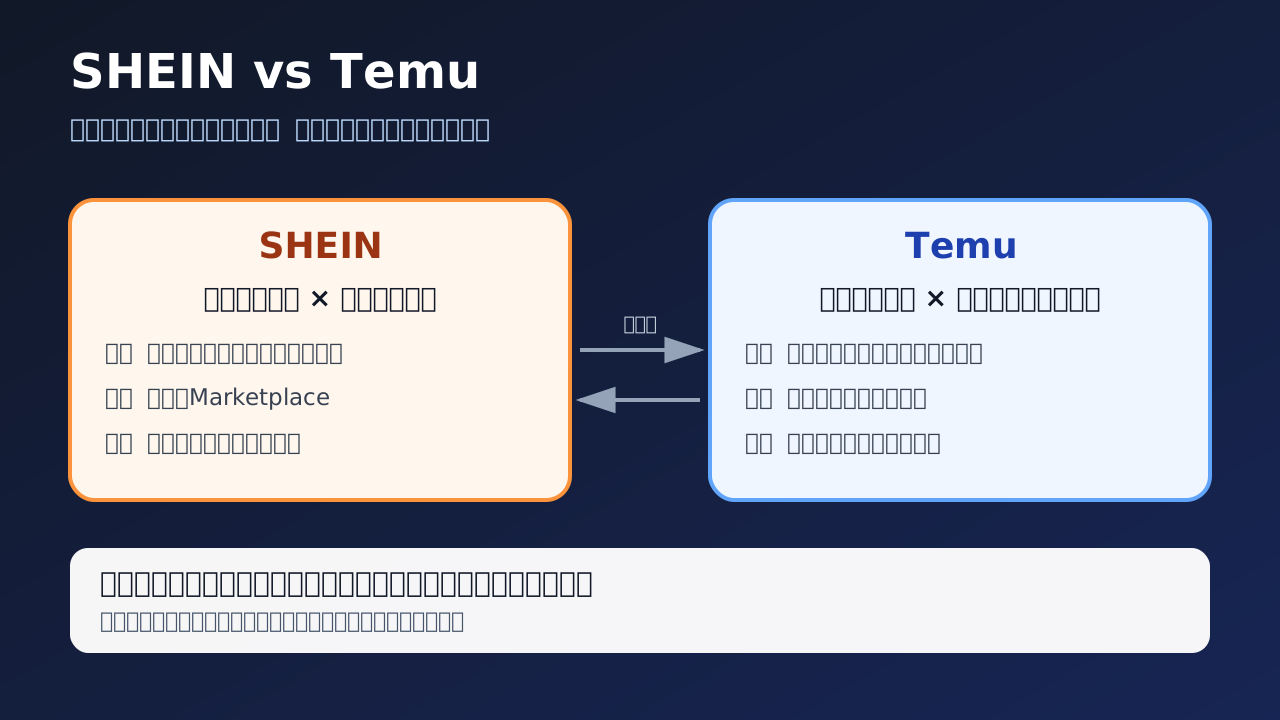
Competition with Temu cannot be measured solely by advertising costs.
Temu is not limited to clothing, but also offers a wide range of products including daily necessities and miscellaneous goods. Although SHEIN has strengths in fashion discoverability, product introduction speed, and supplier network, it is difficult to avoid a situation where both companies compete for the same consumers' disposable time and app usage.
The number of app downloads is impressive, but not the number that growth investors want. Even if you increase the number of new users with advertising expenses, if the frequency of purchases, average order value, and repeat rate do not increase, and only returns increase, there will be no profit left.
The problem with competing with Temu is that it can increase the cost of obtaining demand data. Even if the amount of data increases and prediction accuracy improves, if you are bringing in those customers with high advertising costs, the advantage of small-lot production will be eaten up by promotional costs.
On the other hand, if SHEIN can maintain a high repeat rate in the fashion area and reduce its reliance on advertising, it will be able to differentiate itself from comprehensive marketplaces. To what extent will customer acquisition costs and existing customer sales ratios by region be disclosed in the prospectus? This is quite important.
European regulations are not just about customs clearance
In February 2026, the European Commission launched a formal investigation into SHEIN under the Digital Services Act (DSA). Issues include curbing the sale of illegal products, transparency in recommendation systems, design that can increase dependence, and data access for researchers.
This is not just a matter of fines. Fixed costs will increase if you strengthen product screening, personnel, monitoring systems, seller management, recommendation explanations, and audit logs. If restrictions are placed on the design that encourages app usage, conversion rates and purchase frequency may drop. The difficulty with SHEIN is that customs clearance costs and platform regulations are increasing at the same time.
Not enough numbers to be bullish
CSRC notification confirmation is, of course, a plus. Concerns about plans continuing to stall on the Chinese side have subsided, and existing shareholders have finally had an opportunity to cash in. However, this is not an upward revision to our performance.
What new investors still have doubts about is the rate of return and the transparency of the audited figures after the system changes. Even though IPO valuations are significantly lower than past private equity valuations, the difference is not just pessimism. It's more natural to see it as a discount on tariffs, geopolitics, governance, and commodity management.
Setting prices is also difficult. Even if a good prospectus is released, if the valuation is pushed up to nearly $50 billion, there is likely to be less room for an initial price. While it would be easier to attract demand if the price was kept to the low $40 billion range, it would be difficult to meet the expectations of existing shareholders. There is a difference between completing an IPO and being continuously bought after listing.
At this stage, we don't have enough numbers to be bullish. CSRC filing confirmation is a procedural step forward, but it will not improve gross profit margin or operating cash flow. It is necessary to separate the fact that the IPO story has moved and the fact that it has become more attractive as an investment target.
What makes us bullish is that the prospectus will be released within 2026, and it can be confirmed that the gross profit margin and operating cash flow will remain unchanged even after the system change. If the frequency of purchases by existing customers increases while suppressing the growth in advertising costs, and the effects of small-lot production are reflected in inventory turnover and discount rates, it will be difficult to see SHEIN as just a low-cost app.
The biggest risk is still the profit margin. Even if the HKEX review goes well, if customs duties and local logistics costs cannot be passed on to the price, the profit level expected by IPO participants will not be achieved. Competition with Temu has increased advertising investment, adding to the fixed costs of DSA support and supplier audits. Even if sales are increasing, if there is no cash left over, the evaluation will shift from a `high growth platform'' to a `low margin retail business with regulatory costs.''
A schedule delay is an obvious risk, but to be honest, it's not a fatal injury if it's just that. It is much more important to be able to demonstrate a level of profit that can be used for many years than to go public a few months early.
Once the prospectus is released, sales can be postponed.
I believe that once the prospectus is released, sales can be postponed. The first thing to look at is gross profit margin and operating cash flow. Sales growth can also be achieved through advertising expenses. If you can maintain profits and cash even after customs duties and logistics costs increase, you can confirm the advantages of the small-lot production model in numbers.
Next, consider the number of days in stock, discount rate, and return rate. If you line up these three things, you can get some idea of whether on-demand production is actually working. Even if the number of days in stock is short, there may be cases where the return rate is high or inventory is disposed of at a discount, so a single number is not enough.
When looking at advertising efficiency, you want to look at not only customer acquisition costs, but also existing customer sales ratio, purchase frequency, and average order amount. If your existing customer ratio is high, it shows that you are not dependent on advertising. If the gross profit margin is falling, it should be assumed that either the tariff burden or price reductions are working.
Finally, there are the issuance conditions. The impression of an IPO will change depending on whether the focus is on raising funds for growth through new shares or whether there is a strong sale of existing shareholders. If a large-scale secondary offering comes to the fore, investors may perceive it as `a long-awaited exit for shareholders'' rather than `procurement of growth capital.''
summary
This CSRC notification confirmation is certainly a positive sign in the sense that the IPO process has started moving again. However, new investors do not believe that this alone will restore corporate value.
What investors want to buy is not the name recognition of "SHEIN," but a business model that can accumulate profits even after the system changes. Will small-lot production starting from 100 to 200 items be able to protect gross profit and cash by overcoming the burden of customs duties, logistics, advertising, and regulatory compliance?
With confirmation from CSRC, the door to listing has opened. However, what new investors are buying is not procedural progress.
Gross profit after paying customs duties. Existing customers after stopping advertising. Cash after continued investment. These three things determine the price of SHEIN.
source
- 中国証券監督管理委員会「关于SHEIN Global Holdings Limited(希音国际控股有限公司)境外发行上市备案通知书」(2026年7月10日)
- SHEIN Group「Center of Innovation for Garment Manufacturing Achieves Zero Waste to Landfill Certification」
- 米ホワイトハウス「President Donald J. Trump Closes De Minimis Exemptions」(2025年4月2日)
- 米ホワイトハウス「Suspending Duty-Free De Minimis Treatment for All Countries」(2025年7月30日)
- 欧州連合理事会「EU action on the influx of small parcels」(2026年7月1日更新)
- 欧州委員会「Commission launches investigation into Shein under the Digital Services Act」(2026年2月17日)