Regulation first changed the rules of the game.
Until recently, the competition between SHEIN and Temu was often focused on app downloads, GMV, and advertising volume. Which one can gather customers faster and send cheaper products to the world? It's an easy-to-understand competition for growth.
However, in the United States, the de minimis duty exemption for small-value commercial cargo has stopped, and in the EU, provisional tariffs on small-value cargo will begin from July 2026. It is not enough to create price differences through direct cross-border shipping. Will they have local warehouses, who will be responsible for the inventory, and will they be able to pass on customs duties to prices? Profitability design has come to the fore rather than growth rate.
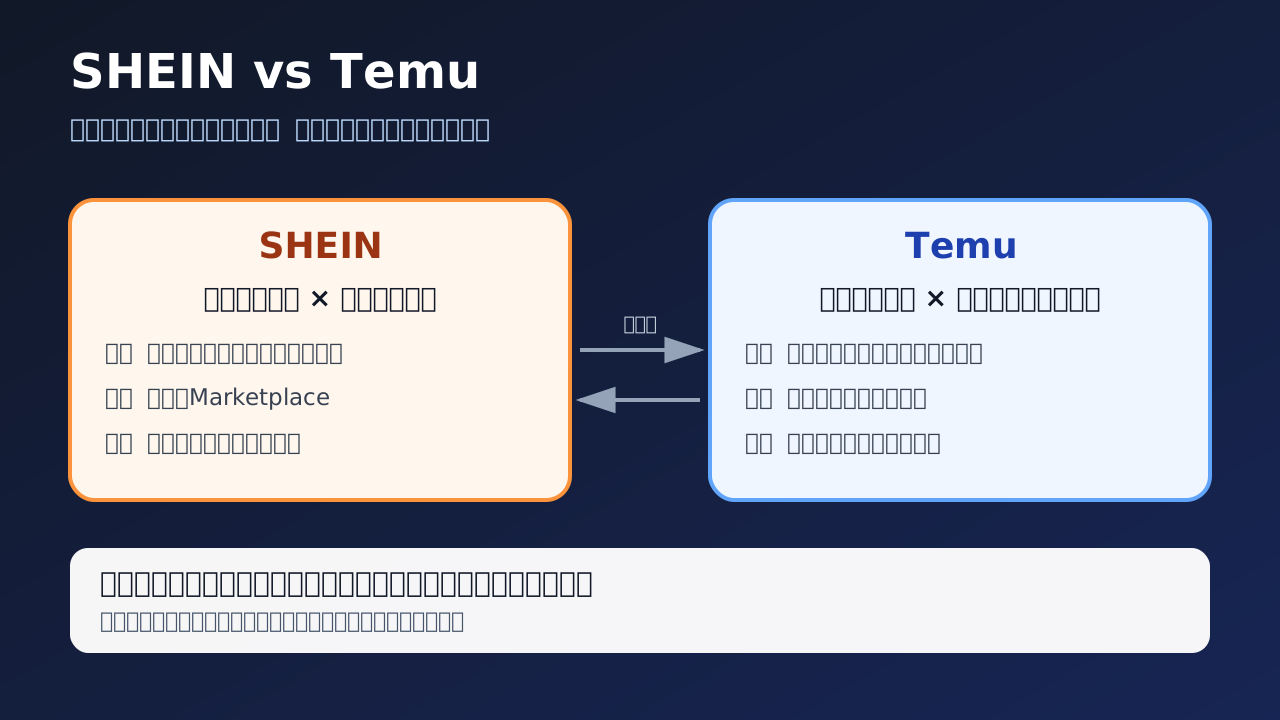
This is where the difference between SHEIN and Temu comes into play. SHEIN began by reading fashion demand and producing its own brand products in small batches. Temu brings together sellers, manufacturers, and brands and puts their product selection and price competition on the app. A company that compiles products and supply networks, or a company that designs trading markets. That's the starting point.
However, boundaries are crumbling. SHEIN will expand its Marketplace and Temu will go deeper into promotional, seller support and fulfillment solutions. My current location is approaching a similar location from the opposite direction.
The difference is where are you holding it?
| point of issue | SHEIN | Temu |
|---|---|---|
| starting point | Fashion EC centered on own brands | A comprehensive marketplace that brings together many sellers |
| Supply chain control points | Demand understanding, small lot orders, additional production | Seller acquisition, product assortment, price competition, sales promotion, fulfillment support |
| Expansion direction | More products and sellers on Marketplace | Improve delivery and regulatory compliance with local sellers and local fulfillment |
| financial transparency | Private company. Waiting for Hong Kong IPO prospectus | PDD consolidated disclosure. Temu's non-consolidated sales and profits are not disclosed. |
Consumer attributes and customer spending vary considerably depending on region, time, and category. Although it is easy to understand that SHEIN is a young woman and Temu is a wide age group, it is dangerous to set average customer spend such as $45 to $75 or $25 to $40 as a company-wide fixed value. Unless it's the same country, same time period, or the same order definition, it doesn't make much sense to put the numbers side by side.
Meaning of starting from 100 to 200 points
SHEIN's on-demand method starts with small lots of 100 to 200 items for each SKU, and additional production is made based on customer response. Advantage is not about disappearing inventory. The advantage is that it is possible to focus production capacity on successful products while reducing the initial input and limiting losses from unsuccessful products.
In this system, inventory efficiency increases as demand signals such as views, cart additions, purchases, and returns on the app can be returned quickly to product planning and supplier ordering. Apparel sales involve size, color, seasonality, and returns, so you can't predict just sales volume. SHEIN's real technology is not just the signboard of AI, but the fact that it combines demand data and factory operations into one short cycle.
The claims that `inventory risk is almost zero'' and `gross profit margin is approximately 45%'' are attractive, but they cannot be confirmed by publicly available audited materials. Even in small lots, unsold items, returns, air logistics, and discounts occur. When the Hong Kong IPO prospectus comes out, I would like to see not only the gross profit rate, but also the number of inventory days, valuation losses, return rate, and working capital.
Another change is Marketplace. In 2023, SHEIN announced an integrated marketplace that will accept SHEIN-branded products, as well as merchants and third-party sellers from each country. While there is more room for product selection and commission income, it faces similar challenges to Temu in terms of product safety and seller management. The closer you get from the brand company to the platform, the more things you have to manage.
Temu is heavier than “renting a place”
Temu's foundation is a marketplace that brings together a large number of sellers and manufacturers into one app. It doesn't focus on apparel, but sells everything from miscellaneous goods to home appliances. By making sellers compete with each other, we lower prices and give more exposure to the best sellers. The quality of this market design is quite different from SHEIN.
Temu's seller page not only lists products, but also provides information on promotional opportunities, seller support, integrated logistics solutions, and returns and disputes. It also states that Temu itself does not directly provide logistics. The division of responsibility varies depending on the country and management method. It's not a monolith like Amazon, nor is it a light market with only advertisements.
Local sales and fulfillment, rather than relying solely on small-lot direct shipments from China, reduces delivery times and customs risks. The trade-off is increased costs for local warehousing, inventory placement, and seller screening. Temu is progressing from a lightweight marketplace to a heavier distribution infrastructure.
PDD's financial strength is strong, but Temu's profitability on a standalone basis is unclear.
In the January-March 2026 period, PDD Holdings had sales of 106.2 billion yuan, operating profit of 19.6 billion yuan, and operating cash flow of 16.4 billion yuan. At the end of the period, cash, cash equivalents and short-term investments amounted to 436.1 billion yuan. The parent company's financial strength is a great support for Temu to continue making long-term investments.
Operating cash flow of 16.4 billion yuan is not weak. Still, considering the strong liquidity of 436.1 billion yuan, being able to invest in Temu and Temu's high investment efficiency are two different things. Simply saying that a company can sustain deficits for a long time because it has the funds does not explain shareholder value.
What you cannot see here is the profitability of Temu alone. PDD shows consolidated results including Pinduoduo and Temu, but does not separate Temu's sales, GMV, operating profit, and promotional expenses. Sales and marketing expenses for the January-March period of 2026 were 33.8 billion yuan. It has not been made public how much money was spent by each business.
Transaction service revenue increased by 20% year-on-year to 56.3 billion yuan, and cost of sales increased by 15%. If you just look at the numbers, leverage is working. However, once Temu's local fulfillment gets into full swing, warehousing, returns, payments, and seller management will become a burden. It will be interesting to see if this relationship breaks down.
Rather, it is Temu that is troubling as an investment target. Since SHEIN is unlisted, it only needs to wait for its prospectus, but PDD is a listed company that is already making profits. In that consolidated profit, it is difficult to see how much Temu earns and how much it consumes. It's a void that's hard for PDD shareholders to ignore.
The true cost after de minimis ends
Starting August 29, 2025, de minimis duty exemption for small-value commercial shipments will be suspended worldwide in the United States. In the EU, from July 1, 2026, a provisional tariff of 3 euros will be applied to small shipments of less than 150 euros for each category of goods in the customs classification.
Fixed customs clearance burdens are heavier the lower the product unit price. For Temu, which handles a wide range of miscellaneous goods at low unit prices, this is a rather unpleasant cost. SHEIN is not unscathed as it sells low-priced products across borders. Gross profit per order, bundling rate, average order value, return rate, local inventory ratio. This is where the difference comes out.
This is where product management comes into play. SHEIN has its own brand and a close apparel supply network, making it easier to match specifications than in the market where there are countless third-party products. However, the more you expand the Marketplace, the more things you can manage. In February 2026, the European Commission began a DSA investigation into SHEIN regarding the prevention of sales of illegal products.
Temu has even tougher materials. In May 2026, the European Commission imposed a fine of €200 million for failing to properly assess the systemic risks of illegal products. Pursuing only individual defective products will not reach the essence. Can seller verification, testing, deletion, relisting prevention, and traceability be implemented on a large scale? It all comes down to the ability to control the seller.
Lighter examinations will increase regulatory risk, while heavier examinations will increase costs. With the addition of customs duties, local inventory, and product safety, the profits and losses of low-price e-commerce have definitely become heavier than before.
Temu has a wide range of categories. Fixed costs can be easily diluted if multiple products can be combined into one order. SHEIN's focus is on increasing the average order amount through coordinated purchasing and brand nomination. Although adding more local sellers and warehouses will ease customs and shipping problems, it will also put a strain on inventory turnover and capital efficiency.
It's too early to decide that ``Temu, who has a small profit, will be fatally injured and SHEIN will survive.'' The profit margin of Temu alone and the profit margin of SHEIN after the system change are not yet known.
Why growth stocks are still difficult for investors to evaluate
SHEIN has a turning point in its disclosure with the Hong Kong IPO. If we can maintain the designation of fashion, expand our lineup of beauty and household goods on Marketplace, and demonstrate the effects of on-demand production through inventory turnover and cash flow, we will be able to see a different evaluation than just cheap clothing.
The difficulty is that the more third-party products we add, the less the SHEIN brand becomes visible. If you go for comprehensive discounts, the difference with Temu will become smaller, and fixed costs will increase due to regulatory compliance, local inventory, and sustainability investments. Just raising the price a little doesn't make it premium. The only way to prove it is by repurchasing it.
Will Temu be able to increase the number of local sellers, reduce delivery time and customs clearance costs, and connect a wide range of categories to everyday use? PDD's supply chain investments in product safety and fulfillment efficiency can turn one-time advertised customers into repeat customers.
Investors who view PDD as a growth stock are concerned about whether Temu will continue to be used even if sales promotions are weakened. Maintaining sales promotions will make it difficult to see profitability, and adding costs to product safety and seller management will narrow the window for low prices. At least for institutional investors, it is difficult to evaluate Temu's investment return based solely on strong consolidated profits.
There aren't many numbers you want to see first.
There is no end to the list of disclosure items. As an investor, the first three things to focus on are gross profit margin, existing customer sales ratio, and operating cash flow.
Gross profit margins are subject to pressure from customs duties, discounts, returns, and logistics. By looking at the existing customer sales ratio, you can see whether customers will remain even if you stop advertising and coupons. Finally, there is operating cash flow. Even if sales and GMV are increasing, the outlook for growth will change if cash is lost due to subsidies, inventory, refunds, and regulatory compliance.
At SHEIN, the number of days in stock and the return rate are also essential. If the production method of starting with 100 to 200 items is effective, it should be reflected in discounts and working capital. In Temu, order frequency and customer acquisition cost payback period. I would like to know if the business will remain even if the sales promotion is weakened.
Product safety violations and relisting rates are not profit indicators, but they can be costly later on. Looking at the 2026 European regulations, this is no longer a supplementary item.
In the end, the next disclosure will change the view.
There aren't enough numbers yet to decide a winner. SHEIN is awaiting further disclosure of Hong Kong IPO prospectus, and Temu is awaiting additional disclosure of PDD.
The app ranking is good enough. The next thing I want to look at is gross profit, existing customers, and cash.
Related pages
source
- SHEIN Group「SHEIN Launches Global Integrated Marketplace」
- SHEIN Group「Center of Innovation for Garment Manufacturing Achieves Zero Waste to Landfill Certification」
- Temu「About Temu」
- Temu Seller Center
- PDD Holdings「First Quarter 2026 Unaudited Financial Results」
- PDD Holdings「2025 Annual Report」
- 米ホワイトハウス「Suspending Duty-Free De Minimis Treatment for All Countries」
- 欧州連合理事会「EU action on the influx of small parcels」
- 欧州委員会「Commission launches investigation into Shein under the Digital Services Act」
- 欧州委員会「Commission fines Temu €200 million for breaching the Digital Services Act」