
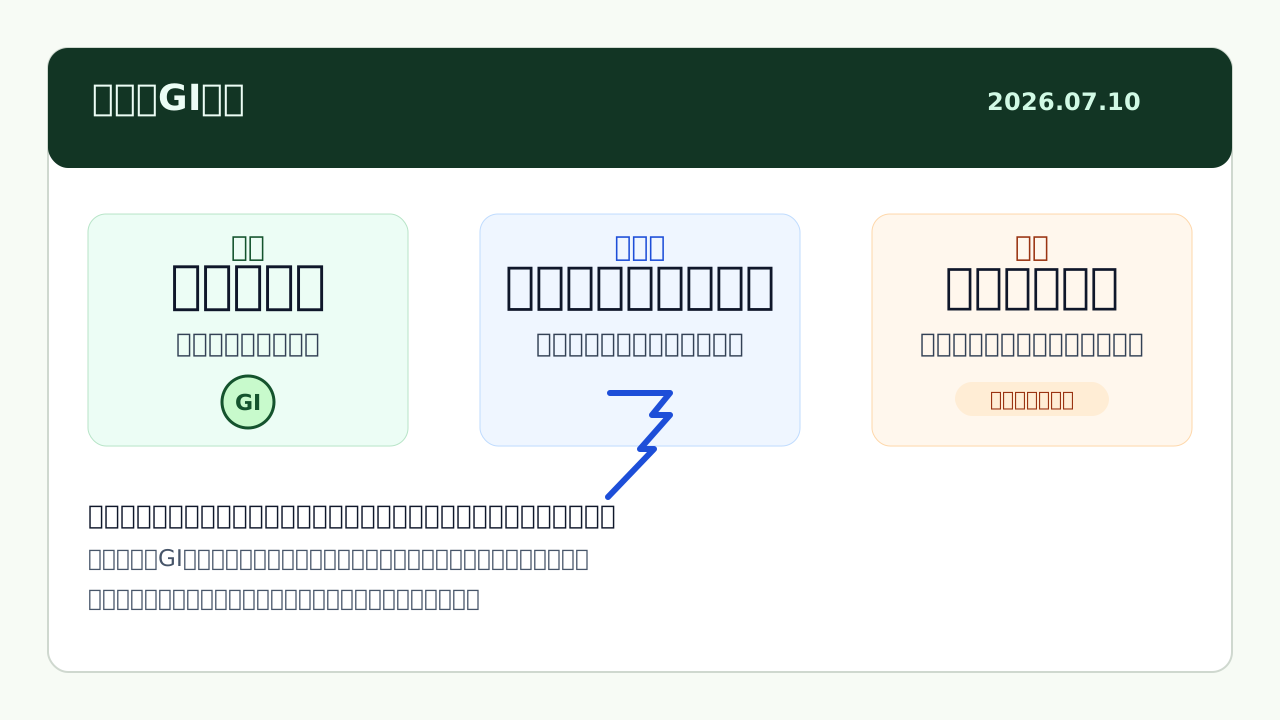
First, the conclusion
It is easier to understand Mirativ's recent situation in terms of the fact that an improvement in its earnings structure and a change in the shareholder composition occurred at the same time, rather than simply looking at whether the company's financial results were good or not.
Looking only at Q1, both sales and profits are off to a reasonable start compared to the full-year plan. Moreover, the outlook for operating income is not bad. This is because the penetration of web payments has lowered payment commission rates, which has improved one of the most significant costs for a platform company.
Furthermore, in July, Akira Katayama acquired shares held by ANRI, Global Brain, and KDDI funds off-market. This is quite important in terms of supply and demand. This is because the VC selling pressure that tends to linger for a while after listing has been consolidated and sorted out.
However, it is a little early to get bullish here. The company has left its earnings forecast unchanged despite good progress in Q1, and explains that the pace of improvement in profit margins will be gradual going forward. Improvements in supply and demand are a tailwind, but what will ultimately push up stock prices is whether profit growth continues.
Company profile
Mirrativ is a company that operates a live platform business centered on the live streaming app "Mirrativ." It has a revenue structure that combines billing, distributor returns, and digital content development, with a focus on smartphone game distribution and community formation.
When looking at this company, what is important is not only sales growth, but also how payment fees, distributor returns, and development costs move. As a growth stock, it is important to expand the user base and product range, but what the stock market is more concerned about is how much that growth translates into operating profit margin.
most recent material
On June 9, 2026, the company published "Questions and answers received from investors." Here, we position the first quarter of the fiscal year ending December 2026 as a "smooth start" and cite improvements in cost structure and marginal profit margin as the reason behind the progress in operating income exceeding the progress in sales.
Subsequently, on July 9, 2026, we announced the ``Notice regarding collection activities specified by government ordinance as acts equivalent to tender offers.'' Mr. Akira Katayama acquired 1,597,900 shares on July 2, 2026, and now holds 9.43% of the voting rights of all shareholders as of June 30, 2026. The purpose of holding is pure investment.
The sellers are ANRI, Global Brain, and KDDI funds. Looking at this lineup, the meaning in terms of supply and demand is quite clear. This is because it can be interpreted that the exit stocks of existing VCs, which tend to be noticed intermittently in the market, have been transferred in a somewhat concentrated manner.
How to view performance
Q1 sales were 1.952 billion yen and operating income was 257 million yen. The progress rate against the full-year plan is 23.2%. On the surface, this may seem like a mediocre quarterly progress, but that's not the point the company is making.
What is noteworthy is that the progress in operating income is seen as being more weighted than the progress in sales. The company describes an improvement in its cost structure and marginal profit margin compared to the same period last year. In the early stages of a growth company, sales growth tends to come first, but Mirativ seems to be gradually moving away from the status of ``a company that has difficulty remaining profitable despite its growth.''
Particularly important are payment fees. The actual payment fee rate, excluding the impact of platform discounts at the beginning of the year, has fallen to 13.5%. The company's explanation that by increasing the proportion of online payments, it is creating a structure where sales are less likely to be influenced by the billing rules of a specific OS is quite meaningful. What the market wants to see is whether this improvement is sustainable rather than an increase or decrease in sales.
On the other hand, other costs increased compared to the same period last year. If you're wondering if this is a bad way to increase, it's not that simple if you read the company's explanation. This is mainly due to the timing of recording development and operating costs for Emomo and live games, and it is not considered to be of a scale that will significantly disrupt current trends. In other words, although not all costs have fallen cleanly, it is natural to see that the quality of heavy fixed burdens has changed slightly.
Seasonality also needs to be taken into account. Mirativ explains that sales are strong in the fourth quarter, when year-end and New Year events are concentrated, and that sales tend to decline slightly in the first quarter. Therefore, even if it appears weak compared to the previous quarter, it is dangerous to assume that this is the only reason for the slowdown. This Q1 can be said to be a good start, even considering the seasonality.
However, the company has not made any upward revisions here. This is important. The market prefers whether the company is confident in its forward numbers rather than the progress rate itself, but it's still cautious at this point. The numbers are good. The question is how much of that quality will accumulate throughout the year. The market is still looking there.
View of external environment
The first interesting thing about the external environment is that the company views generative AI and AI agents as a tailwind rather than a risk. Normally, it wouldn't be strange to get involved because of concerns such as `being replaced'' and `increasing competition,'' but Mirativ sees it positively, including lower content generation costs, improved operational efficiency, and even more leisure time in the medium to long term.
This view is easy to understand as a story. However, in the stock market, this does not directly lead to high valuations. Although AI may be useful, themes that have a long way to go before monetization tend to end up with high expectations. As an investor, I would like to see whether the use of AI will actually lead to improved distribution experiences, deeper billing, and lower operating costs.
On the other hand, regarding the escalating situation in the Middle East, the company has stated that there is essentially no direct impact on its business. This is because our business structure, which is a live distribution platform for smartphone games, is less affected by energy and material procurement. Unlike manufacturing or logistics-dependent industries, explanations for external shocks are relatively straightforward here.
In short, Mirativ's external environment is insensitive to macro headwinds and easy to take advantage of technological advances. However, its strengths can only be evaluated when they are manifested in profit margins and operational efficiency rather than sales. Good as a theme. The question is how far the numbers go.
How to view supply and demand and shareholder trends
Investors are actually quite divided in how they read this disclosure. If you just look at our results, Q1 is honestly positive. This is because improving settlement fee rates is an issue that affects future marginal profit rates rather than short-term cost reductions.
However, for small-cap stocks in the growth market, good numbers alone will not lead to a sustained revaluation. VC exit pressure that remained after the listing, concerns about supply and demand after the lock-up was lifted, and a thin stock of liquid stocks. This area always weighs on the stock price. The latest acquisition by Mr. Akira Katayama can be seen as a material that will significantly alleviate concerns about supply and demand.
To be honest, there is also a market announcement effect here. The fact that a well-known individual investor held a net investment of 9.43% is likely to attract short-term attention. However, whether that alone will make it a stock that will continue to be bought for a long time is another matter. This is because there is a difference between a situation in which a company's performance increases based on supply and demand and a situation in which it is evaluated based on performance.
In other words, Mirativ may have become a `growth stock with improved supply and demand,'' but it has not yet reached the level of `a growth stock whose performance quality is completely trusted.'' From now on, it will be easier to establish a reputation only if you improve the payment commission rate, maintain the operating profit margin, and recover the content investment.
bullish scenario
The bullish scenario is clear. The shift to online payments will continue, and improvements in payment commission rates will continue to have an effect on profit margins in the second half of the year. In addition, operating income will increase at a faster pace than the full-year plan while absorbing increases in distributor returns and development costs.
In this case, this major shareholder change will not just be a topic of discussion, but will be a combination of improvements in supply and demand and improvements in fundamentals. This is the pattern that the market likes the most. If the selling pressure from VCs eases and the profit margin improves, the outlook as a growth stock will change considerably.
In addition, if the progress of generative AI and AI agents, which the company views positively, actually leads to content diversification and operational efficiency, it will be easier to explain the room for growth. However, at this point, we have high expectations, and it is natural not to evaluate too much until the numbers fall.
bearish scenario
A bearish scenario is a case in which the profit margin improvement in Q1 is limited to a discount at the beginning of the year or a temporary mix improvement, and in the second half of the year, distributor returns and development cost burdens become heavier again. Given that the company itself believes that the pace of improvement will be gradual, it would be dangerous to assume that profit margins will improve in a straight line.
Another bearish factor is the shelf life of improvements in supply and demand. The acquisition of Akira Katayama is a good sign as it will reduce the overhang, but this alone will not eliminate the uncertainty in the company's business performance. If short-term funds are too proactive, there will likely be a backlash when additional upside is not seen in the next financial results.
The same goes for AI. The company sees a tailwind, but investors will look not at the word "AI" but at whether it manifests itself in improvements in ARPU, billing rates, content turnover, and operational productivity. Unless this can be confirmed with numbers, stock prices will not last long based on dreams alone.
Featured KPIs
The top priority is whether the actual settlement fee rate can be maintained at the 13% level. If this situation worsens again, the story of improving profit margins will become much weaker.
The next thing I would like to see is how the operating profit margin and gross profit will grow. Even if sales increase, if there is no operating profit left due to distributor returns and content investment, the market will quickly become difficult.
In terms of supply and demand, the future trends of major shareholders and the quality of trading volume are also important. It is true that this acquisition has made the stock even lighter, but the stability of the stock price will change depending on whether medium- to long-term funds become established or end up focusing on short-term funds.
summary
It is natural to read Mirativ's latest developments based on two pillars: improvement in profit margin in Q1 and movement of VC holdings. The former is an improvement in the profit structure, and the latter is an improvement in the supply and demand structure. Both are positive, but their natures are quite different.
In terms of performance, the most important factor is the decline in commission rates due to the shift to online payments. This is not a one-off good news, but an issue that will change how profits remain. As a growth stock, it can be said that the evaluation axis is finally starting to shift from sales to profit margin.
On the other hand, in terms of supply and demand, the fact that concerns about VC exits have diminished is likely to be viewed favorably. However, the sustainability of stock prices will ultimately be determined by the numbers from the next quarter onwards. What the market really wants to know is not whether the supply and demand balance has eased, but whether the earnings growth will continue to match the lightened stock market.
Related pages
source
- Mirativ Co., Ltd. “Questions and answers received from investors” (disclosed on June 9, 2026, confirmed on July 10, 2026)
- Mirativ Co., Ltd. “Notice regarding collection activities specified by government ordinance as acts equivalent to a tender offer” (disclosed on July 9, 2026, confirmed on July 10, 2026)
- 株式会社ミラティブ IRページ (confirmed on July 10, 2026)