
First, the conclusion
If the stocks you own were to drop by 30% tomorrow, how much would it affect your lifestyle and financial plans? Rather than guessing the rate of decline, it is more realistic to think about how you can continue investing even if the stock declines.
If you want to make use of the three caves in your investment, prepare an ``escape route'' before the market gets rough. The way out here is not to sell in a hurry. Don't put too much money into one company, one country, or one purchase.
Even if you diversify your investments, you will still incur losses. The purpose is not to eliminate losses, but to reduce concentration risk where a single bad news event can significantly damage the entire asset.
There's a trade-off here. When a particular asset continues to rise, a diversified portfolio pales in comparison to concentrated investments. Still, the reason for choosing diversification is not to maximize upside, but to help avoid losses that would disrupt operations.
What the story teaches is “preparation” rather than “prediction”
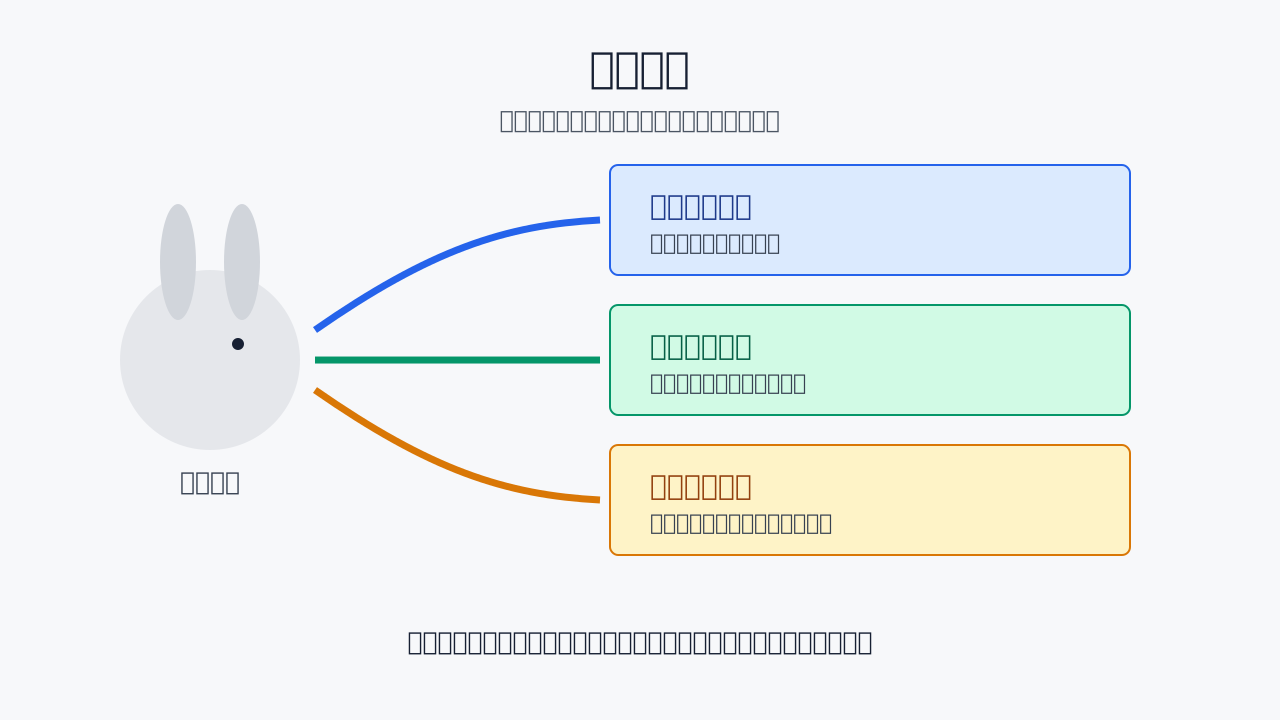
Kouto Sankutsu is a story that originates from ``Sengoku Saku''. Rather than being a word that explains the detailed ecology of rabbits, it has been passed down as a metaphor for being prepared, as one thing is not enough to protect yourself.
Even in investing, it is difficult to predict exactly when a strong stock or country will stall. Therefore, instead of placing your money on the assumption that you will win, you will place your funds on the assumption that it may go wrong. Before chasing profits, avoid situations where you cannot continue. These are the three holes in investing.
Hole 1: Separate assets
Stocks, bonds, cash, gold, etc. do not have the same reasons for their price movements. By combining assets with different characteristics, you may be able to reduce the impact of a decline in one market on your overall assets.
For example, if you invest 3 million yen in an individual stock and the stock declines by 50%, the valuation will be 1.5 million yen. If you divide 1 million yen into stocks, bonds, and cash, and assume that only stocks fall by 50% and everything else stays the same, the total will be 2.5 million yen. This is a simple example of how diversification works, as in reality bonds and gold can also go down, and fees and exchange rates also come into play.
The first thing you want to check is whether you are spending money you will soon be spending on products with price fluctuations. Having cash to cover living expenses and sudden expenses will reduce the chances of having to sell your investments during a downturn. Since cash has the disadvantage that its real value decreases due to rising prices, we will consider its roles separately.
Second hole: separate regions
The idea of holding only Japan or only the United States is strongly influenced by that country's economy, policies, and currency. By using investment trusts/ETFs that cover multiple countries and regions, you can reduce regional bias.
However, even investment trusts with global stocks may have a large composition ratio of U.S. stocks. Don't worry just because the product name says "worldwide"; check which countries and industries are included and to what extent. When investing in overseas assets from Japan, exchange rate fluctuations also affect returns.
Third Hole: Separate the purchase timing
Instead of buying the entire amount at once, you can spread the time by dividing the purchase into multiple purchases, such as every month. With fixed-amount savings, you buy less when the price is high and more when the price is low.
Time diversification is not a surefire way to prevent high price capture. If the price continues to rise, the price of buying later may be higher than investing in a lump sum. It is used as a means to reduce the burden of market forecasting and make it easier to continue with the financial plan you have decided on.
How to make three holes with NISA
As of July 2026, NISA has a "Tsumitate Investment Limit" that covers certain investment trusts suitable for long-term accumulation and diversified investment, and a "Growth Investment Limit" that also covers listed stocks.
Simply setting up savings using the accumulated investment limit does not necessarily mean that assets and regions will be automatically diversified. Some investment trusts are concentrated in one country or industry, so it is necessary to check the contents. In addition, NISA is a system that exempts investment profits from tax, and does not guarantee principal or profits.
| Things to check | Points to see |
|---|---|
| Asset hole | Do you separate investment funds from cash for immediate use? |
| Regional holes | Is it biased toward one country, currency, or industry |
| Time hole | Which fits your financial plan: bulk purchase or savings |
| Duplication of products | Are they linked to the same index even if they have different names? |
Risk that does not disappear even if diversified
There are times, such as during a financial crisis, when many assets decline at the same time. Too much diversification can make it difficult to keep track of your holdings and fees. The key is not to look at the number of stocks, but to see whether the reasons for price movements are different.
"Even if you can't predict a crash, you can make preparations in case it goes wrong." When considering diversified investments, this level of distance is probably the best.
Case where three holes do not work
| Condition | Appearance | Actual Risk |
|---|---|---|
| Owning multiple stocks with the same theme | There are many stocks | They tend to fall all at once due to the same material |
| Holds multiple similar investment trusts | Many products | Top stocks and indexes overlap |
| Diversification with only overseas assets | Multiple countries | Impact of decline in currencies and global stocks overall |
| Rely only on savings | Diversify purchase timing | Unbalanced asset allocation, such as 100% stocks, remains |
When markets are calm, this overlap doesn't seem like a problem. In fact, results may seem better if you focus on the same theme. Only when the market crashed did we realize that the risk factor was the same, just with a different product name. Checking for dispersion will be delayed until prices have fallen.
Judgment axis for review
There is no need to change allocation based on daily price movements. Check when there is a significant deviation from the initially decided asset allocation, when income or expenditure schedule changes, or when the contents of the product or fees change.
If the ratio inflates due to a rise in a specific asset, holding it as is is not ``doing nothing'' but a decision to accept the increase in concentration. Conversely, mechanical rebalancing also involves taxes, fees, and opportunity costs as it sells rising assets. Even within a NISA account, you need to consider the system and financial plan separately, including when to reuse the tax-free holding limit after selling.
[Summary]
What Kouto Sankutsu teaches is not how to accurately predict danger, but how to prepare for when predictions are wrong. Separate your assets, region, and time of purchase to secure the cash you need for your daily life. The idea is to check for escape routes during normal times so that you don't become unable to continue investing due to a single mistake in judgment.
Source
- "Sengokusaku" Saisaku 4 (The story of "The Three Caves of the Cunning Rabbit")
- Financial and Economic Education Promotion Organization J-FLEC "Diversified Investment"
- Financial Services Agency "Access FSA No. 270"