
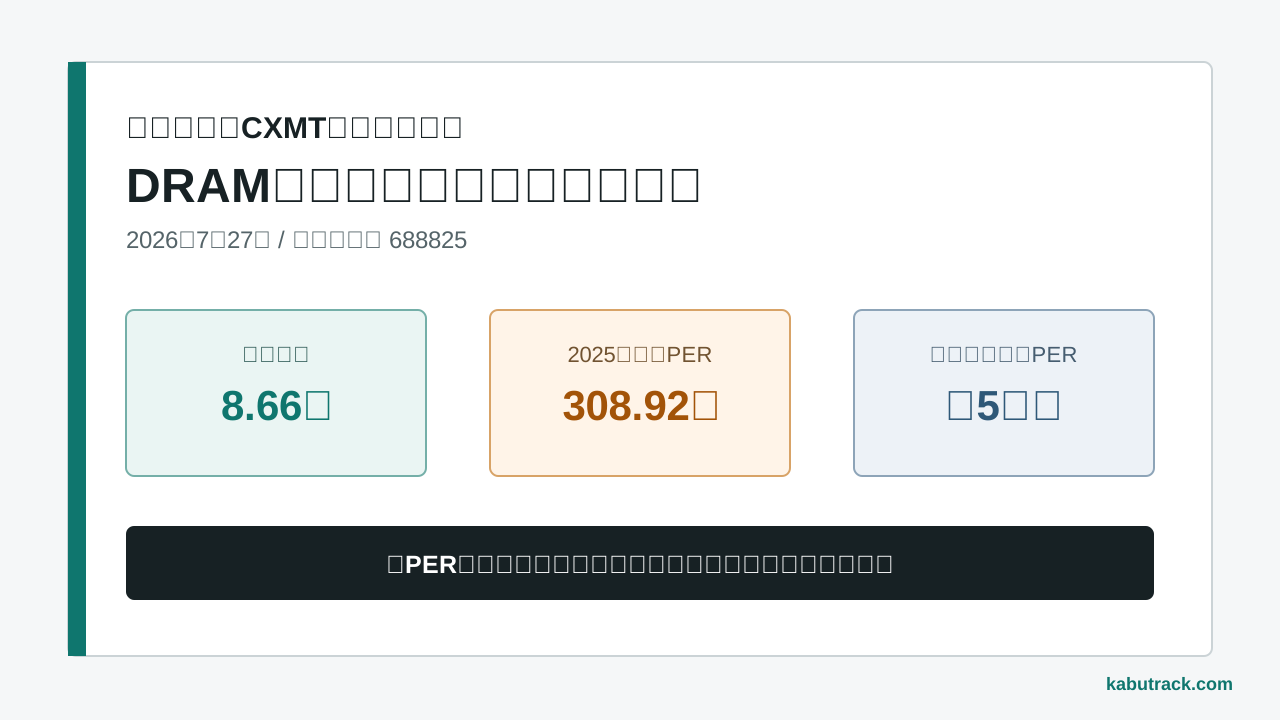
First, the conclusion
It is not enough to simply read this punishment as ``the Chinese government has once again begun to tighten its grip on IT companies.''
The State Administration for Market Regulation found that the company used its dominant position in China's domestic online hotel booking market to force hotels to accept exclusive deals and "lowest prices across the network," which it enforced through flow allocation, price adjustment tools, and deposit deductions.
There are three things that are important.
- Not only the blatant "choice between the two" but also the de facto exclusionary conditions in exchange for preferential treatment of flow rate were subject to punishment.
- The “lowest price guarantee” was recognized as a most-favored-nation clause that weakens competition, rather than benefiting consumers.
- Requested to stop the violation, confiscate the illegal income, fine, and refund the money to the merchant.
In other words, China's platform regulation has moved from restricting the size of companies to individually examining how algorithms and contract terms distort competition.
The temporary burden of 5.179 billion yuan is not a small amount for the company. However, what investors should focus on over the medium to long term is not the fine amount itself, but whether the profit structure of the hotel reservation business will change. If traditional methods such as exclusive inventory securing, price advantages, and flow allocation become difficult to use, the source of competitiveness will need to shift from retaining affiliated stores to customer attraction, search quality, membership base, and even overseas expansion.
Participation: Chinese domestic brand
Trip.com: Brand for international market
What happened?
On July 25, 2026, the State Administration for Market Regulation announced an administrative penalty against Cheng Group Co., Ltd. for violating the Antimonopoly Act.
The details of the disposition are as follows.
| Item | Amount/Contents |
|---|---|
| Fine | 3.521 billion yuan |
| Fine ratio | 7.5% of China's domestic sales of 46.958 billion yuan in 2025 |
| Confiscation of illegal income | 1.658 billion yuan |
| Total fines | 5.179 billion yuan |
| Return to hotel | Order reserve 122 million yuan |
| Others | Suspension of illegal activities, complete restructuring |
Authorities said they began their investigation in January 2026, gathering evidence from competing platforms and numerous hotel operators, and also conducted big data and algorithm analysis. It was determined that the violation had continued since 2020.
In past large-scale cases in the platform economy field, Alibaba was fined 4% of domestic sales and Meituan was fined 3%. This time's 7.5% exceeds those, and according to commentary from authorities, it is positioned as the highest ratio ever in this field.
However, not all of the 5.179 billion yuan is a "7.5% fine of sales." The total amount is 3.521 billion yuan, which is 7.5%, and 1.658 billion yuan of illegal income, resulting in 5.179 billion yuan. This distinction is necessary.
Why was it raised to 7.5%?
1. Exclusion conditions were embedded in flow distribution
The hotel was categorized as `special tile'', golden tile'', and `no tile''.
According to the authorities' findings, ``special tier'' hotels with high transaction value, high service quality, and high customer attraction were required not to do business with competing platforms in exchange for preferential treatment of flow rate and rights.
This is not a simple exclusive transaction that simply states in the contract that ``you are not allowed to open stores with other companies.'' This is a system that forces hotels to make choices by using resources that influence sales on the platform, such as search rankings and exposure opportunities.
The message from authorities this time is clear. Even if a preferential treatment system is formally arbitrary, if a dominant platform takes advantage of the disparity in flow rate and effectively limits merchants' business partners, it could become an issue under antitrust law.
2. “Lowest price across all networks” robbed other companies of room to lower prices
Hotels with `Golden tile'' and `No tile'' are subject to conditions that do not make their prices higher than those on other companies' websites. It is said that the "golden tile" also had the condition that it would be more than 20 yuan or 5% cheaper than other companies.
At first glance, the lowest price guarantee is advantageous to consumers. However, the market as a whole may have the opposite effect.
ホテルが他社で値下げする
↓
携程でも同額以下にする必要が生じる
↓
他社プラットフォームが低い手数料で価格競争する意味が薄れる
↓
新規参入や競合の値下げ余地が狭まる
↓
長期的にはプラットフォーム間の競争圧力が低下する
This type of condition is discussed in competition law as a platform most-favoured nation clause. This is the first time that the Chinese authorities have directly punished the "lowest price across the network" as an abuse of independent dominant position.
3. Algorithms have become devices that allow violations to continue.
Using tools and human resources such as `price assistants'' and `pecking order'', when it detected a higher price than other companies, it lowered the price listed by the company. Hotels that did not comply with the conditions were also subject to flow restrictions, rank cancellations, and order reserve deductions.
This is the key to understanding the gravity of this punishment.
The problem is not the algorithm itself. The problem was that price monitoring, flow allocation, and sanctions were combined, making it difficult for merchants to decide their own prices and sales channels.
China's Antimonopoly Law, as revised in 2022, prohibits the abuse of a dominant position using data, algorithms, technology, capital, and platform rules. This case is a representative example of applying this abstract provision to concrete platform operations.
Why “now”?
Linked everything from legal guidelines to individual enforcement
In February 2026, the Chinese authorities published the `Internet Platform Antimonopoly Regulation Guidelines,'' which listed eight examples of risks, including choice between the two,'' `lowest price across all networks,'' algorithmic collusion, and discriminatory treatment.
The investigation into the case began in January. In February, we showed general types of conduct, and in July we clarified the boundaries in specific cases.
Rather than a temporary political campaign, this move is closer to regular supervision that combines preliminary presentation of rules, investigation, punishment, and restructuring. Although it cannot be said that predictability is completely high, at least the behavior that is considered problematic has become more concrete than before.
Correcting “inward roll” is not a prohibition on selling cheaply
In recent years, the Chinese government has viewed price competition that ignores profitability and excessive burden-shifting to business partners as a problem, calling it ``internal competition.''
However, it is not appropriate to view this disciplinary action as a policy of "not lowering prices." The problem was that dominant platforms took away pricing power from hotels, making it difficult for other companies to lower prices and sell.
The goal is not to reduce competition, but to restore the ability of multiple platforms to compete on price, quality, fees, and service. At least the official explanation from authorities is consistent in that logic.
Protection of small and medium-sized businesses is now at the center of enforcement
From a hotel's perspective, if the risk of losing search traffic is high, it will be difficult to refuse even if the conditions are unfavorable. When automatic price adjustments and deposit deductions are added to this, even if there is contractual freedom, actual bargaining power remains weak.
This time, in addition to being fined, the company was also ordered to fully refund the 122 million yuan in reserve funds that had already been deducted. This shows that the purpose of disposal was not just to pay money to the national treasury, but to actually restore the terms of trade with merchant families.
What the 19 changes mean
The government fully accepted the disciplinary action and announced 19 reform measures in five areas. The main contents are as follows.
| Area | Main responses |
|---|---|
| Exclusive trading | Abolishing the primary consignment sales model equivalent to "special tiles" |
| Lowest price | Abolishing the secondary consignment sales model equivalent to the "golden tile" and the lowest price requirement |
| Algorithm | AI assistant will be suspended in March 2026, and Pei Pai Tong will also be suspended |
| Merchant protection | Review of price adjustment clauses, traditional price tag fees, and excessive promotional categories |
| Restoration to original condition | Order reserve fund of 122,781,078 yuan returned to target hotels |
| Governance | Strengthening anti-monopoly regulations, screening, reporting, and training |
This restructuring could become a standard model for Chinese platform companies to develop in the future.
What is particularly important is that not only the wording of the contract, but also the flow allocation, operating authority of sales personnel, price adjustment tools, and sanctions in the event of non-compliance were subject to review. Even if exclusivity clauses are formally removed, if algorithms and sales evaluations encourage the same behavior, it will be difficult to recognize this as a reform.
On the other hand, it would be premature to conclude that the problem has been resolved just because the 19 items have been published. It will be necessary to confirm in future operations whether the new member store rankings, commission structure, and sales promotion system will create essentially the same pressures as the old system.
Performance impact on progress
Temporary losses are absorbable but not negligible
In 2025, the Group's full-year net sales were 62.4 billion yuan, non-GAAP profit attributable to shareholders was 31.8 billion yuan, and year-end cash and short-term assets under management were 105.8 billion yuan.
A simple comparison of the fine of 5.179 billion yuan is equivalent to approximately 8.3% of full-year net sales, approximately 16.3% of non-GAAP profit attributable to shareholders, and approximately 4.9% of year-end liquid assets.
The definition of "domestic sales in China" that the authorities used to calculate fines and the consolidated net sales in the company's financial statements are different. Additionally, the timing of expense recognition and tax treatment must be confirmed separately. Therefore, this ratio is an approximation to see the scale of the burden.
If we only look at the financial base, it is hard to imagine that it is at a level that will immediately jeopardize business continuity. However, the 2025 profits include a large amount of investment-related profits, and the burden cannot be underestimated when compared to the earning power of the main business.
The real issue is the profitability of accommodation reservations
Lodging reservation sales in 2025 were 26.1 billion yuan, accounting for 42% of consolidated sales. This violation certification targets that core business.
The expected changes after the reorganization are as follows.
- Exclusive inventory will be reduced, making it easier to find the same hotel on multiple sites
- The system that ensures the lowest price only for affiliated companies will be weakened.
- Promotional expenses may increase in order to acquire hotels and maintain users.
- Lower pressure on fee rates may increase *Search quality, member benefits, and customer service other than price become important.
In the short term, this is a headwind to margins. However, in the medium to long term, it may lead to improved relationships with merchants, a more stable product lineup, and lower regulatory risks.
Structural changes and spillover destinations
Areas susceptible to headwinds
The biggest headwind is the business model that uses flow control to impose exclusion conditions and price conditions on merchants.
The following systems may be subject to inspection not only for travel, but also for food delivery, e-commerce, recruitment, housing/automobile information, ride dispatch, and lifestyle services.
- A system that restricts the use of other companies in exchange for priority display
- A system that automatically monitors other companies' prices and forces them to lower their own prices.
- If a merchant refuses, the search ranking and traffic will drop.
- Substantive coercion using deposits, penalties, and promotional participation
- Operations that avoid accountability based on algorithmic neutrality
The costs of regulation will be higher in industries where market power is stronger and merchants have a harder time avoiding dependence on a particular platform.
Areas with relative tailwinds
Competitive platforms have more opportunities to acquire merchants and inventory. However, regulations alone will not automatically cause users to migrate. Differences remain in customer sending ability, payment, reviews, membership system, and customer support.
Relative potential beneficiaries include the following companies:
- SaaS that allows merchants to centrally manage multiple channels
- Reservation management system that allows stores to manage prices and inventory themselves
- Payment, CRM, and advertising services that support direct sales for independent hotels
- Algorithmic audit, competition law compliance, data governance related services
However, these are the current structural directions and do not mean that a specific company's performance will improve.
KPIs that investors should look at
When looking at China platform stocks, it is necessary to follow not only the stock price on the day the disposal was announced, but also the numbers after the restructuring.
| KPI | Meaning of checking |
|---|---|
| Growth rate of lodging reservation sales | Will declines in inventory and price advantages affect transaction volume |
| Take rate for accommodation reservations | Will the new fee structure lower the profit rate |
| Sales and marketing expense ratio | Will maintenance costs increase for guests and hotels |
| Number of member hotels and inventory amount | Can supply be maintained even if the use of multiple sites expands |
| Domestic and overseas reservation mix | Can domestic regulatory risk be diversified through overseas growth |
| Repeat rate/member usage rate | Is it possible to retain customers through service quality rather than locking them in? |
| Additional disposition/reorganization report | Is there any operation equivalent to the old system? |
In the January-March period of 2026, the total booking amount on overseas platforms increased by about 65% compared to the same period last year, and travel reservations to China increased by about 90%. The turning point in evaluation will be the extent to which overseas and inbound growth can compensate for the intensifying competition in the domestic hotel business.
Risk scenario
Bearish scenario
Hotels expand their inventory across multiple platforms, and competitors attack with fees and prices. In order to protect its market share by increasing promotional expenses, the profit margin on accommodation reservations will decline. This is a scenario in which the investigation spreads to other businesses and platforms, and the regulatory discount for Chinese Internet stocks as a whole widens again.
Neutral scenario
Although the fines will be absorbed as a one-time cost and the price and flow rate system will change due to the restructuring, the company's membership base, reviews, supply network, and customer service will remain its competitiveness. Even if sales growth and profit margins slow slightly, overseas operations will compensate.
Bullish scenario
Inventories will increase as merchants' confidence recovers, and the company will maintain its lead in a competitive environment where regulatory compliance is transparent. If the competitive axis shifts from excessive price reductions to service quality, and overseas/inbound growth continues, the reduced uncertainty after fines may lead to a review of evaluations.
Conditions to disprove the bullish scenario are a stall in room reservation sales, a sustained rise in promotional expense ratios, and a decline in member hotels. The conditions to disprove the bearish scenario are that transaction volumes and profit margins remain stable even after the restructuring, and that overseas growth outweighs the domestic slowdown.
[Summary]
The 7.5% penalty on carrying charges is not important because it is a large amount.
The significance lies in the fact that the platform disposes of the very structure that deprives merchants of the right to choose and decide prices by viewing multiple mechanisms such as exclusive contracts, minimum prices, flow allocation, algorithms, automatic pricing, and guarantee deposits as one.
This indicates that China's platform policy is no longer a binary choice of ``growth or regulation,'' but has entered the stage of finely enforcing transaction rules while allowing growth.
The key issue for investors is not whether the squeeze on Chinese IT companies has resumed in full force. The question is whether each company's profit margins depend on exclusive lock-in, or whether they can be reproduced through technology, services, brands, and overseas expansion.
From now on, rather than looking at the amount of fines, it will be better to track the take rate after the reform, promotional expenses, actions of member stores, and growth in overseas reservations to more accurately grasp the long-term impact of this matter.
Source
- [State Administration for Market Regulation "Administrative Disposition and Complete Restructuring of Engagement Group Co., Ltd."] (https://www.samr.gov.cn/xw/zj/art/2026/art_46d2c74cbd7249f189622dd030e3c3a7.html)
- State Administration for Market Regulation "Governing the minimum price clause and platform economy"
- [Explanation of the State Administration for Market Regulation "Internet Platform Antimonopoly Regulation Guidelines"] (https://www.samr.gov.cn/xw/mtjj/art/2026/art_24c375548c7f46f29bca305b3e9e2ee7.html)
- Progress Group “Reorganization Measures in 19 Items in Five Fields”
- Trip.com Group 2025 full-year financial results
- Trip.com Group Financial Results for January-March 2026