
First, the conclusion
The current resale/purchasing issue is not a factor that will directly depress short-term financial results. This is because while limited edition goods and character lottery tickets are highly talked about, their sales are not large enough to drive Seven & i's overall operating profit.
Rather, what is troubling is not whether it sold or not, but that it undermines the premise that ``Seven can buy it fairly.'' Convenience stores are businesses that are built on everyday purchasing habits, but IP collaboration products have the role of adding new reasons for visiting the store to those habits. If this seems unfair, fans will give up before going to the store.
The market probably won't significantly revise Seven & i's profit forecasts based on this news alone. In the first quarter of the fiscal year ending February 2027, structural reforms and improved profits at domestic and overseas convenience stores were the main focus. However, Seven & i is currently seen as a company that is becoming more focused on convenience stores. That's why the small fraying in domestic 7-Eleven's brand control is easier to deal with than before.
What's happening?
According to an article distributed by Kyodo News on July 23, 2026, 7-Eleven Japan issued a warning letter to member stores nationwide on July 13, 2026. According to reports, some stores were holding popular anime and game-related products on hold before they were released, store personnel were buying up and reselling them, and some customers were given priority sales.
The same report also states that there have been cases where franchisee contracts have been canceled mid-term, and that the company has developed rules for store personnel in response to requests from character manufacturers and copyright holders. 7-Eleven's comments indicated that they will continue to alert stores to ensure that products can be purchased fairly.
What I would like to note here is that this does not mean that the same fraud was confirmed at all stores nationwide. This is a case of inappropriate behavior at an individual store, and not all affected product names and store names have been made public. As an article, it would be appropriate to focus on the structure that investors should look at, without covering too much of the facts.
Direct impact on performance
The short-term sales impact can be seen to be limited.
According to Seven & i's financial summary for the first quarter of the fiscal year ending February 2027, which was released on July 9, 2026, SEJ's same-store sales increased by 2.0% year-on-year, product gross profit margin increased by 32.0%, and sales at all chain stores increased by 2.4%. Product sales in the convenience store business are estimated to be 2.42 trillion yen, an increase of 3.2% from the same period last year.
For a business of this scale, it is difficult to imagine that limited character products alone will produce a noticeable change in quarterly profits. Even if the product is for resale, once the product passes through the cash register, sales and gross profit are established in accounting terms. If you only look at the short-term numbers, there are times when it looks like the project has a high sell-out rate.
However, that is only a momentary accounting perspective. Normally, fans would come to the store and buy drinks, sweets, side dishes, cafes, and other products along with the target products. Even if I can't buy something, I sometimes buy another item and go home. This cross-selling disappears when the motivation to visit the store breaks down due to panic buying and reservations.
This is difficult to see in terms of sales scale. This is because it is difficult to measure the actual opportunity loss without looking at the number of customers for each store and campaign, the number of purchasers of target products, and the simultaneous purchase rate. Therefore, short-term financial results appear to be minor. However, this does not mean that you can ignore it just because it seems minor.
Damage to brand value
Convenience store brands are built not only on the selection of products, but also on the feeling of being ``close, easy to buy, and guaranteed to not let you down.'' This feeling is diminished when a sense of unfairness arises regarding popular products.
Character products, in particular, have a high level of emotional energy, unlike regular foods and daily necessities. Fans will be sensitive to release dates, quantities, arrival times, and purchase restrictions. If there is a lingering suspicion that the item may have been removed before it was available in stores, it is more than just a shortage. Consumers perceive this as an unfair sale rather than a shortage.
The blaze itself may subside in a few days. However, what is scary is the quiet decline in the frequency of store visits. If decisions such as `I can't buy it anyway,'' I'll look for it at another chain,'' or `I'll do it online'' increase, it will show up in the financial statements later. Loss in LTV is much harder to measure than sales from a single campaign.
The market dislikes this type of risk because the amount of loss cannot be calculated immediately. Easy-to-understand factors that reduce profits are easy to factor in. Brand doubts take time to disappear.
Relationship with IP holders
The biggest issue in this issue is the relationship with manufacturers and copyright holders.
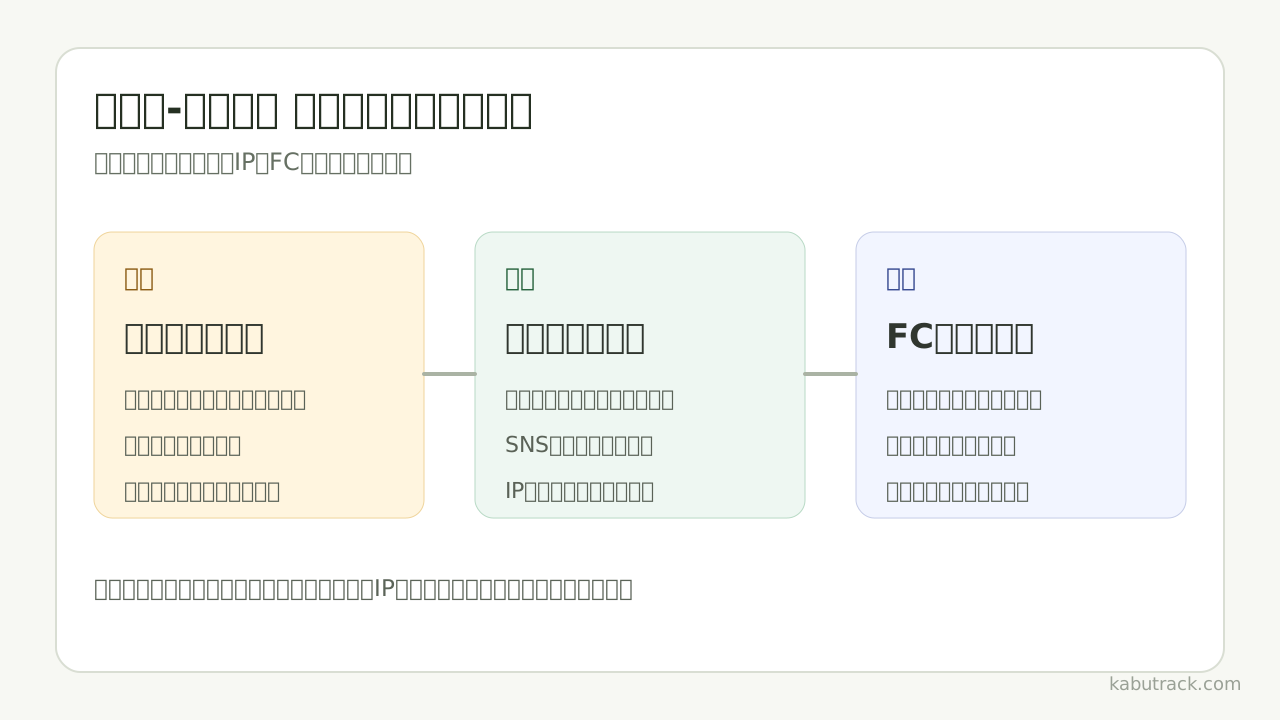
Limited edition projects of popular IPs are not just small product sales events for convenience stores. It is a customer attraction device that attracts young people and families to the store, creates a buzz on SNS, and draws in customers who are not part of the regular store flow. From the perspective of IP holders, the nationwide network of convenience stores serves as a sales channel to spread works and characters to people who come into contact with them on a daily basis.
However, if there is a suspicion that a product that arrives at a store is not being sold fairly, IP holders will become cautious from the perspective of protecting their brand. Limited edition products generate heat due to their rarity, but that rarity only becomes positive when sold ``fairly.'' Scarcity turns into dissatisfaction when insider preferential acquisition is suspected.
What you lose here is not only the gross profit of the target product. Will they be entrusted with the next big IP project, will they be subject to severe restrictions on sales volume and release conditions, and will the manufacturer ask for audits and operational reports? These negotiation costs add up.
Franchise control issues
7-Eleven's business is a joint venture between franchised stores and headquarters. Seven-Eleven Japan's official policy also explains that the core of the franchise business is a relationship of trust with member stores.
That is why it is difficult for headquarters to deal with inappropriate sales at some stores. Store operations will not work unless member stores are left with discretion. On the other hand, when it comes to sales rules for brands and IP projects, unless the headquarters thoroughly enforces unified standards, the entire chain will be under suspicion.
If the measures are strengthened, the costs will increase, such as auditing, training, confirmation of sales start times, lot sales management, backyard notices, and disciplinary actions in the event of violations. If the contract is canceled in a malicious case, royalty income and local store network will also be affected. If you don't respond, your brand will be damaged. Either way, it's not free here.
From an investor's perspective, the strengths of the franchise model are its light capital burden and expanded store network. The weakness is that the quality of on-site operations varies. The current issue can be said to be an example of that weakness becoming visible through consumers' smartphones and the secondary distribution market.
Interpretation in the stock market
It is hard to imagine that this news alone will cause an immediate change in the valuation of Seven & i stock. What the market is currently looking at is improvements in North American convenience stores, gross profit margins in domestic convenience stores, liquidation of non-core businesses, ROIC, and capital allocation. For the first quarter of the fiscal year ending February 2027, the operating profit forecast and net profit forecast have been revised upward.
However, after a good financial result, such intangible asset risks tend to be overlooked. It's dangerous to dismiss it as just because the numbers are good, so there's no problem. The convenience store business is built not only on the number of stores and sales, but also on the trust in the shelves, the trust in sales rules, and the trust in franchised store management.
The market is not yet at the stage to factor this incident into profit forecasts. Rather, they are probably at the stage of seeing whether the headquarters can deal with the matter quickly and forcefully. If they are disposed of quickly, rules are thoroughly enforced, and explanations are given to the manufacturer, the reputational risk will be short-lived. On the other hand, if similar cases occur repeatedly, trust in 7-Eleven's IP project itself will decline.
Bullish scenario
- Headquarters will clarify sales start times, purchase limits, and purchase rules for store personnel to prevent recurrence of cases.
- Explanations to manufacturers and copyright holders and operational improvements have progressed, and there will be no hindrance to the continuation of large-scale IP collaborations.
- Dissatisfaction on SNS will subside in a short period of time, and there will be no noticeable deterioration in the number of existing store customers or campaign customer attraction.
- In fact, strengthen the impression that you can buy fairly through digital lottery, app linkage, sales volume disclosure, etc.
In this case, the impact on business performance will be only temporary. In fact, improved operations could make the rules for selling popular products more transparent, making the sales channel easier for IP holders to use.
Bearish scenario
- Similar cases continue due to additional reports and SNS posts, and this cannot be resolved as a problem of "some stores"
- IP holders will tighten sales conditions, reducing the frequency and scale of 7-Eleven exclusive projects
- Increased auditing, training, and system support for member stores, increasing on-site workload and head office costs
- The fan base will shift to Lawson, Family Mart, specialty stores, and online sales, weakening the ability of limited edition events to attract store visitors.
In this case, the impact will not be on small lines of sales, but as a deterioration in the brand and ability to attract customers. By the time it shows up on financial statements, consumer habits may have already changed.
Featured KPIs
| Check items | How to read |
|---|---|
| Number of customers at existing SEJ stores | Isn't the frequency of store visits decreasing due to price factors? |
| Simultaneous purchase rate for campaign products | Is IP planning creating sales next to beverages and food |
| Recurrence of complaints and SNS complaints | Is it a temporary flare-up or a continuing operational issue |
| Number and scale of IP collaborations | Is the trust of manufacturers and copyright holders maintained? |
| Disposal of member stores and rule implementation | Is the control from the headquarters reaching the workplace |
What is particularly important to look at is the number of customers rather than sales at existing stores. The average spend per customer increases due to price revisions and product mix, but a decline in customer trust is likely to be reflected in the number of customers. If fans stop coming because of issues with limited edition products, that's where the first feeling of discomfort will be.
[Summary]
The current reselling/purchasing problem is small in terms of short-term performance. However, this is a material that investors should not take too lightly.
Seven-Eleven's strengths go beyond its store network, product development, delivery, and single-item management. This is due to the deep habit that consumers have of thinking, `I can buy it here'' or `I won't go far wrong here.'' Popular IP projects are devices that add energy to that habit. If there is a sense of unfairness mixed in, trust will be diminished before sales.
Seven & i's main battlegrounds in the stock market continue to be North America, domestic gross profit margin, structural reforms, and capital efficiency. However, as the company becomes more focused on convenience stores, damage to the domestic 7-Eleven brand becomes more than just a ``small on-site problem.'' The numbers haven't moved much yet. That is why I would like to see the effectiveness of the headquarters' initial response and prevention of recurrence.
Related pages
- Seven & i Holdings (3382) stock analysis
- 7&iHD (3382) Financial results for the first quarter of the fiscal year ending February 2027
- Oshitabi/content tourism related stocks | Where is the profit of IP consumption?
Source
- Article distributed by Kyodo News, "Seven: Is illegal resale rampant? Warning sent to member stores nationwide before release of popular character products", distributed on July 23, 2026
- Seven & i Holdings “[Summary of first quarter financial results for the fiscal year ending February 2027]” (https://www.7andi.com/company/news/release/202607091530.html), published on July 9, 2026
- Seven-Eleven Japan “[Actions for the healthy development of franchise business]” (https://www.sej.co.jp/company/principle/fc_conduct.html), confirmed July 24, 2026