
A dispersed heritage area needs access and interpretation
The archaeological sites span Kashihara, Sakurai and Asuka. The cited cultural-property account identifies 19 component assets, including palace and temple remains, Ishibutai, Kitora and Takamatsuzuka tombs. UNESCO's 48th committee materials use the name Ancient Capitals of Asuka and Fujiwara and criteria (ii) and (iii).
Nominations and advisory materials explain the heritage case; the committee's inscription decision establishes status. The distinction matters when tracing the registration process.
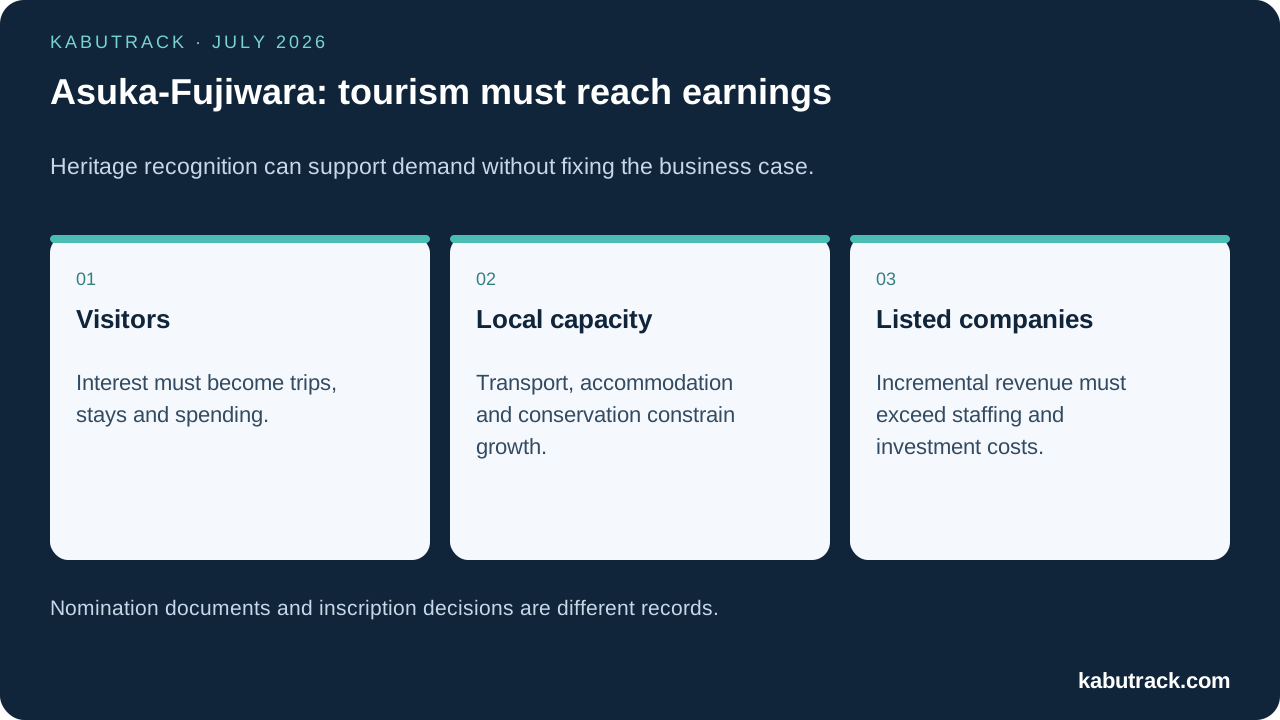
Unlike one large attraction, the area's sites require routes, information and time to visit. That creates opportunities for transport and interpretation while also placing limits on visitor capacity and the speed of commercial development.
Rail and travel businesses capture demand differently
Kintetsu Group Holdings (9041) connects the Asuka and Kashihara area with railway, hotel and travel services. Its Blue Symphony offers a relevant existing tourism product. Non-commuter traffic and spending across those services would show whether attention becomes demand.
JR West (9021) connects Nara with wider Kansai routes, including the Manyo Mahoroba Line. The effect depends on itineraries and travel patterns, alongside costs and the post-Expo tourism cycle.
KNT-CT Holdings (9726) can develop historical, group and educational tours. Arranged travel volume is less informative than the margin after accommodation, transport and coordination costs. The autumn season and educational bookings from 2027 were relevant prospective tests, not assured revenue.
Cultural-property technology requires commissioned work
TOPPAN (7911) has experience with high-resolution archives and VR, including KOISHIKAWA XROSS opened in 2024. Dai Nippon Printing (7912) offers photography, 3D archives and digital viewing systems.
Such capabilities can help communicate fragile or dispersed assets without increasing physical access indiscriminately. A company's general capability is not evidence that it has won a particular Asuka–Fujiwara contract. Local budgets, procurement and the size of an actual project establish the earnings exposure.
Nomura (9716) and Tanseisha (9743) provide exhibition, guidance and cultural-facility design. Backlog, outsourcing costs and project gross margins distinguish profitable work from a larger but low-return contract.
The timetable extends beyond the announcement
A registration decision can generate immediate share-market attention. Tourist behavior, hotel bookings and public investment take longer to appear. An anticipated designation may also have been reflected in expectations before the final decision.
Congestion, preservation needs, access limitations and local acceptance can constrain growth. Large groups may gain only a small amount of consolidated revenue from an individual regional theme.
Visitor counts, stays and spending are useful early evidence. Non-commuter rail revenue, travel margins and disclosed digital or exhibition orders then connect the local effect to each business. Operating profit and cash flow provide the final test.
The heritage recognition creates a reason to investigate these links. It does not make all connected companies equivalent beneficiaries.
Sources
- UNESCO: Ancient Capitals of Asuka and Fujiwara, Inscribed in 2026
- UNESCO: Nominations to the World Heritage List, WHC/26/48.COM/8B
- Agency for Cultural Affairs: ICOMOS Evaluation and Recommendations for Asuka-Fujiwara
- Cultural Heritage Online: Asuka and Fujiwara
- Asuka-Fujiwara World Heritage Council: Component Sites
- Kintetsu Railway: Blue Symphony
- Kintetsu Group Holdings: Medium-Term Management Plan 2028 Update
- TOPPAN Holdings: KOISHIKAWA XROSS Digital Cultural Property Museum
- Dai Nippon Printing: Cultural Property Digital Archives
- Nomura: Public-Sector Project Portfolio
- Tanseisha: Cultural and Tourism Facilities