
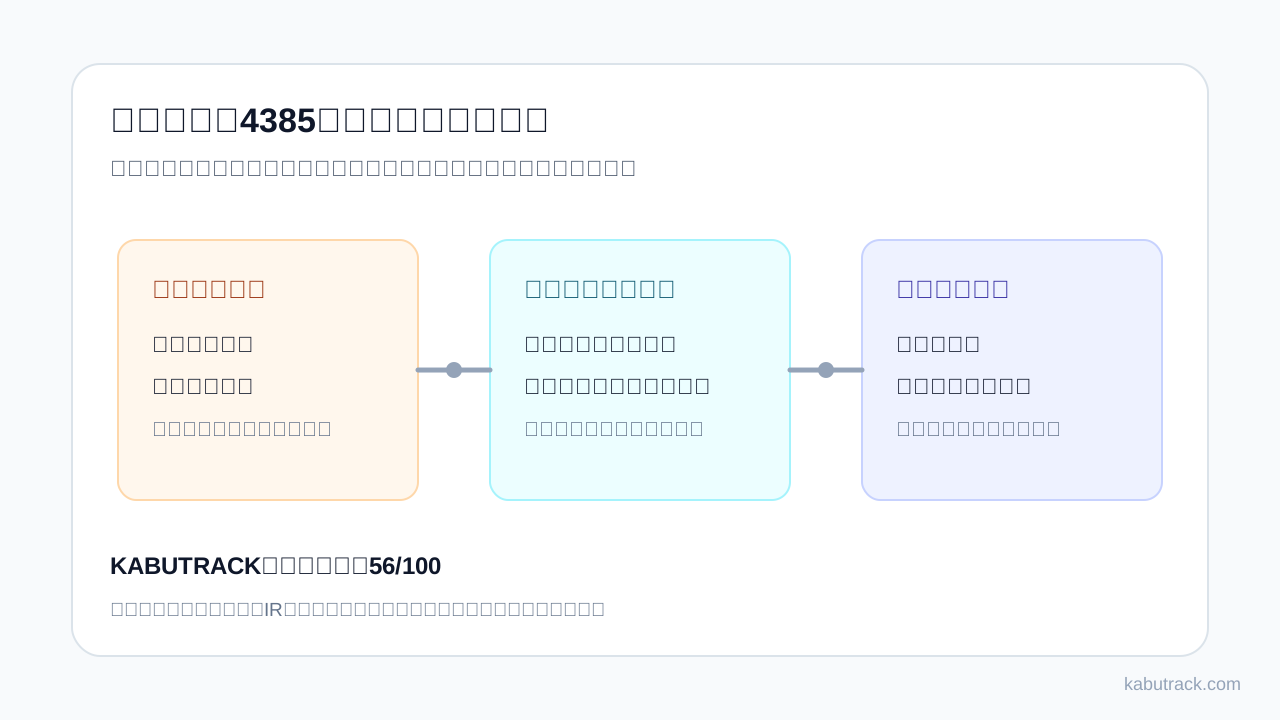
First, the conclusion
Mercari has no shareholder benefits. As of July 26, 2026, the company has not announced a system for receiving Mercari points or Merpay balances.
The same goes for dividends. The company's shareholder return policy is to prioritize strengthening its financial base through growth investment and retained earnings for the time being, and there are currently no plans for dividends. KABUTRACK's [Mercari dividend page] (/securities/4385/dividend/) also organizes the annual dividend forecast for the fiscal year ending June 2026 as 0 yen.
So, is there no possibility of new preferential treatment being established? That's a little different. Mercari is a consumer service company, so it's not bad if you just look at the compatibility with shareholder benefits. The question is not `Can it be done?'' but `Is there a reason to put it at the top of your capital allocation list now?''
To be honest, it is too early to put new preferential treatment on the main line at this stage. In the Q&A at the shareholders' meeting, the company indicated that it will continue to consider shareholder benefits, but when it comes to how to use cash, a comparison of capital allocation, including growth investments and share buybacks, comes first. What the market is looking for is the sustainability of profit growth and the implementation of the company's return policy.
Why are you interested in “Mercari benefits” now?
The reason is easy to understand. Mercari has services that individual investors can use on a daily basis.
Mercari is a flea market app, Merpay is a payment service, Melcoin is a cryptocurrency service, and Mercari Shops is for businesses. It is easy to imagine how these could be used as shareholder benefits. Train tickets for train companies, meal tickets for restaurant companies, points and coupons for e-commerce and app companies. That association naturally arises in an investor's mind.
Another factor is shareholder psychology. As a company listed as a growth stock enters a phase of profitability and profit expansion, how will it combine return measures such as dividends, stock buybacks, and shareholder benefits? This is something that individual investors are likely to be concerned about.
However, if you talk about the stock price only based on the expectation of preferential treatment, it will be diluted. In Mercari's case, preferential treatment is just a supporting role in capital policy, and the main factors are the profitability of the domestic marketplace, the rebuilding of the US business, the profitability of the Fintech field, and the priority of shareholder returns.
Read shareholder return policy from IR/financial documents
Looking at Mercari's IR, the current status of shareholder returns is quite clear.
The company's shareholder return policy currently prioritizes growth investment and retained earnings over dividends. Looking only at this aspect, the company's enthusiasm is a little different from that of companies that immediately introduce shareholder benefits.
On the other hand, the Q&A for shareholders related to the 13th Ordinary General Meeting of Shareholders provided a more in-depth explanation of capital allocation. If the plan progresses, retained earnings could turn positive, and the company could legally consider dividends and share buybacks. However, the company has indicated that it is prioritizing growth investments in existing businesses and new businesses, including M&A, while weighing stock buybacks as an option.
This is important from an investor's perspective. Even if shareholder returns were to move forward, stock buybacks may be the first option rather than dividends or preferential treatment. In situations where the stock price does not fully reflect expectations since the company's listing, there is room for the company to consider buying back its own shares as an ``investment in itself.''
Regarding shareholder benefits, the company has indicated that it will continue to consider shareholder benefits based on shareholder opinions and cost-effectiveness. This is not "planned to be introduced". However, it is also hard to read that it is being ``completely excluded from consideration.'' That's why it's best to treat Mercari preferential treatment as a conditional scenario, rather than a definitive offer.
Comparison with other companies: What are the benefits offered by online companies aimed at?
Shareholder benefits offered by internet companies are often designed as a guide to getting people to use their services, rather than just gifts. When considering Mercari, this comparison is quite useful.
| Companies | How benefits and rewards should be viewed | Aim | Suggestions for Mercari |
|---|---|---|---|
| Rakuten Group | Implementing special benefits for Rakuten Mobile | Letting shareholders experience the company's services | Mercari point-type benefits go well with service shopping |
| GMO Internet Group | Developing benefits based on the use of group services | Promoting the use of securities and internet services | Value is created for users, but the terms and conditions are likely to be complicated |
| LINE Yahoo | Comparison is based on the huge ID/payment economic zone including PayPay | The focus is on the stickiness of the economic zone rather than the benefits themselves | Merpay benefits are attractive, but the design of regulations, accounting, and identity verification is heavy |
| Visional | No shareholder benefit system | It is easy to prioritize growth investments and improving corporate value | There are plenty of options for growing companies not to have shareholder benefits |
| Mercari | No shareholder benefits at this time | If introduced, it would strengthen contact with individual shareholders | There are benefits to introducing it, but it must be consistent with IR policy |
Looking at examples like the Rakuten Group, it seems like Mercari could also create a ``special offer for people to try out their own services''. However, although they seem similar, there are also difficulties. Mercari has CtoC transactions, payments, and crypto asset-related services, so it is necessary to carefully design identity verification, unauthorized use, convertibility, and accounting procedures.
Benefits are not as light a measure as they seem. Particularly in the case of Mercari, the more convenient the benefits, the greater the operational risk.
This benefit if introduced: Candidate ranking
If it were to be introduced, the most realistic option would be points or coupons that can be used within Mercari. Increase the use of Mercari's services and make it easier for shareholders to understand. System design is also relatively simple.
- Mercari points or purchase coupons The most natural candidate. Since it can be used for purchases on Mercari, it is easy to connect service experiences and shareholder returns. While the value of the experience can be gained even if the amount is small, it is necessary to design cashability and expiration dates.
- Listing fee discount coupon It has a strong Mercari feel. Since it can encourage not only purchases but also listings, it can also be expected to have a ripple effect on the gross merchandise value. However, the value tends to be divided between those who are already selling and those who are mainly purchasing.
- Mercari Shops Coupon It would be interesting to expand awareness of the marketplace for businesses. It's a bit niche as a shareholder benefit, but it could be an option if you want to show growth for Mercari Shops.
- Merpay related points It is highly compatible with daily payments. However, because it involves payment of funds, identity verification, and countermeasures against fraudulent use, the design is more complicated than a simple shopping coupon. If introduced, it seems likely that the scope of use will be narrowed down.
- Melcoin related benefits It's topical. However, the price fluctuations, regulations, and compatibility of crypto assets are difficult to explain, making it difficult to provide shareholder benefits. I want to keep the level of reality low.
This ranking is KABUTRACK's own arrangement. The company has not announced any specific preferential treatment plans.
Factors hindering the introduction of preferential treatment
There is also a reason why it is difficult for Mercari to introduce preferential treatment.
First, there is the priority of capital allocation. The company still focuses on growth investments. How can we continue to invest in the US, Fintech, and new businesses while increasing profits in the domestic marketplace? There is a very clear purpose here to demonstrate the rationality of using cash for preferential costs.
Next, there are differences in the investor base. Although perks are easy to understand for individual shareholders, institutional investors and overseas investors find it easier to evaluate stock buybacks, dividends, improved ROE, and discipline in growth investment rather than perks. If Mercari wants to maintain its reputation as a growth company, the incentives may seem a bit half-hearted as a message to capital markets.
Furthermore, there are operational issues. Points, payments, crypto assets, and C2C transactions are all inseparable from fraudulent use and identity verification. Even if the amount of preferential treatment is small, it is necessary to develop a system, respond to inquiries, manage expiration, and organize taxes and accounting.
Now comes the difficult part. Mercari has “stories” for preferential treatment. However, it remains to be seen how strongly the company views the cost-effectiveness of making this material a system.
If preferential treatment is introduced, when is the timing?
Rather than assuming that new benefits will be established in the short term, it is more realistic to look at a time when several conditions are met.
| Assumed timing | Conditions to look at | Relationship with preferential treatment |
|---|---|---|
| After full-year financial results for the fiscal year ending June 2026 | Retained earnings, operating income, and cash generation ability | Easier to discuss overall shareholder returns |
| When updating the FY2027 policy | Medium-term profit growth and capital allocation | Stock buybacks may come before preferential treatment |
| When the growth of domestic services slows down | Gross merchandise value, active usage, and number of sellers | It becomes meaningful as a measure to convert shareholders into users |
| Time to clearly announce the expansion of individual shareholders | IR events, shareholder composition, and awareness measures | Easy to explain small points-based benefits |
Personally, I think that even if something were to come out, it would be a coupon-type product that you can try on a small scale rather than a sudden big discount. Unlike dividends and stock buybacks, once benefits begin, there is an expectation that they will continue. If you quit, you will be disappointed. Therefore, the company should design it very carefully.
Independent evaluation: Benefit realization score
The following is KABUTRACK's own evaluation, not an official announcement. Rather than a statistical probability of occurrence, I would like to see this as a reference score that lists business affinity, IR policy, capital allocation, and operational difficulty.
| Evaluation items | Score | Perspective |
|---|---|---|
| Profit structure | ★★★★☆ | Recently, profit growth has been confirmed, and the foundation for discussion on returns is better than before |
| Compatibility with individual shareholders | ★★★★★ | Mercari's services are easy to offer preferential treatment and easy for readers to imagine |
| Room for cash/capital allocation | ★★★☆☆ | Room is emerging, but comparison with growth investment is necessary |
| Consistency with IR policy | ★★☆☆☆ | In the company's explanation, growth investments and share buybacks are prioritized over benefits |
| Ease of explaining to institutional investors | ★★☆☆☆ | There are situations where improving capital efficiency is more likely to be evaluated than preferential treatment |
| Easy to operate | ★★☆☆☆ | The design is surprisingly heavy since points, payments, and identity verification are involved |
KABUTRACK original score: 56/100.
If you just look at the numbers, it's positioned as ``possible, but not the main path.'' Mercari is a company that can offer preferential treatment. However, in the current IR context, the market's focus is more on growth investments, share buybacks, and sustainability of profit growth than on new incentives.
Q&A likely to be asked at the general meeting of shareholders
Q. Are there any plans to introduce shareholder benefits?
In past Q&As for shareholders, the company has indicated that it will continue to consider shareholder benefit programs, taking into account shareholder opinions and cost-effectiveness. Although this expression leaves room for positivity, it does not mean that the timing or content of introduction is fixed.
Q. Do you prefer dividends or stock buybacks?
When reading IR, share buybacks tend to be discussed first. The company has shown a stance of prioritizing growth investments while weighing capital allocation, including share buybacks. Regarding dividends, the company's official shareholder return policy states that there are currently no plans for dividends.
Q. Is it possible to get Mercari point benefits right away?
It looks simple, but in practice it's not so easy. It will be necessary to authenticate target shareholders, link accounts, prevent point expiration, transfer/exchange, prevent unauthorized use, and respond to inquiries. Even if the benefit amount is small, operating costs will not be reduced to zero.
Q. Is it okay to make investment decisions based solely on the expectation of preferential treatment?
If you only focus on expectations for preferential treatment, your perspective will be quite biased. When looking at Mercari, you'll also want to check the profitability of its domestic marketplace, improvements in its U.S. business, Fintech profitability, shareholder return policy, and the extent to which expectations are factored into the stock price.
Points that investors should check in the future
If you want to follow Mercari's new benefits, it's easier to organize them by looking at them in the following order, rather than just the news headlines.
- Are there any updates regarding dividends, share buybacks, and preferential treatment on the shareholder return policy page?
- How will the explanation of retained earnings, operating cash flow, and capital allocation change in the full-year financial results?
- Will the reference to share buybacks materialize?
- Are the total transaction volume and the active level of purchases and listings on domestic marketplaces increasing?
- Are Merpay, Melcoin, and Mercari Shops close to contributing to profits?
- Will the tone of responses to preferential treatment change in IR for individual shareholders and shareholder meeting Q&A?
It is easier to misread preferential treatment when viewed as part of capital policy than when viewed individually. This is especially true for Mercari. There is compatibility with the service. However, what the company most wants to demonstrate to the market right now is profit growth and discipline in capital allocation rather than the appeal of perks.
Frequently asked questions
Q. Does Mercari offer shareholder benefits?
there is no. As of July 26, 2026, it cannot be confirmed that Mercari is implementing a shareholder benefit plan.
Q. Is there a Mercari dividend?
The company's shareholder return policy states that there are currently no plans for dividends. Even in KABUTRACK's restructuring, the annual dividend forecast for the fiscal year ending June 2026 is 0 yen.
Q. Is there a possibility that Mercari will introduce new shareholder benefits?
I can't deny it completely. The company has shown a stance of considering shareholder benefits based on shareholder opinions and cost-effectiveness. However, no specific plans or details have been announced.
Q. If introduced, what kind of benefits would be realistic?
The most realistic option would be points or purchase coupons that can be used within Mercari. Next options include listing fee discounts, Mercari Shops coupons, and Merpay-related points. Although Melcoin-related topics are popular, there are high hurdles in designing the system.
Q. If there are no preferential treatment, is there little point in looking at Mercari stocks?
It's not a stock to look at solely based on whether or not it offers preferential treatment. Mercari's main focus is on how to increase the profitability of domestic CtoC, payment/finance, U.S. business, and new businesses. Benefits are just one option for shareholder returns, and when making investment decisions, it is necessary to consider business performance, capital allocation, and expectations factored into the stock price.
[Summary]
Mercari has no shareholder benefits. There are no plans to pay dividends at this time. This fact should be noted first.
On top of that, Mercari is not a company that is completely incompatible with shareholder benefits. In fact, it is quite easy to create suggestions such as points, coupons, and listing fee discounts. It can be compared to the idea of using their own services as preferential treatment, such as Rakuten Group and GMO Internet Group.
However, the current position based on IR is calm. Investment for growth, share buybacks, and sustainability of profit growth are more important than establishing new incentives. If you are looking forward to Mercari preferential treatment, you should not only look at whether it will be introduced, but also whether the company has reached a point where it can explain the preferential treatment as a rational measure for capital allocation.
This article is an original examination of the possibility of introducing shareholder benefits based on Mercari's IR materials, shareholder return policy, materials related to shareholder meetings, and stock and dividend information published on KABUTRACK. It does not guarantee or predict future benefits, dividends, share buybacks, or stock price trends.
Related pages
- Mercari (4385) Stock Analysis
- Mercari (4385) dividend information
- Mercari (4385) shareholder benefits information
Source
- Mercari “Shareholder Return Policy”
- Mercari "Financial Information"
- Mercari “Shareholder Meeting”
- Mercari “13th Ordinary General Meeting of Shareholders Questions from Shareholders” (materials posted on the General Meeting of Shareholders page)
- Rakuten Group "Shareholder Benefit Plan"
- GMO Internet Group “Shareholder Benefits”
- Visional "IR FAQ"