
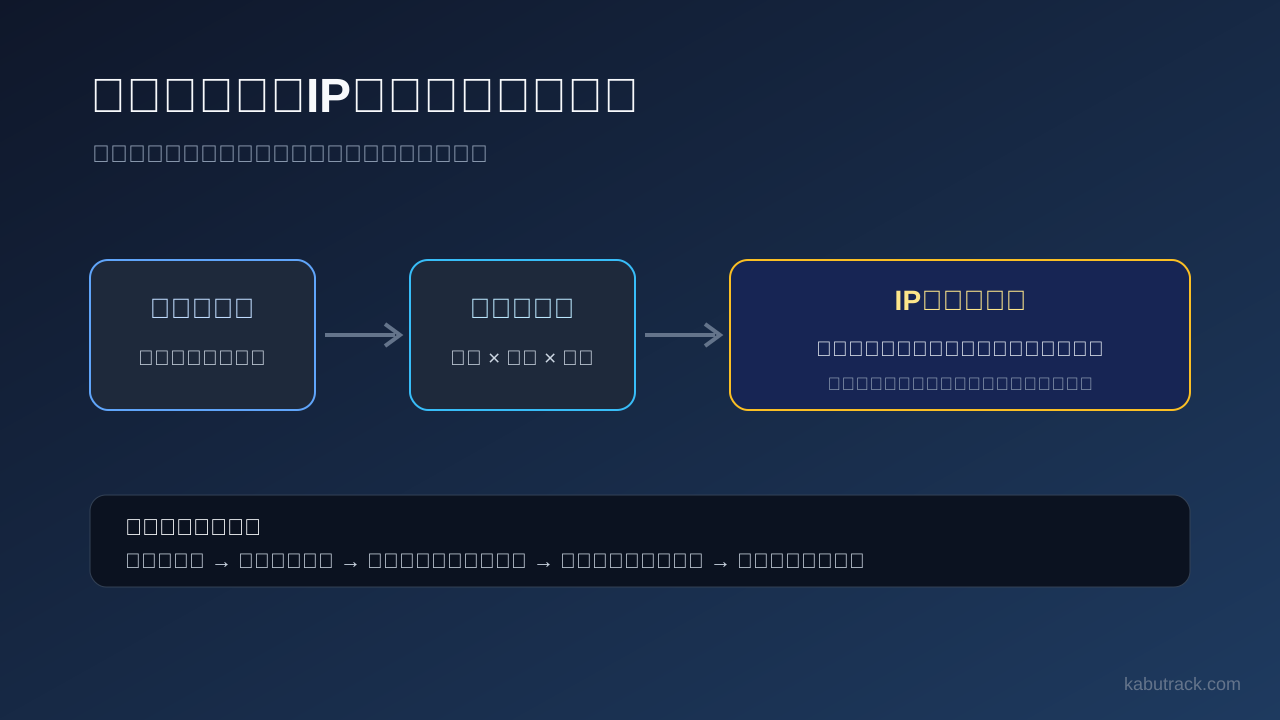
First, the conclusion
If you think of the movie industry only as an industry that attracts customers to movie theaters, you will misunderstand the differences between listed companies. The current revenue structure has expanded to include creating and distributing works, releasing them in theaters, and then developing rights for distribution, TV broadcasts, overseas sales, merchandising, games, and events.
What determines profitability here is how rights are held, rather than the point of sales. Companies that have a high stake in their own IP or major works, and can use them for secondary purposes both domestically and overseas, are more likely to accumulate profits even after they are released in theaters. Conversely, for companies that rely heavily on movie theater operations and contract production, even if customer numbers return, personnel costs, rent, capital investment, and a shortage of production personnel will put pressure on profits.
In other words, the investment issues are different even for "movie-related stocks." We should not use the same yardstick to compare companies like Toho, which integrates production, distribution, performance, and IP, anime IP companies like Toei Animation, and production support companies like IMAGICA GROUP.
Movie industry value chain
The movie business can be broadly divided into four categories.
| Area | Main revenue sources | Factors that affect profit |
|---|---|---|
| Planning and production | Production income, investment interest, copyright and merchandising rights | Production costs, investment ratio, hit rate, ownership of rights |
| Distribution | Distribution fees, distribution of box office revenue | Release scale, advertising costs, release timing, film composition |
| Entertainment | Tickets, food and beverages, product sales, advertising | Number of attendees, average unit price, occupancy rate, rent/personnel costs |
| IP/Secondary Use | Distribution, Broadcasting, Overseas Sales, Merchandising, Games, Events | Contract Terms, Overseas Penetration, Product Lifespan, Additional Costs |
Under the production committee system, even if a work becomes a hit, all profits do not belong to one company. Rather than estimating the contribution to business results based on box office revenue alone, we would like to check the investment ratio, whether there is distribution, and the scope of merchandising rights and overseas rights held.
Domestic market will recover rapidly in 2025, but dependence on works will remain
According to the Japan Motion Picture Producers Federation, domestic box office revenue in 2025 was 274,452 million yen, an increase of 32.6% from the previous year, and attendance was 188,756,000, an increase of 30.7%. The average admission fee is 1,454 yen and the number of screens is 3,697. Japanese movies accounted for 75.6% of the box office revenue.
The numbers are strong. The recovery in customer numbers coincided with an increase in unit prices. However, this does not mean that the overall market will grow at the same pace every year. The movie market fluctuates greatly from year to year depending on the release timing and success or failure of major films. What investors should look at is how much of the increase in box office revenue left behind in each company's operating income and cash, and whether they have a series of films that can be repeated next year.
Distribution services are not only an alternative to movie theaters, but also a new sales destination. Business opportunities exist for companies that can design a ``window strategy'' that creates awareness through theatrical release and recovers it through distribution and commercialization after a certain period of time. There is also the risk that the terms of distribution contracts may deteriorate and that viewing data may be controlled by platforms, so the quality of profits cannot be measured solely by an increase in the number of distributions.
List of major listed companies
The following are representative examples for easy comparison of domestic film and video value chains. Excludes companies that have a portion of their video business, such as general electronics and telecommunications companies.
| Company | Main position | Points for investors | Main risks |
|---|---|---|---|
| Toho (9602) | Production/Distribution/TOHO Cinemas/IP/Anime | Will it be possible to expand profit sources from movies to IP/anime? Overseas expansion | Expected advance, product cycle, recovery of large investment |
| Toei (9605) | Production, distribution, entertainment, and copyright of film and television works | Multiple use of rich video assets and overseas profits | Dependency on hits, production costs, personnel and equipment costs |
| Shochiku (9601) | Video, Kabuki/Theater, Real Estate | Utilization of rights to video and theater, revenue structure including real estate | Fluctuations in video, theater fixed costs, asset efficiency |
| Toei Animation (4816) | Anime production/overseas sales/copyrights | Overseas/copyright revenue, long-term monetization by work | High market expectations, concentration of works, release cycle |
| KADOKAWA (9468) | Publication IP, animation/live-action video, games | Recovery power from original creation to media mix | Production investment, game fluctuations, business complexity |
| Tokyo Theater (9633) | Video, real estate, food and beverages | Profitability of independent distribution and entertainment and complementation of non-video business | Thin profit margins, depreciation of works, store fixed costs |
| IMAGICA GROUP (6879) | Content production, video production technology, games, and industrial video | Orders from planning to editing, localization, and distribution delivery | Personnel costs, operating rates, contract profitability, business restructuring |
Toho (9602): Trying to reevaluate from integrated type to IP/anime type
In addition to planning, producing, and distributing movies and operating TOHO Cinemas, Toho also has a licensing business for TOHO animation and Godzilla. It is symbolic that the "IP/Anime Business" has been made an independent segment from the fiscal year ending February 2026. In order for the market to evaluate the company as an IP company that can operate over the long term, rather than as a hit company at the domestic box office, it will need to continue expanding overseas sales and licensing profits.
Now comes the difficult part. The higher the evaluation of IP strategies, the more the problem of ``pricing'' arises, where stock prices react more slowly even when good news emerges. I want to track not only the number of films and box office revenue, but also the profit margin, investment return, and overseas ratio of the IP/anime business.
Toei (9605) and Toei Animation (4816): Even within the same group, the way profits are generated is different
Toei has a broad base that includes theatrical films, television films, distribution, box office, post-production, and archives. Our strength is that we can distribute, commercialize, hold events, and expand our long-standing video assets overseas.
Toei Animation relies heavily on anime production, copyrights, and overseas sales, making it more like an IP revenue company than a movie company. While it is easy for the market to evaluate high profit margins and overseas expansion, expectations rise accordingly. Even if the company's performance is good, it is easy to take profits when there is a trough in the main product or when the next big IP is not in sight.
Shochiku (9601): View not only movies but also theater and real estate
In addition to producing, distributing, and presenting movies, Shochiku also develops theater, mainly Kabuki, and real estate. Comparing the hit rates of individual movies makes it hard to see, and the point of contention is the use of assets, including video copyrights, distribution of theatrical content, and real estate income.
Owning multiple businesses helps diversify profits, but theaters and real estate require capital and fixed costs. Rather than recovering sales, we want to see whether the operating profit margin and profits relative to invested capital continue to improve.
KADOKAWA (9468): The strength of having the original work and the complexity of the business
Starting with publishing and IP creation, KADOKAWA also expands into animation, live-action video, games, web services, and education. The ability to turn original works into films and expand them into games and merchandise is a strength that companies specializing in film do not have.
However, you can't judge a company's achievements just by looking at the success or failure of a single movie. The timing of investments in publishing, anime, and games is delayed, and even if a hit product comes out, it is sometimes difficult to see its contribution to company-wide profits. Investors are looking at the lifetime value (LTV) per IP, overseas sales, and the balance between production investment and operating cash flow rather than the number of titles.
Tokyo Theater (9633) and IMAGICA GROUP (6879): Profitability management comes first in surrounding areas
Tokyo Theater has video, real estate, and food and beverage facilities. Although it has the uniqueness of distributing and showcasing mini-theater-type works, it is dangerous to short-circuit it by thinking that it is stable because it has real estate and food and beverages. The first thing to do is to see if there will be operating income and cash left after absorbing the depreciation costs of video works and store costs.
IMAGICA GROUP is not a movie company, but rather a group of companies that support video planning, production, editing, localization, and distribution delivery. The increase in demand for video provides an opportunity to receive orders, but profits are likely to fluctuate due to the utilization rate of personnel and equipment, the unit price of projects, and the restructuring of the production system. Profitable based on order volume. This is quite important.
KPIs to watch for movie-related stocks
When comparing companies, the following order is easy to use.
- Entertainment: Number of attendees, average unit price, screen occupancy rate, food and beverage sales
- Works: Number of releases, concentration of hits, production/investment ratio, advertising costs and depreciation costs
- IP: Distribution/merchandising/overseas sales, copyright profits, number of years of continuation, regional composition
- Profitability: Segment operating profit margin, operating cash flow, content investment amount
- Leading indicators: Scheduled releases, production pipeline, contracted distribution projects, overseas expansion regions
What we need to be especially careful about is not to directly link box office revenue to the profits of listed companies. Revenues are split between distribution companies, theaters, production committees, and rights holders, and advertising and depreciation costs are also incurred. When news of a big hit comes out, I want to break down the question of ``who will get it, when, and how much will be left over.''
Bullish and bearish scenarios
Bullish scenario
Domestic customer numbers will be maintained, and overseas distribution and merchandising, especially anime, will grow. Multiple works contribute throughout the year, reducing dependence on a single work. At theaters, the average price per customer increases due to premium screenings, live viewing, and food and beverage sales, while for IP companies, royalty income with low additional costs boosts profit margins.
Bearish scenario
Due to the slump in major works and the postponement of release, only production and advertising costs are ahead. At movie theaters, personnel costs, rent, and utility costs are rising, making it difficult for a recovery in customer numbers to lead to profits. In distribution, the unit price per contract does not increase, and even in overseas expansion, localization costs and marketing costs cannot be recovered. For stocks where expectations are concentrated on popular IP, even if the numbers are not bad, the valuation can drop just because of a slowdown in the growth rate.
Wrap-Up
The movie industry is not just concerned with box office recovery. For each investment destination, it is necessary to differentiate whether to obtain movie theater operation, hit production/distribution, long-term profits from IP, or demand for production technology.
A market recovery in 2025 is a tailwind, but the numbers are already known. What changes the company's evaluation from this point on is not the one-shot hit, but the reproducibility of profits, including overseas, distribution, and commercialization. Operating income is more than box office revenue, and cash is more than operating income. And will the profits remain even after reinvesting in the next work? That is the essence of looking at movie-related stocks.
Related pages
- Toho (9602) Analysis: Will it transform from a movie company to an IP platform company?
- Structural analysis of publishing/IP companies including KADOKAWA
- Content tourism-related stocks: the difference between IP holders and transportation companies
Source
- [Japan Film Producers Federation "Latest Eiren Presentation Materials"] (https://www.eiren.org/toukei/) (2025 National Film Overview, confirmed August 1, 2026)
- Toho "Company Profile", "Management Philosophy/Strategy" (confirmed on August 1, 2026)
- Toei “IR Library” (Business details/management materials, confirmed August 1, 2026)
- Toei Animation “Business Content” (confirmed on August 1, 2026)
- Shochiku "Company Information" (confirmed August 1, 2026)
- KADOKAWA “Business Introduction” (Confirmed August 1, 2026)
- Tokyo Theater “What is Tokyo Theater?” (confirmed on August 1, 2026)
- IMAGICA GROUP "What is IMAGICA GROUP" (confirmed on August 1, 2026)