
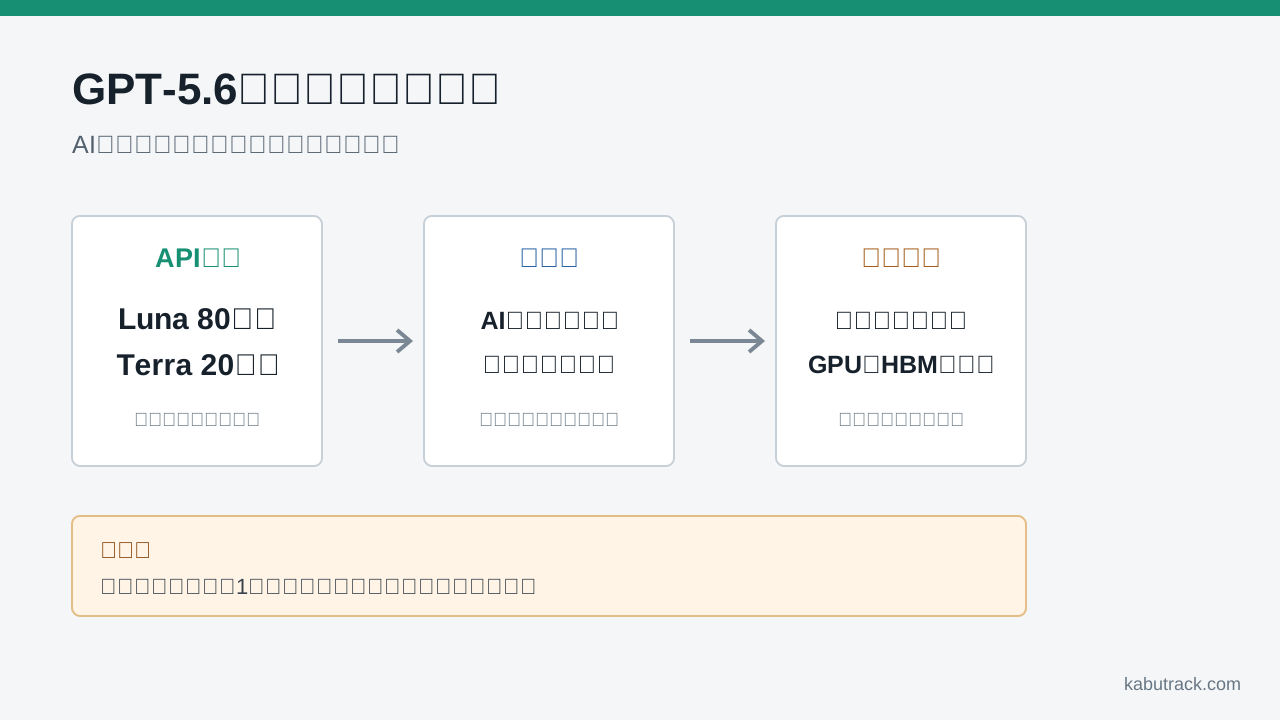
First, the conclusion
This price reduction indicates that the generative AI market has progressed from the ``stage of competing for the highest performance'' to the stage of disseminating performance that can be used for different purposes. In particular, Luna's price tends to change the profitability of operations with a large number of cases, such as inquiry classification, document processing, routine code creation, and background AI agents.
This could be a medium- to long-term tailwind for AI-related stocks. However, there is no basis for buying semiconductor stocks all at once. At the same time, OpenAI is making its models, inference systems, routing, and context management more efficient, allowing it to do more work with the same computational resources. Even if demand increases, the required GPU time does not necessarily increase at the same rate.
The formula the market should look at is simple.
AIインフラ総需要
= 利用件数 × 1件当たりの処理量 × 1トークン当たりの計算負荷
Lower prices push up usage. On the other hand, increasing the efficiency of the model reduces the amount of processing and calculation load. What affects stock prices is who wins.
What's happening?
OpenAI's announcement date was July 30th in the US and confirmed in Japan on July 31st. The changes are as follows.
| Model | Positioning | Input price | Output price | Changes |
|---|---|---|---|---|
| GPT-5.6 Sol | High performance/complex operations | $5.00 | $30.00 | Standard price remains unchanged |
| GPT-5.6 Terra | Balancing performance and cost | $2.00 | $12.00 | 20% price reduction |
| GPT-5.6 Luna | Large volume/low cost processing | $0.20 | $1.20 | 80% price reduction |
Price is per 1 million API tokens. Luna's cached input is $0.02, Terra's is $0.20, and Sol's is $0.50.
Additionally, OpenAI has replaced Priority Processing in the API with Fast mode. GPT-5.6 Sol offers up to 2.5 times the speed of standard processing at twice the standard price. This is an option for companies that want to buy time without changing the model's intelligence level.
What's important here is that this announcement isn't just about cheap models. It has become easier for companies to use different models within a single workflow, with Luna for high-volume processing, Terra for daily tasks, and Sol for tasks that are difficult to judge or require low latency.
Structural change: From the unit price of AI to the “cost of one successful job”
What really makes a difference when companies introduce AI is not just the price of 1 million tokens. If response accuracy is low and re-execution and manual corrections increase, business costs will not come down even if the API unit price appears to be low.
On the other hand, if a low-priced model can produce sufficient quality, applications that were previously not cost-effective will begin to be used. These include summarizing all call center cases, sorting a huge amount of company documents, organizing sales records, software testing, and routine agent processing.
In the future, the focus of competition will shift from the performance of individual models to the next set of indicators.
| Items to check | Meaning from the company's perspective |
|---|---|
| AI processing cost per item | Did the price reduction lead to an actual cost reduction |
| Task success rate | Is it profitable even if it includes re-execution and manual correction |
| Number of uses/active usage | Has it not stopped at the demonstration experiment but has become established in daily work? |
| Human processing time | Did the effects of the introduction appear in the expense ratio and processing capacity |
| Gross profit margin/ARPU of AI functions | Has increased usage been converted into sales and profits |
Lower prices will widen the entry point. However, it is not the ``company that uses AI'' that gains profits, but rather the company that uses the reduced inference to increase the unit price per customer or reduce operational costs.
Beneficial area Japanese stocks are viewed separately by distance
AI application/implementation support
The closest ones are companies that incorporate external models to provide services. If API costs fall, it will be easier to improve gross profit even with the same price, and the company will be able to expand its focus to small-scale customers and large-volume processing, which were previously unprofitable.
However, the barriers to entry will also fall at the same time. Adding AI functionality alone can easily lead to price competition. What investors should look at is the retention rate, ARPU, gross profit margin, processing time reduction, and the connection with customer data and business flow rather than the number of AI implementations.
Cloud Data Center
If the amount of AI usage increases, it will be a tailwind for the utilization rate of inference infrastructure, storage, and networks. Among Japanese stocks, stocks such as Sakura Internet (3778) are likely to be seen in the context of domestic cloud and data center investment.
However, even if sales increase, if capital investment and electricity costs take precedence, it will be difficult to make a profit. I would like to check the GPU utilization rate, order backlog, power security, depreciation burden, and operating profit margin all at once.
Optical communication/Electric cable
If inference traffic increases and investment in connections between data centers continues, demand for optical-related products could spread to Fujikura (5803) and Furukawa Electric (5801).
This area is likely to be bought with expectations for AI infrastructure already factored in. It is too early to raise earnings forecasts based solely on news of price cuts, and the focus will be on whether optical-related orders, product mix, room for increased production, and profit margins will exceed expectations.
Semiconductor inspection/manufacturing equipment
Advantest (6857), Tokyo Electron (8035), Disco (6146), SCREEN Holdings (7735), KOKUSAI ELECTRIC (6525) is likely to be more sensitive to performance when investments in GPUs, HBM, advanced logic, and advanced packages expand.
However, there is a long way from API price reduction to equipment orders. This is because cloud companies' usage increases, existing GPU utilization rates rise, semiconductor manufacturers decide to increase production, capital investments, and equipment orders are received. Lasertech (6920) is also likely to be associated with investment in cutting-edge semiconductors, but its main field is related to EUV masks, and its connection to daily inference volumes is more indirect.
Headwind area Cheap AI also makes competition cheap
Declining API prices not only lowers costs for existing AI services, but also lowers the hurdles for competitors to enter. Services that do not have proprietary data, customer bases, sales networks, or the ability to integrate into business systems risk narrowing the gap in functionality and being forced to lower prices.
There are other headwinds in cloud and semiconductors. OpenAI has indicated its policy to extract more processing from the same computational resources by improving the efficiency of its inference infrastructure. Even if usage increases, if efficiency improvements are faster, the timing for equipment expansion will be pushed back.
And in stock prices, expectations move before performance. Even if AI-related stocks are bought when they become available, if there is no visible change in orders or profit margins in the next financial results, they are likely to run out of material. Even if the theme is correct, if the stock price has already factored in the future several years ahead, the upside will be heavy.
KPIs that investors should look at
| Layers | Indicators to track | Changes that lead to bullish decisions |
|---|---|---|
| AI models/apps | API usage, cost per successful task, retention rate, ARPU | Increase in usage and gross profit improvement at the same time |
| Cloud/DC | GPU utilization rate, backlog of orders, power capacity, capital investment | Expansion continues while maintaining utilization rate |
| Telecommunications/Electric Wires | Optical-related orders, product mix, production increases, profit margins | Volume increases outweigh price cuts and cost increases |
| Semiconductors | GPU/HBM shipments, inventory, and capital investment plans | Increase in actual demand shifts to additional investment |
| Manufacturing equipment | Orders, shipments, advanced investment ratio, China ratio | Investment in AI is reflected in orders and profits |
The quickest way to check in the short term is the usage volume and unit profitability of the AI service. To determine whether the impact has spread to semiconductor equipment, it is necessary to look at capital investment plans and orders received every few quarters.
Risk scenario
Bullish scenario
In response to the price drop, AI agents and mass document processing will spread rapidly, and the amount of token usage will exceed the improvement in model efficiency. Cloud utilization increases, leading to additional investments in GPUs, HBM, and networks. In this case, the performance effects will first spread to AI services and data centers, and then to electric wires and semiconductor equipment.
Neutral scenario
Although usage will increase, infrastructure demand will only increase moderately as inference efficiency and cache utilization progress. While cost improvements can be seen with AI apps, there are differences between cloud and semiconductors depending on the number of companies receiving them and product mix. At present, this view is the most reasonable.
Bearish scenario
As price competition becomes more intense, AI service companies are unable to protect their gross profits by passing on price reductions to customers. Growth in usage is also slower than efficiency improvements, raising doubts about the recovery of cloud capital investment. Semiconductor and data center stocks, which are highly anticipated, have a difficult time reacting even to good financial results.
[Summary]
The price reduction of GPT-5.6 is a major factor in promoting the spread of AI. In particular, Luna's 80% price reduction will expand the scope for moving previously high-cost, high-volume, repetitive tasks to AI. Fast mode also shows that there is a growing market that pays not only for low prices but also for processing time.
However, this does not mean that Japan's semiconductor-related stocks will immediately see a significant improvement in performance. Will usage increase as the price goes down? Will computing demand grow faster than efficiency improvements? Will cloud companies make additional investments? The market waits for answers in this order.
News is a tailwind. We still need to be selective about how this will be communicated to our business results.
Related pages
- Advantest (6857) Financial results for the first quarter of the fiscal year ending March 2027
- Tokyo Electron (8035) Financial results for the first quarter of the fiscal year ending March 2027
- Fujikura (5803) Full-year financial results for the fiscal year ending March 2026