
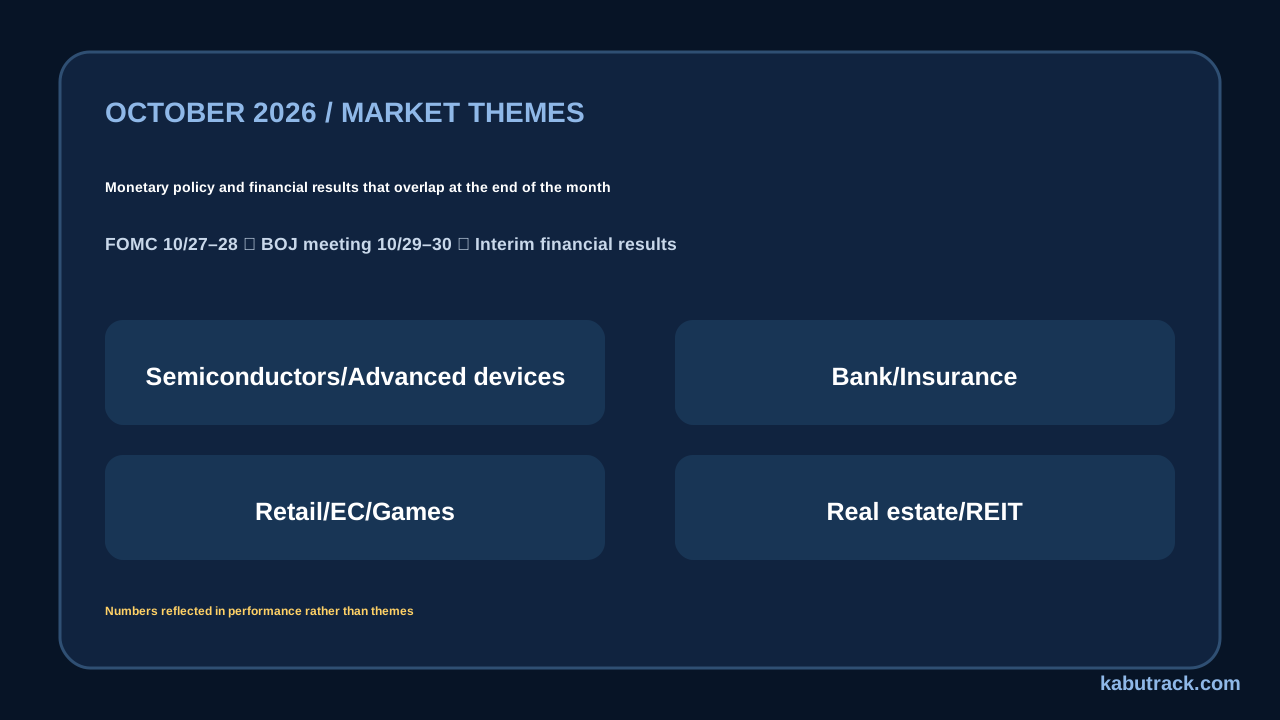
At the end of October, monetary policy and financial results coincide.
According to the Bank of Japan's schedule, the monetary policy meeting will be held on October 29th and 30th, and the FOMC will be held on October 27th and 28th according to the US Federal Reserve's calendar. NRI and ZOZO are scheduled to announce their financial results for the second quarter of the fiscal year ending March 2027 on October 29th.
The timing when interest rate outlooks are reflected in stock valuations is close to the timing when companies' earnings and full-year forecasts are released. Rather than deciding on stocks based on the results of meetings, the focus is on how much each company's profits can absorb changes in interest rates and demand. Since the earnings announcement dates are subject to change, the latest IR schedules of each company are used as the standard before making announcements.
Semiconductors and advanced devices | Will AI investment reach orders?
Even if AI infrastructure investment continues, there will be a lag before it shows up in the sales of domestic equipment and material manufacturers. Will customers' capital investments turn into orders, order backlogs turn into sales, and will it be possible to maintain profit margins? Orders, backlog, inventory, and gross profit margin reflect that path.
Even in the semiconductor industry, customers and business results vary depending on front-end equipment, inspection equipment, back-end equipment, and materials. AI and HBM headlines alone are not enough to buy. If capital investment postponement or inventory adjustment is seen, the reaction is likely to be stronger for stocks with higher expectations.
Banking/Insurance | Comparing interest margin improvement and bond evaluation
Rising interest rates can push up banks' lending margins and insurance companies' new investment yields. However, there are times when rising interest rates on deposits and valuation losses on bond holdings reduce profits. By arranging deposit costs, return on funds, credit costs, and bond valuations, we can see how far the benefits of rising interest rates will remain.
After the meeting, the market will focus not only on the policy interest rate, but also on the speed at which interest rates are rising. A sudden rise in interest rates has ripple effects on bond prices, the economy, and the repayment ability of borrowers. The evaluation of bank stocks is determined not only by interest rate levels, but also by the composition of each company's assets and liabilities.
Retail/EC/Games | Will year-end sales remain profitable?
In retail and restaurant business, not only the growth in same-store sales, but also the number of customers, average spend per customer, gross profit margin, and inventory are important. Even if sales are generated through sales promotions, profits will be difficult to increase if discounts and logistics costs increase. The same is true for e-commerce, where sales growth cannot be separated from sales promotion and delivery costs.
For games, revenue is determined not only by the release schedule, but also by the number of consoles sold, the software attach rate, digital sales, and recurring charges. Nintendo Switch 2 launched in June 2025. In October 2026, the focus is demand for consoles and software during the year-end shopping season and companies’ sales forecasts, beyond the hardware launch itself.
Real estate/REIT | Will rent growth exceed borrowing costs?
Rising interest rates will affect real estate companies and REITs through borrowing costs and property valuation yields. The deciding factor is whether rent revisions and improvements in utilization rates can compensate for the increase in interest payments. For offices, the clues are rent and vacancy rate, and for residential and commercial facilities, utilization rate and rental income are clues.
Even if the interest rate rises the same, the impact will vary depending on the fixed/floating loan ratio, repayment period, and LTV. In addition to rent, we track how changes in refinancing conditions and interest payments affect dividends and profits.
Don’t use October seasonality as a buy or sell signal
The market rule of thumb, such as “October will be firm”, will have different results depending on the aggregation period and the treatment of dividends. Past averages do not guarantee future price moves. Seasonality should not be used as a conclusion for buying or selling, but should be kept as a hypothesis that can be verified using targeted long-term data such as TOPIX.
Conclusion
The end of October coincides with monetary policy and interim financial results. The focus is on orders and profit margins for semiconductors, interest margins and bond evaluations for finance, sales and inventory for retail and gaming, and rent and funding costs for real estate and REITs.
The outcome of an industry cannot be determined by the event schedule alone. I would like to select themes based on the interest rate outlook after the meeting and the company's numbers, and whether the results are consistent with the expectations raised by the stock price.
Related Articles
- Should I buy Kioxia (285A) or pass it on? Latest shareholder structure and AI NAND market price drop risk
- The core of the AI semiconductor bubble | How far will Tokyo Electron (8035) grow in 2027
Sources
- Bank of Japan “2026 Monetary Policy Meeting Schedule”
- Federal Reserve「October 2026 Calendar」
- Nomura Research Institute “IR Event”
- ZOZO “IR Schedule”
- Nintendo “Nintendo Switch 2 will be released on June 5, 2025”
*Meeting and settlement dates are published information as of October 1, 2026. Subject to change. When making investment decisions, refer to each company's latest disclosures.