
What is the core/satellite strategy?
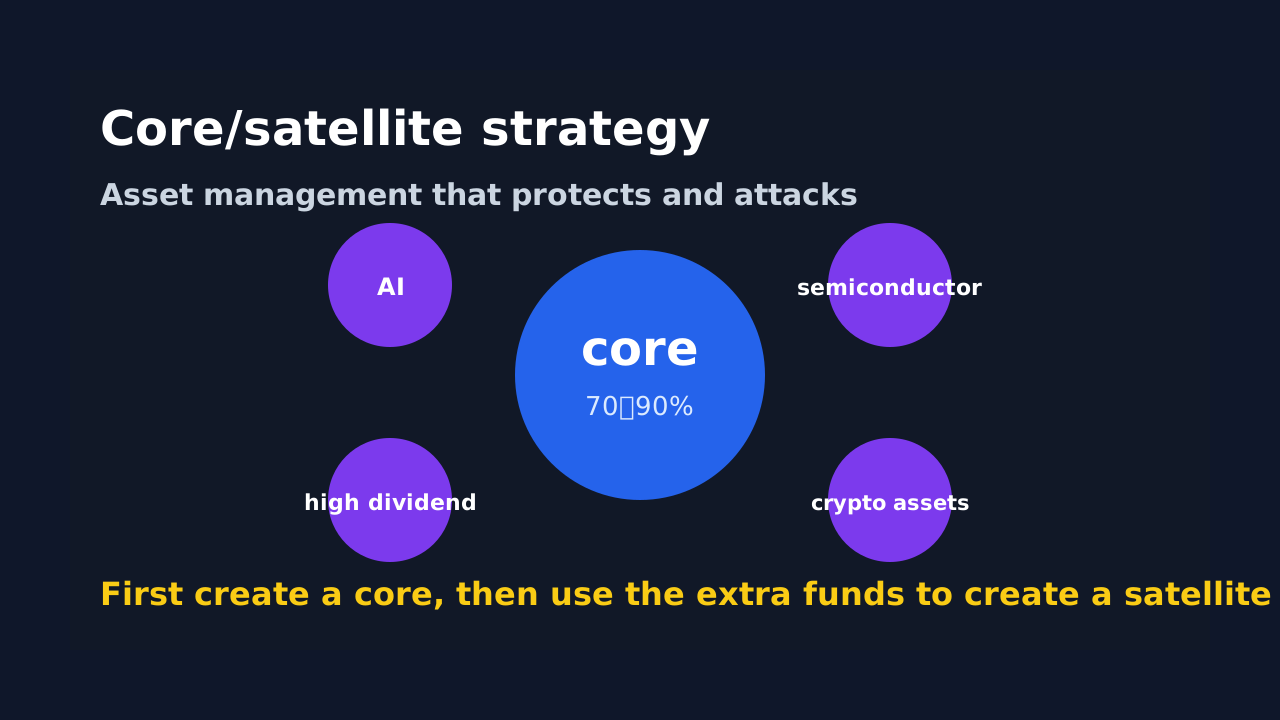
The core-satellite strategy is a concept that divides assets into "core" and "peripheral" areas.
The image is as the name suggests.
        satellite
            ●

● ● ● Core ● ● ●

            ●
        satellite
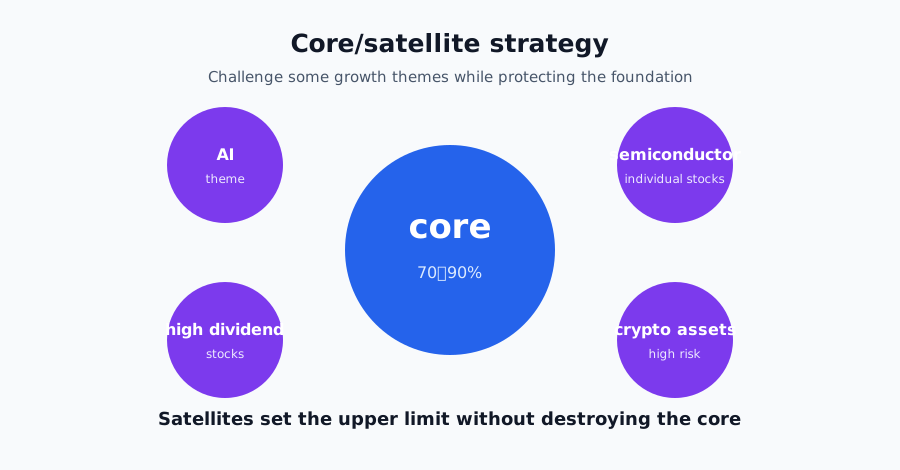
The core at the center is the foundation of asset formation.
Surrounding satellites are used for growth themes and individual investment ideas.
The good thing about this strategy is that it doesn't make all your investments "safe" or "aggressive".
You can protect the portion that you want to increase over the long term, while still leaving a little room to invest according to your own ideas.
What are core assets?
Core assets are assets that aim for stable growth over the long term.
Since it is the center of all assets, a diversified product is better than one whose price movements are too volatile.
Representative examples are as follows.
- World stock index
- US stock index
- Developed country stock index
- balanced fund
- bond funds
- Part of cash/deposits
Core assets are the foundation of a house.
If the base is weak, it will not be stable even if you put fancy decorations on top.
The same goes for investing. If AI stocks or crypto assets are successful, they may increase significantly, but if you put most of your assets there, it will be difficult to continue when the market goes down.
The purpose of core assets is not to win big in the short term.
Our aim is to create a situation where we can continue for a long time while capturing the growth of the entire market.
What is a satellite asset?
Satellite assets are assets that aim for high returns around the core.
Typical examples are as follows.
- AI related stocks
- semiconductor stocks
- high dividend stocks
- Emerging market stocks
- small cap stocks
- individual stocks
- REIT
- crypto assets
- Thematic investment trust
Satellites act like growth engines.
If all goes well, you will be able to aim for higher returns than operating with just the core.
However, the price movements will also be large.
For example, semiconductor stocks have seen a significant rise due to the AI boom. On the other hand, they may be sold all at once due to the capital investment cycle, rising interest rates, or inventory adjustments.
The same goes for crypto assets. It's intense when it goes up, but it's also intense when it goes down.
Satellites are not the main role in asset building, they are just additional engines rather than training wheels. If you overload the engine, it will be difficult to drive.
Specific example: When investing 1 million yen
Here, let's consider the case of investing 1 million yen.
Example 1: For beginners
Core 900,000 yen
└ World stock index

Satellite 100,000 yen
└ AI-related stocks, individual stocks, etc.
This is enough to start with.
If the satellite rate is 10%, even if it were to drop by half, the impact on the entire asset would be around 5%. It's psychologically easier to continue.
Example 2: Emphasis on stability
Core 900,000 yen
├ Global stocks
└ Bonds/Cash

Satellite 100,000 yen
└ High dividend stocks/individual stocks
If you are not good at price movements, you may choose to include bonds or cash in your core.
Satellites will also be more stable if they focus on high dividend stocks and large-cap stocks rather than crypto assets and small-cap stocks.
Example 3: Aggressive type
Core 700,000 yen
└ S&P500 linked products

Satellite 300,000 yen
├ Semiconductor stocks
├ High dividend stocks
└ Crypto assets
This is quite aggressive.
This is for people who have investment experience and can continue to save and hold stocks even if the price goes down. If a beginner suddenly decides to use satellite at 30%, he or she will feel anxious when the market is bad.
Recommended ratio for beginners
There is no one correct answer to the core to satellite ratio.
However, if you are a beginner, it will be easier to manage if you start with the following.
| investment experience | core | satellite | Comment |
|---|---|---|---|
| Beginner | 90% | 10% | First, make the base |
| Intermediate | 80% | 20% | Expand your thematic investments a little |
| Advanced | 70% | 30% | For those who are familiar with price movements and trading management |
The important thing is to periodically review the ratio once you decide on it.
For example, let's say that Satellite's AI stock has risen significantly and now accounts for 40% of your total assets.
At this time, if you leave it as is because it is profitable, you may find that most of the risk is biased toward AI stocks.
If the ratio deviates significantly, take a portion of the profit and return it to the core. This is rebalancing.
Benefits
Easy to manage risk
Since the core supports the assets, even if a satellite fails, damage to the entire system can be easily suppressed.
For example, if the satellite is 10%, even if that portion declines by 30%, the impact on the entire asset will be about 3%.
Of course you don't want to lose, but it's easier to continue betting than betting on the same theme with all your assets.
Keep the fun of investing alive
Full index investing makes sense, but some people find it boring.
When I see AI, semiconductors, robots, defense, space, crypto assets, etc. on the news, I sometimes feel like buying some for myself.
Rather than completely eliminate that feeling, it is more realistic to set an upper limit as a satellite frame.
Good for long-term investment
The basics of asset building is to continue investing for a long time.
Learn at the satellite while continuing to accumulate at the core. This will increase your investment experience.
If you own a small amount of individual stocks on satellite, you will be able to see financial results, interest rates, foreign exchange, and industry news. This will also help you learn about investing.
Disadvantages
satellite becomes too large
This is the most common failure.
first
core 80%
Satellite 20%

a few years later
core 30%
Satellite 70%
Individual stocks and theme stocks, which you initially intended to hold only a small amount, will eventually become the majority of your assets.
It feels good when it's going up, but when it goes down, it suddenly becomes painful.
Satellites need to be managed when they increase in number.
buying and selling increases
The satellite part is more responsive to news and stock prices.
More buying and selling means more fees, taxes, and emotional decisions.
Especially when you follow a trending stock on social media, you may find that the moment you buy it, it hits the ceiling.
The core may collapse
When people lose money on satellites, some people want to sell their core assets as well.
This is something you want to avoid.
The core is the long-term foundation. If you sell the core and take on more risk to recover from the failure of the satellite, your entire wealth creation will collapse.
common misconceptions
Core is not profitable
That's not true.
Index investing like global stocks and S&P 500 just doesn't look flashy in the short term.
Over the long term, you can capture corporate earnings growth, dividend reinvestment, and global economic expansion.
Although its core is modest, it plays a fairly strong role in asset formation.
Satellite is the main character
In fact, it's the opposite.
The main role of asset formation is the core.
Satellites are a place to test out your investment ideas. It would be great if I won, but the main premise is to make sure that even if I lose, my life and future plans will not be ruined.
All satellites should be high-risk products
Just because it's a satellite, it doesn't necessarily have to be a crypto asset or small-cap stock.
Satellite stocks include high dividend stocks, REITs, ETFs with specific themes, and stocks from emerging countries with slightly different regions.
There's no need to buy something you don't understand just because it's a satellite product.
Diagram: Role of core and satellites
Starting order for beginners
For beginners, it is more stable to start from the core than from the satellites.
The order is as follows.
- Secure livelihood defense funds
- Start accumulating core assets with NISA etc.
- Continuing the monthly savings amount without difficulty
- Create a satellite slot with extra funds
- Check the ratio once or twice a year
If you start investing without a life insurance fund, you may be forced to sell when the market is bad due to sudden expenses.
First, cash. Next is the core. Finally, the satellite.
This order is very important.
Summary
The core-satellite strategy is an investment method that allows you to attack while defending.
The basic idea is simple.
- Core: Foundation for asset formation
- Satellite: Challenge frame aiming for high returns
- For beginners, 90% core and 10% satellite is enough.
- Rebalance if the satellite gets too big
- Create life defense funds and long-term savings first
Investing is not just about winning.
It's about making it sustainable.
Build a foundation with the core and attack a little while learning with the satellites. If you can maintain this balance, it will be much easier to continue investing.