
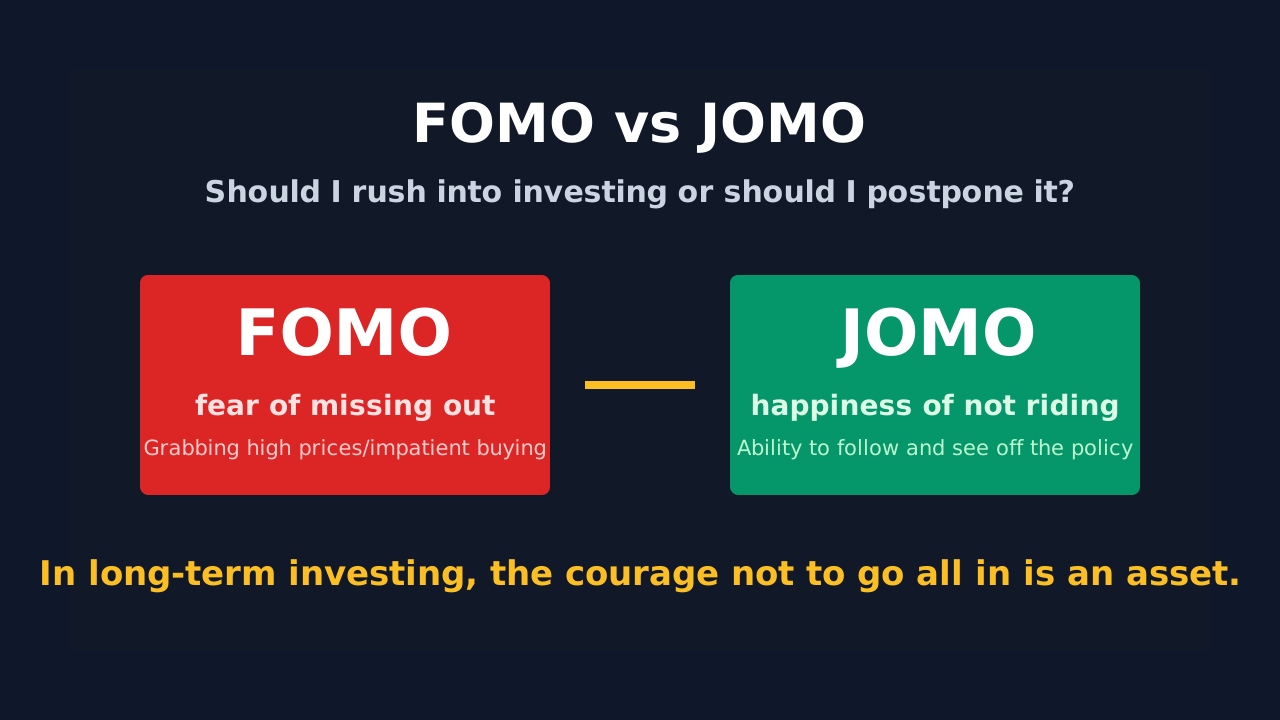
A quick guide to FOMO and JOMO
First, let's sort out the differences.
| Item | FOMO | JOMO |
|---|---|---|
| english | Fear Of Missing Out | Joy Of Missing Out |
| Japanese image | fear of missing out | happiness of not riding |
| emotion | impatience, anxiety, jealousy | peace of mind, satisfaction, margin |
| investment behavior | Easy to jump on with high price | It is easy to decide to pass on |
| distance from information | Easy to be swayed by SNS and news | Easy to choose the information you need |
| Compatibility with long-term investment | tends to get worse | likely to get better |
However, JOMO does not mean "ignoring all opportunities".
There's a difference between researching a good investment opportunity and passing it on, and not thinking about it at all because it's a hassle.
What is FOMO?
FOMO stands for Fear Of Missing Out.
In Japanese,
fear of being left behind
Anxiety about missing the train
It is translated as
Originally, it is a word that is often used in the context of social media and human relationships.
For example, if you see a friend's travel, drinking party, or event posts,
I am not the only one participating
↓
I feel like I missed the fun place.
↓
I feel anxious
That's the psychology.
In the investment world, this can be even more pronounced.
Because money is involved.
FOMO common in investing
Investment FOMO generally occurs as follows.
Trending themes are on the rise
↓
More success stories on SNS
↓
I feel like I'm the only one who doesn't have it
↓
I bought it before researching it.
Typical examples include crypto assets, AI-related stocks, semiconductor stocks, theme-based investment trusts, and individual stocks that are rapidly rising.
Bitcoin and crypto assets
Cryptocurrency assets such as Bitcoin are an area where FOMO is likely to occur due to large price movements.
price goes up
↓
Increase in profit reporting on SNS
↓
I feel like if I don't buy it now, I'll never be able to buy it.
↓
buy at high price
This kind of mentality is not uncommon.
The problem is that the reason people buy something is not because they understand it, but because they don't want to be left behind.
AI boom and semiconductor stocks
The same thing happens with AI stocks and semiconductor stocks.
Investing in companies that are doing well is not a bad thing in and of itself.
However,
It has the word AI attached to it.
everyone is buying
stock prices are rising
If you buy just for that reason, you may jump on it after expectations have been built in.
Even if the company is good, if the purchase price is too high, the return on investment will be poor.
This is the scary part of FOMO.
The problem with FOMO
The problem with FOMO is that investment decisions are based too much on emotion.
Common mistakes include:
| Behavior due to FOMO | likely outcome |
|---|---|
| buy after a spike | Grasping high prices |
| See only success stories around you | underestimate the risk |
| concentrate on one theme | Great damage when falling |
| can't admit loss | Loss cuts and reviews are delayed |
| See prices daily | stress increases |
Investments bought with FOMO become difficult to judge when they go down.
This is because my basis for this is weak in the first place.
Why did you buy it? How long will it last? Under what conditions should you review it? If there is ambiguity around this area, you will suddenly become anxious when the price drops.
What is JOMO?
JOMO stands for Joy Of Missing Out.
In Japanese,
enjoy not riding
Sense of security of not participating
It's a word similar to
In terms of investment, JOMO's philosophy is as follows.
It's a hot topic
↓
But I can't understand
↓
Risks are also difficult to read.
↓
I'll skip it this time
This is not bearish.
It's a decision that protects your money, time, knowledge, and risk tolerance.
JOMO for investors
In long-term investing, there are situations where JOMO's sense is useful.
For example, let's say you see the following post on social media:
I made a lot of money with AI stocks.
How many times have your assets increased with crypto assets?
I make a profit every month from short-term trading.
When you see stories like this, it's natural to feel anxious.
Still,
I will continue accumulating the index.
Don't destroy your livelihood defense fund
Don't buy products you don't understand
No concentrated investment
If you can decide, that's an attitude close to JOMO.
The important thing is to decide what you won't do.
When it comes to investing, there are times when deciding not to do something is more effective than doing more.
JOMO accepts opportunity losses
JOMO also has a slightly strict side.
It's about accepting the opportunity cost.
It is common for stocks that have been shelved to rise further.
I saw you off
↓
It went up even more
↓
frustrating
This feeling will never go away.
However, you don't have to ride every rise in investing.
It is important to continue to take actions that are reproducible to the extent that you can understand them.
JOMO is not about becoming a "person without regrets".
Even if you feel frustrated, don't break your rules.
FOMO happens in life too.
FOMO isn't just about investing.
It appears in various situations in life.
- SNS
- job change
- side job
- marriage
- home purchase
- Qualification acquisition
- trendy services
For example,
Everyone is starting a side job
Everyone is changing jobs and increasing their annual income.
Everyone is using new SNS
When you come into contact with this kind of information, it becomes easy to feel that ``I have to do it too.''
Of course, it's important to take on challenges.
However, if you pursue things that are not aligned with your goals, you will run out of time and money.
In life and investing, you don't have to ride everything.
Specific ways to reduce FOMO
It's difficult to completely eliminate FOMO.
However, it can be reduced considerably.
1. Write down your reasons before buying
Before investing, write down your reasons, even if it's just one line.
why buy
how long does it last
What to do if it goes down
If you cannot write this down, you may be trying to buy an investment with FOMO.
2. Set your budget first
Decide in advance the amount you will spend on the investment you are talking about.
For example,
Core assets: index accumulation
Satellite investment: up to 5-10% of assets
This is how to divide it like this.
This way, you can participate in topics you are interested in for a small amount of money while making it less likely to disrupt your household finances and long-term asset formation.
3. Reduce time spent looking at social media
FOMO is exacerbated by too much information.
In particular, profit reports are noticeable on social media.
Loss reports may be few and only success stories may seem significant.
If you feel anxious watching it every day, just setting a time to watch it can help.
4. Decide on your own investment policy
If you don't have an investment policy, your investment policy will fluctuate every time the topic comes up.
At a minimum, you should decide on the following three things.
- how much to invest each month
- What should you mainly buy?
- how much risk do you take
With this foundation in place, you will be less likely to get sucked into FOMO.
How to use FOMO and JOMO
FOMO isn't all bad.
It can also be an opportunity to learn about what is happening in the world.
The problem is that people buy it out of impatience.
On the other hand, JOMO is not a panacea either.
If you put things off, you'll miss out on learning and investment opportunities.
What is important is the following order.
I'm curious
↓
examine
↓
compare it with your own policy
↓
decide whether to buy or pass on
If you can follow this flow, you will be less likely to be swayed by emotions whether you buy or pass on.
Summary
FOMO is the fear of missing out.
JOMO is the feeling of enjoying not riding.
In investing, FOMO can lead to high price grabbing and overly concentrated investments.
JOMO does not just ignore popular investments.
It's the ability to pass on things that don't fit your understanding, budget, risk tolerance, and investment policy.
What is important in asset formation is
It's not about whether others made money, but whether you can stick to your plan.
It is.
There's no need to rush and ride everything.
Continue making investments that you understand and within reason.
This down-to-earth attitude is a powerful weapon in long-term investing.
Source/reference materials
- Cambridge Dictionary, FOMO
- Merriam-Webster, JOMO Definition & Meaning
- Przybylski et al., Motivational, emotional, and behavioral correlates of fear of missing out, Computers in Human Behavior, 2013
- Confirmation date: 2026-05-30