The beginning of the 20 million yen problem in retirement
The issue of 20 million yen for retirement became a hot topic after a 2019 Financial Services Agency-related report.
The Financial Services Council Market Working Group report ``Asset Creation and Management in an Aging Society'' discussed not only public pensions, but also the idea of building assets after retirement and extending the lifespan of assets as people live longer.
As a model case, the monthly income and expenditure shortfall of an unemployed elderly couple was shown, and it became widely believed that the shortfall could be around 20 million yen, assuming a long retirement period.
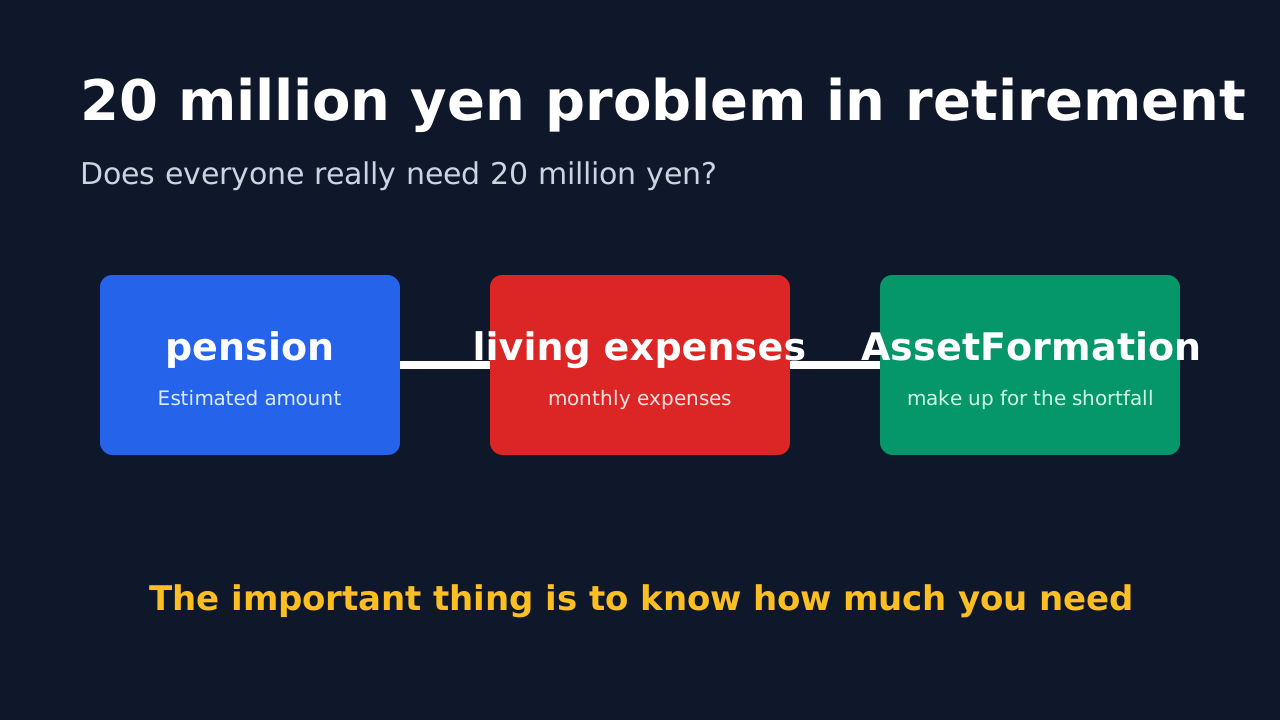
The important point here is that this is an `estimate for a certain household budget model'' and does not mean that `all Japanese people need the same amount of money.''
Why was it said to be 20 million yen?
The idea is fairly simple.
Approximately 55,000 yen short each month
×
12 months
×
30 years
=
Approximately 19.8 million yen
Roughly speaking, if you continue to have a monthly deficit of 50,000 yen for 30 years, you will end up with a shortfall of nearly 20 million yen.
Only this number took on a life of its own. It certainly has an impact. However, the cost of living in retirement differs from household to household. The pension amount is also different. Housing costs are also different. There is no guarantee that the cost of living will remain the same for 30 years.
Therefore, it is best to view 20 million yen not as an "absolute amount" but as "a starting point for calculating your own shortfall."
The actual amount needed varies greatly from person to person.
Even at the same retirement age, the required funds can vary considerably.
| conditions | Trends in required funds |
|---|---|
| Own your home and pay off your mortgage | tends to be less |
| Rental life | tends to be too much |
| Welfare pension and corporate pension available | tends to be less |
| Self-employed, mainly on national pension | tends to be too much |
| Work even after retirement | tends to be less |
| Medical and nursing care costs increase | tends to be too much |
| Continued support for children and parents | tends to be too much |
For example, if the husband and wife are both company employees and receive welfare pensions, and the household owns a home with no mortgage, it may be possible to make a living plan with less than 20 million yen.
On the other hand, if you are renting and have to continue to pay housing costs, are self-employed and mainly rely on the national pension, and would like to have plenty of provisions for medical and nursing care expenses, 20 million yen may not be enough.
There are limits here even when looking at average values. You have no choice but to replace it with your own household budget.
Considering 2026, 20 million yen is not the target amount.
If you think about it in 2026, retirement funds are a little more complicated than they were in 2019.
There is a rise in prices. We do not know what will happen to our own medical and nursing care costs in the future. As life expectancy increases, the period over which assets can be depleted also increases.
If you think about it that way, 20 million yen is not a goal where you can feel safe if you save this much.
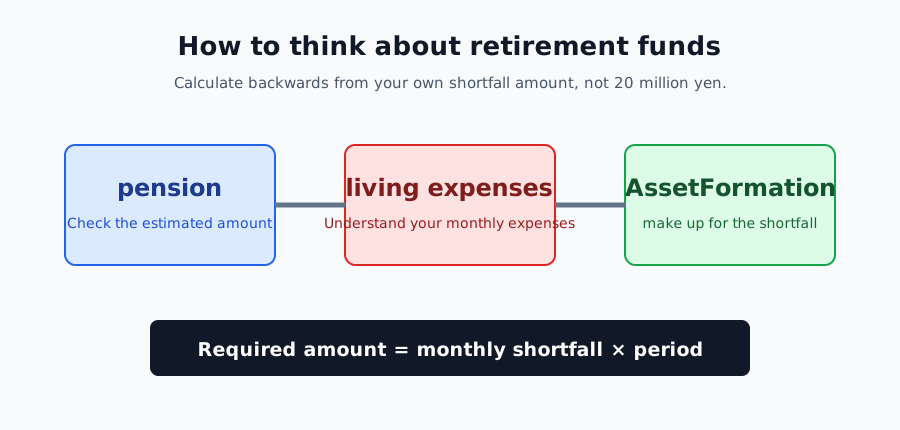
Rather, it is more practical to think of it as follows.
Monthly expenses after retirement
-
Pension/retirement income
=
Monthly shortfall

Monthly shortfall
×
12 months
×
Estimated number of years
=
Required withdrawal funds
For example, if you are short by 30,000 yen every month, you will end up with 10.8 million yen in 30 years. If you are short 80,000 yen every month, it will be 28.8 million yen in 30 years.
Even for the same 30 years, the answer will be completely different if the monthly shortfall is different.
The first thing to check is the estimated pension amount.
When thinking about retirement funds, the first thing you want to check is your estimated pension amount.
The Japan Pension Service's ``Nenkin Net'' allows you to estimate the amount of pension you are expected to receive in the future. Rather than looking at average amounts or news figures, looking at the expected amount based on your own subscription record is closer to reality.
Especially for the following people, it is easy to deviate from the average amount alone.
- People who change jobs often
- People who have a period of freelance or self-employment
- People who have a mixed period of Employees' Pension and National Pension
- People who have an exemption period or non-payment period
- Husband and wife work in very different ways
Even if you think about whether you need 20 million yen without knowing the amount of your pension, it will be quite vague.
You can't determine the amount you need unless you know your expenses.
The next thing to look at is spending.
When calculating your retirement funds, it's more likely to be about expenses than income. If you calculate it with the same mindset as when you were working, you will overlook the expenses that will decrease after retirement and the expenses that will increase.
| expenditure item | Changes that are likely to occur in old age |
|---|---|
| housing costs | If you own a home, it's easy to reduce it. Continues if rented |
| food expenses | It often does not decrease significantly. |
| Transportation expenses | Commuting costs will decrease, but may increase due to hospital visits and travel. |
| medical expenses | tends to increase with age |
| Nursing care costs | The timing and amount of occurrence are difficult to read. |
| insurance premium | It may be reduced by reviewing |
| Hobbies/Travel | This may increase immediately after retirement. |
If you actually want to do this, it is sufficient to first divide your current living expenses into fixed costs and variable costs.
Fixed costs: housing costs, communication costs, insurance premiums, cars, taxes, etc.
Variable expenses: food expenses, daily necessities, medical expenses, entertainment expenses, travel, etc.
If you just start building assets without looking at this, your target amount will be vague.
Long-term investment is one way to fill the gap
When it comes to building funds for retirement, an increasing number of people are considering long-term investments using investment trusts and ETFs, in addition to savings.
The reason is inflation. When prices rise, fewer things can be bought with the same 1 million yen. While deposits are highly safe, there are times when they are weak in protecting long-term purchasing power.
For example, if you save 30,000 yen every month for 20 years, the principal alone will be 7.2 million yen.
30,000 yen
×
12 months
×
20 years
=
7.2 million yen
If investment income is added to this, the future amount may be larger than the principal. The basic formula for compound interest is as follows.
A = P × (1 + r)^n

A: Future amount
P: Principal
r: Yield
n: number of years
However, investments are subject to loss of principal. Because it's your retirement fund, it's important to consider how to combine deposits, bonds, investment trusts, ETFs, etc., rather than putting all your money into stock-type products.
common misconceptions
If you don't have 20 million yen, you will go bankrupt in old age.
Not necessarily.
People with large pensions, low living expenses, no housing costs, and people who work after retirement may need less.
On the other hand, even if you have 20 million yen, it doesn't necessarily mean you have peace of mind. You may need more if you have large expenses, continue to rent, have heavy nursing care costs, or are concerned about longevity risks.
Pension alone is always enough
I can't say this either.
Pensions are the foundation of retirement, but they may be insufficient depending on your standard of living and household finances. In particular, self-employed or freelancers who rely on the national pension are more likely to have to provide for themselves than employees.
You should prepare with just a deposit.
A deposit is required. It is best not to put too much of your life defense fund or money that will be used in the near future into investment products that have price fluctuations.
However, if you keep all your money in savings for 20 or 30 years until retirement, you may be vulnerable to inflation.
Balance safety and growth. This is realistic when it comes to building funds for retirement.
Illustration: Consider retirement funds in terms of "pension, expenditures, and asset formation"
Summary
The issue of 20 million yen in retirement became popular as a warning that ``pensions alone are not always enough.''
However, if you are too tied to the 20 million yen figure itself, you will end up making a mistake in your judgment.
It's simple.
- Check the estimated pension amount on Nenkin Net etc.
- Estimate your retirement expenses from your current living expenses
- Calculate monthly shortfall
- Prepare with a combination of deposits and long-term investments
Your retirement funds are determined by your own household budget, not by someone else's average amount.
20 million yen is not a number to be scared of. This is the first step to calculating how much you need in your case.
Source/reference materials
- Financial Services Agency, Regarding the publication of the Financial Services Council “Market Working Group” report
- Financial Services Agency, Financial Services Council Market Working Group Report “Asset Creation and Management in an Aging Society”
- Japan Pension Service, Estimated pension amount using “Nenkin Net”
- Confirmation date: 2026-05-30