What is the 50 million yen problem in retirement?
The 50 million yen retirement problem is an extension of the 20 million yen retirement problem and the 30 million yen retirement problem.
The issue of 20 million yen for retirement, which became a hot topic in 2019, was triggered by the Financial Services Council Market Working Group report ``Asset Creation and Management in an Aging Society''. In the model case, the idea that monthly income and expenditure shortfalls accumulate over a long period of time is about 20 million yen.
After that, some people began to think that 30 million yen was necessary in light of rising prices and longer lifespans.
The 50 million yen problem is an expression that assumes households with larger expenditures, households with smaller pensions, and households that desire a more comfortable retirement.
It is not an official uniform standard. If you make a mistake here, your anxiety will only increase.
Why does the number 50 million yen appear?
The reason is that if the monthly shortfall increases, the amount will quickly increase over the long term.
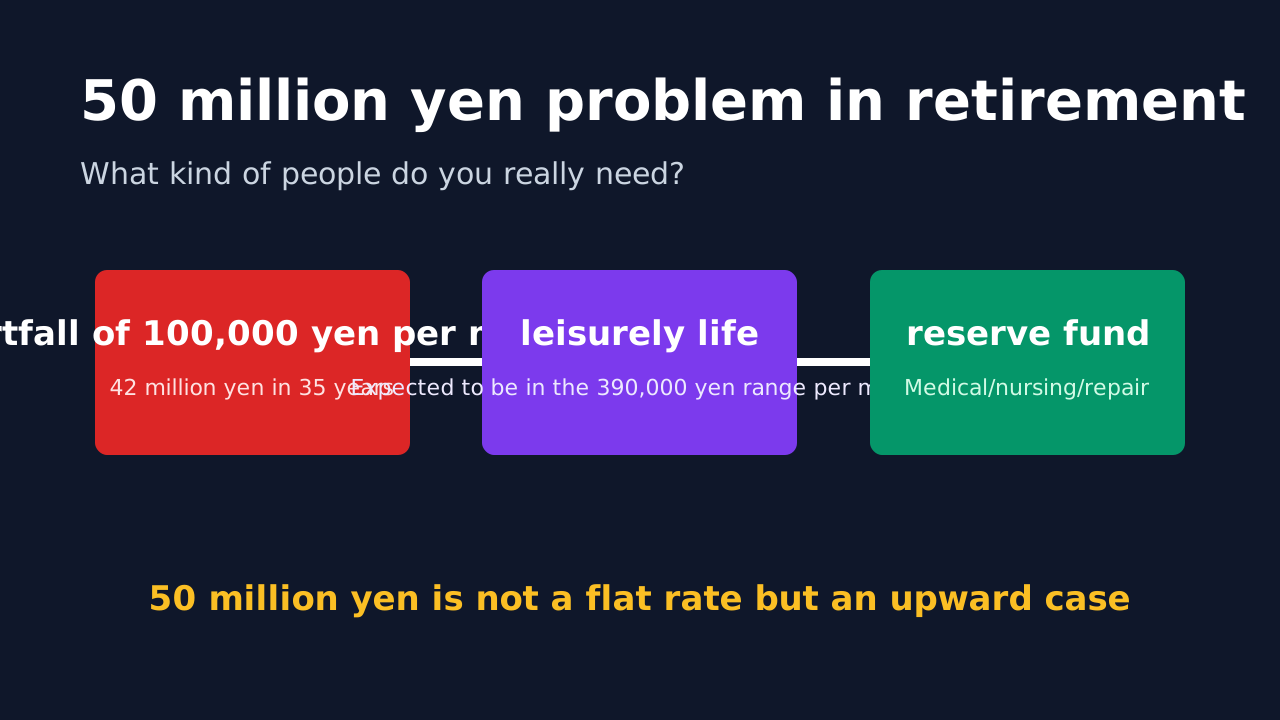
Case 1: Shortage of 100,000 yen every month for 35 years
Let's assume you retire at age 65 and live until age 100.
If your pension income alone is 100,000 yen short each month, the required withdrawal amount is 42 million yen.
Shortage of 100,000 yen every month
×
12 months
×
35 years
=
42 million yen
At this point, it has already exceeded 40 million yen.
Furthermore, if you consider the following costs, 50 million yen becomes more realistic.
- medical expenses
- Nursing care costs
- Housing repair costs
- Replacement of home appliances and cars
- Support for children and grandchildren
- reserve fund
Retirement funds are not just about monthly living expenses. There are also unexpected expenses.
Case 2: Imagine a comfortable retirement
According to the Life Insurance Culture Center's 2025 "Survey on Life Security," the average amount of "comfortable retirement living expenses" for a married couple is 391,000 yen per month.
For example, if your monthly pension income is 220,000 yen and your monthly expenses are 390,000 yen, you will be short 170,000 yen each month.
Shortfall of 170,000 yen every month
×
12 months
×
30 years
=
61.2 million yen
This is a very loose case. If you take a closer look at travel, hobbies, entertainment expenses, housing maintenance expenses, etc., you can find estimates of over 50 million yen.
However, this is not the "average minimum cost of living." This is the case if you want to live a comfortable life.
People for whom 50 million yen is realistic
When the following conditions are met, the figure of 50 million yen suddenly becomes not so far away.
| conditions | Reasons why shortfalls tend to increase |
|---|---|
| continue to live in rental housing | Housing costs continue even after retirement |
| Welfare pension is low | Monthly pension income decreases |
| Mainly self-employed/freelance | It is easy to focus on the national pension |
| Retirement allowance is low | Lack of sufficient capital |
| live in the city | Rent and living costs tend to rise |
| long-lived family | Cancellation period tends to be long |
| I want to enjoy traveling and hobbies. | Leisure costs increase |
| I want to take a closer look at nursing care costs. | reserve funds are required |
Particularly large are rent and pension amounts.
The amount of funds required differs considerably between households that own their home and have paid off their mortgage in full and households that continue to pay rent even after retirement. Furthermore, if the national pension is the main focus, the monthly shortfall is likely to be large.
Many people don't need up to 50 million yen.
Conversely, if the following conditions are met, you may not need up to 50 million yen.
| conditions | Reasons why shortfalls tend to be small |
|---|---|
| Own your home and pay off your mortgage | Easily reduce housing costs |
| Employees' pension for both husband and wife | Relatively large pension income |
| Retirement allowance/company pension available | Initial assets increase |
| Working after age 70 | The start of withdrawal can be delayed |
| Can manage expenses | You can reduce your monthly shortfall |
| Have medical/nursing care insurance and preparations | Easy to deal with unexpected expenses |
In this case, a retirement plan of around 10 million to 30 million yen may be possible.
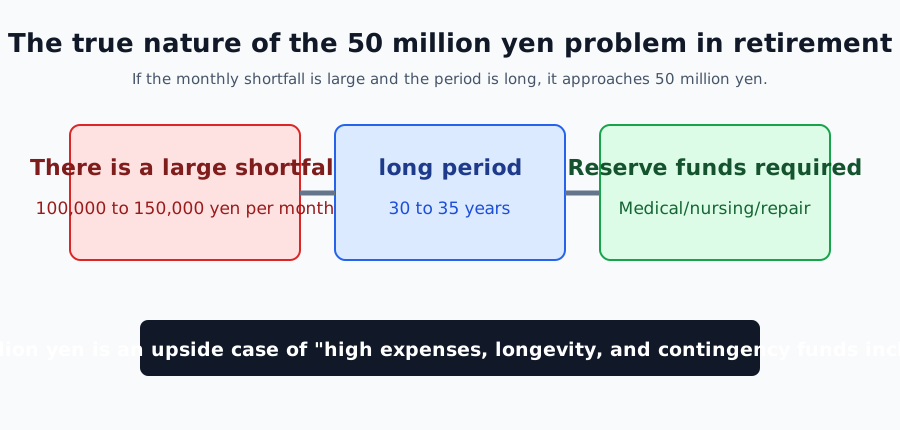
In other words, 50 million yen is not a "standard amount." This is an upside case that occurs in households with large expenditures and households that desire a comfortable retirement.
What really matters is how much you don't have each month.
You can pretty much organize your retirement funds using the following formula.
required funds
=
Monthly shortfall
×
12 months
×
years of retirement
+
reserve fund
-
A lump sum of income such as retirement allowance
For example, even for the same 30 years, the results can vary greatly depending on the monthly shortfall.
| Monthly shortfall | 30 years worth | 35 years worth |
|---|---|---|
| 30,000 yen | 10.8 million yen | 12.6 million yen |
| 50,000 yen | 18 million yen | 21 million yen |
| 80,000 yen | 28.8 million yen | 33.6 million yen |
| 100,000 yen | 36 million yen | 42 million yen |
| 150,000 yen | 54 million yen | 63 million yen |
If you look at this table, you can understand the true nature of the 50 million yen problem.
If your household budget is short by 150,000 yen every month, it will be 54 million yen in 30 years. On the other hand, if you are short by 30,000 yen every month, it will be 12.6 million yen even in 35 years.
What I want to be aware of from 2026 to 2035
Looking ahead to the next 10 years, the debate over retirement funds is likely to become even more individualized.
There are three reasons.
- When prices rise, the amount of money required to live the same life increases.
- As lifespans increase, the period during which assets are depleted becomes longer.
- Differences in pension amounts are likely to occur due to diversification of work styles
The pension amount in old age will differ depending on those who have been enrolled in the Employees' Pension as a company employee for a long time and those who have been self-employed or freelance for a long time. The presence or absence of retirement benefits also makes a difference. It also depends on when you pay off your mortgage.
Therefore, it is dangerous to simply apply the 50 million yen problem in retirement to yourself.
The first thing you need to look at is your expected pension amount, current assets, retirement allowance, housing costs, and up to what age you will work. These five.
You can still adjust if you are in your 40s or 50s.
If you are in your 40s or 50s, you can still adjust your retirement funds.
For example, you can:
- Make long-term, accumulated, and diversified investments with NISA
- Utilize iDeCo and corporate DC
- Review the timing of paying off your mortgage loan
- Reduce fixed costs and create reserves
- Keeping the option of working until around age 70
- Decide in advance how you will use your retirement funds
In particular, the effect of working for several years after retirement is significant.
The amount of assets required will differ considerably between those who withdraw their assets immediately after the age of 65 and those who have some income until the age of 70. Not only do you have income, but you can also delay the start of depreciation.
Illustration: The true nature of the 50 million yen problem in retirement
Summary
The issue of 50 million yen for retirement is not a uniform amount required by public institutions.
However, if the monthly shortfall of 100,000 to 150,000 yen continues for 30 to 35 years, and if you take a closer look at medical expenses, nursing care costs, home repairs, etc., there are cases where funds of around 50 million yen are needed.
What you should look at is not the 50 million yen figure itself.
- How much pension can I expect?
- how much do you spend each month
- How much retirement money do you have?
- Will housing costs continue into retirement?
- Until what age do you work?
- How to withdraw assets such as NISA and iDeCo
Replace this with your own numbers.
It may seem like a worrying number, but when you break it down, it's simple. Retirement funds are determined by "monthly shortfall x number of years". The question is not whether or not 50 million yen is needed, but how much would be short in my case. It is realistic to think from there.
Source/reference materials
- Financial Services Agency, Regarding the publication of the Financial Services Council “Market Working Group” report
- Financial Services Agency, Financial Services Council Market Working Group Report “Asset Creation and Management in an Aging Society”
- Life Insurance Culture Center, How much do you think you need for living expenses in retirement?
- Life Insurance Culture Center, 2025 (Reiwa 7) Survey on Life Insurance
- Japan Pension Service, Estimated pension amount using “Nenkin Net”
- Related article: What is the 30 million yen problem in retirement? Explanation for beginners about how much money you need for retirement due to rising prices
- Confirmation date: 2026-05-30