
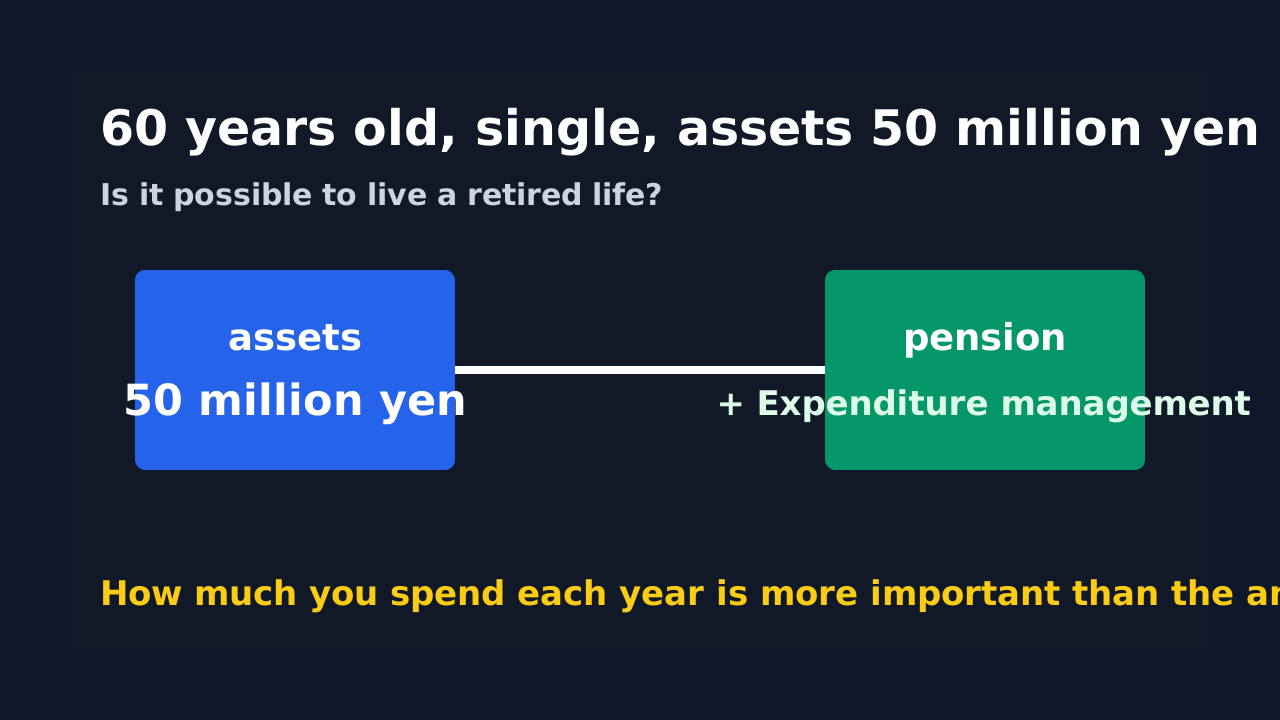
First, the conclusion
60 years old, single, and has financial assets of 50 million yen.
This is a very advantageous starting point for retirement funds in Japan.
In particular,
Financial assets: 50 million yen
Start receiving pension: 65 years old
Residence: Owned house
Living expenses: around 200,000 yen per month
With that in mind, a retirement life is well within your horizon.
However, it's also not a good idea to get too comfortable here.
35 years from 60 to 95 years old. You have 40 years to reach 100 years old.
Your retirement funds are determined not only by how much you have, but also by how much you lose each year.
Case 1: If you own a home and live on 200,000 yen per month
First, there are cases where you own your home and have a small rent burden.
If your monthly living expenses are 200,000 yen, your annual expenses will be 2.4 million yen.
200,000 yen × 12 months
= 2.4 million yen/year
Assume that you will receive a pension of 1.5 million yen per year after the age of 65.
In this case, the amount of shortfall after the start of the pension is as follows:
Annual expenditure 2.4 million yen
− Pension 1.5 million yen
= Shortfall amount 900,000 yen/year
According to a simple calculation, if 50 million yen is deducted by 900,000 yen per year, it will take about 55 years.
50 million yen ÷ 900,000 yen
≒ 55 years
Of course, there is actually a non-pension period between the ages of 60 and 64. There are also rising prices, medical costs, and home repair costs.
Still, if you own a home and your monthly expenses are around 200,000 yen, 50 million yen is a level you can easily afford.
Case 2: If you live in a rental property
When renting, the rent is the biggest deciding factor.
For example, if the rent is 80,000 yen and other living expenses are 120,000 yen, the total is 200,000 yen.
Rent: 80,000 yen
Living expenses 120,000 yen
Total 200,000 yen/month
At this level, it is not much different from the case of owning a home.
However, this changes quickly as the rent increases.
Rent 150,000 yen
Living expenses 150,000 yen
Total 300,000 yen/month
If your monthly expenses are 300,000 yen, your annual expenses will be 3.6 million yen.
If the annual pension after age 65 is 1.5 million yen, the shortfall is 2.1 million yen.
Annual expenditure 3.6 million yen
− Pension 1.5 million yen
= Shortfall amount 2.1 million yen/year
If you withdraw 50 million yen by 2.1 million yen per year, it will take about 24 years.
50 million yen ÷ 2.1 million yen
≒ 24 years
If you think from age 60, you can see how you can live until around age 90, but if you plan to age 95 or 100, you will have less leeway.
If you are going to retire by renting, it is very important to know how much you can keep the rent down.
Be careful about the non-pension period between the ages of 60 and 64.
If you quit your job at age 60 and start receiving your pension from age 65, you will live without a pension for the first five years.
If you live on 200,000 yen a month, that's 12 million yen in 5 years.
200,000 yen × 12 months × 5 years
= 12 million yen
If you pay 300,000 yen a month, that's 18 million yen over 5 years.
300,000 yen × 12 months × 5 years
= 18 million yen
This is an area that is often overlooked.
Even if you have 50 million yen, you need to think about how much you will have left at age 65.
Rough asset life by expenditure
Assuming that your annual pension is 1.5 million yen, a rough look at the shortfall after age 65 is as follows.
| monthly living expenses | annual expenditure | Difference from pension of 1.5 million yen | Simple asset life of 50 million yen |
|---|---|---|---|
| 180,000 yen | 2.16 million yen | 660,000 yen | about 75 years |
| 200,000 yen | 2.4 million yen | 900,000 yen | about 55 years |
| 250,000 yen | 3 million yen | 1.5 million yen | Approximately 33 years |
| 300,000 yen | 3.6 million yen | 2.1 million yen | about 24 years |
| 350,000 yen | 4.2 million yen | 2.7 million yen | about 18 years |
This is a simple calculation that does not include investment profits, inflation, taxes, and medical/nursing care costs.
However, what we do know is that it is expenditure that determines the lifespan of assets.
Even with the same amount of 50,000,000 yen, the results will be completely different for someone who lives on 200,000 yen a month and someone who lives on 350,000 yen a month.
How about using the 4% rule?
The 4% rule is a concept often used in FIRE.
Very roughly speaking,
If you have assets worth 25 times your annual expenses, it will be easier to maintain your assets over the long term.
That's the idea.
The calculation formula is as follows.
Required assets = annual expenditure x 25If the annual expenditure is 2 million yen, the required assets are 50 million yen.
2 million yen × 25
= 50 million yen
In other words, 50 million yen is a fairly strong level if your annual expenses are around 2 million yen.
However, the 4% rule is often talked about as a concept based on past data in the United States, and cannot be directly applied to Japan's tax system, exchange rates, inflation, investment products, and pension systems.
It is more realistic to use it as a reference indicator and recalculate it using your own expenses and pension.
Main risks from age 60
Even if you have 50 million yen at age 60, there are some risks in retirement.
1. Longevity risk
If you are between 60 and 95 years old, it is 35 years, and if you are up to 100 years old, it is 40 years.
Living a long life is a blessing, but longevity itself is a risk when it comes to estate planning.
Especially if you are single, it is difficult to rely on your family, so you need to think about the costs of nursing care and relocation on your own.
2. Inflation
200,000 yen a month now and 200,000 yen a month 20 years from now are not necessarily the same value.
As prices rise, the amount of money needed to maintain the same lifestyle also increases.
If you continue to hold on to your savings, your real purchasing power may decrease, even if the nominal amount does not decrease.
3. Medical/nursing care expenses
As you get older, your medical and nursing care expenses may increase.
It is important to have a reserve fund in addition to your regular living expenses.
If you want to prepare for a large amount of expenses, it will be easier to feel secure if you separate out a reserve fund of several million yen from your living expenses.
4. Operational risk
Some people use investment to extend the life of their assets.
However, if there is a large drop immediately after retirement, the withdrawal and investment loss may overlap.
When investing after the age of 60, it is important not only to increase your income, but also to have a design that allows you to secure your living expenses even if the income declines.
Example of allocation of assets of 50 million yen
There is no need to deposit the entire 50 million yen.
On the other hand, investing everything in stocks is also a considerable risk.
An example is the following allocation:
| assets | ratio | Amount image | role |
|---|---|---|---|
| Cash/Deposits | 30% | 15 million yen | Living expenses, non-pension period, sudden expenses |
| Bonds/term assets | 20% | 10 million yen | suppress price movements |
| stock index | 40% | 20 million yen | Anti-inflation measures, long-term growth |
| Other / Reserve slot | 10% | 5 million yen | REITs, individual stocks, reserve funds, etc. |
This is just an example.
In reality, it depends on your pension amount, expenses, whether you own or rent a home, your investment experience, and your tolerance for falling prices.
After the age of 60, keeping three to five years' worth of living expenses in cash will make it easier to avoid selling stocks when the market is bad.
Checklist to check before retiring
If you're thinking about retiring at age 60, you'll want to check the following points.
- Have you checked the estimated pension amount on Nenkin Net?
- Have you calculated the living expenses separately for those aged 60-64?
- Do you know your monthly living expenses based on actual results?
- If you own a home, are you planning on repair costs?
- If you are renting, are you considering rent increases and relocation costs?
- Do you have separate reserve funds for medical and nursing care?
- Have you decided how many years worth of living expenses you will have in cash in the event of a market crash?
- Do you have the option of working part-time even after retirement?
If you have confirmed this far, it will be much easier to see the level of security of 50 million yen.
Illustration: Points to consider when retiring with 50 million yen
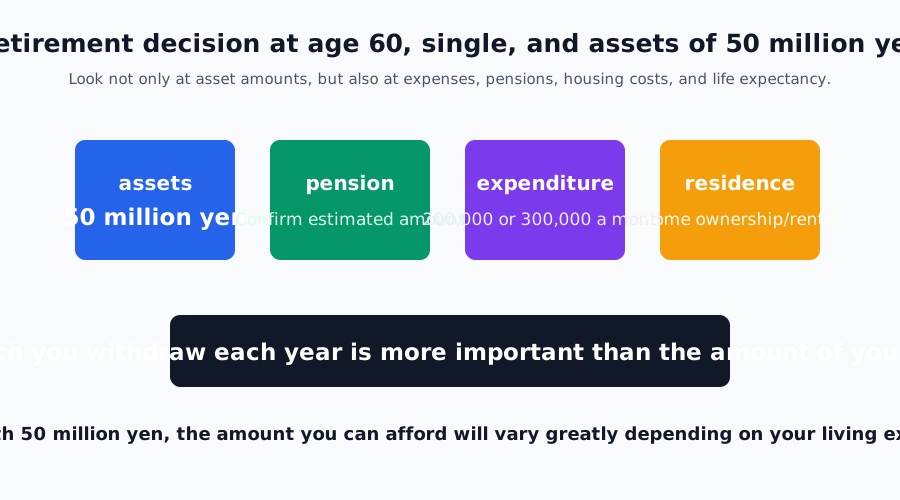
Summary
If you are 60 years old and single and have financial assets of 50 million yen, retirement is quite realistic.
In particular,
- Own a house
- Pension available
- Living around 200,000 yen per month
- Reserve funds available for medical and nursing care expenses
- Don't take too much operational risk
Under these conditions, you are in a strong position as a retirement fund.
However, if you are renting and the rent is high, your living expenses exceed 300,000 yen a month, or you will have no income at the age of 60, you need to look carefully.
What is more important is expense management than the amount of assets themselves.
How to protect 50 million yen, how to withdraw it, and how to combine it with pension.
If you can plan to this extent, your retirement life from the age of 60 will become much easier to foresee.
Source/reference materials
- Japan Pension Service, Estimated pension amount using “Nenkin Net”
- Ministry of Health, Labor and Welfare, My and Everyone's Pension Portal "What's going on with my pension?"
- Financial Services Agency, Basics of asset formation: NISA special website