
What is foreign tax deduction for U.S. shares?
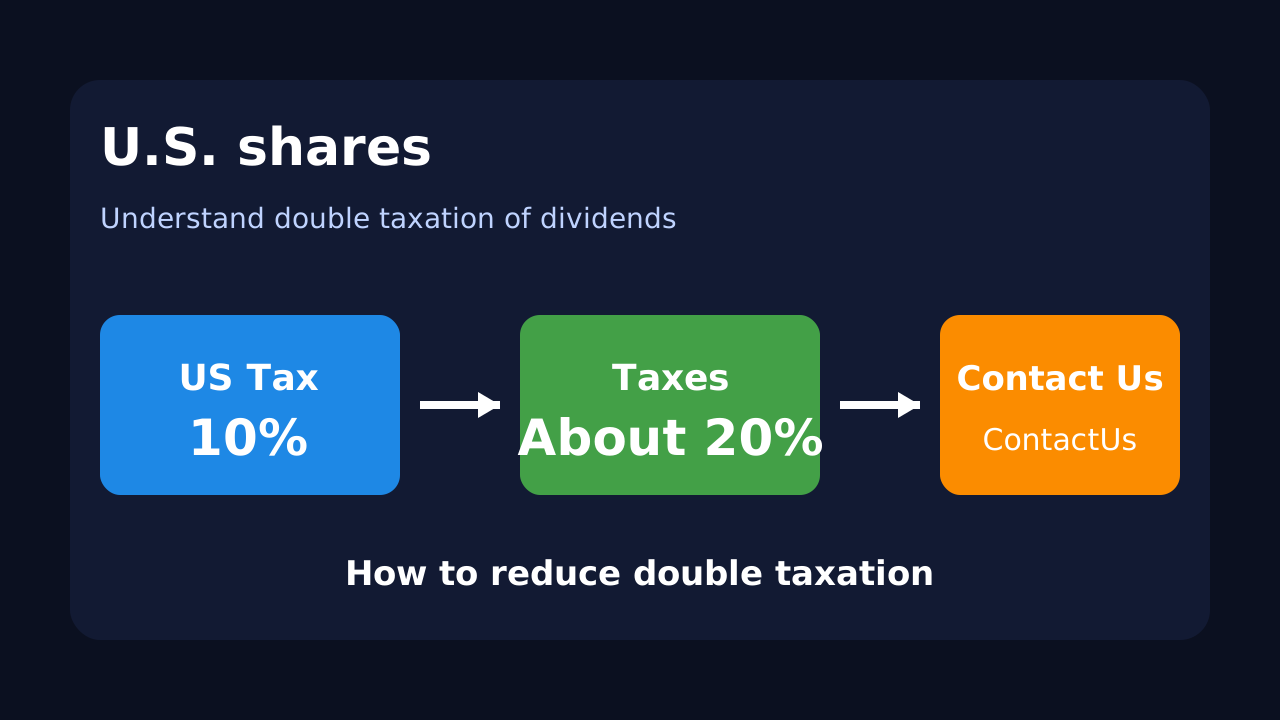
If you receive a dividend of U.S. shares, you will receive tax on the U.S. side.
For example, if the dividend is $100, it is the image that $10 in the United States is collected and the remaining $90 enters the Japanese securities account.
In addition, due to the taxation of dividends in Japan, there is a structure that makes it easy to double tax dividends.
Foreign tax deductions are available here.
Foreign tax deduction is a system that deducts the tax equivalent to the income tax paid overseas to a certain extent from the Japanese income tax amount.
It is close to practice to think of a system that adjusts the amount of tax and the limit of deduction on the Japanese side rather than "the tax drawn in the US always returns full".
Why is U.S. stock investment important?
In the U.S. stock investment, the difference in dividend tax is effective as long as it is.
Even if you don’t care for a small amount, the increase in dividend income will also increase the amount of tax in the United States.
| Annual dividend | 10% Estimate Drawn in USA |
|---|---|
| 10 | 1 year |
| 50 million yen | 5 |
| 100 million yen | 10 |
The more people who reinvest the dividend, the more the preparation after the tax is effective.
In particular, it is a case that has a high dividend ETF with a tax account.
- VYM
- HDV
- SPYD
These ETFs are attractive to dividends, but the more the dividends you receive, the more the tax you need to check.
Foreign tax deduction flow
1. Source collection in the United States
If a Japanese resident receives a dividend of U.S. shares, the U.S.-Japan tax treaty often has a 10% source tax rate.
In general, there are many cases in which investors can make a 10% declaration directly to the US because it is processed by the securities company side.
However, it may differ depending on the handling of symbols, products, accounts, and securities companies. The actual tax amount is confirmed in the dividend statement and annual trading report.
2. Taxed in Japan
idends received by tax account will be taxed in Japan.
In dividends of listed shares, etc. 20. 315%
In other words, since it is taxed by the Japanese side after the source is collected in the United States, it becomes easier to get down after taxation if nothing is done.
3. Apply for a deduction in a final declaration
In principle, tax deductions are required.
If you enter a foreign tax deduction in the final declaration, some or all of the taxes collected in the United States may be deducted from the Japanese tax amount.
The following documents are often needed:
- Annual trading report
- idend Statements and Payment Notices for Foreign Shares
- Foreign Tax Deduction
- Identification, My Number related documents
The name of the document is slightly different by the securities company. It is easy to work by downloading annual trading report and dividend statement before final declaration.
What happens with Nで
This is a place where beginners are easy.
。idend tax is not taxable on N。 accounts.
However, the U.S. source tax on the U.S. shares and U.S. ETF dividends remain essentially.
| 口座 | Taxes | US Tax |
|---|---|---|
| SpecialAccount | Close | Close |
| NISA | None | Close |
N。 has no tax on the Japanese side due to tax exemption.
Therefore, it is a little dangled if you think that it is completely zero tax because it is Nisa. Even if the Japanese side is tax-free, local tax of foreign shares may remain.
Foreign Tax Deduction
It is easy to consider foreign tax deductions:
- Have a U.S. stock or U.S. ETF in tax account
- idend income is large
- Operating mainly with high dividend ETF
- Accepts the accuracy of the final declaration
On the other hand, if the dividend is small, it depends on the person whether it is suitable for the declaration work.
The number of foreign tax deductions is limited to those operating in N。.
Before finely optimizing taxes, it is often more effective to choose investment amounts, products, and design for long term.
Common failure of beginners
Nなら is tax-free
N、 is a system to tax Japanese tax.
In foreign stocks and overseas ETFs, locally sourced tax may remain.
If you are a U.S. stock, you should be aware of 10% of the U.S. side.
Don't return
If you are receiving a U.S. share dividend on a tax account, you may miss the opportunity to use a foreign tax deduction.
Of course, the refund amount varies depending on income, tax and deduction limit.
It is enough to have a sense of distance that "check once if the dividend has increased."
Select by dividend yield
The higher the dividend, the better the tax.
Even if the surface yield is 4%, it will be lowered after tax. When looking at high dividend ETFs and individual high dividends, I would like to think about not only yield, but also post-tax return, exchange rate, and reduction risk.
Practical thinking in investment
Beginners are free of charge even if they don’t enter the tax optimization.
First, the following order is difficult to fail.
- Separate living defense funds
- Started investing in New Nisa
- Decentralize with low- investment trusts and ETFs
- Long-term
- Check tax if the dividend has increased
Typical US stock ETFs include:
- VOO
- VT
- VTI
However, whether ETF is good or investment trust is good depends on account, fee, tax, and ease of reinvestment.
Do you design dividends or focus on efficiency with investment trusts that don’t issue dividends? This is not just a preference, but also a post-tax collection.
Diagram

Foreign tax deduction is a system to adjust the tax paid overseas from the Japanese tax amount.
In U.S. stocks and U.S. ETFs, the U.S. source tax may be paid for dividends, and the U.S. may be taxed by the Japanese side.
T who have high dividend ETF and high dividends in tax accounts are worth knowing foreign tax deductions.
However, beginners do not need to worry about tax counter、s from the beginning.
First of all, long-term ownership and decentralized investment. If the dividend has increased, confirm the final declaration and foreign tax deduction.
This order is enough.
Taxation depends on individual circumstances. Please check the National Tax Agency, Securities Company, and Tax Accountant.