Why "How Much Per Month?" Is Harder Now
New NISA provides a larger tax-free investment quota than before.
That is a good thing. For long-term investors, tax-free investment gains can be a major advantage.
But the larger quota has also created new uncertainty.
"Am I missing out if I do not invest 100,000 yen a month?"
"On social media, 50,000 yen a month looks normal."
"Is 10,000 yen a month meaningless?"
Many people get stuck around these questions.
But New NISA is not a competition over household budgets. Rather than filling the tax-free quota quickly, it is more important to keep emergency savings and choose an amount you can continue even when prices fall.
Bottom Line: If Unsure, Start From 30,000 or 50,000 Yen
If you are unsure, using 30,000 or 50,000 yen as a starting reference is realistic.
30,000 yen a month is 360,000 yen a year. It is an amount that makes it easier to build an investing habit while keeping the household burden moderate.
50,000 yen a month is 600,000 yen a year. For people serious about retirement funding, it can make a meaningful difference to future assets.
100,000 yen a month is 1.2 million yen a year. It uses the full annual accumulation investment quota. It is a strong option for people with room in their budget, but it can be heavy for households with mortgages, education expenses, care costs, or job-change risk.
10,000 yen/month = get used to price movements
30,000 yen/month = balance household budget and investing
50,000 yen/month = build retirement funds in earnest
100,000 yen/month = fully use the accumulation quota
The important thing is not to guess the correct amount from the start. It is to set an amount that lets you keep investing even during a downturn or unexpected expense.
Principal Comparison
First, here is the principal only, without investment gains.
| Monthly Contribution | Principal After 10 Years | Principal After 20 Years | Principal After 30 Years |
|---|---|---|---|
| 10,000 yen | 1.2 million yen | 2.4 million yen | 3.6 million yen |
| 30,000 yen | 3.6 million yen | 7.2 million yen | 10.8 million yen |
| 50,000 yen | 6 million yen | 12 million yen | 18 million yen |
| 100,000 yen | 12 million yen | 24 million yen | 36 million yen |
One notable point is that 50,000 yen a month for 30 years reaches 18 million yen in principal. That equals New NISA's lifetime tax-free holding limit.
On the other hand, 100,000 yen a month for 20 years produces 24 million yen in principal. Since the lifetime tax-free holding limit is 18 million yen, you would eventually need to think about using taxable accounts or adjusting the contribution amount.
Rough Estimates at 3% and 5% Per Year
Next are rough estimates assuming annual returns of 3% and 5%.
The assumptions are equal monthly contributions at month-end and monthly compounding based on the annual return. Taxes, trust fees, currency movements, trading costs, and the psychological burden of declines are simplified.
After 20 Years
| Monthly Contribution | Principal | 3% Estimate | 5% Estimate |
|---|---|---|---|
| 10,000 yen | 2.4 million yen | About 3.27 million yen | About 4.06 million yen |
| 30,000 yen | 7.2 million yen | About 9.81 million yen | About 12.17 million yen |
| 50,000 yen | 12 million yen | About 16.34 million yen | About 20.29 million yen |
| 100,000 yen | 24 million yen | About 32.69 million yen | About 40.58 million yen |
Looking only at the table, 100,000 yen a month looks powerful.
But those numbers assume that you keep investing 100,000 yen every month for 20 years.
In investing, contribution size is not the only thing that matters. Continuity matters too. For some households, continuing 30,000 or 50,000 yen for 20 years fits better than investing 100,000 yen for only three years and stopping.
Who 10,000 Yen a Month Suits
10,000 yen a month may look small.
But for beginners, it is a very good start.
It suits people like these.
- Little or no investing experience
- Household surplus is still small
- Not used to price declines
- Still building emergency savings
- Wants to experience using a NISA account first
The good thing about 10,000 yen a month is that it is less likely to damage daily life.
Investment trusts and stocks can fall. Rather than investing a large amount from the start and selling out of fear after a small decline, it is more realistic to begin small and get used to price movements.
You do not need to dismiss 10,000 yen a month as meaningless. First continue. Then increase later.
Who 30,000 Yen a Month Suits
30,000 yen a month is a balanced amount for household finances and asset building.
It is 360,000 yen a year. Over 20 years, principal alone reaches 7.2 million yen.
It suits people like these.
- Monthly surplus is stable
- Some emergency savings are already in place
- Wants to start building retirement funds
- Finds 50,000 yen a month slightly heavy
- Wants investing to become a regular household habit
30,000 yen often feels neither too small as an investment amount nor too large as a household burden.
If unsure, continue 30,000 yen for six months to a year. If there is still room, increase to 50,000 yen. That order is quite prudent.
Who 50,000 Yen a Month Suits
50,000 yen a month suits people who are serious about building retirement funds.
It is 600,000 yen a year. Over 20 years, principal alone reaches 12 million yen.
It suits people like these.
- Household budget has at least 50,000 yen of monthly room
- Emergency savings are secured
- Wants to build retirement funds through NISA
- Wants to invest monthly without relying on bonuses
- Is in their 30s to 50s and wants to build assets seriously
50,000 yen a month has a large effect on future assets.
At the same time, it can be a heavy burden for households with high fixed costs. If you have a mortgage, education expenses, insurance premiums, car costs, or care costs for parents, it may be safer to start with 30,000 yen and check whether you have room to increase.
Who 100,000 Yen a Month Suits
100,000 yen a month is for people who want to fully use the accumulation investment quota.
It is 1.2 million yen a year. As of May 31, 2026, that equals the annual accumulation investment quota under New NISA.
It suits people like these.
- Income is stable
- Monthly surplus funds are large
- Emergency savings are sufficient
- Large future expenses such as housing, education, and care have been checked
- There is a reason to use the tax-free quota early
100,000 yen a month is powerful, but it is not for everyone.
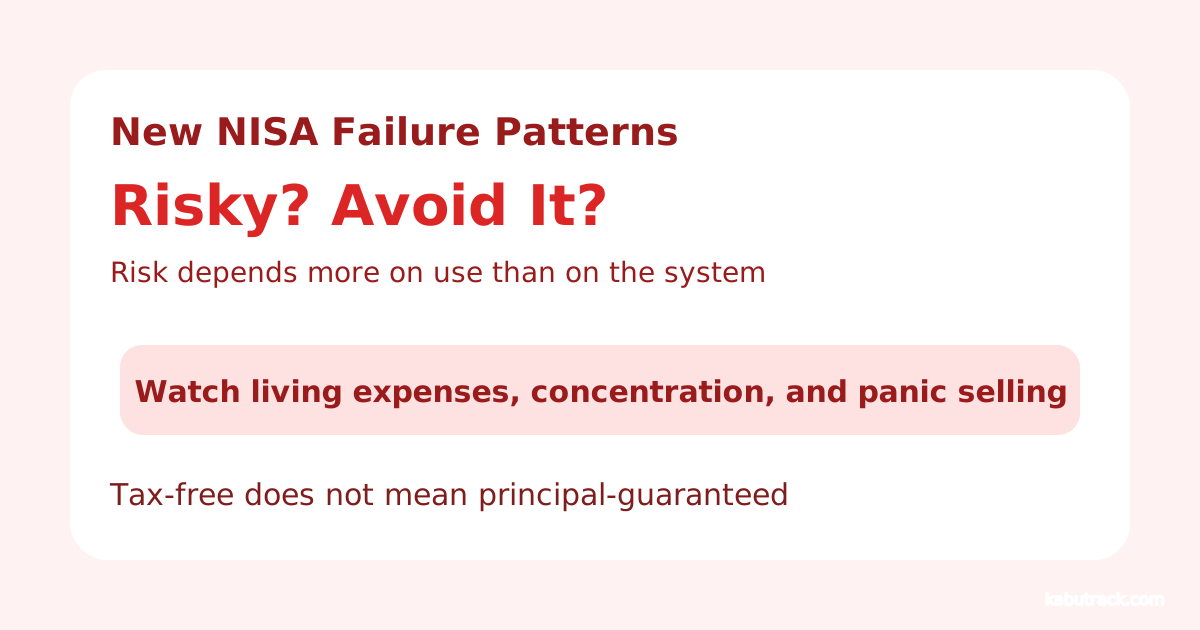
In particular, setting it only because you want to "fill the quota" despite having little room in the household budget is dangerous. NISA is a tax-free investment system, not a system for putting living expenses or emergency funds into the market.
Checklist for Deciding the Contribution Amount
Use this order to decide the amount.
| What to Check | Point |
|---|---|
| Monthly surplus | Has it continued for at least three months? |
| Emergency savings | Do you hold six months to one year of living expenses in cash? |
| Spending within one year | Have car inspections, moving, travel, education costs, and taxes been excluded? |
| Fixed costs | Are mortgage/rent, insurance, and communication fees too heavy? |
| Downturn tolerance | Is it an amount you can avoid selling even after a 20% decline? |
The key is not to invest all surplus funds.
For example, if your household has 50,000 yen left each month, starting with 30,000 yen may be easier to continue than investing the entire 50,000 yen immediately.
You can increase the investment amount later. But if you overdo it and have to sell along the way, the premise of long-term investing breaks down.
You Can Increase or Decrease Later
Your New NISA contribution amount does not have to stay fixed forever.
It is fine to adjust it based on household finances and income.
| Situation | Example Adjustment |
|---|---|
| Income increased | Raise from 30,000 yen to 50,000 yen |
| Education costs increased | Lower from 50,000 yen to 30,000 yen |
| Right after changing jobs | Temporarily lower to 10,000 yen |
| Bonus received | Consider additional investment after checking emergency savings |
| Market has fallen | Continue if the household budget is fine |
Adjusting the contribution amount is not a failure.
People who can adjust to household conditions are more likely to continue for a long time.
Common Failures
Common failures in setting New NISA contribution amounts include:
| Failure | Problem |
|---|---|
| Starting with 100,000 yen a month | Household finances can become tight |
| Starting without emergency savings | You may have to sell during sudden expenses |
| Copying someone else's amount from social media | Income, family structure, and spending differ |
| Stopping contributions during a crash | You miss chances to buy during cheaper periods |
| Making quota-filling the goal | It drifts away from real asset building |
Be especially careful about copying other people's amounts.
The same 50,000 yen a month feels completely different for a single person living with parents, a household raising children, and a household paying a mortgage.
The right NISA amount is not someone else's amount. It is the amount that fits your household.
FAQ
Is there any point in using New NISA with only 10,000 yen a month?
Yes. The tax-free benefit becomes larger as the amount grows, but for beginners, getting used to price movements and building the habit of investing are also important.
Am I missing out if I do not invest 100,000 yen a month?
Not necessarily. 100,000 yen a month uses the accumulation investment quota fully, but it can backfire if it strains the household budget. In some cases, emergency savings should come before the tax-free quota.
Is it okay to invest a lump sum from a bonus?
It can be an option if it is surplus money. But avoid investing money needed within one year, taxes, housing costs, education costs, or car-related expenses. Do not build the plan on the assumption that you can time the market.
Summary
How much you should invest monthly in New NISA depends on your household.
10,000 yen a month is an amount for getting used to investing.
30,000 yen is a sustainable standard line.
50,000 yen is a line for building retirement funds in earnest.
100,000 yen is a line for fully using the accumulation investment quota.
If unsure, use 30,000 or 50,000 yen as a reference, then decide after checking emergency savings and monthly surplus.
New NISA is not a race to fill the quota. It is stronger when used as a system that lets you protect your household and stay in the market for a long time.
Sources
This article is based on Financial Services Agency NISA information available as of May 31, 2026.