
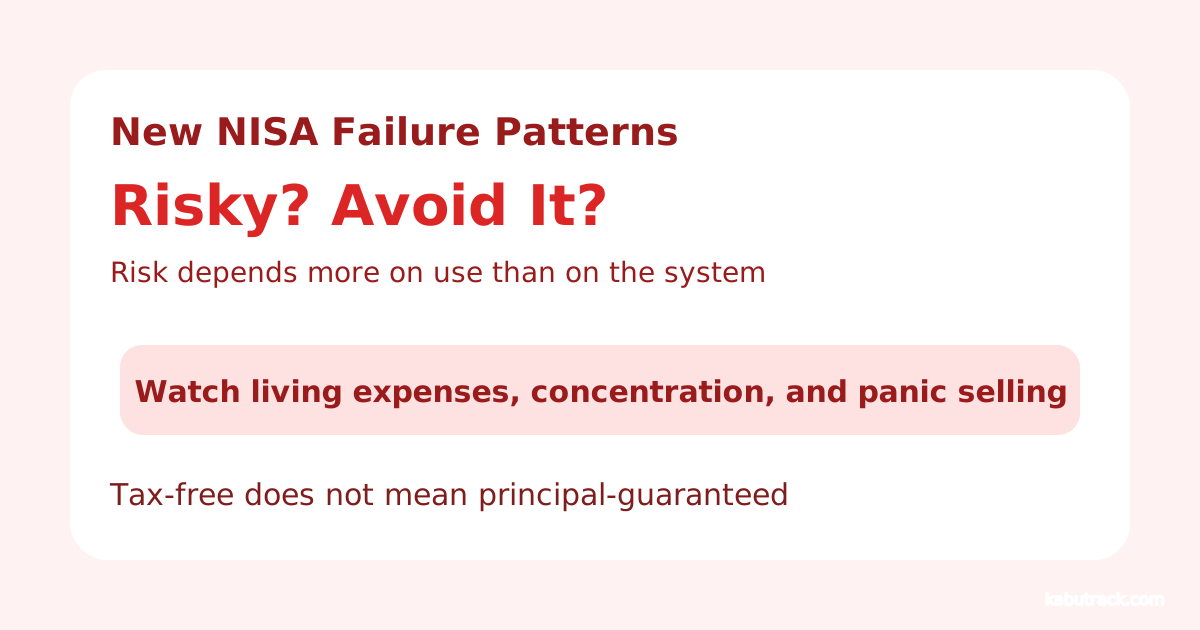
The New NISA Structure Itself Is Not Bad
New NISA is a system where profits from investments are tax-free.
Government Public Relations Online explains that the New NISA from 2024 has an accumulation investment quota and a growth investment quota, both of which can be used in one account.
The annual investment limit is 1.2 million yen for the accumulation quota and 2.4 million yen for the growth quota, for a total of 3.6 million yen.
The lifetime tax-free holding limit is 18 million yen.
Looking only at the system, it is easy to use for long-term asset building.
The problem is that investment risk does not disappear just because gains are tax-free.
Failure 1: Investing Money Needed for Living Expenses
The most dangerous mistake is investing money needed for living expenses or near-term use.
Stocks and investment trusts can fall sharply in the short term.
If you invest living-expense money, you may be forced to sell when prices are down.
| Type of Money | Suited for New NISA? |
|---|---|
| 1-3 months of living expenses | Not suited |
| Education funds needed soon | Not suited |
| Down payment for a home | Requires caution depending on timing |
| Surplus funds not needed for 10+ years | Often suitable |
New NISA should generally be used with surplus funds.
Failure 2: Buying Whatever Is Popular on Social Media
Products that are trending on social media can look easy to buy.
But if you cannot explain why you are buying something, it becomes hard to hold when it falls.
| Social Media Claim | What to Check Yourself |
|---|---|
| "Just buy this" | What does it invest in? |
| High return | Which period is the result from? |
| High dividend | Has the principal declined? |
| Popularity ranking | Does it fit your goal? |
Popularity can be one reference point, but it should not be the investment reason itself.
Failure 3: Investing a Lump Sum and Immediately Seeing It Fall
Lump-sum investing can look advantageous in a rising market.
But if the market falls sharply right after you invest, the psychological burden becomes heavy.
| Method | Suited For |
|---|---|
| Lump-sum investing | People who can keep holding after a decline |
| Monthly investing | People who want to get used to volatility gradually |
| Split investing | People who want a middle ground between lump sum and monthly investing |
Beginners should think not only about theoretical expected return, but also whether they can tolerate a decline.
Failure 4: Thinking You Are Diversified When You Are Actually Concentrated
Buying multiple investment trusts does not necessarily create diversification if the holdings are similar.
For example, buying All Country, S&P 500, and a U.S. Nasdaq-related fund together increases exposure to U.S. large-cap stocks.
| Holdings Example | Caution |
|---|---|
| All Country + S&P 500 | U.S. weight rises |
| S&P 500 + Nasdaq 100 | Tilt toward U.S. tech |
| High-dividend stocks + high-dividend ETF | Concentration in dividend stocks |
| Multiple thematic funds | Concentration in popular themes |
Look at diversification by underlying holdings, not by the number of products.
Failure 5: Choosing Only by High Dividends
High-dividend stocks look attractive.
But sometimes the dividend yield is high because the share price has fallen or earnings are uncertain.
| Item to Check | Reason |
|---|---|
| Payout ratio | Check whether the dividend is sustainable |
| Earnings | Check whether profits are declining |
| Debt | Check whether the balance sheet is stretched |
| Dividend cut history | Check dividend stability |
Dividends are welcome, but if the principal falls sharply, the benefit weakens.
Failure 6: Buying Too Many Individual Stocks in the Growth Investment Quota
The growth investment quota allows purchases of listed stocks and certain investment trusts.
Because it has more freedom, beginners who buy too many individual stocks can take on excessive risk.
| Use Case | Risk |
|---|---|
| Concentrating in one stock | Large company-specific risk |
| Concentrating in theme stocks | Weak when the theme fades |
| Short-term trading | Harder to use the benefit of long-term tax-free holding |
| Choosing only high dividends | Risk of dividend cuts and price declines |
The growth investment quota is not a convenient "buy anything" bucket. It requires risk management.
Failure 7: Ignoring Fees
In long-term investing, fee differences gradually matter.
For investment trusts, check the trust fee, purchase fee, and redemption-related costs.
For beginners, it is usually safer to start by considering low-cost products with easy-to-understand holdings rather than complicated high-cost products.
Failure 8: Selling During a Crash
Stock markets fall sharply many times.
If you sell during a crash, you lock in losses and may miss the subsequent recovery.
| What to Do During a Crash | Meaning |
|---|---|
| Check living expenses | Can you avoid selling investments? |
| Check contribution amount | Is it an amount you can continue? |
| Check the product's holdings | Has anything fundamental changed? |
| Check your reason for selling | Are you selling only because of fear? |
Preparation for enduring a crash can only be done before the crash arrives.
Failure 9: Having No Goal
Investing without a goal creates confusion whether markets rise or fall.
| Goal | What to Think About |
|---|---|
| Retirement funds | From what age will you use the money? |
| Education funds | Is the spending date near? |
| Housing funds | Can you accept principal loss risk? |
| Surplus fund investing | How much decline can you tolerate? |
Once the goal is clear, it becomes easier to decide contribution amount, product, and selling timing.
Failure 10: Judging Only by Tax-Free Status
New NISA's biggest attraction is tax-free gains.
But tax-free treatment only matters when there are gains.
If you lose money, unlike a taxable account, you cannot offset losses against other gains or carry losses forward.
| Item | New NISA |
|---|---|
| Investment gains | Tax-free |
| Loss offsetting | Not available |
| Loss carryforward | Not available |
| Principal guarantee | None |
Do not look only at the advantage when you profit. Understand how losses are treated too.
Summary
New NISA is a useful system for long-term asset building.
But failures become more likely if you invest money needed for living expenses, buy based on social media popularity, cannot tolerate lump-sum declines, are not truly diversified, or sell during a crash.
New NISA itself is not the danger. Starting too big without preparation is the danger.
First secure emergency savings, start small, and narrow your choices to products and contribution amounts you can hold for 20 years.