

This article is general investment educational content and does not recommend the purchase or sale of specific financial products. When analyzing a company, check its disclosure materials, accounting standards, reconciling items, financial position, and cash flow.
What is EBITDA?
There are several stages of corporate profits.
Roughly arranged, the flow is as follows.
売上高
↓
営業利益
↓
経常利益
↓
当期純利益
However, the appearance of a company's profits changes depending on factors such as the amount of debt, tax rate, depreciation method, and scale of capital investment.
Therefore, EBITDA is used to make it easier to compare the earning power of core businesses.
EBITDA refers to earnings before interest, taxes, depreciation, and amortization of intangible assets.
| English | Meaning in Japanese |
|---|---|
| Earnings | Profit |
| Before Interest | Before interest expense is deducted |
| Taxes | Before taxes are deducted |
| Depreciation | Before deducting depreciation of tangible fixed assets |
| Amortization | Before deducting amortization of intangible assets |
The US SEC's guidance on non-GAAP metrics also explains EBITDA as earnings before interest, taxes, depreciation and amortization.
EBITDA calculation formula
The basic concept of EBITDA is as follows.
EBITDA = EBIT + 減価償却費 + 無形資産償却費EBIT stands for earnings before interest and taxes.
In the practice of Japanese companies, it is often simplified using the following formula.
EBITDA ≒ 営業利益 + 減価償却費However, calculation methods may differ depending on the company and materials. In particular, when ``Adjusted EBITDA'' is written, it may include further adjustments for stock-based compensation, acquisition-related costs, one-time expenses, impairment losses, restructuring costs, etc.
This is quite important.
Even if the name EBITDA is the same, the content may differ from company to company. Investors need to check which items the company is adding back.
Why is EBITDA important?
The reason EBITDA is used is to make it easier to compare the earning power of companies.
There are three main reasons.
| Reason | Contents |
|---|---|
| Easy to compare companies | Differences in borrowings, tax rates, and depreciation methods can be evened out to some extent |
| It is a measure of cash generation ability | Depreciation is an accounting expense and is an allocation of expenses for equipment that has already been spent |
| Easy to use for M&A evaluation | Easy to compare corporate value and profitability using EV/EBITDA multiple |
For example, suppose there are two companies in the same industry, one with more debt and the other with less. Net income changes depending on the difference in interest expense, but EBITDA makes it easier to compare by excluding the effect of interest.
Additionally, companies with many factories and communication facilities tend to have large depreciation costs. Even if profits appear small when looking only at operating profits, EBITDA makes it easier to confirm the earning power generated by equipment.
Illustration: What EBITDA excludes
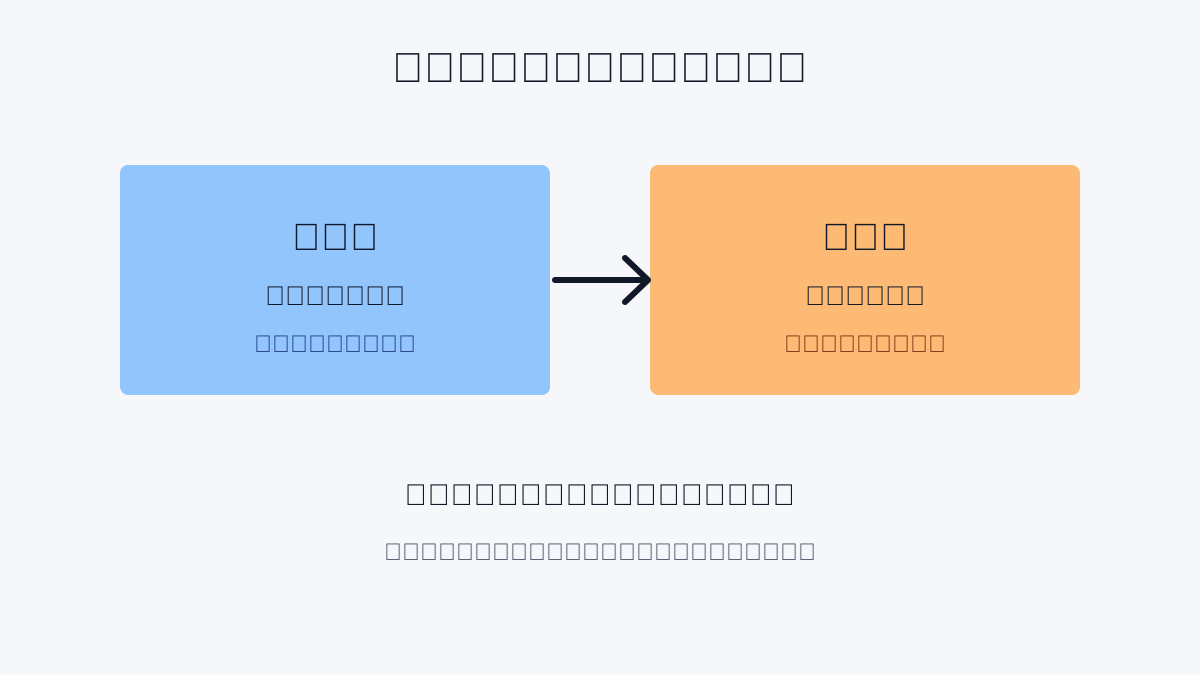
Difference from operating profit
Operating profit is the profit earned from the main business minus selling expenses, administrative expenses, depreciation, etc.
On the other hand, EBITDA is often larger than operating income because depreciation and amortization expenses are added back.
| Item | Operating income | EBITDA |
|---|---|---|
| Depreciation | Subtract | Add back |
| Comparison of main jobs | Usable | Easy to use depending on the industry |
| Estimated cash generation ability | Slightly difficult to see | Easy to see |
| M&A evaluation | Used | Frequently used |
| Burden of capital investment | Partially reflected in PL | Hard to see directly |
In industries where capital investment is large, when looking only at operating profits, profits may appear small due to the effects of depreciation and amortization. By using EBITDA, the impact of accounting treatment after capital investment can be seen to some extent.
However, for businesses that require capital investment, simply adding back depreciation is not sufficient. Cash will be needed in the future to maintain old equipment and install new equipment.
Industries where EBITDA is commonly used
EBITDA is often used in industries with large depreciation expenses.
Representative examples are as follows.
| Industry | Reasons why EBITDA is easy to see |
|---|---|
| Communications | Large investment in communication equipment, base stations, and networks |
| Railways | Fixed assets such as rolling stock, tracks, and station equipment are large |
| Infrastructure | Large capital investments in power plants, roads, facilities, etc. |
| Semiconductor manufacturing | Large investment in factories, manufacturing equipment, and clean rooms |
| Manufacturing industry | Large depreciation costs for machinery, equipment and factories |
| Companies targeted for M&A | Easy to compare acquisition price and earning power |
Conversely, for software and service companies with light capital investment, the discrepancy between operating income and free cash flow may be small.
What is EV/EBITDA multiple?
The EV/EBITDA multiple is often used in combination with EBITDA.
EV stands for Enterprise Value. Roughly speaking, it is the value of the entire company, which is the stock value plus net interest-bearing debt.
EV/EBITDA倍率 = 企業価値 ÷ EBITDAThis multiple is used to determine whether a company's acquisition price or stock valuation is overvalued or undervalued.
For example, in the same industry, if Company A has 6x EV/EBITDA and Company B has 10x, Company A simply looks cheaper. However, if the growth rate, profit margin, financial risk, capital investment burden, and business quality are different, there are reasons for the difference in multiples.
The Japanese Institute of Certified Public Accountants' corporate valuation guidelines also provide examples of valuations using similar companies' EBIT, EBITDA, corporate value, and multiples.
Notes on EBITDA
EBITDA is useful, but it's not a panacea.
The following points should be especially noted.
| Points to note | Contents |
|---|---|
| Not cash itself | EBITDA is not cash flow |
| It is easy to ignore capital investment | Companies with large CAPEX may not have any cash left |
| Easy to overlook debt | Financial risks are difficult to see because interest is excluded |
| It's easy to overlook taxes | It's different from the actual balance |
| Be careful with adjusted EBITDA | The items to be added back may differ depending on the company |
For example, even if your EBITDA is large, your free cash flow may be small if you require more capital investment each year.
Additionally, companies with a large amount of debt may have heavy interest and repayment burdens even if their EBITDA is positive. I would also like to check Net Debt/EBITDA, equity ratio, and operating cash flow.
The SEC also explains that metrics that are calculated differently from EBITDA should be distinguished by different names, such as Adjusted EBITDA, rather than EBITDA. In other words, it is necessary to read the contents of the adjusted indicators.
View for beginners
When looking at EBITDA in a company analysis, check it over multiple years rather than a single year.
| Changes in EBITDA | Perspective |
|---|---|
| Increasing trend | Possibility of expanding the earning power of the main business |
| Decreasing trend | Possibility of declining profitability, intensifying competition, and increasing costs |
| EBITDA decreases even though sales increase | Be careful of declining gross profit margin and increasing SG&A expenses |
| EBITDA increases but FCF decreases | Be careful of increases in capital investment and working capital |
| Only improved EBITDA after adjustment | Check the details of adjustment items |
Beginners will find it easier to understand if they are viewed in the following order.
- Are sales increasing?
- Is operating profit growing?
- Is EBITDA growing?
- Is operating cash flow growing?
- Is there free cash flow left?
- Is the debt and equity ratio reasonable?
If only EBITDA is good, but operating cash flow and free cash flow are bad, you should question the quality of profits.
summary
EBITDA is an indicator for measuring a company's profitability, excluding the effects of interest, taxes, depreciation, and amortization of intangible assets.
The points to keep in mind are as follows.
- EBITDA is an indicator that makes it easier to compare the earning power of the main business.
- Often viewed simply as operating income + depreciation and amortization expenses
- Often used in industries with large capital investments and in M&A evaluations *EV/EBITDA multiple is a representative indicator used in corporate value evaluation
- EBITDA is not cash flow itself
- Don't overlook capital investments, borrowings, taxes, and adjustment items
EBITDA is a useful entry point for investors when analyzing companies.
However, do not stop at the entrance. By looking at operating income, operating cash flow, free cash flow, ROE, and equity ratio, you can finally see the company's earning power and financial reality.