
Subordinated bonds have a lower repayment priority than straight bonds.
Corporate bonds are bonds issued by companies to borrow money from investors. The basic mechanism is that investors receive interest and the principal is redeemed at maturity.
However, if an issuer goes bankrupt, not all creditors will receive repayments in the same order. Subordinated corporate bonds have a lower repayment priority than senior debt such as straight corporate bonds.
The general image is as follows.
| Ranking | Main target | View |
|---|---|---|
| 1 | Bank loans, secured debts, etc. | Easily repaid preferentially |
| 2 | Straight corporate bonds, general claims | Senior than subordinated bonds |
| 3 | Subordinated bonds | Junior to straight corporate bonds, senior to stocks |
| 4 | Common stocks | Most susceptible to loss |
In other words, subordinated corporate bonds are more vulnerable to losses than straight corporate bonds, although not as much as stocks.
The explanation of the terms of issuance assumes that the design is such that priority will be given to senior creditors in the event of subordination. Even though it has the word "corporate bond" in its name, it does not have the same level of safety as a straight corporate bond.
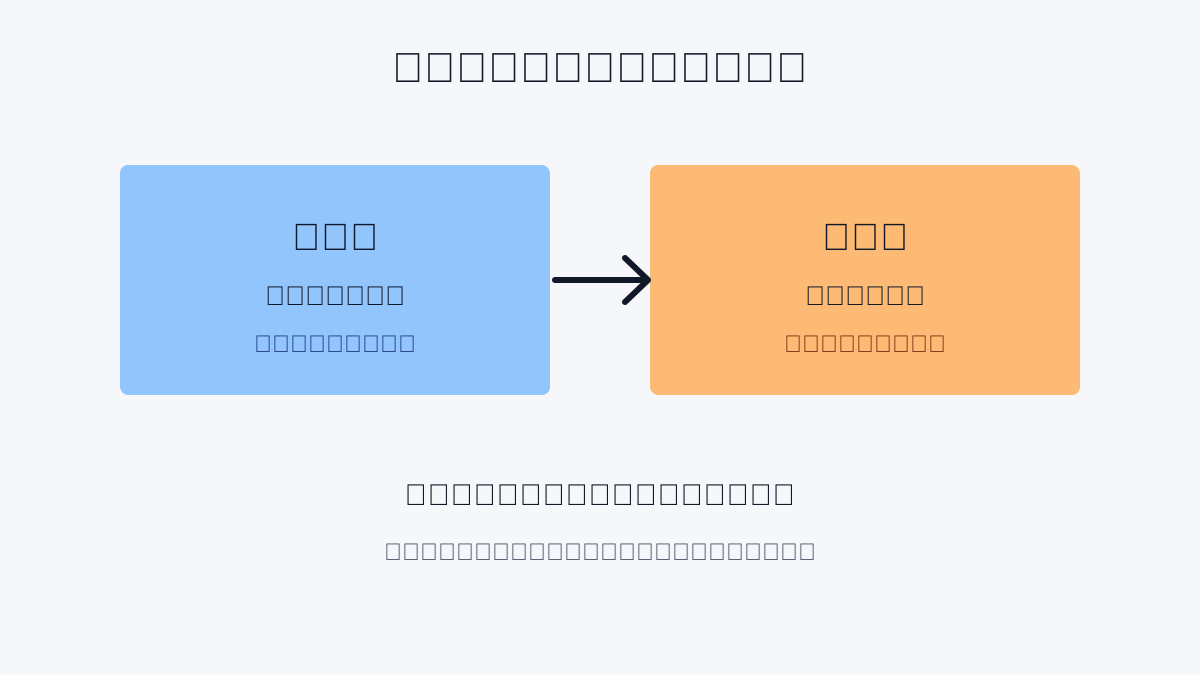
Illustration: Relationship between repayment order and yield
Why do subordinated corporate bonds have high yields?
The reason that yields on subordinated corporate bonds tend to be higher is because the risk borne by investors is greater than on straight corporate bonds.
The main risks are as follows.
| Risk | Contents |
|---|---|
| Credit risk | If the issuer goes bankrupt or suffers financial deterioration, there is a possibility that the principal and interest will not be paid. |
| Subordination risk | Senior debts such as straight corporate bonds are paid first |
| Interest payment deferral risk | Interest payments may be postponed depending on the conditions |
| Prepayment risk | Early redemption may occur at the discretion of the issuer, and the operation may end earlier than expected |
| Interest rate risk | Bond prices tend to fall when interest rates rise |
| Liquidity risk | It may not be possible to sell at the desired price or the price may drop significantly during a mid-term sale |
The Japan Securities Dealers Association also explains that corporate bonds have credit risk, price fluctuation risk, and liquidity risk. It is not a product that is guaranteed to be safe if held until maturity.
In the case of subordinated corporate bonds, the condition of ``lower repayment priority'' is added to this normal corporate bond risk. Therefore, the yield is high.
Differences from straight corporate bonds
The difference between straight corporate bonds and subordinated corporate bonds can be simplified as follows.
| Item | Straight bonds | Subordinated bonds |
|---|---|---|
| Yield | Yield tends to be low | Yield tends to be high |
| Repayment order | Higher than subordinated bonds | Lower than straight corporate bonds |
| Price fluctuations | Fluctuations depending on the issuer and interest rate environment | More likely to fluctuate in times of credit instability |
| Product characteristics | Relatively simple | Interest payment deferral, early redemption, and long term maturity may be attached |
| Is it suitable for beginners | Depends on the conditions | Difficult unless you understand the mechanism |
A common problem here is thinking that subordinated corporate bonds are safer than stocks because they are corporate bonds.
It is true that subordinated corporate bonds are ranked higher than common stocks when looking only at the order of repayment. However, if the issuer's creditworthiness becomes insecure, bond prices can fall significantly. Price volatility risk is also a very real issue for those who need to sell before maturity.
Term subordinated debt and perpetual subordinated debt
Subordinated bonds can be broadly divided into fixed-term subordinated bonds and perpetual subordinated bonds.
| Type | Contents |
|---|---|
| Subordinated debt with a fixed term | Subordinated debt with a fixed maturity |
| Perpetual subordinated debt | Subordinated debt that has no maturity or is substantially long |
For products sold to individuals, the "first call date" may be emphasized. For example, if it says, "Prepayment is possible after 5 years," it tends to look like the maturity is 5 years.
However, early redemption is often carried out at the issuer's discretion, rather than the investor's right. There is no guarantee that the loan will be repaid after five years.
This is quite important. A product you buy thinking it will return in five years may actually have long-term holding risks of 10, 20, or even longer.
Advantages are high yield and regular interest income
The advantage of subordinated corporate bonds is that they can be expected to yield higher yields than straight corporate bonds or government bonds.
For investors who value interest income, the ability to earn a certain amount of income is attractive. Some products have clearer interest payment terms than stock dividends, and may be considered as bonds in a portfolio.
However, it is dangerous to judge based on yield alone.
The yield on subordinated corporate bonds is compensation for assuming loss of principal, deferral of interest payments, decline in mid-term sale price, and deterioration of the issuer's creditworthiness. The higher the yield on a product, the more you want to think about why that interest rate is necessary.
The disadvantage is the depth at the time of loss
The biggest disadvantage is that losses are likely to be large if the issuer deteriorates.
Even with straight corporate bonds, if the issuer goes bankrupt, the principal and interest may not be paid. Subordinated corporate bonds have an even lower priority for repayment, making collection difficult if there is little remaining assets.
Bond prices are also affected by interest rates. Generally, when interest rates rise, the price of outstanding bonds tends to fall. Subordinated bonds with longer maturities are more susceptible to price fluctuations.
Mid-term sale is not always easy. When market conditions are bad or the issuer's creditworthiness is uncertain, it may be difficult to find buyers and the selling price may drop significantly.
Three points that beginners tend to misunderstand
The three points that beginners tend to misunderstand about subordinated corporate bonds are summarized in these three points.
| Misconception | Actual perspective |
|---|---|
| Safe because they are bonds | Subordinated bonds are riskier than straight bonds |
| It's a good deal because the yield is high | There are reasons for the high yield such as credit, subordination, and liquidity |
| You can rest assured that the issue is issued by a large company or bank. | Even if the issuer is famous, there is a risk of loss if business deteriorates |
In particular, subordinated bonds of financial institutions are sometimes issued for the purpose of supplementing their equity capital. It is easy to feel safe when you see the name of a bank or insurance company, but this does not mean that the product itself is safe.
`A company you know'' and `the principal is safe'' are two different things.
Checklist to check before purchasing
When considering subordinated corporate bonds, at least the following points should be confirmed.
- Do you understand that these are subordinated bonds rather than straight bonds?
- Have you confirmed that the payment priority is lower than that of straight corporate bonds?
- Have you read whether there is an interest payment deferral clause?
- Have you confirmed whether prepayment is an "issuer's right" or an "investor's right"?
- Can you distinguish between maturity, first call date, and effective holding period?
- Can you accept price declines and liquidity risks during mid-term sales?
- Have you checked the issuer's rating, financial situation, and business risks?
- Are you investing your living funds or money that will be used soon?
If you are stuck on this check, there is no need to force yourself to buy one. Rather than being an introductory bond investment product, subordinated corporate bonds are products that should be considered after understanding straight corporate bonds, interest rates, and credit risks to some extent.
What kind of people is it suitable for?
Subordinated corporate bonds are suitable for people who can read not only the yield, but also the issuer's creditworthiness and product terms.
The following people may be suitable:
- Understand bond price fluctuations and credit risk
- You can check the financial status and rating of the issuer
- You can invest with spare funds without having to sell midway.
- Cases without interest payment deferral or early redemption can also be assumed.
- Avoid concentrating funds in one issuer
On the other hand, it is not suitable for beginner investors, people who want to avoid loss of principal, people who are looking for an alternative to deposits, and people who plan to use their funds in five years.
If you want to own bonds as a safe asset, you should first check the structure of individual government bonds, high-grade bonds, and diversified bond funds.
summary
Subordinated corporate bonds are bonds that accept a lower payment priority than straight corporate bonds in exchange for a higher yield.
The points to keep in mind are as follows.
*Subordinated corporate bonds have a lower repayment priority than straight corporate bonds.
- High yield is compensation for risk
- Pay attention to interest payment deferrals, early redemptions, and long maturities
- Bonds are also subject to price fluctuations and loss of principal.
- It is easy to misunderstand the risks when looking at it as a substitute for deposits and government bonds.
Rather than thinking that subordinated corporate bonds are safe because they are bonds, it is more true to think of them as a bond product that has some characteristics similar to stocks.
Before looking at yields, read up on what happens in the worst case scenario. For subordinated corporate bonds, the order is important.
Related articles
- What is a subordination clause? Easy-to-understand explanation of contract clauses that postpone repayment order
- What is interest payment deferral? Interest payment deferral risk to be aware of with subordinated bonds
source
- [Japan Securities Dealers Association "How to obtain information on characteristics, risks, and prices of corporate bonds for individuals"] (https://www.jsda.or.jp/about/hatten/risk/shasai/index.html)
- [Financial Services Agency "Financial Inspection Manual Related Materials: Supervisory Explanation Regarding Subordinated Bonds"] (https://www.fsa.go.jp/p_fsa/guide/guidej/yokin/y004.html)
- Japan Exchange Group "Explanation on credit risk of bonds"