
What is a subordination clause?
Simply put, a subordination clause is a ``promise to lower the priority of repayment.''
Interest and principal payments may be made on schedule while the company continues to operate normally. Problems arise when an issuer enters a state of bankruptcy, corporate reorganization, civil rehabilitation, liquidation, etc.
Debts with subordination clauses are paid first to senior creditors. The structure is such that subordinated creditors cannot receive principal or interest payments until senior creditors have been fully repaid.
The Financial Services Agency's supervisory explanation also states that with respect to subordinated bonds and subordinated loans, it is to be confirmed whether there is a contract that gives priority to senior creditors in the event of subordination.
In other words, a subordination clause is not just a name. This is an important clause that determines who will bear the burden first in the event of a loss.
Image of repayment order
When a company goes bankrupt, there is a certain order of distribution to creditors and shareholders.
Simplifying it considerably, it looks like this:
| Ranking | Main target | View |
|---|---|---|
| 1 | Secured claims, etc. | Easily prioritized by collateral or contract |
| 2 | Straight corporate bonds, general receivables, ordinary borrowings, etc. | Senior than subordinated debt |
| 3 | Debt with subordinated clause | Subordinated to senior debt |
| 4 | Preferred stocks, common stocks, etc. | Tends to be ranked later than creditors |
The actual ranking and recovery amount will vary depending on the presence or absence of collateral, contract details, legal procedures, and the issuer's financial situation. The table above is just a rough diagram for beginners.
Still, the essence of the subordination clause is clear.
Top creditors first. Creditors with subordination clauses come later.
This order leads to higher yields and greater risks.
Illustration: Position of subordination clause
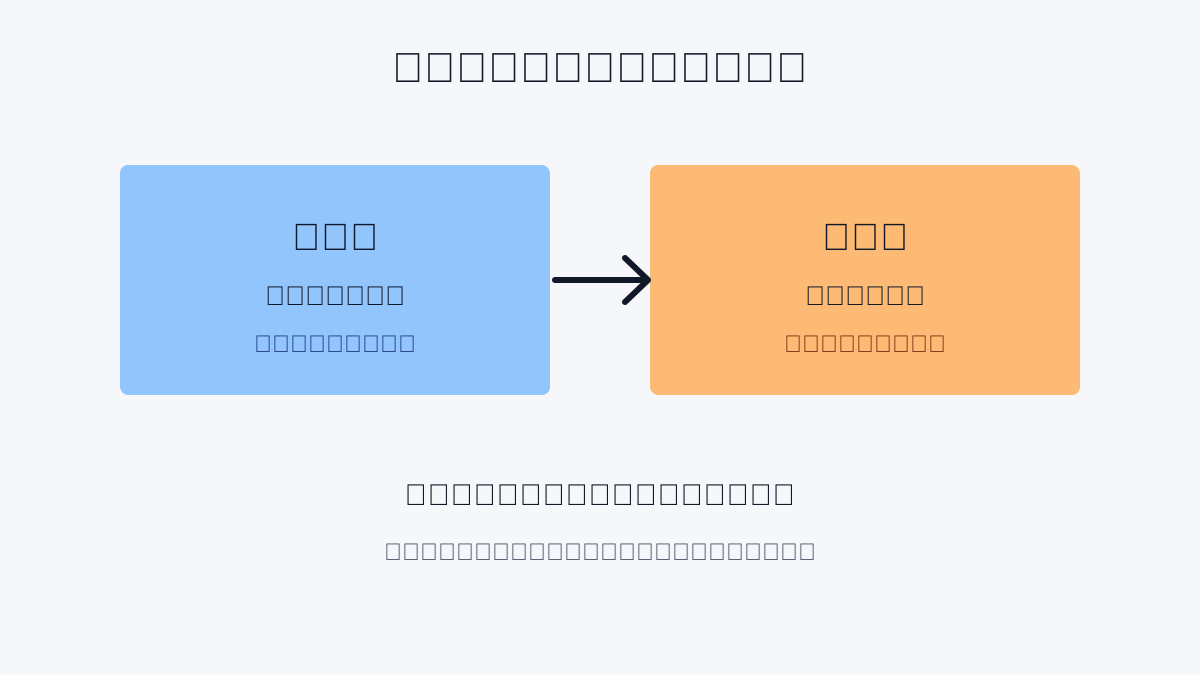
Image if only 10 billion yen remains
As an example, consider a case where the remaining assets at the time of bankruptcy are only 10 billion yen.
Suppose the structure of debt and equity is as follows.
| Classification | Amount |
|---|---|
| Top debt | 8 billion yen |
| Straight corporate bonds/general receivables | 3 billion yen |
| Subordinated debt | 2 billion yen |
| Stocks | Distribution if any remaining |
Although the total amount of claims is over 13 billion yen, the remaining assets are only 10 billion yen.
In this case, the proceeds are first distributed to the higher-ranking creditors. To simplify,
*Top debt: Easy to collect
- Straight corporate bonds/general receivables: Possibility that only a portion can be recovered
- Debt with subordinated clause: Possibility of unrecovery
- Stocks: No distribution if there is no remainder
This could be the result.
In practice, this is not always the case. Varies depending on collateral, liquidation value, bankruptcy proceedings, and conditions among creditors. Still, if you are buying a product with a subordination clause, you want to have the sense that you are ``last in line.''
Why add a subordination clause?
From the issuer's perspective, funds with subordination clauses tend to have characteristics closer to equity than ordinary debt.
In particular, financial institutions sometimes use subordinated bonds and subordinated loans to raise funds with an eye toward capital adequacy ratios. J-FLEC's glossary also explains that subordinated bonds are corporate bonds that have a lower priority for debt repayment than general creditors, and are sometimes issued for the purpose of increasing banks' equity ratios.
For the issuer, it provides a financial cushion.
Investors can potentially incur deeper losses than with straight corporate bonds.
Even for the same product, the views seen by issuers and investors are quite different.
Main products with subordination clause
Subordination clauses are not limited to corporate bonds.
| Product | Contents |
|---|---|
| Subordinated bonds | Bonds with subordination stipulated in the bond terms |
| Subordinated loan | A loan that is borrowed money but has a lower repayment priority than general debt |
| Hybrid corporate bonds | Corporate bonds with characteristics intermediate between debt and equity |
| Capital products of financial institutions | May be issued in relation to capital adequacy regulations |
In some cases, the product name clearly states "subordination clause," while in other cases it is described by other names, such as hybrid corporate bonds, subordinated equity loans, Tier 2 bonds, and AT1 bonds.
Don't make a judgment based on the name alone; you need to check the bond terms and contract to confirm the priority of repayment.
Benefits for investors
1. Yields tend to be high
Products with subordination clauses may have higher interest rates than straight corporate bonds.
The reason is simple: investors take on more risk than with straight corporate bonds. High yields are not a gift, but compensation for subordination risk, credit risk, and liquidity risk.
2. You can expect regular interest income
With corporate bonds and loan-type products, you may be able to receive interest according to the terms and conditions.
However, for products with interest payment deferral clauses, there is a possibility that interest will not be paid as scheduled. The more I buy it for income purposes, the more I can't skip this part.
Disadvantages for investors
1. High risk of loss of principal
The biggest risk is that the recovery ranking will be low in the event of bankruptcy.
Even with straight corporate bonds, if the issuer goes bankrupt, the principal and interest may not be paid. For products with subordination clauses, senior debts are paid off first, so if the remaining assets are small, the amount recovered will be even smaller.
2. Price fluctuations tend to be large
If the issuer's creditworthiness becomes uncertain, the price of subordinated bonds may fall significantly.
Products with long maturities and products similar to perpetual subordinated bonds are particularly vulnerable to rising interest rates and widening credit spreads. Liquidity risk is also a real issue for those who need to sell before maturity.
3. Conditions are complex
Products with subordination clauses may include the following clauses:
- Early redemption clause
- Interest payment deferral clause
- Perpetual subordination clause
- Principal and interest exemption/principal reduction clause in the event of virtual bankruptcy *Step up interest rate
It is not enough to understand only the "subordination clause." It is necessary to read which clauses are activated and under what conditions.
Difference between subordinated bonds and stocks
Subordinated bonds may have characteristics similar to stocks. However, it is not the stock itself.
| Item | Subordinated bonds | Stocks |
|---|---|---|
| Interest/Dividends | There is interest | Dividends are determined by the company |
| Maturity | Fixed-term and perpetual types available | No maturity |
| Voting rights | Usually not | Yes |
| Ranking at the time of bankruptcy | Tends to be lower than straight corporate bonds and higher than stocks | Tends to be last in rank |
| Price movements | Fluctuations as bond prices | Fluctuations as stock prices |
Subordinated bonds may have characteristics intermediate between bonds and stocks.
The important thing here is not to short-circuit that it's safe because it's higher than stocks. Since they are ranked lower than straight corporate bonds, they carry a considerable amount of risk among bonds.
Checklist to check before purchasing
If you are considering a product with a subordination clause, you should at least check the following points.
- Do you understand that there is a subordination clause?
- To which debts is it subordinated?
- What is the reason for subordination?
- Is there an interest payment deferral clause?
- Is prepayment the issuer's right or the investor's right?
- Is there a distinction between maturity, first call date, and effective holding period?
- Are there any provisions for principal and interest exemption or principal reduction in the event of virtual bankruptcy?
- Have you confirmed the issuer's rating, financial situation, and capital adequacy ratio?
- Can you accept the possibility of a disadvantageous price when selling midway?
- Are you investing your living funds or money that will be used soon?
It's only natural that this check takes time. Products with subordination clauses are not products to be purchased based on yield alone. This is a product that requires you to read the terms and conditions.
Points that beginners tend to misunderstand
| Misconception | Actual perspective |
|---|---|
| There is no need to worry about subordination clauses as they are detailed contract terms | Important clauses that affect recovery order in the event of bankruptcy |
| It's a good deal because the yield is high | A high yield is the price of a low repayment rank |
| No worries if it's a large company or bank | Even if the issuer is famous, there is a risk of loss if the terms are unfavorable |
| Must be redeemed on the first call date | Early redemption is often at the issuer's discretion |
In particular, with high-yield bonds sold to individuals, it's easy to see that the bond will be redeemed in five years or that it's okay because it's a well-known company.
However, there are actually 35-year bonds, perpetual subordinated bonds, and products with interest payment deferral clauses. There are times when the contract terms are more important than the apparent interest rate.
summary
A subordination clause is a contract provision that allows the issuer or borrower to receive repayment in a priority order after the higher-ranking general creditors in the event of bankruptcy.
The points to keep in mind are as follows.
- Subordinated debt has a lower repayment priority than straight corporate bonds and general receivables.
- High yield is compensation for assuming subordination risk
- Used not only for subordinated corporate bonds, but also for subordinated loans and hybrid corporate bonds
- Check with clauses such as interest payment deferral, early redemption, principal reduction, etc.
- Beginners should not think that ``bonds are safe''
Subordination clauses are less noticeable in normal times. However, when there are concerns about the issuer's creditworthiness, it suddenly becomes important.
Before looking at the yield, look at the repayment ranking. For products with subordination clauses, it is most important not to get the order wrong.
Related articles
- What is a subordinated bond? Repayment order and risks behind high yield
- What is interest payment deferral? Interest payment deferral risk to be aware of with subordinated bonds
source
- J-FLEC / Investment time "Subordinated bonds"
- [Japan Securities Dealers Association "How to obtain information on characteristics, risks, and prices of corporate bonds for individuals"] (https://www.jsda.or.jp/about/hatten/risk/shasai/index.html)
- [Financial Services Agency "Inspection Manual Related Materials for Deposit-Accepting Financial Institutions"] (https://www.fsa.go.jp/p_fsa/guide/guidej/yokin/y004.html)