
What does "Sell in May" mean?
“Sell in May” is a well-known seasonal adage in the stock market.
In English it is said as follows.
Sell in May and go away.
In longer form, the following expressions are also used:
Sell in May and go away, come back on St. Leger's Day.
St. Leger's Day is an expression derived from a British horse racing event. In the old days of the London market, there was a feeling that in the summer, the number of market participants would decrease due to holidays, and then return in the fall. From there, it became popular as a saying that the stock market tends to be sluggish during the summer.
Today's markets are driven by algorithmic trading, ETFs, global funds, central bank policy, and corporate earnings. The market will not stop for the same old reasons. Even so, it still comes up in investor conversations as a seasonality, with the idea that it tends to be weak from May to October.
Why is it said that “May to October is weak”?
The basis for sell-in-may is often cited as the difference in returns between November to April and May to October.
The image is as follows.
| Period | Frequently mentioned trends | Proverbs |
|---|---|---|
| November to April | Relatively strong | Period of holding stocks |
| May to October | Relatively weak | Period away from stocks |
Bouman and Jacobsen's 2002 study is known as a representative paper that examined this seasonality, known as the "Halloween indicator," in international markets. The study found that returns tended to be relatively strong from November to April, although there were differences depending on the country.
However, don't misread this here.
This is a matter of "average trends" and does not mean that "you can win by selling in May every year." The market differs from year to year. There are many factors that are greater than seasonality, such as monetary policy, the economy, corporate performance, exchange rates, war/geopolitics, the AI boom, and inflation rates.
Does it actually work?
Cell in May is an interesting subject for research. Historical data may show some seasonality.
However, it is difficult for individual investors to adopt trading rules as they are.
There are three reasons.
| Difficult points | Contents |
|---|---|
| Varies from year to year | There are years when stock prices rise even after May |
| Varies depending on country and index | US stocks, Japanese stocks, and emerging market stocks do not necessarily move in the same way |
| There are buying and selling costs | Taxes, commissions, spreads, and repurchase failures come into play |
For example, in U.S. stocks, there are years such as 2020, 2021, and 2024, where the upward trend continued after May. In 2023, AI-related stocks and large-scale tech stocks continued to drive the market through the summer.
If you decide to sell because it's May, you may miss out on these gains.
Market maxims seem very clear in the year they apply. The problem is what to do in a year when it doesn't work out. Even if you plan to buy back in the fall, if the market goes up in August, down in September, and rebounds in October, it will be quite difficult to actually buy or sell.
What should long-term investors think?
For long-term investors, it is better to treat sell-in-may as a "memo to be aware of seasonality" rather than a "buy or sell signal."
Especially when it comes to NISA and investment trust savings, it is simpler and more reproducible to continue saving than to sell every May and buy back in the fall.
The following points should be prioritized when making long-term investments.
- Make the amount you can continue saving
- Determine the ratio of stocks, bonds, and cash
- Don't focus too much on one country or theme
- Focus on investment period rather than market maxims
- Leave enough money for living that you don't have to sell in the event of a market crash.
If you feel uneasy after seeing sell-in-may, it would be more realistic to slightly review the risk asset ratio, check the cash ratio, or adjust the pace of additional purchases rather than selling everything.
Common mistakes
The most common mistake in Sell in May is that the moment you learn the proverb, you think, ``It's going to happen again this year.''
The three main failures are:
| Failure | What Happens |
|---|---|
| Rises after selling | Unable to return to rising market, opportunity loss becomes large |
| Remove the buyback period | I was planning to buy in the fall, but I ended up chasing the high price |
| Forget taxes and costs | Theoretical benefits are reduced by taxation of sales profits and transaction costs |
Especially in taxable accounts, if you sell a mutual fund or ETF that has a profit, you will incur taxes. Even with NISA accounts, it is necessary to check the system conditions regarding the handling of the limit once sold and the timing of reinvestment.
If you like short-term trading, you can use seasonality as a factor. However, if you try to guess the timing every year with long-term funds, the difficulty of investing increases considerably.
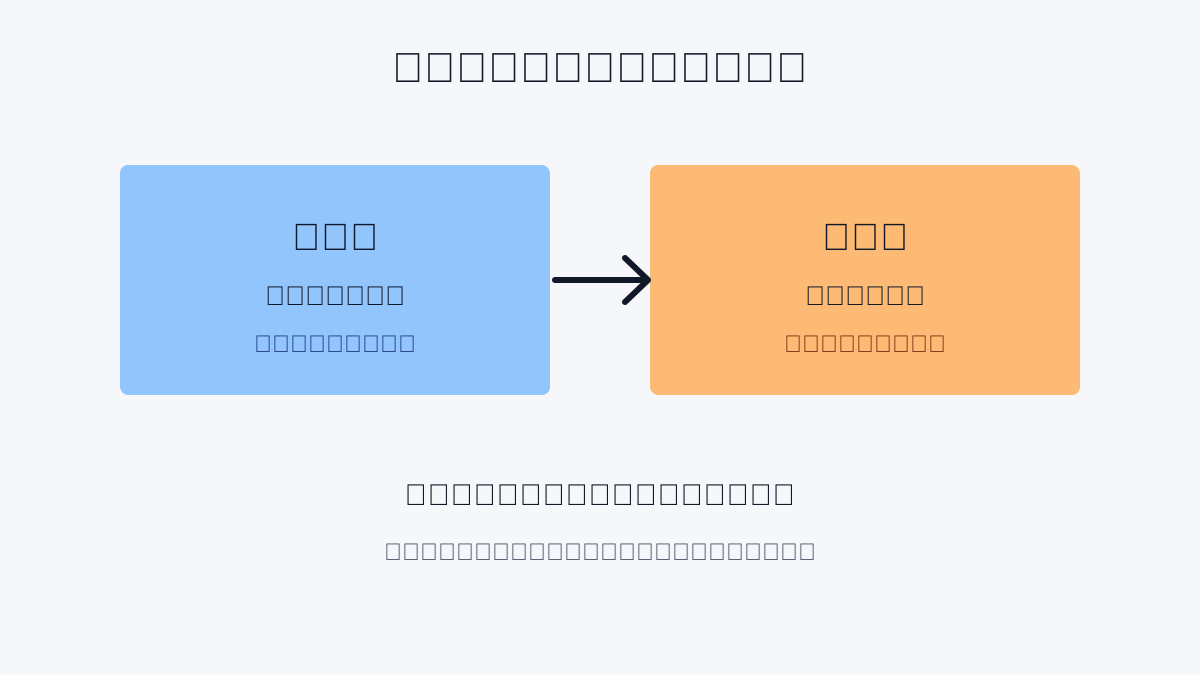
Illustration: Don't let proverbs become rules for buying and selling
Checklist for Beginners
If you want to sell Cell in May, check these five things first.
- Isn’t the only reason for selling “because it’s May”?
- Do you decide when to buy back after selling?
- Have you calculated taxes and buying and selling costs?
- Is it consistent with the purpose of long-term savings?
- If the stock goes up, don't you regret it and buy after it?
If you can't answer these five questions, it's best to avoid buying and selling based on proverbs alone.
The important thing when investing is not to memorize a lot of market terms. The question is whether you can take action that suits your funds, goals, and time frame.
summary
"Sell in May" is a famous saying that describes the seasonality of the market.
The points to keep in mind are as follows.
- A saying that indicates seasonality: strong from November to April and weak from May to October *Research has confirmed certain trends, but they do not always hold true every year.
- There are years when stock prices rise even after May.
- Post-sale buybacks, taxes, and costs become a real hurdle
- For long-term investments, it is better to prioritize accumulation, diversification, and continuation.
A saying is a tool that allows you to stop and look at the market for a moment. If you blindly trust these rules as rules, you will end up making poorer investment decisions.
Cell in May is "useful to know." However, it is not enough to "buy and sell as is." This distance is perfect for beginners.