| Item | Details |
|---|---|
| Issuer | SoftBank Group Corp. |
| Bond name | 9th unsecured bond with interest deferral clause and early redemption clause (with subordination clause) |
| Total issue amount | 260 billion yen |
| Amount of each bond | 1,000,000 yen |
| Coupon | Undecided; indicative range for the first five years is 4.80-5.60% per year |
| Term | 35 years |
| Maturity date | June 19, 2061 |
| First optional redemption date | June 19, 2031 |
| Subscription period | June 8 to June 18, 2026 |
| Payment date | June 19, 2026 |
| Preliminary rating | BBB+ by JCR |
As of June 3, 2026, the coupon had not yet been finalized.
SoftBank Group's official announcement says issuance terms such as the coupon are scheduled to be decided on June 5, 2026.
Therefore, this article does not assume a "confirmed 3.15% coupon." Instead, it organizes the risks investors should examine based on the official announcement and the "indicative range of 4.80-5.60%" confirmed in selling-company materials.
This article is not a recommendation to buy or sell any specific bond. Corporate bonds carry credit risk, price fluctuation risk, and liquidity risk. This bond in particular is a hybrid bond with a subordination clause, interest deferral clause, and early redemption clause. Before making any investment decision, always check the prospectus, pre-contract documents, selling-company materials, tax treatment, and the issuer's financial condition.
Not A Plain Corporate Bond, But A Hybrid Bond
The 9th bond is different from a typical unsecured plain corporate bond.
The name is long, but the key features can be divided into three parts.
| Clause | Meaning |
|---|---|
| Interest deferral clause | The issuer can defer interest payments at its discretion |
| Early redemption clause | The issuer can redeem the bond from June 19, 2031 onward at its discretion |
| Subordination clause | If a subordinating event occurs at the issuer, repayment priority is lower than senior obligations |
In other words, the high coupon investors receive is not compensation only for ordinary credit risk.
It is also compensation for lower repayment priority than plain corporate bonds, the possibility that interest may be deferred, and the possibility that the bond may not necessarily be redeemed on the first optional redemption date.
If this point is misunderstood, investors may judge the bond by coupon alone.
This bond is less a five-year high-yield product and more a 35-year hybrid bond that must be evaluated together with the likelihood of redemption after five years.
The Initial Five-Year Indicative Range Is 4.80-5.60%
Mizuho Securities' materials show an indicative fixed-rate range of 4.80-5.60% per year for the first five years.
The coupon determination date is scheduled for June 5, 2026, and the final coupon may fall outside the indicative range.
A simple after-tax estimate is as follows.
| Pre-tax coupon | Approximate after-tax coupon |
|---|---|
| 4.80% per year | About 3.825% |
| 5.00% per year | About 3.984% |
| 5.60% per year | About 4.462% |
For a 1,000,000 yen investment, the annual interest image during the first five years is as follows.
| Pre-tax coupon | Annual interest before tax | Approximate annual interest after tax |
|---|---|---|
| 4.80% per year | 48,000 yen | About 38,249 yen |
| 5.00% per year | 50,000 yen | About 39,842 yen |
| 5.60% per year | 56,000 yen | About 44,623 yen |
For a yen-denominated corporate bond, this is a very eye-catching level.
The important question, however, is why it is high.
SoftBank Group's issuer ratings shown on its official ratings page are A by JCR and BB+ by S&P.
The preliminary rating for this 9th hybrid bond is BBB+ by JCR.
The rating looks lower than that of a plain corporate bond because it reflects the subordination and hybrid-bond structure.
There is a reason the coupon is high.
How To View The First Optional Redemption
The most easily misunderstood part of this bond is the redemption date.
SoftBank Group, the issuer, can redeem the bond early on each interest payment date from June 19, 2031 onward.
However, this does not mean investors are guaranteed to get their money back in five years.
Early redemption is at the issuer's discretion.
The structure can be summarized as follows.
| Timing | Interest rate |
|---|---|
| First five years | Fixed rate; indicative range is 4.80-5.60% per year |
| After year 5 | 1-year JGB yield + issue spread + 0.25% |
| After year 20 | 1-year JGB yield + issue spread + 0.30% |
| After year 25 | 1-year JGB yield + issue spread + 1.00% |
Because the bond shifts to a floating rate after five years and step-ups begin, it becomes easier for the issuer to have an economic incentive to redeem it early.
Still, whether redemption actually happens depends on the issuer's financial condition, ratings, equity-credit treatment, refinancing market, and rate environment at that time.
Investors should not buy only on the assumption that the bond will be repaid in five years. They also need to consider the possibility that it remains outstanding as a 35-year bond if it is not called.
Subordination Risk
Mizuho Securities' materials explain that if bankruptcy or another subordinating event occurs at the issuer and continues, principal and interest on this bond will not be paid until senior obligations have been fully repaid.
This is highly important.
This is not a product repaid at the same priority as a plain corporate bond.
| Type | How to view repayment priority |
|---|---|
| Deposits and general obligations | Different protections and ranking from bonds |
| Unsecured plain corporate bonds | Senior to subordinated bonds |
| Subordinated bonds and hybrid bonds | Junior to senior obligations |
| Shares | Receive residual assets last |
If only the high coupon is considered, the bond can look more attractive than a plain corporate bond.
However, its loss-absorption capacity in a credit event is also higher.
From the issuer's perspective, a hybrid bond has characteristics close to capital.
From the investor's perspective, it is a product where the recovery priority for principal and interest is weaker than that of a plain corporate bond.
This asymmetry needs to be understood.
Interest Deferral Means Interest Is Not Guaranteed Every Time
This bond has an interest deferral clause.
On an interest payment date, the issuer may defer all or part of the interest payment at its discretion.
That means investors should not assume that interest will always be paid on schedule just because the initial five-year fixed coupon is high.
Of course, interest deferral is likely to be a heavy credit signal for the issuer.
It is not something that would be used lightly.
Still, because the clause exists, investors need to price in the risk.
| Misunderstanding | What should actually be checked |
|---|---|
| The high coupon means interest is definitely received every time | Interest deferral at the issuer's discretion is possible |
| It will definitely be redeemed in five years | Early redemption is at the issuer's discretion |
| BBB+ means the same as a plain corporate bond | It has subordination, so repayment priority differs |
| Yen-denominated means safe | There is no currency risk, but credit, subordination, and liquidity risks remain |
This is a product where investors need to read the clauses, not only the coupon.
What Drives SBG Credit Risk?
SoftBank Group is a separate company from SoftBank Corporation, the telecommunications operating company.
Mizuho Securities' materials also explain that the issuer, SoftBank Group, is a strategic investment holding company and is separate from SoftBank Corporation.
This distinction matters.
Investors are not looking only at stable mobile-phone fee income.
SBG's credit quality is strongly affected by its investment portfolio, listed holdings, AI-related investments, Arm, the Vision Fund, and funding conditions.
The main risks to watch are as follows.
| Risk | Details |
|---|---|
| Changes in investee valuations | Market values of Arm, AI-related investments, and fund portfolio companies move |
| Equity market declines | Affect how NAV and LTV appear |
| Rate increases | Affect refinancing costs, bond prices, and early-sale prices |
| Foreign exchange | Affects foreign-currency assets and liabilities and overseas investment valuations |
| Downgrades | Affect bond prices, refinancing terms, and investor demand |
| Liquidity | Selling may become difficult when market conditions deteriorate |
SBG reported large profits for the full fiscal year ended March 2026.
However, an investment company's profits are easily affected by the valuation of its holdings.
The larger the numbers look, the more investors should examine cash, debt, LTV, and the liquidity of held shares.
Corporate bond investing is not like equity investing, where investors seek upside gains.
The interest received is limited.
That is why investors should first examine how much downside can be endured.
Comparison With Tokyo Gas And NEC Capital Bonds
Compared with recent domestic corporate bonds, the indicative range for SBG's 9th hybrid bond is quite high.
However, the comparison needs care.
| Issue | Term and nature | Coupon | Risks to examine |
|---|---|---|---|
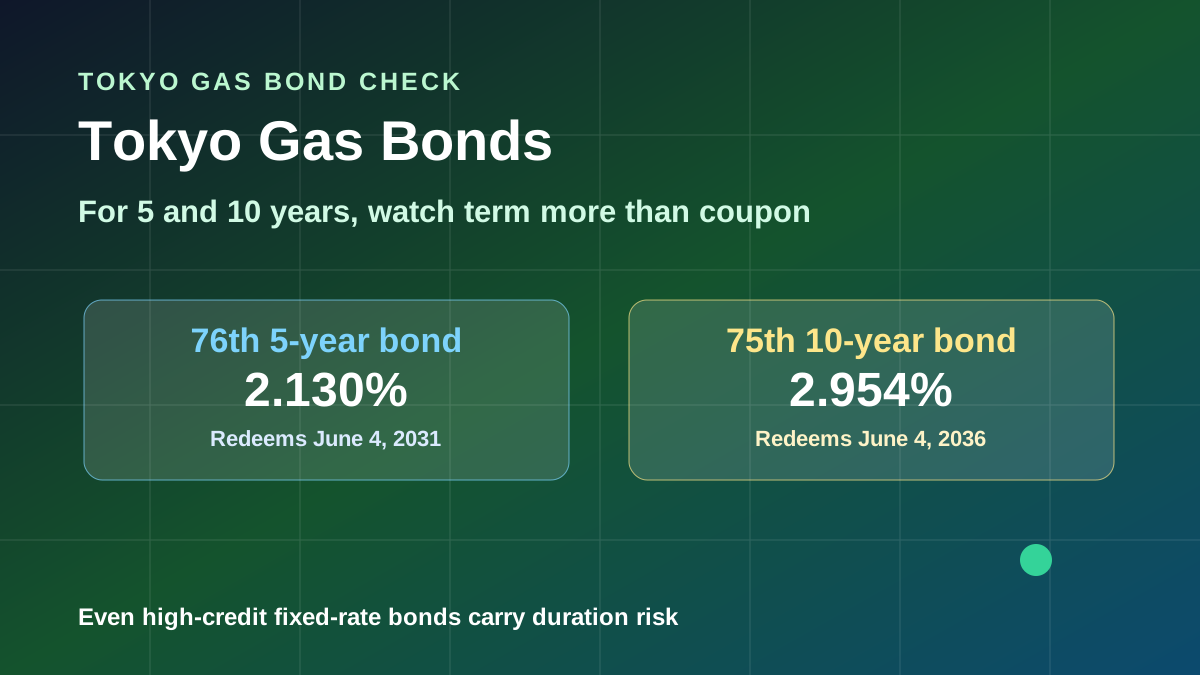
| Tokyo Gas 76th bond | 5-year plain corporate bond | 2.130% per year | Rate risk, issuer risk |
| Tokyo Gas 75th bond | 10-year plain corporate bond | 2.954% per year | 10-year rate risk |
| NEC Capital Solutions 31st bond | 4-year plain corporate bond | 2.36% per year | A-grade credit risk |
| SBG 9th hybrid bond | 35-year subordinated bond, fixed for first five years | Indicative 4.80-5.60% per year | Subordination, interest deferral, optional redemption, investment-company risk |
The SBG bond's coupon is high because investors are not taking only five years of credit risk, but also structural risk as a hybrid bond.
If it is placed on the same shelf as plain corporate bonds from Tokyo Gas or NEC Capital and compared only by coupon, it is easy to misread.
This product is not simply "higher than five-year JGBs" or "higher than plain corporate bonds." It is a transaction where investors receive a high initial coupon in exchange for accepting subordination and interest deferral.
Stronger Against Inflation, But Credit Risk Is Heavy
If the initial five-year indicative range is 4.80-5.60% per year, it is likely to exceed 2% inflation even after tax.
On a simple comparison, even if inflation is 2%, the after-tax coupon can easily look positive in real terms.
| Pre-tax coupon | Approximate after-tax coupon | Difference versus 2.0% inflation |
|---|---|---|
| 4.80% per year | About 3.825% | About +1.83% |
| 5.00% per year | About 3.984% | About +1.98% |
| 5.60% per year | About 4.462% | About +2.46% |
This is not a strict real-yield calculation. It is a simple guide that subtracts inflation from the after-tax coupon.
Looking only at the coupon, inflation resilience is strong.
The problem is what the coupon compensates for.
In the case of SBG's 9th hybrid bond, the center of that compensation is credit risk, subordination, interest deferral, and the risk that the first optional redemption is not exercised.
A number that appears likely to beat inflation does not make the product safe.
Who It May Suit
This bond may suit investors who can understand fairly demanding conditions.
| Potentially suitable investor | Reason |
|---|---|
| Can maintain diversification even with 1,000,000 yen units | The minimum investment is large and concentration risk can arise |
| Can read hybrid bond clauses | Interest deferral, subordination, and optional redemption must be understood |
| Can accept SBG's investment-company risk | NAV, LTV, and changes in investee valuations need to be accepted |
| Can consider the possibility of no redemption after five years | Maturity is in 2061, and optional redemption is not certain |
| Seeks higher yen-denominated income outside equities | A product that takes compound risks in exchange for a high coupon |
Conversely, it is less suitable for the following money.
| Less suitable money | Reason |
|---|---|
| Emergency savings | This is not a deposit; it is a subordinated corporate bond |
| Money assumed to be repaid with certainty after five years | First optional redemption is at issuer discretion |
| Money that must use every interest payment for living expenses | The bond has an interest deferral clause |
| Trial money for corporate bond beginners | The 1,000,000 yen unit is large, and the structure is complex |
| Long-term growth money for NISA | It is not a substitute for equity assets |
This product is a little too aggressive to call a defensive asset.
It is better viewed as a credit investment in bond form.
Conclusion: The High Coupon Compensates For Subordination And Optional Redemption Risk
SoftBank Group's 9th hybrid bond is a very noticeable deal in Japan's domestic retail corporate bond market in 2026.
The total issue amount is 260 billion yen.
The amount of each bond is 1,000,000 yen.
The indicative fixed coupon range for the first five years is 4.80-5.60% per year.
The preliminary rating is BBB+ by JCR.
Looking only at the numbers, it is strong as a yen-denominated income product.
However, this is not a plain corporate bond with a five-year maturity.
It is a 35-year hybrid bond with a subordination clause, interest deferral clause, and early redemption clause.
Three decision points are enough.
1. Do you understand that the high initial coupon compensates for subordination and interest deferral?
2. Can you accept the possibility that the bond is not redeemed early in 2031?
3. Can you manage SBG concentration risk even in 1,000,000 yen units?
For investors who can satisfy these three conditions, it may be worth considering as part of a portfolio.
On the other hand, it is quite risky to view it as a substitute for deposits, a substitute for plain corporate bonds, or a product with certain five-year redemption.
SBG's 9th hybrid bond is not a product for guessing the Bank of Japan's rate outlook.
The real question is whether investors can trust SoftBank Group's investment portfolio and funding capacity for five years, and possibly longer.
It is a credit product that asks exactly that question.
This article is a general explanation of the terms and risks of SoftBank Group's 9th hybrid bond and is not a recommendation to buy or sell any specific financial product. Corporate bonds carry credit risk, price fluctuation risk, and liquidity risk. This bond is more complex than a plain corporate bond because it has a subordination clause, interest deferral clause, and early redemption clause. Before making any investment decision, check issuer materials, selling-company materials, the prospectus, pre-contract documents, tax treatment, fees, and cash-out conditions.
Related Articles
- Corporate Bond Strategy In A Rate Normalization Phase: Duration And Rate Risk In Tokyo Gas' 75th And 76th Bonds
- Should You Buy NEC Capital Solutions' Corporate Bond? Coupon, Credit Risk, And Inflation Resilience For The 31st Bond
- Should You Buy Tohoku Electric Power's Retail Bond? Coupon, Risks, And Key Points For The 584th Bond
Sources
- SoftBank Group: Notice Concerning Issuance of Domestic Hybrid Corporate Bonds With Interest Deferral Clause, May 25, 2026
- Mizuho Securities: SoftBank Group Corp. 9th unsecured bond with interest deferral clause and early redemption clause (with subordination clause)
- SoftBank Group: Rating information
- SoftBank Group: Bond information
- SoftBank Group: Fiscal year ended March 2026 earnings
- Statistics Bureau of Japan: Consumer Price Index
- Bank of Japan: Price Stability Target of 2 Percent