
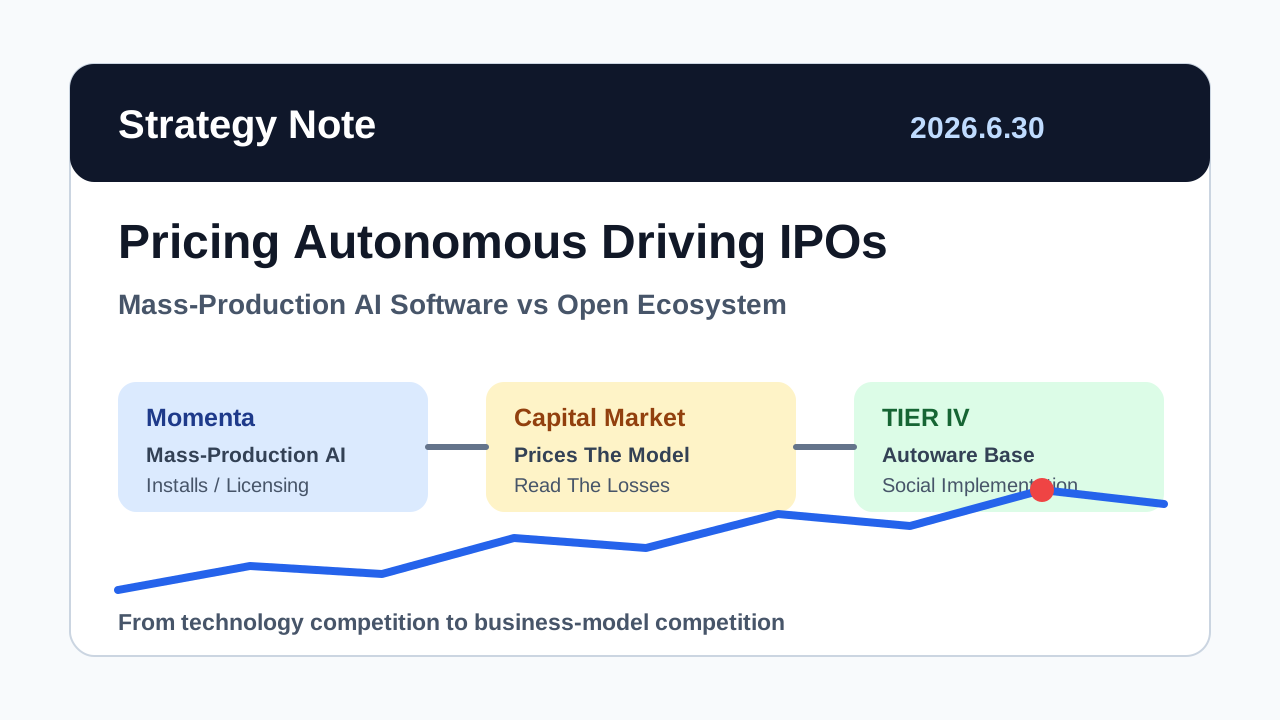
Introduction: July 2026 Marks A New Valuation Phase For Autonomous Driving
In July 2026, a symbolic moment arrives for East Asia’s autonomous-driving industry. Momenta is scheduled to list on the Hong Kong Stock Exchange on July 8, while TIER IV is scheduled to list on the Tokyo Stock Exchange Growth Market on July 22.
This is not just a coincidence of IPO timing.
It is an event that shows how capital markets are trying to value the monetization models of autonomous driving. For years, autonomous driving has been discussed through terms such as technology demos, pilot projects, Level 4 deregulation, and AI model progress. But once a company enters the public market, the questions become colder.
Will it become revenue? Will gross profit remain? Will it become recurring revenue? How much long-term loss can the market tolerate?
The near-simultaneous listings of Momenta and TIER IV put two different answers side by side.
In other words, this IPO moment is not about deciding which autonomous-driving technology is superior. It is also about asking which revenue model allows capital markets to tolerate long-term losses.
1. The Market Is Valuing Revenue Models, Not Just Technology
According to Momenta’s prospectus, its market capitalization based on the offer price of HK$295.60 is about HK$69.6 billion. TIER IV’s assumed market capitalization is about 64.48 billion yen, based on an assumed issue price of 1,015 yen.
Reading that gap as a simple difference in technology quality would be dangerous.
Momenta supplies mass-production vehicle software to OEMs and builds licensing revenue based on vehicle sales volume. Its prospectus shows that, as of the end of December 2025, it had secured cumulative nominations for 170 vehicle models, 68 models had reached SOP, and installation volume exceeded 680,000 units. In other words, investors can value it as software that is already inside cars.
TIER IV is an open-platform company centered on Autoware, connecting municipalities, logistics, public transportation, automakers, and research institutions. Its revenue model combines autonomous EV bus deployment support, OEM development support, software licensing, and solution revenue that includes government-commissioned projects.
Capital markets are valuing the two companies on different timelines.
Momenta is judged on the possibility that licensing revenue will scale as mass-production volume increases. TIER IV is judged on whether Autoware adoption can expand and whether demonstration and deployment support can turn into recurring revenue.
Even within the same autonomous-driving theme, investors are buying different stories.
2. Losses Are Not The Issue. What The Losses Are Funding Is The Issue
Both companies are loss-making. But the label “loss-making company” tells us almost nothing by itself.
Momenta posted revenue of RMB2,412.5 million in 2025, up 82.1% year on year. At the same time, its loss for the year was RMB3,457.9 million. Revenue is growing, but the profit-and-loss statement remains heavy, including R&D, share-based compensation, and fair-value effects related to preferred shares.
TIER IV also forecasts revenue of 8,484 million yen and an operating loss of 11,239 million yen for the fiscal year ending September 2026. Planned R&D expenses are 9,550 million yen. The company plans to keep investing more in R&D than it generates in revenue.
What investors are watching here is not just the size of the losses.
They are asking whether the losses are investments that can become future revenue models.
For Momenta, the key indicators are the number of equipped vehicle models, SOP models, Urban NOA installation volume, and the share of licensing revenue. For TIER IV, enterprise adoption of Autoware, social implementation regions, commercial Level 4 projects, and recurring revenue from Solution Service will shape the valuation.
The market uses completely different indicators for the two loss-making companies. Revenue matters, but profit matters more. Profit matters, but cash matters more. And before all of that, investors need to understand what the losses are funding.
3. Two Platform Strategies
The difference between the two companies also reflects how they define autonomous driving as an industry.
Momenta is a model that embeds its own AI deeply into mass-production vehicles. Its prospectus describes relationships with 24 major OEMs, including Mercedes-Benz, BMW Group China, Audi, Toyota, Honda, and Dongfeng Nissan. If its software goes into mass-production vehicles and the number of models and installed units rises, the revenue opportunity expands.
This is close to a vertical-integration mindset.
Momenta deepens relationships with OEMs, enters vehicle platforms, and deploys functions such as Urban NOA into mass-production vehicles. It treats autonomous driving as AI software installed in cars.
TIER IV, by contrast, is building a horizontal ecosystem that allows many companies and municipalities to participate around the open-source Autoware platform. It is better understood as a company trying to turn autonomous driving into social infrastructure across public transportation, logistics, OEM development, research institutions, and government projects.
Its source of competitiveness is not only internal.
As more participants use Autoware, vehicles, sensors, communications, insurance, fleet operations, and municipal projects can connect. That creates network effects. This structure resembles the recurring technology-industry contest between vertical integration and open platforms.
There is no clear answer yet. Embedding into mass-production vehicles can monetize faster. A social-infrastructure model takes longer, but it can become powerful if it turns into a standard. The market will price that difference in time horizon.
4. KPIs The Market Will Watch After Listing
Listing is not the goal. It is the starting line for valuation.
For Momenta, the key KPIs are the number of equipped vehicle models, SOP models, licensing revenue ratio, and expansion to overseas OEMs. The most important question is whether revenue growth shifts from development services to volume-linked licensing revenue.
For TIER IV, the key KPIs are Autoware adoption, growth in commercial Level 4 projects, implementation regions, Development Service customers, and licensing or recurring revenue from Solution Service. Because the operating loss is expected to remain large in FY2026, the market will ask how far the company can bridge social implementation and monetization using IPO proceeds.
| KPI To Watch | Momenta | TIER IV |
|---|---|---|
| Deployment | SOP models, Urban NOA installation volume | Implementation regions, commercial Level 4 projects |
| Customer base | OEM count, overseas OEM expansion | Municipalities, transport operators, OEMs, research institutions |
| Monetization | Volume-linked licensing revenue | Licensing, maintenance, recurring revenue after deployment |
| Costs | R&D, selling expenses, share-based compensation | R&D, hiring, deployment support costs |
| Risks | WVR structure, Hong Kong tech IPO demand, OEM dependency | Continued losses, offering size, social implementation timeline |
Comparing both companies simply as “autonomous-driving stocks” is likely to mislead investors. Momenta should be read as a mass-production AI software scaling story. TIER IV should be read as an open-ecosystem adoption story.
5. How Japanese Equity Investors Should Read This
For Japanese equity investors, TIER IV’s IPO is an easy theme to understand. Autonomous driving, AI, SDV, public-transport labor shortages, logistics automation. The words are strong.
But the stronger the theme, the more likely the stock can be cooled down by numbers after listing.
TIER IV’s assumed absorption amount is about 25.0 billion yen including the over-allotment. That is not light for a TSE Growth IPO. In its FY2026 forecast, the operating loss exceeds revenue, and R&D expenses are large. Early price formation may become a collision between excitement around the autonomous-driving theme and caution over the offering size and loss scale.
This is where the comparison with Momenta becomes useful.
The market is not asking autonomous-driving companies for “impressive technology” alone. Is the software already in vehicles? Can it become recurring revenue? Does gross profit remain after deployment? Can public transportation and logistics projects move from trials to commercial operations?
When looking at TIER IV, investors should look beyond the philosophy of Autoware and watch how close Development Service and Solution Service move toward mass production and recurring revenue.
Conclusion: The Market Is Pricing Industrial Structure, Not “AI” Alone
The two IPOs in July 2026 are not events that decide which autonomous-driving technology is better.
One model monetizes software through mass-production vehicle installations. The other spreads an autonomous-driving foundation as social infrastructure. These IPOs give capital markets an early chance to price which model can create more durable value.
That is why these two IPOs are more than just new listings. They mark a symbolic moment in which the autonomous-driving industry is moving from technology competition to business-model competition.
What matters after listing is not the first-day price alone. For Momenta, the answer will be in installation volume and licensing revenue. For TIER IV, it will be in Autoware adoption and recurring monetization.
Related Reading
- Japan-China Autonomous Driving IPO Comparison News
- TIER IV (593A) IPO News
- 593A: TIER IV Analysis
- 2026 IPO Annual Listing List
- TIER IV: Revised Loss-Heavy FY2026 Forecast