
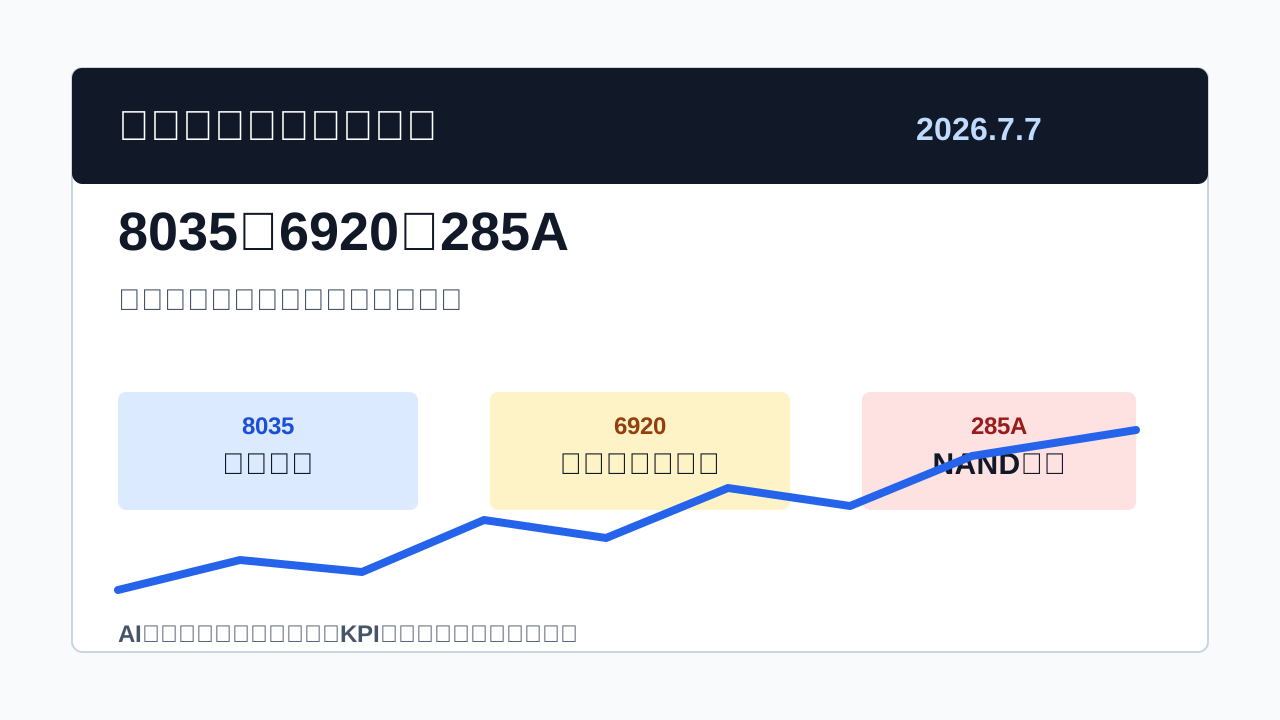
First, the conclusion
To put it simply, the difference in today's price movements is that the market has begun to look at the same large-cap stocks in very fine-grained terms.
Nintendo is not a company that is directly influenced by semiconductor prices or equipment orders. Nintendo Switch 2, software sales, digital sales, IP revenue including movies and theme parks, foreign exchange. This will be the axis of evaluation. When capital is withdrawn from semiconductor stocks, it is easy to see the same large-cap stocks as stocks with different profit cycles.
Tokyo Electron is a core stock in semiconductor manufacturing equipment that will benefit from capital investment for AI. However, as it is an equipment stock, it is influenced by the customer's capital investment cycle. Even if demand for AI is strong, stock prices will be weighed down if the timing of investment plans is off.
Lasertec has a strong position in EUV-related inspection equipment, but growth expectations tend to be reflected in the stock price first. What the market is looking at is not only `current profits,'' but also `Will the next orders increase again?''
Kioxia is closest to the NAND flash memory and SSD market. If memory prices rise, profits will increase significantly, but if inventory adjustment or competition increases in supply, stock prices will begin to reflect a peak out.
In other words, today's main role is "selecting among large-cap stocks." Game/IP, comprehensive equipment, EUV inspection, memory market conditions. Each one is playing a different game.
What happened in the stock market today
According to the July 7th observation memo, Nintendo was on the rise, Tokyo Electron was weak, Lasertec was down significantly, and Kioxia was down, showing differences even among large stocks.
This price movement raises more questions from investors than meets the eye. Why did stocks closer to AI and semiconductors sell more, while Nintendo, a gaming stock, was relatively bought?
The answer is not just short-term supply and demand. Semiconductor stocks have been heavily bought in recent months on themes such as AI investment, generative AI servers, HBM, NAND, and front-end equipment. The more expectations there are for a stock, the more likely it will be sold if the overall market tilts towards taking profits.
On the other hand, even though Nintendo is a large stock, it is viewed in a different cycle. The points of discussion are not orders for semiconductor manufacturing equipment or NAND prices, but sales of new hardware, software installation rates, IP revenue, and exchange rate sensitivity. At a time when the market is trying to cool down the overheated semiconductor market, these large-cap stocks that are in a different cycle are likely to be seen as an escape.
The main reason is the difference in business models
To read the differences in price movements, you first need to look at what companies are making profits from.
| Stock | Main business model | Themes that the market is looking at |
|---|---|---|
| Nintendo (7974) | Game consoles, software, digital, IP | New hardware, software sales, IP revenue, weak yen |
| Tokyo Electron (8035) | Semiconductor front-end process equipment | Capital investment for AI, semiconductor factory investment, profit margin |
| Lasertec (6920) | EUV-related inspection equipment | Order momentum, high PER tolerance, advanced semiconductor investment |
| KIOXIA HD (285A) | NAND, SSD, Memory | NAND price, AI storage demand, inventory, credit supply and demand |
Nintendo's sales grew to 2,313 billion yen and operating profit to 360.1 billion yen in the fiscal year ending March 2026. Nintendo Switch 2 had a great start, and hardware sales, software sales, and digital sales increased. However, next year's sales are expected to decline by 2.5 trillion yen, and the market is waiting to see if the momentum from the first year of release will continue into the second year.
Tokyo Electron had sales of 2,443.5 billion yen and operating profit of 624.9 billion yen in the fiscal year ending March 2026. As it is a comprehensive equipment stock involved in multiple processes at a semiconductor factory, it is likely to attract institutional investors who invest in the semiconductor sector as a whole. On the other hand, if equipment investment slows down, profit margins will come under pressure.
Lasertec had sales of 169,539 million yen and operating income of 78,191 million yen in the third quarter of the fiscal year ending June 2026. Profitability is high, but the stock price is likely to wait for confirmation of a recovery in orders. Stocks with high growth expectations are subject to resale if the next growth is not visible, even if the numbers are not bad.
Kioxia improved its revenue to 2,337.6 billion yen and operating profit to 870.4 billion yen in the fiscal year ending March 2026. If you just look at the numbers, it's very strong. However, NAND memory is close to a market commodity. The stronger the company's financial results, the more the market wants to ask, ``Will this profit margin continue?''
Why were only semiconductor stocks selling easily today?
It would be a mistake to attribute the reason for the sale of semiconductor stocks solely to poor business performance. Rather, the issue this time is more like adjusting expected values.
First, there was considerable room for profit-taking in AI and semiconductor stocks. Stocks that were bought based on materials such as generation AI investment, data center investment, HBM, NAND, and front-end equipment tend to have heavy positions after a rise. If the market as a whole loses even a small amount of risk, stocks that were rising will be sold.
Next, be wary of stocks with high PER. Stocks such as Lasertec and Tokyo Electron that have a high degree of future growth factored in are likely to be sensitive to movements in interest rates and U.S. semiconductor stocks. Even for a good company, if good factors are already included in the stock price, the upside will be heavy in the short term.
Kioxia is a little different. If you look only at the P/E ratio, it may seem cheap, but the low P/E ratio of memory stocks also reflects the market's suspicion that ``profits may be at their peak.'' This is the difficult part. Just because a P/E ratio is low does not mean it is safe.
Nintendo is not directly affected by the deterioration in supply and demand in the semiconductor sector. Of course, stock prices fluctuate depending on exchange rates, hardware sales, and software lineup. However, there were conditions that made it easy for funds to be directed to another large-scale growth market on the day semiconductor stocks took profits.
You can see the difference by looking at the PER
PER is difficult to use to simply judge whether a stock is overvalued or undervalued. Especially when stocks with different business models are lined up like they are today, the P/E ratio is like a thermometer that measures how far the market is pricing in future profits.
The reason why Lasertec's PER looks high is because the growth potential and high profitability of EUV-related equipment is highly evaluated. However, a high PER can also be a weakness in a situation where a recovery in orders cannot be confirmed. The market is buying growth stories, so when momentum slows, multiples will fall first.
Tokyo Electron also tends to command a premium as a core stock in semiconductor manufacturing equipment. However, since it is a comprehensive equipment stock, we can see not only individual themes but also the cycle of semiconductor capital investment as a whole. Even if AI investment is strong, the evaluation will fluctuate if profit margins, R&D costs, and customer investment timing are affected.
Nintendo is evaluated on a different basis than semiconductor stocks. Generational changes in game consoles, software sales, IP revenue, digital ratio, and exchange rates will change the way we view PER. Even if only hardware sales grow, if profit margins fall, the market will cool down, and if software, digital, and IP are strong, valuations will likely be supported.
Even though Kioxia's P/E looks low, the market may be doubting the sustainability of its profits. Memory stocks tend to have low P/E ratios when they are most profitable. Beginners tend to get stuck here.
The exact PER changes daily based on stock price and EPS assumptions. Therefore, in this article, we treat PER as an auxiliary line that looks at differences in expected values, rather than a fixed value ranking.
What should investors think?
In short-term investments, the strength of price movements, freshness of materials, trading volume, and credit supply and demand come into play. Semiconductor stocks have strong themes, so they can move up or down quickly. With stocks like Lasertec and Kioxia, there are times when the question of whether there are still people who want to sell is more important than the positive factors.
When it comes to medium- to long-term investments, the place you look will change. Performance, ROE, operating cash flow, investment burden, and how much profit can be left in the next growth market. Will Nintendo be able to make profits from software, digital, and IP after the Switch 2 becomes popular? For Tokyo Electron, will capital investment for AI be continued as a front-end process investment rather than a one-off? Will orders for Lasertec accelerate again? For KIOXIA, how long will the rise in NAND market prices last?
A stock that has fallen doesn't necessarily mean it's a bad company. Conversely, stocks that have risen in value are not necessarily safe. What matters is what the stock price has factored in, and what is still in doubt.
Points to pay attention to in the future
The points to check from here are quite different depending on the brand.
| Brand | KPIs to check |
|---|---|
| Nintendo | Switch 2 unit sales, software sales, digital sales, IP-related revenue, currency sensitivity |
| Tokyo Electron | Semiconductor capital investment, orders, operating profit margin, R&D expenses, demand for AI equipment |
| Lasertec | New orders, backlog, equipment sales, service sales, acceptance inspection, and cash flow |
| KIOXIA | NAND price, eSSD demand, inventory, competitive investment, credit buying balance |
From a macro perspective, we cannot ignore the direction of US semiconductor stocks, the yen exchange rate, domestic long-term interest rates, and the monetary policies of the Bank of Japan and the Federal Reserve. When interest rates rise, stocks with high P/E ratios that factor in growth in the distant future are more likely to fluctuate. The weak yen is a tailwind for Nintendo and semiconductor-related industries, but a market that is driven solely by exchange rates is unlikely to last long.
Summary
The price movement on July 7, 2026 will not be a simple one where only semiconductor stocks are bad and only Nintendo is good.
Nintendo is seen in the cycle of games, IP, and new hardware. Tokyo Electron is the core of semiconductor equipment investment. Lasertec has momentum in receiving EUV-related orders. KIOXIA depends on NAND market conditions and credit supply and demand. This difference led to different price movements even for the same large-cap stocks.
Rather than making judgments based only on short-term stock prices, it is more accurate to look at what generates profits and which KPIs the market is doubtful about. Today's market conditions made this very clear.
Related pages
- [Will Nintendo stock become a safe haven for semiconductor prices? | July market price based on Switch 2 and IP revenue] (/news/market/2026/07/07/nintendo-ip-rotation.html)
- [Why Lasertec and semiconductor stocks are weak | 3 points to consider in the July market] (/news/market/2026/07/07/lasertec-semiconductor-selloff.html)
- [Why Kioxia stock is rough | Looking at AI storage expectations and NAND market risk separately] (/news/market/2026/07/07/kioxia-nand-selloff.html)
- [Reading the polarization of the semiconductor sector | The reason why the price movements of 8035, 6920, and 285A diverged] (/strategy/2026/07/07/semiconductor-sector-divergence-8035-6920-285a.html)
- Read Tokyo Electron (8035) AI semiconductor business model
source
- Nintendo "Information for shareholders and investors"
- Nintendo "Financial Results, etc."
- Tokyo Electron "Investor Information"
- Tokyo Electron "Financial Results/Financial Results Briefing Materials"
- Lasertec "Performance Report"
- Lasertec "Latest IR Materials"
- KIOXIA Holdings “Shareholder/Investor Information”
- KIOXIA Holdings "IR News"