First, the conclusion
The polarization of semiconductor stocks is not just based on good or bad business performance, but also on the time axis of business models.
Tokyo Electron is a stock that broadly invests in semiconductor factories themselves. There is a wide range of front-end processes such as film formation, cleaning, coater/developer, etc., and it is easy to receive investment cycles not only for AI but also for logic, memory, and mature areas. As the core of the sector, it is easy to buy back after being sold.
Lasertec has a strong position in cutting-edge EUV testing, but the market is more focused on `momentum for next orders'' than on `current profits.'' High PER stocks are likely to see their valuation multiples reduced while there is no sign of a recovery in orders.
Kioxia is easier to understand. While NAND prices and AI storage demand are pushing up performance, memory stocks are always suspected of a market reversal. Moreover, after stock prices rise significantly, credit supply and demand and profit taking tend to amplify the price range.
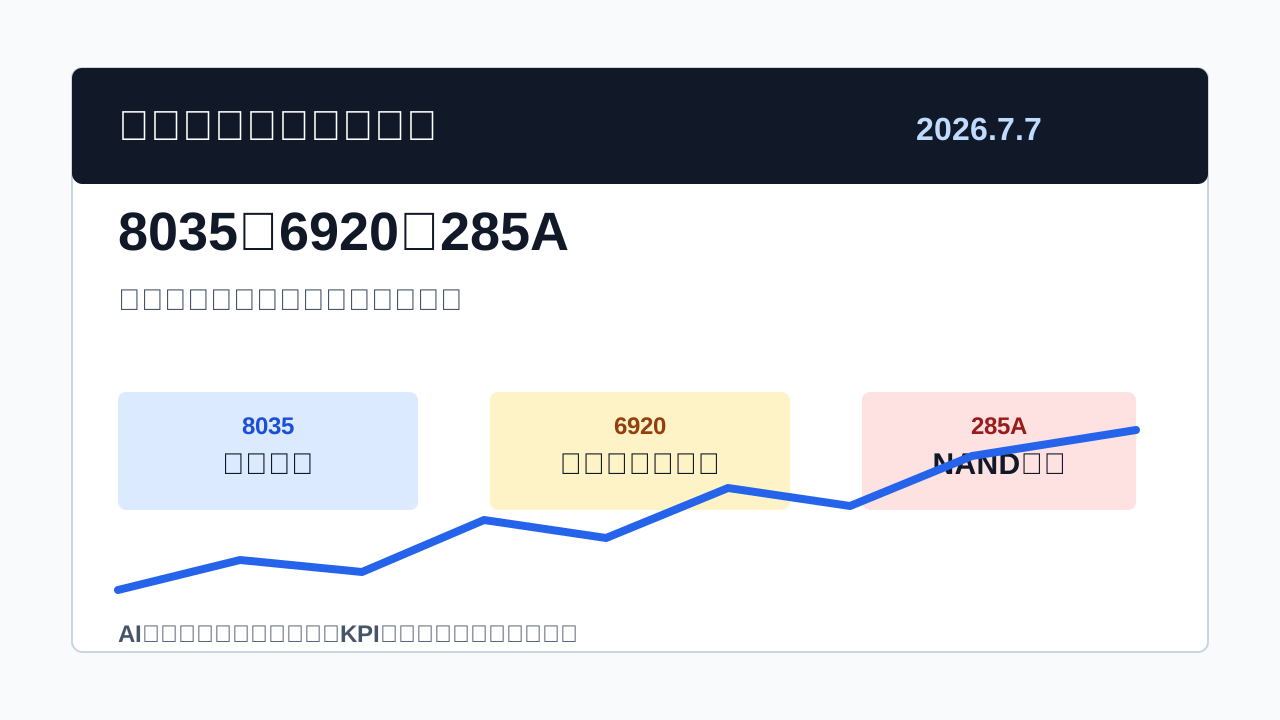
In other words, the difference on the morning of July 7th, ``8035 is positive, 6920 and 285A are negative'' is not a coincidence. The market is starting to segment semiconductor stocks quite finely.
What's happening?
Regarding Japanese stocks in July 2026, the Nikkei average and TOPIX appear to be out of sync. The Nikkei average is strongly influenced by semiconductor and high-value stocks. On the other hand, TOPIX also reflects the resilience of banks, trading companies, domestic demand, and value stocks.
In this situation, among semiconductor stocks, `stocks that were bought to high prices,'' stocks with heavy credit supply and demand,'' and `stocks whose peak profits are suspected'' are likely to be sold first. On the other hand, stocks that are the core of a sector and are easy for institutional investors to hold are likely to be bought back after a round of selling.
The observation memo as of 9:30 clearly reflects the difference.
| Stocks | Observations as of 9:30 | Main issues the market is looking at |
|---|---|---|
| Tokyo Electron (8035) | +520 yen | Comprehensive strength in front-end equipment, capital investment for AI, index and institutional investors |
| Lasertec (6920) | -2,140 yen | Timing of order recovery, tolerance for high PER, composition of equipment sales and service sales |
| Kioxia HD (285A) | -3,800 yen | NAND price, AI storage demand, credit supply and demand, memory market peak out warning |
What is important about this table is that it is not simply a case of stocks that have gone up in value as good and stocks that have gone down in value as bad. Each has different perceived risks.
Chapter 1: Kioxia is in the middle of the silicon cycle
Kioxia is the closest to the market price of the three stocks. Since the company focuses on NAND flash memory and SSDs, the sales price, shipment volume, inventory, and production increases of its competitors directly impact its profit margin.
In the fiscal year ending March 2026, sales revenue improved to 2,337.6 billion yen, operating profit 870.4 billion yen, and profit attributable to the parent company to 554.5 billion yen. This is a strong financial result. Demand for data centers and enterprises, including those for AI applications, and improvements in the flash memory market were simultaneously effective.
However, this is where the market gets scared.
Memory stocks are suspected of peaking out when the numbers look their best. If prices rise, profits will increase rapidly, but as soon as supply increases or inventory adjustments become apparent, valuations will reverse at the same speed. In the case of Kioxia, the forecast for the first quarter of the fiscal year ending March 2027 is extremely strong, with sales revenue of 1.75 trillion yen and operating profit of 1.298 trillion yen, but these are not full-year forecasts. If we convert quarterly strength into an annualized rate, it would be quite dangerous for memory stocks.
The other factor is supply and demand. The more stocks soar, the more margin purchases, short-term funds, and profit-taking will accumulate. In the event of a decline, the price range may increase simply due to position adjustments rather than due to a deterioration in performance.
When looking at Kioxia, what you need to look at is not just ``is there strong demand for AI?'' NAND prices, eSSD demand, inventories, competitors' capital investment, clearing backlog of credit purchases, bottoming out due to trading volume. This area will be set.
Chapter 2: Lasertec is a stock waiting for order momentum
Lasertec has a very strong business theme of EUV-related inspection equipment. It is niche, strong, and has high profit margins. Finances are not weak either. In the third quarter of the fiscal year ending June 2026, sales were 169,539 million yen, operating income was 78,191 million yen, and quarterly net income attributable to owners of parent was 56,823 million yen. The equity ratio is also high at 72.5%.
Still, the reason why stock prices have been slow to recover is more a problem with valuation multiples than with financial concerns.
The market is looking at Lasertec's ``will orders accelerate next time'' rather than its current profit level. In its interim results report for February 2026, the company explained that orders had temporarily weakened in the previous fiscal year due to some customers reviewing their investment plans, but that orders will gradually recover from the second half of the fiscal year ending June 2026.
This will be the focus of the market.
The stronger the theme of a stock, the more expectations are placed on the stock price first. If the company sees orders, it will be easy for the company's valuation to recover, but until the recovery in orders can be confirmed in numbers, the question remains whether the company can maintain its high P/E ratio. In a situation where interest rates are rising and TOPIX value funds are becoming stronger, this question is quite important.
What Lasertech needs is confirmation material, not a story. Orders, order backlog, recovery in equipment sales, growth in service sales, timing of acceptance inspections and cash flows. Until these conditions are in place, the market is likely to be pushed back to sell even if the market is positive.
Chapter 3: Why is Tokyo Electron relatively stable?
Tokyo Electron has a different personality from Lasertec, even though they are the same equipment stock.
If Lasertec is in the high-profit niche of cutting-edge inspection equipment, Tokyo Electron is more like a comprehensive platform for all front-end processes. He is widely involved in multiple processes used in semiconductor factories, such as film formation, cleaning, coater/developer, etc. The structure is not completely dependent on the market conditions of any one device.
For the full year ending March 2026, sales were 2,443.5 billion yen, operating income was 624.9 billion yen, and net income attributable to owners of parent was 574.4 billion yen. Although operating income is down, the company's sales scale, finances, and equipment portfolio are large. On Tokyo Electron's IR page, the announcement of financial results for the first quarter of the fiscal year ending March 2027 is scheduled for July 30, 2026.
There is another reason why the market favors Tokyo Electron. When incorporating the Japanese semiconductor sector globally, it tends to become a large core stock that institutional investors can easily touch first. Rather than a large sell-off due to individual factors, the market is likely to be sold due to position adjustments in the entire sector, and then try to recover after a round of selling.
Of course, Tokyo Electron also has risks. If semiconductor capital investment slows down, no one will be able to survive unscathed. If R&D expenses and upfront investments become heavy, profit margins will be difficult to increase even if sales increase. However, the way stock prices fluctuate is different from Kioxia, which is directly affected by market conditions, and Lasertec, which is waiting for order momentum.
Comparison table: Different KPIs are being looked at even though they are related to the same AI
| Viewpoint | Tokyo Electron (8035) | Lasertec (6920) | Kioxia HD (285A) |
|---|---|---|---|
| Business characteristics | Comprehensive platform for front-end equipment | Highly profitable niche for EUV-related inspection equipment | Memory stocks centered on NAND/SSD |
| Main KPIs that drive stock prices | Semiconductor capital investment, orders, profit margin, demand for AI equipment | New orders, backlog, equipment sales, acceptance inspection, service sales | NAND price, shipment volume, inventory, eSSD demand, credit supply and demand |
| Strong situation | When funds return to the entire sector | When orders are confirmed to accelerate again | When NAND price increases and AI storage demand run at the same time |
| Weak situation | Postponement of capital investment and upfront investment burden | Rising interest rates where high PER is difficult to tolerate | Concerns about market peaking, deterioration of credit supply and demand |
| Investors' doubts | Can the profit margin be maintained? | When will we see the next peak in orders | Will the current profit margin continue |
If you look at semiconductor stocks all at once, you will overlook this difference.
Tokyo Electron is easily seen as the core of the sector. Lasertec's valuation multiple is likely to fluctuate until order momentum returns. Kioxia's stock price fluctuates wildly depending on market conditions and supply and demand, even if actual demand is strong.
KPIs that investors should look at
From now on, for semiconductor stocks, I would like to see which KPIs have the power to explain stock prices, rather than whether they have gone up or down.
Tokyo Electron will confirm the outlook for demand for semiconductor manufacturing equipment, investment in cutting-edge devices for AI servers, operating profit margin, and increase in R&D expenses in its next financial results. Even if sales are strong, stock prices will react slowly if profit margins are slow.
At Lasertec, our first priority is order volume and order backlog. Even if service sales are growing, what the market needs is a recovery in new orders for equipment. If only a high P/E ratio remains without a recovery in orders in sight, reversal selling is likely to continue.
At KIOXIA, we look at NAND prices, SSDs for data centers and enterprises, inventory, capital investment, and credit purchase balances. The 1Q forecast is very strong, but unless we see how it will lead to the full year, it is easy to buy the peak profit.
Risk scenario
Even though the semiconductor market appears bullish, there are multiple risks.
The biggest risk is that the market misunderstands that the promise of AI investment will have the same effect on equipment, memory, and inspection equipment. Even if AI server investment is strong, NAND prices, orders for EUV inspection equipment, and capital investment for front-end equipment do not move at the same time.
Next is interest rates. When domestic long-term interest rates are at a high level, stocks with high P/E ratios that factor in growth in the distant future are likely to be undervalued. It tends to work directly on stocks like Lasertec. For memory stocks like Kioxia, market conditions and supply and demand come into play before interest rates. At Tokyo Electron, continuity of capital investment and profit margin are more important than interest rates.
Finally, there is supply and demand. For stocks that have skyrocketed like Kioxia, the exit of short-term funds can have a big impact on the stock price. Even if business performance is good, if supply and demand are poor, stock prices will collapse first. It's not pretty here.
Summary
Semiconductor stocks on July 7, 2026 are not just a risk-off. The market is starting to sort through semiconductor stocks.
Tokyo Electron is the core of the sector and is prone to buybacks. Although Lasertec has a strong technology position, it is still waiting for confirmation of order momentum. KIOXIA has a strong theme of AI storage demand, but is most affected by NAND market conditions and credit supply and demand.
The term "semiconductor stocks" is convenient, but the market price in the summer of 2026 is too rough. Equipment, testing, memory. Just by looking at these parts separately, the meaning of price movements changes considerably.
Related pages
- Read Tokyo Electron (8035) AI semiconductor business model
- [Why Lasertec and semiconductor stocks are weak | 3 points to consider in the July market] (/news/market/2026/07/07/lasertec-semiconductor-selloff.html)
- [Why Kioxia stock is rough | Looking at AI storage expectations and NAND market risk separately] (/news/market/2026/07/07/kioxia-nand-selloff.html)
- KIOXIA 1Q financial results are scheduled to be announced on July 31st, confirm NAND market conditions and AI storage demand
- Ranking of 20 Japanese semiconductor stocks: Compare AI, HBM, equipment, and materials