
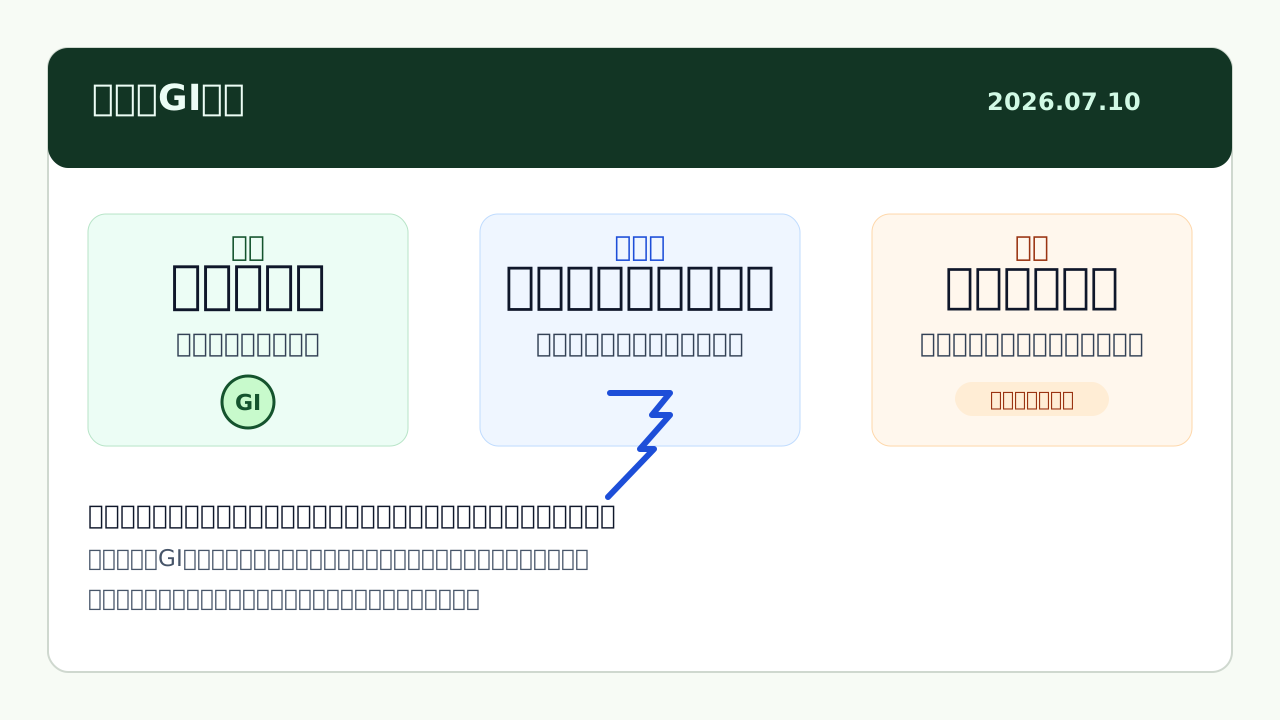
First, the conclusion
If you take only the first quarter, the numbers are quite strong. Although sales increased by only 9.3% compared to the same period last year, operating income increased by 106.1%. The operating profit margin rose from 6.1% in the same period last year to 11.5%. The operating profit margin for the full year is 6.5%. Looking at this difference, it is no surprise that some people might ask, ``Why didn't the company change its full-year forecast?''
In fact, some investors are likely to be conscious of upward revisions from next quarter onward. The progress rate for operating income in 1Q was 44.6%. This is higher than the 29.7% for the same period last year. If you look at the numbers alone, the company's plans look cautious.
However, reading the financial results, the company's sentiments are not that optimistic. Difficulties in procuring raw materials derived from crude oil, time lag in passing on prices, demand for securing domestic inventory, and weak demand in North America. There are also factors that make it difficult to say that the strength of the first quarter will continue to grow throughout the year.
This financial result was a ``numbers are strong, but the market is testing its sustainability'' type of first quarter. Here's where things get a little difficult.
Company profile
MORESCO is a company in the petroleum and coal products sector that develops specialty lubricants, hot melt adhesives and materials. Our customers include automobiles, data center-related products, sanitary materials, and industrial applications.
MORESCO is a company that is difficult to evaluate based on sales volume alone. When raw material prices rise, costs increase first, and there is a time lag before price revisions are passed. Profit margins will return as the costs are passed on, but high crude oil prices themselves will not provide a tailwind.
The latest financial results show that rather than using high raw material prices as a source of profit, we have returned to profitability through price corrections and improved product mix. That's why the market next wonders whether the price and mix will continue.
most recent material
On July 9, 2026, MORESCO announced its financial results for the first quarter of the fiscal year ending February 2027. Sales were 9,306 million yen, operating income was 1,071 million yen, ordinary income was 1,117 million yen, and quarterly net income attributable to owners of parent was 731 million yen.
Gross trading profit was 3,351 million yen, an increase from 2,608 million yen in the same period last year. Gross profit margin improved from 30.6% to 36.0%. Not only the operating profit margin has jumped, but profitability has changed from the gross profit level. It's really strong here.
The fact that the growth in net income exceeded the growth in operating income should be taken with a bit of a grain of salt. In the same period last year, foreign exchange losses of 139 million yen pushed up non-operating expenses, but in the first quarter of this fiscal year, foreign exchange losses decreased to 21 million yen. There was also no extraordinary loss this fiscal year, compared to a loss on valuation of investment securities of 3 million yen in the same period last year. Although the headline that net income has more than tripled is strong, if we are to measure changes in the company's core business, it is better to focus on improvements in operating income and gross profit margin.
The full-year forecast remains unchanged at 37,000 million yen in sales, 2,400 million yen in operating income, 2,700 million yen in ordinary income, and 1,550 million yen in net income attributable to owners of parent. The dividend forecast remains unchanged at 25 yen in the interim, 30 yen at the end of the period, and 55 yen for the full year.
How to view performance
Looking at the segment, the main character this time is almost all about Japan. Sales to external customers in Japan were 6,368 million yen, and segment profit was 819 million yen. The segment profit margin was 12.9%, accounting for approximately 76% of the total segment profit of 1,080 million yen before adjustment.
The company's structure of earning about three-quarters of its profits from Japan alone has quite significant implications. Although we are making progress in improving the profitability of our overseas businesses, it is ultimately the domestic business that determines consolidated profits. As long as this dependence is high, even a small change in the profit margin of the Japanese business will change the outlook for full-year profits.
Japan's strength is due to a combination of price corrections in all sectors, an increase in sales of die-casting lubricants and other products due to customers securing inventory, and growth in high-value-added products including hard disk surface lubricants for data centers. Price, mix, and potential for front-loading demand. These three things worked all at once in the first quarter.
In China, sales were 946 million yen and segment profit was 109 million yen. Although automobile production decreased, sales of new vacuum oils and cutting fluids, and hot melt adhesives for insect traps made up for the decline. The segment profit margin is 11.5%, which is close to Japan's level.
In Southeast and South Asia, sales were 1,553 million yen, a decrease of 9.9%, and segment profit was 167 million yen, an increase of 207.3%. Segment profit margin was 10.8%. This can be evaluated as improving profitability by eliminating unprofitable products. However, a decrease in sales and increase in profits is not always a pleasant evaluation. After reorganization, can sales be returned to more profitable uses? Only when we can see that much can we say that the decline in revenue is positive.
In North America, sales were 439 million yen and segment loss was 15 million yen. The proportion of the company's total sales is only about 4.7%, so it is not large enough to shake up the entire consolidated business at this point. Even so, the company is in the red due to a decline in demand from its major customers, which remains a factor limiting the margin for profit growth.
How to view financial status/cash
Total assets were 40,221 million yen, a decrease of 462 million yen from the end of the previous fiscal year. Notes and accounts receivable increased by 302 million yen, and raw materials and supplies increased by 289 million yen. It seems that the increase in trade receivables due to the increase in sales, the increase in inventory in preparation for procurement difficulties, and the increase in working capital burden are occurring at the same time.
Cash and deposits decreased by 909 million yen. It is easy to read this loosely as ``profits are not converted into cash.'' In the 1Q financial results report, a quarterly cash flow statement has not been prepared, and there is a decrease of 801 million yen in short-term debt and 165 million yen in long-term debt. Debt repayments, dividends, capital investments, and working capital. It is still difficult to say which one was more effective.
Equity ratio improved from 57.7% to 60.0%. Our financial health is actually improving. However, in a situation where raw material procurement is unstable, a strong balance sheet alone is not enough. The pace at which accounts receivable and inventory expand will affect the financial burden behind the profit margin.
How to read the full-year outlook and dividends
The 1Q progress rate against the full-year forecast was 25.2% for sales, 44.6% for operating income, 41.4% for ordinary income, and 47.2% for net income. In the previous year's 1Q of the fiscal year ending February 2026, the operating income progress rate was 29.7% and the net income progress rate was 18.2%. Compared to the same period last year, the progress in 1Q profits this time is clearly high.
So the market is confused. If it's just 1Q, 2.4 billion yen for the full year seems low. However, the company did not move. This is where I feel uncomfortable this time.
The company did not provide a detailed explanation of the reason for the suspension. In terms of disclosure, we can confirm the turmoil in the Middle East, difficulties in procuring crude oil, naphtha and other crude oil-derived raw materials, uncertainty about the global economy, and declining demand in North America. The company probably believes that it is still too early to extend the 1Q profit margin to the full year.
The dividend forecast remains unchanged at 55 yen per year. This is the same level as the results for the fiscal year ending February 2026. If the profit progress is high, it is tempting to get ahead of expectations for dividend increases, but this is something that should be separated from expectations for earnings revisions. First, how does the company handle profit forecasts? Next is the dividend.
Interpretation in the stock market
What the market cares about is the company's attitude rather than the numbers themselves. Operating profit margin 11.5%, operating profit progress 44.6%, Japan segment profit margin 12.9%. Based on this arrangement alone, the company's projected operating income of 2.4 billion yen seems quite conservative.
However, since the company did not take any action, it is difficult for the market to give a full response immediately. The strength in 1Q was mixed with demand to secure inventory, and it is possible that future demand was brought forward. It is not certain that there will be a backlash. However, there is enough reason for investors to be suspicious.
Another point is that the market can easily make mistakes in the handling of high oil prices. High crude oil prices are essentially a cost increase factor for MORESCO. As raw material prices rise and there is a time lag until price revisions, profit margins will recover as the costs are passed on. This improvement in profit margins indicates the effects of price correction, but if crude oil and naphtha prices rise again, the same lag will occur again.
This number alone is sufficient for evaluation. The problem is not the 11.5% profit margin itself. Will this level remain in the 2Q, or was it a tailwind unique to the 1Q? The market should try that.
bullish scenario
The bullish scenario is a case where the consolidated operating profit margin remains around 10% even in the cumulative 2Q. Once that is seen, the market will begin to reconsider the company's plans. Even if the company does not make any moves, the investor's image of profits will improve first.
If the Japan segment profit margin remains at around 12% and growth in high value-added products continues, the improvement in profit margin in 1Q will be more likely to be seen as a structural improvement rather than a temporary one. If the North American deficit shrinks, the loss of profits will be small. If that happens, the market will be talking about the room for upside in full-year operating profit, not dividends.
bearish scenario
A bearish scenario is when the inventory buildup is due to front-loaded demand. Even if volumes return to normal levels, profit margins are likely to fall more than expected. Because profits are highly dependent on Japan, if the profit margin in the Japan segment collapses, the overall impression of the consolidated group will change immediately.
The rise in crude oil and naphtha prices is accelerating again, and the development of delays in price revisions is also an unpleasant pattern. If sales in Southeast and South Asia continue to decline and reinvestment in growth areas is not visible after profitability improvements, evaluations will be difficult to improve. Although North America is small, if the deficit persists, the perception will likely be that ``1Q was good, but there are still holes.''
Featured KPIs
The most important KPI is the consolidated operating profit margin. Will it suddenly drop from 11.5% in 1Q to 6.5% based on the full-year plan, or will it be able to maintain around 10%? Here, the outlook for full-year upside changes significantly.
Next, let's look at the profit margin of the Japan segment. In 1Q, it was 12.9% and led the overall profit. Since we earn about three-quarters of our profits domestically, a decline in this number directly translates into concerns about our consolidated profits.
The third is the sales volume after the demand for securing inventory has run its course. If the volume does not decline in 2Q and the gross profit margin is maintained, it will be much easier to believe in the strong performance in 1Q. Accounts receivable, raw materials and supplies, cash and deposits serve as supplementary indicators to assess working capital burden and cash conversion.
summary
If you look only at the 1Q financial results, MORESCO is in a fairly strong category. Operating profit margin 11.5%, operating profit progress 44.6%. Based on this figure alone, the full-year operating profit of 2.4 billion yen seems a little cautious.
However, the company did not move its forecast. Reading the financial results, there are still some factors behind this that we cannot be confident about, such as the sustainability of raw material procurement and inventory demand. The weakness in North America is also a small but worrisome problem.
Ultimately, while this is a 1Q that raises expectations for an upward revision, it is also a 1Q in which the company itself is not yet that optimistic.
Will the profit margin be maintained in the next financial results, or will it return to normal levels? That one point alone is likely to change the way we view the market.
Related pages
source
- MORESCO Co., Ltd. “Summary of financial results for the first quarter of the fiscal year ending February 2027 [Japanese GAAP] (consolidated)” (disclosed on July 9, 2026, confirmed on July 10, 2026)
- 株式会社MORESCO 株主・投資家情報 (confirmed on July 10, 2026)
- KABUTRACK "MORESCO | Sales 9.306 billion yen (+9.3%) | 1st quarter financial results for the fiscal year ending February 2027", disclosure date: July 9, 2026