
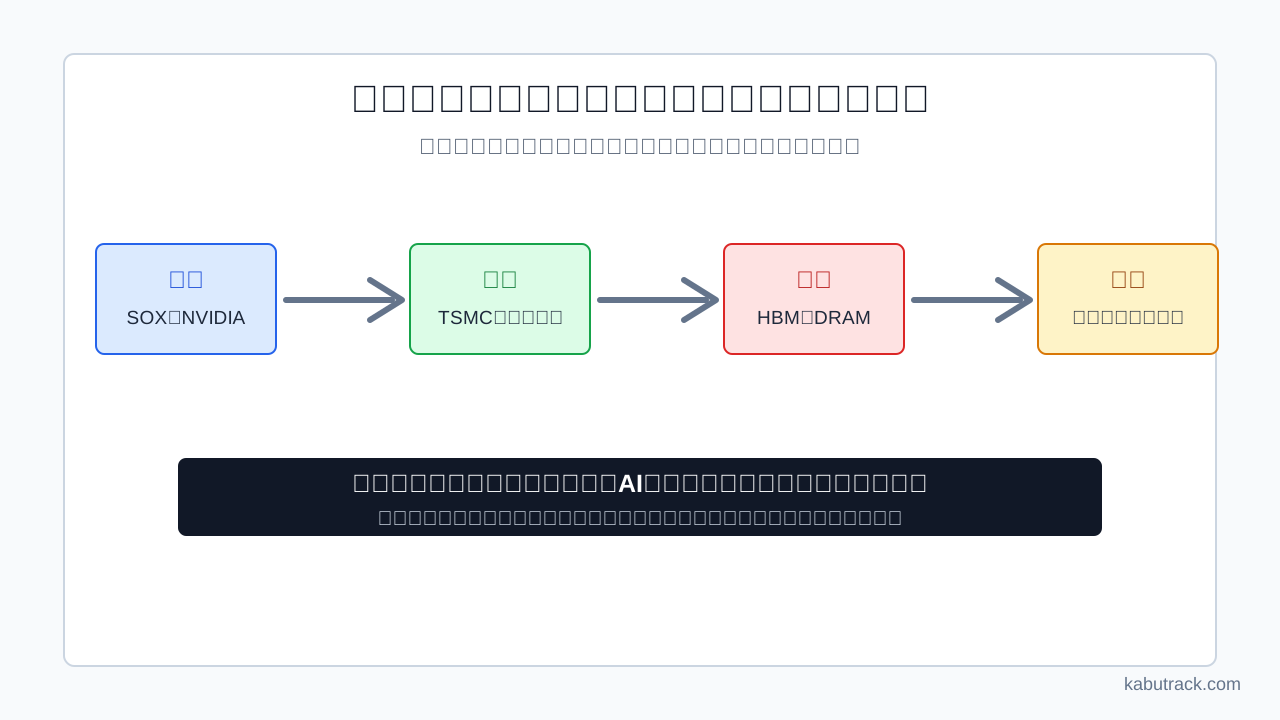
First, the conclusion
The reason why Japanese semiconductor stocks also sell when South Korean stocks go down is because South Korea and Japan are part of the same semiconductor supply chain. South Korea is strong in memory, and Japan is strong in equipment, materials, and testing. Although their roles are different, in investors' minds they are all connected by one question: "Will AI semiconductor investment continue?"
The important thing here is to separate the reasons for selling into two.
| Types of selling | What's happening | Views on Japanese stocks |
|---|---|---|
| Selling fundamentals | Doubts about memory prices, HBM demand, and capital investment plans | Check the outlook for orders for equipment and materials |
| Selling of supply and demand | Foreign funds and short-term funds drop semiconductor themes all together | Stock prices may move before business results |
To be honest, in the short term, there are days when the latter ratio is greater. Rather than selling because a Japanese company's financial results have deteriorated, portfolio adjustments will be made first, such as ``If Korean memory stocks collapse, we will lighten the overall market for Asian semiconductors a little.''
What's happening?
The starting point for the semiconductor market is likely to be the United States. Nasdaq's PHLX Semiconductor Sector Index (SOX) is an index of companies involved in the design, distribution, manufacturing, and sales of semiconductors, and is viewed as a thermometer for semiconductor stocks around the world.
When SOX and NVIDIA go down, the next thing you'll see are TSMC, Samsung Electronics, and SK hynix. NVIDIA's Blackwell generation GPUs are said to be manufactured using TSMC's custom process, and AI computing demands drive logic, HBM, advanced packaging, and data center equipment together.
TSMC also says its HPC platform for AI will combine logic, high-performance memory, silicon photonics, and 3DFabric. In other words, AI semiconductors are not just about GPUs. It has become a system industry that includes memory, manufacturing capacity, equipment, and materials.
AI memory thermometer in Korean market
The meaning of looking at Korean stocks is that Samsung Electronics and SK hynix are at the center of the memory market. In AI servers, the supply capacity of not only GPUs but also HBM, DRAM, and eSSDs tends to become a bottleneck. SK hynix's official newsroom also has articles and investment plans related to AI Memory, DRAM, HBM, and eSSD as of July 2026.
If this sells, the market will question not only whether demand for AI is weak, but also whether good factors have already been priced in. The numbers are good. The problem is the inclusion. Memory stocks are highly cyclical, and while profits increase rapidly during periods of rising prices, valuations tend to cool down the moment supply increases or inventory adjustments become apparent.
The reason why the decline in the Korean market affects Japanese stocks is because this doubt is transmitted to capital investment. If investment in HBM and DRAM slows down, there is a possibility that front-end process equipment, back-end process equipment, inspection equipment, silicon wafers, and electronic materials will also be affected over time.
Group of companies that are easily associated with Japanese people
Japanese semiconductor stocks do not sell the same products as Korean manufacturers. Rather, much of it involves equipment, materials, inspection, and precision processing for making semiconductors.
| Area | Typical examples | Associated KPIs |
|---|---|---|
| Front-end equipment | Tokyo Electron (8035), SCREEN Holdings (7735) | Orders, customer investment, equipment shipment, profit margin |
| Inspection equipment | Advantest (6857) | Demand for testers for AI semiconductors, backlog, gross profit margin |
| Precision machining | Disco (6146) | Dicing, grinding, post-process demand |
| Materials | Shin-Etsu Chemical (4063), SUMCO (3436) | Wafer price, operating rate, inventory adjustment |
Tokyo Electron is a semiconductor manufacturing equipment company, and its official website shows products related to processes such as film formation, lithography, etching, and cleaning. Advantest focuses on semiconductor testing, DISCO handles precision processing equipment and processing tools, and Shin-Etsu Chemical and SUMCO handle silicon wafers.
Therefore, the decline in Korean stocks does not mean that Japanese companies will immediately see a decline in sales. Rather, the market is proactive and discounts capital investment, operating rates, and profit rates for six months or one year ahead. Now comes the difficult part. Stock prices may fall first even though actual orders have not fallen, or conversely, even if stock prices have returned, it is later confirmed that orders have slowed down.
Foreign funds move by theme, not by region
Large funds don't view Japan, South Korea, Taiwan, and the United States as completely separate boxes. Funds are invested in individual themes such as AI semiconductors, memory, manufacturing equipment, and data center power, and when expectations get too high, they are dropped all at once.
At such times, a decline in Korean stocks is likely to be the ``first warning''. Samsung Electronics and SK hynix will be sold. Next, we will check the reactions of Taiwan's TSMC and US semiconductor stocks. Japan time, there will be futures, arbitrage, and theme selling in highly liquid stocks such as Tokyo Electron, Advantest, and Disco.
However, not all items are sold at the same rate. Stocks with high P/E ratios, stocks with high expectations, stocks with strong margin buying, and stocks that have recently skyrocketed will take profits more quickly. On the other hand, stocks whose financial results show solid orders and improvement in profit margins may be able to recover quickly even if they decline. The market is looking at that.
See sector rotation
On days when semiconductor stocks are sold, the overall market looks weak when looking only at the index. But on the inside, funds may just be going elsewhere. If money moves into banks, insurance, defense, trading companies, power equipment, high-dividend stocks, etc., this is sector rotation rather than an all-out bearish move.
When reading about declines in semiconductor stocks, it is better to look at where the money went rather than whether it was sold. If only semiconductors are sold and domestic demand, finance, and defense are bought, then the AI theme is likely to take profits. On the other hand, if foreign exchange rates, interest rates, and credit spreads all collapse at the same time, it should be treated as a broader risk-off.
KPIs that investors should look at
If you want to check before arriving, the following order is practical.
| Check items | Reasons to watch |
|---|---|
| SOX Index | Risk Tolerance of Overall Semiconductor Theme |
| NVIDIA | Center of AI computing demand and GPU cycles |
| TSMC | Temperature of advanced manufacturing and capital investment |
| Samsung Electronics・SK hynix | Views on HBM, DRAM, and memory prices |
| Dollar yen/won exchange rate | How foreign funds and export stocks look |
| Orders and profit margins of Japanese companies | Will association selling turn into deterioration in actual demand |
Don't conclude here that ``Japanese stocks are weak because Korean stocks have fallen.'' Is SOX broken, is it just NVIDIA, is it just memory, or is the exchange rate swinging towards a strong yen? Just by separating the causes, the meaning of the same decline can change considerably.
Risk scenario
The bearish scenario is that the view of capital investment changes, rather than the demand for AI itself. Even if demand for HBM and AI servers continues, customers will postpone ordering, memory prices will slow, inventory adjustments will be made, and export regulations will be tightened. If this happens, the valuations of equipment and materials stocks tend to shrink before performance is confirmed.
The other is the amplification of short-term funds through leveraged ETFs and inverse ETFs. Leveraged and inverse ETFs have a large presence in the Korean market, and their trading value tends to increase during periods of rough price movement. After the theme funds tilt in one direction, the unwinding will be reflected in the price before logic.
The conditions for a bullish review are that Korean memory stocks stop falling, TSMC's capital investment stance remains unchanged, and Japanese companies maintain their orders, company plans, and profit margins. If all of these points are corrected, there is room for the South Korean stock market decline to be reconsidered as simply a short-term supply and demand situation.
[Summary]
The reason why the plunge in South Korean stocks has a ripple effect on Japanese semiconductor stocks is that investors around the world view semiconductors as an AI infrastructure supply chain rather than a country. Although SOX and NVIDIA in the United States, TSMC in Taiwan, Samsung Electronics and SK hynix in South Korea, and equipment and materials stocks in Japan are separate companies, they are all part of the same capital cycle.
It is realistic for Japanese stock investors to use the Korean market as an `early warning'' rather than an `answer.'' Is the reason why Korean stocks have fallen because of a slowdown in AI demand, concerns about memory prices, or simply profit taking? Only by separating these points will it be easier to read the impact on Tokyo Electron, Advantest, DISCO, Shin-Etsu Chemical, and SUMCO.
Related pages
- Why is leveraged ETF buying and selling so active in South Korea? Organizing market structure and risks
- Not just semiconductor stocks | How far has profit-taking in the AI infrastructure market spread?
- Reading the polarization of the semiconductor sector | The reason why the price movements of 8035, 6920, and 285A diverged
- NAND flash market in 2026, who will profit from eSSD for AI