
First, the conclusion
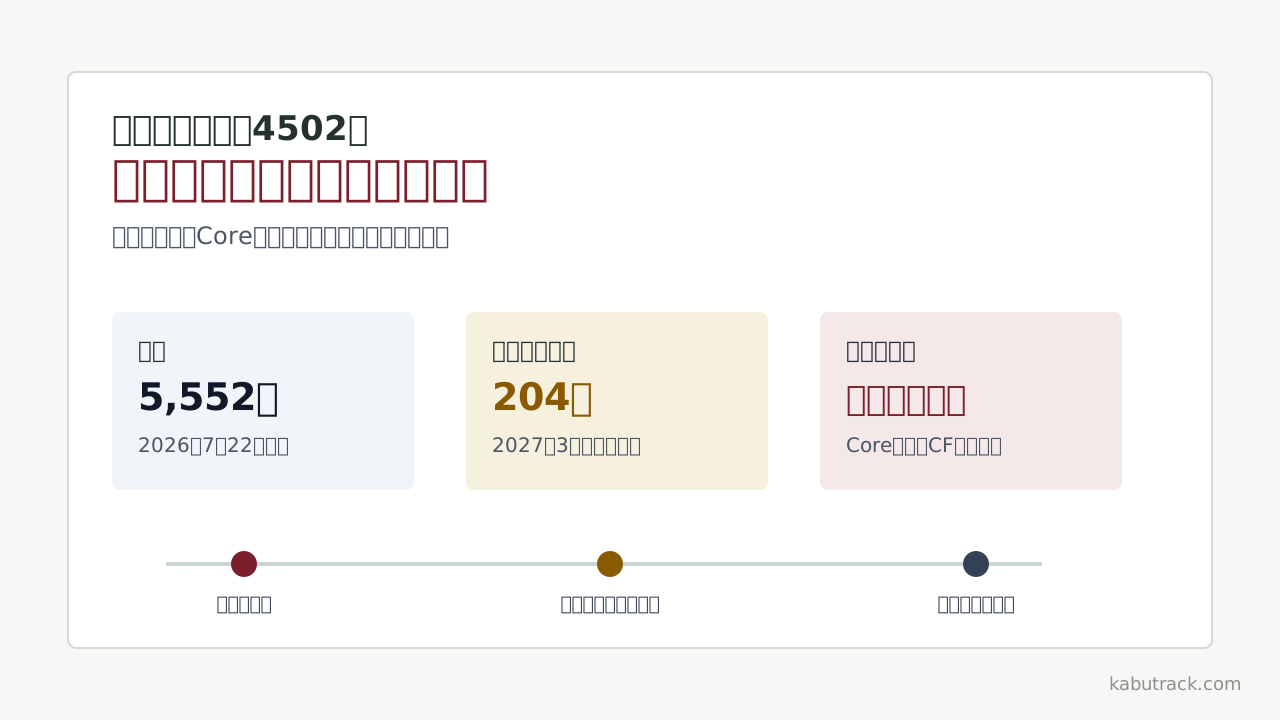
Takeda Pharmaceutical is worth watching as a high dividend stock. However, as of summer 2026, it is difficult to simply dismiss it as a stable stock because of its high dividend yield.
The stock price on July 22, 2026 is 5,552 yen. Dividing by the company's annual dividend forecast of 204 yen for the fiscal year ending March 2027, the dividend yield is approximately 3.7%. This is an eye-catching level for a large Japanese pharmaceutical stock.
However, here's where it gets difficult. The financial results for the fiscal year ending March 2026 were revised on June 5th due to the impact of the US antitrust lawsuit regarding AMITIZA. The company has not changed its Core performance, forecasts for the fiscal year ending March 2027, or dividend forecast, but the market is looking at the difference between reported profits and Core profits, and how much litigation costs will remain.
In other words, you can look at Takeda Pharmaceutical starting with "dividend yield," but you want to make a decision by looking at "core profit, operating cash flow, litigation, and pipeline." Dividends are attractive. The question is how much the market will believe in the profits and cash that support the dividend.
Company Overview
Takeda Pharmaceutical Company is a global research and development-oriented biopharmaceutical company originating from Japan. The main areas are digestive system/inflammatory diseases, rare diseases, plasma derivatives, cancer, neuropsychiatric diseases, and vaccines. It is listed on the Tokyo Stock Exchange Prime Market and the Nagoya Stock Exchange Premier Market, and the trading unit is 100 shares.
Rather than being a domestic pharmaceutical stock, it is actually a global pharmaceutical stock with a high proportion of overseas sales. Therefore, stock price factors include not only the domestic economy but also the U.S. pharmaceutical market, drug prices, patents, litigation, exchange rates, and the success or failure of research and development.
Even within the same pharmaceutical stock, stocks with growth expectations like Daiichi Sankyo, those with pipelines waiting to be reevaluated like Astellas Pharma, and those with specific drug themes like Eisai are viewed differently in the stock market. Takeda Pharmaceutical is a large-capacity defensive stock whose dividend and cash-generating ability are easy to see.
Recent materials
The most recent material is the full-year financial results for the fiscal year ending March 2026 and subsequent revised disclosures.
The full-year financial results announced on May 13, 2026 showed a revenue forecast of 4,640 billion yen, an operating profit forecast of 420 billion yen, a profit attributable to owners of the parent company of 166 billion yen, and an annual dividend forecast of 204 yen for the fiscal year ending March 2027. Subsequently, as a result of the jury verdict in the AMITIZA lawsuit on June 5, 2026, an amendment was announced to reflect litigation-related reserves of 402.5 billion yen and related tax effects of 58.4 billion yen for the fiscal year ending March 2026.
This correction has made the reported profit on an IFRS basis considerably less visible. On the other hand, the company has not changed its Core financial results, earnings forecast for the fiscal year ending March 2027, adjusted free cash flow forecast, and annual dividend forecast of 204 yen.
This is the biggest temperature difference when considering the reaction of stock prices. The company explains that ``the basic tone of our business remains unchanged.'' The market will look to see if the cash impact is really limited and whether there will be any additional burden. Even though the numbers are the same, the entrance to evaluation is different.
How to view performance
Revenue for the full year ending March 2026 was 4,505,720 billion yen, down 1.7% from the previous year. The revised operating income was 6.2 billion yen, and the loss attributable to owners of the parent company was 152.4 billion yen. If you just read the headline, the results look pretty weak.
However, this deterioration in profits is largely due to litigation-related reserves, so in order to look at the earning power of the regular pharmaceutical business, it is necessary to separate Core performance and operating cash flow. According to the financial statements based on company disclosure, operating cash flow for the fiscal year ending March 2026 is 1,041.431 billion yen, and cash and cash equivalents at the end of the period are 595.054 billion yen.
The investment issue for Takeda Pharmaceutical is the quality of profits rather than sales growth. Large pharmaceutical companies must continue to invest in the next major drug while facing expiration of patents on existing drugs and pressure on drug prices. Currently, the question is how much growth can be achieved with new products and late-stage pipelines while absorbing the impact of the end of the exclusive sales period for products such as VYVANSE.
The company's forecast for the fiscal year ending March 2027 is for operating profit of 420 billion yen and core operating profit of 1.16 trillion yen. To look at dividends with confidence, the focus is not just on the return of operating profits, but also on whether core profits and cash can support dividends, research and development, and debt repayments at the same time.
Interpretation in the stock market
The stock price as of July 22, 2026 is 5,552 yen. The year-to-date high is 6,033 yen, and the year-to-date low is 4,710 yen. The price collapsed from the high range in April until June, and has since returned to the mid-5,000 yen level.
The question for investors here is whether to place more emphasis on supporting yields or incorporating negative news. Assuming an annual dividend forecast of 204 yen, the dividend yield will be in the high 3% range at 5,500 yen. This is a level that is easy for investors to see.
On the other hand, stocks with high dividend yields are not only `undervalued,'' but also `the market is suspicious of something.'' In Takeda's case, the suspects are not its dividend intentions, but rather its reported profit deficit, the ultimate burden of litigation, the sustainability of Core profits, and the speed of commercialization of its pipeline.
Even if good news emerges, there may be situations in which stock prices do not rise as expected. Maintaining the dividend has been priced in to a high degree, and what the market wants next is progress in the first quarter of the fiscal year ending March 2027, the launch of major new drugs, and no additional deterioration of litigation risk. It seems that we are in a situation where we need not only dividends, but also a sense of stopping the bad news.
Dividend and investment effect
The company's forecast for the fiscal year ending March 2027 is 102 yen for the interim period, 102 yen for the end of the period, and 204 yen for the full year. The forecast is for an increase of 4 yen from the annual actual dividend of 200 yen for the fiscal year ending March 2026.
If you acquire 100 shares for 5,552 yen, the investment amount is approximately 555,000 yen. If the annual dividend forecast is 204 yen, the annual dividend per 100 shares is 20,400 yen. In a taxable account, if you simply subtract the tax rate of 20.315%, the amount after tax is approximately 16,256 yen. Dividends in NISA accounts may be exempt from tax due to the system, but since the treatment differs depending on the receiving method and system conditions, it is necessary to confirm the actual settings.
The idea in the original article of ``40,000 yen per year for a 1 million yen investment'' is useful for getting a sense of yield. However, with unit shares, you cannot buy 200 shares for 1 million yen based on the stock price on July 22, 2026. In reality, 100 shares will cost about 555,000 yen, and 200 shares will cost about 1,110,000 yen. When it comes to dividend simulations, misunderstandings will be reduced if you look at stock prices, unit shares, taxes, and NISA account settings separately.
Dividend reinvestment also works in the long run. However, in the case of Takeda Pharmaceutical, it is a stock that you want to check not only the compound interest of dividend reinvestment, but also the quality of the dividend source every year. Even if reported profits are in the red, there are times when you can maintain dividends if your core profits and cash are strong, but if this situation continues for a long time, the market will gradually become more difficult.
Bullish scenario
The bullish scenario is a case in which litigation-related uncertainty does not worsen further and progress toward the business forecast for the fiscal year ending March 2027 is confirmed.
In this case, the annual dividend of 204 yen would likely support the stock price. In addition, if the extent of the decline in Core operating profit falls within the company's expectations and adjusted free cash flow proceeds close to the forecast of 650 billion yen to 750 billion yen, the market's doubts about the company's ability to achieve both dividends and financial improvement will diminish somewhat.
On the pipeline front, progress on late-stage development products, which the company expects to receive regulatory approval in 2026-2027, will be key. If the approval and commercialization of new drugs progress smoothly, there is room for the view to change from a view of `high dividends but poor growth'' to `a large-cap stock that can wait for pipeline re-evaluation while receiving dividends.''
Exchange rates will also be a factor in the short term. For Takeda Pharmaceutical, which has a high proportion of overseas sales, a weaker yen will likely push up sales and profits in yen terms. However, exchange rates alone do not lead to a sustained revaluation of stock prices. What the market wants to see is Core growth and profit margin excluding foreign exchange.
Bearish scenario
A bearish scenario is one in which additional litigation-related burdens and protracted proceedings rekindle concerns about reported profits and cash.
The company explained that as of June 5, 2026, it does not anticipate any material impact on its forecast for the fiscal year ending March 2027. However, the final cost of the lawsuit has not been determined. Investors will be wondering for some time whether the current reserves are sufficient.
Another bearish factor is that the resilience of Core earnings is lower than market expectations. When the exclusivity period for existing drugs ends, drug price pressures, and R&D expenses and sales investments increase, high dividend yields alone may not be enough to support stock prices.
If there is any doubt that the company will maintain its dividend, the outlook on the stock price will suddenly change. The current market views Takeda as a ``large-capacity pharmaceutical stock with high dividends.'' If that assumption is shaken, the buying that was supported by yields will weaken. This is the scary part about high dividend stocks.
Featured KPIs
| Items to check | Reasons to watch |
|---|---|
| Core operating profit | To confirm profitability excluding temporary factors such as litigation |
| Adjusted free cash flow | To see if it can simultaneously support dividends, R&D, and debt repayment |
| Maintain annual dividend forecast of 204 yen | To see if the stock price as a high dividend stock continues to be supported |
| Litigation-related reserves/contingent liabilities | To gauge market concerns about whether there will be additional burdens |
| Approval and launch of late-stage pipeline products | To identify the next source of growth to offset the impact of patent expiration |
| Net interest-bearing debt and leverage | To see if financial improvement continues after major acquisition |
| Exchange rate assumptions and CER growth rate | To separate the effects of yen depreciation and actual value |
The next high point will be the first quarter financial results for the fiscal year ending March 2027, scheduled for July 30, 2026. What you should look at here is the progress of Core operating profit, cash, comments on litigation, and explanation of dividend policy, rather than changes in sales.
Points to note when viewing with NISA
Takeda Pharmaceutical is a stock that is easy to find for investors who want to own high dividend stocks in their NISA growth investment framework. The benefits of dividends being tax-free seem significant.
However, being compatible with NISA and having a low risk of stock price decline are two different things. Even in pharmaceutical stocks, stock prices fluctuate due to lawsuits, clinical trial failures, drug prices, patent expirations, and foreign exchange rates. High dividend stocks can experience wild price movements when there are concerns about dividend ex-dividends or dividend reductions.
If you look at NISA, what you want to check is not `Can you hold it for a long time?'' but `Can you explain why you hold it even when bad financial results or lawsuit news come out?'' If you rely only on dividends, your judgment will be easily swayed when stock prices decline.
summary
Takeda Pharmaceutical Company (4502) has a strong presence as a high dividend stock. If you look only at the combination of the annual dividend forecast of 204 yen for the fiscal year ending March 2027 and the stock price of 5,552 yen as of July 22, 2026, the dividend yield is approximately 3.7%. As a large pharmaceutical stock, it is at a level that is easily visible to income investors.
However, Takeda Pharmaceutical is not currently in a situation where it can be said that it is safe because it has stable dividends. In the amended disclosure on June 5, 2026, the provision related to the AMITIZA litigation significantly reduced reported profits. The company is maintaining its Core results and forecast for the fiscal year ending March 2027, but the market is still confirming that explanation.
When looking at future stock prices, we want to track dividend yield, core operating income, adjusted free cash flow, litigation risk, and late-stage pipeline. Dividends are attractive. However, dividends alone are not enough. Will the market's doubts be reduced even a little with the next financial results? This is the main point when looking at Takeda Pharmaceutical as of summer 2026.
Related pages
- Takeda Pharmaceutical (4502) stock analysis
- Takeda Pharmaceutical Company (4502) Company Profile
- Takeda Pharmaceutical Company (4502) dividend information
- Takeda Pharmaceutical (4502) Full-year financial results for the fiscal year ending March 2026
Source
- Takeda Pharmaceutical Company “Summary of Financial Results for the Fiscal Year Ending March 2026 [IFRS] (Consolidated)”, Disclosure date: May 13, 2026
- Takeda Pharmaceutical Co., Ltd. “(Correction/Numerical data correction) Regarding recording of reserves due to subsequent events and amendments to ``Summary of Financial Results for the Fiscal Year Ending March 2026 [IFRS] (Consolidated)'', Disclosure date: June 5, 2026
- Takeda Pharmaceutical Company “Takeda Updates FY2025 Financial Results Based on Impact of AMITIZA Antitrust Verdict” Publication date: June 5, 2026
- Takeda Pharmaceutical Company “Stock Information/Shareholder Returns”, confirmed on July 22, 2026
- Takeda Pharmaceutical Company “Investor Events and Presentations” confirmed July 22, 2026
- Nomura Securities “Takeda Pharmaceutical (4502/T) Stock Price”, confirmed on July 22, 2026