First, the conclusion
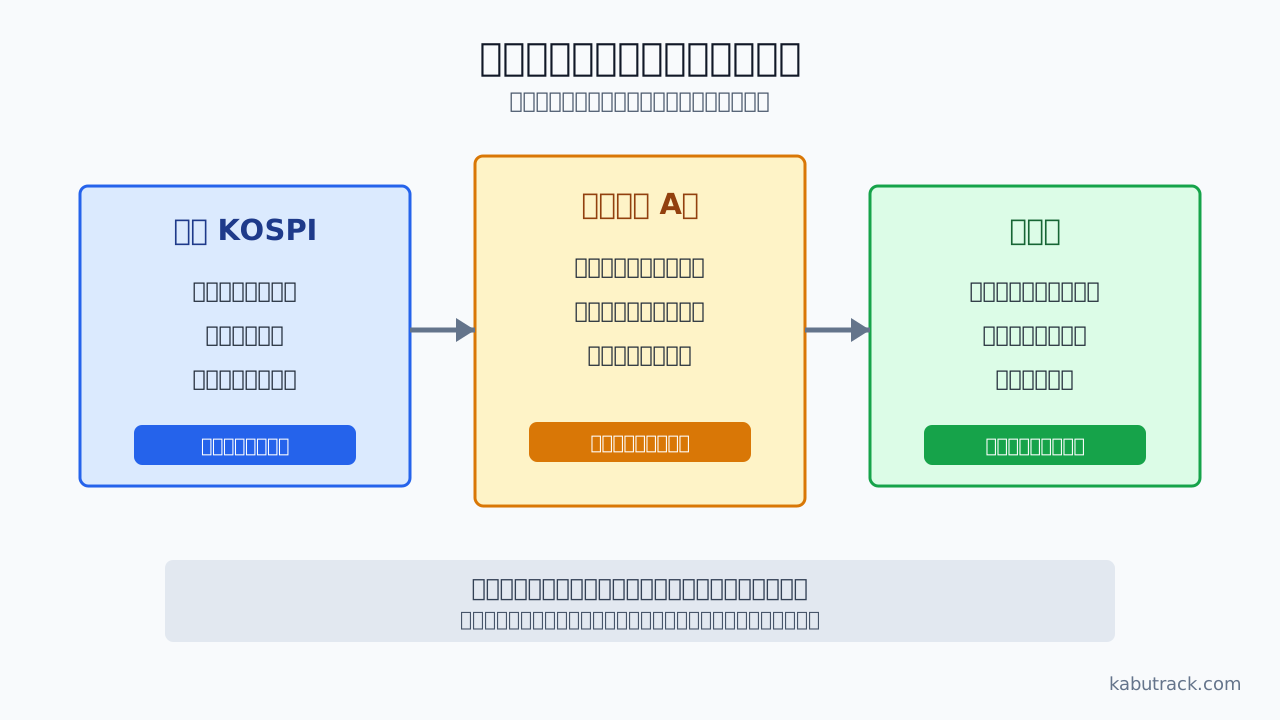
The three markets are linked. However, what is at the center of the linkage is not the country, but profit drivers such as semiconductors, capital investment, consumption, resources, and interest rates.
Even if A-shares rise due to China's economic stimulus measures, if the rise is limited to banks and state-owned enterprises, it will not necessarily spread to Japanese machinery stocks or South Korean semiconductor stocks. Only when China's retail, capital investment, and housing sales improve will it be easier to match the corporate performance of Japan and South Korea.
On the other hand, if the US SOX index and HBM expectations collapse, Korean memory stocks and Japanese equipment and materials stocks are likely to be sold more strongly than Chinese domestic demand stocks. Even Asian stocks do not receive the same news with the same intensity.
Align the indices to be compared
Before comparing, it is necessary to determine the scope of "Chinese stocks" and "Japanese stocks." In this article, we look at South Korea using KOSPI, Japan using TOPIX, and mainland China using CSI 300. Both are broad market indexes that include large-cap stocks, but the target markets and constituent stocks are different.
| Market | Comparison Axis | Themes that tend to appear in the market |
|---|---|---|
| South Korea | KOSPI | Semiconductors, electronic equipment, automobiles, materials, exports |
| Japan | TOPIX | Manufacturing industry, finance, trading companies, communications, services, domestic demand |
| Mainland China | CSI 300 | Finance, Manufacturing, Consumption, Materials, State-Owned Enterprises, Policy |
The Nikkei 225 average is important for reading Japanese stocks, but it is a stock price average of 225 stocks, and its price movements are different from the TOPIX. In China, the content is different for the Shanghai Comprehensive, CSI 300, Founding Board, and Science and Innovation 50. Furthermore, Hong Kong's Hang Seng Index is strongly influenced by foreign investors, internet giants, and Hong Kong dollar interest rates, so it is better to treat it separately from mainland A-shares.
Temperature difference in summer 2026
The recent numbers show that it is difficult to talk about the three markets in one direction.
According to the Korea Customs Service, semiconductor exports in June 2026 were a record high of $44.9 billion. Actual demand numbers are strong. Still, KOSPI and semiconductor large-cap stocks made a big correction in July. What the market is looking at is not only the current export amount, but also the HBM price, customers' AI investment, supply capacity, capital investment, and expectations that have already been reflected in the stock price. The numbers were good, but expectations were also high. Now comes the difficult part.
According to China's National Bureau of Statistics, GDP in the first half of 2026 increased by 4.7% compared to the same period last year, but the increase slowed to 4.3% in the April-June period. In the first half, retail sales increased by 1.3%, while sales of new commercial buildings decreased by 13.6%. Household consumption and real estate are still weak compared to production and external demand.
Even if Chinese stocks rebound due to policy expectations, for this to spread to Japan and South Korea, the policy announcement must lead to credit expansion, corporate orders, and household spending. Markets don't buy on policy headlines alone for as long as they used to. We are seeking confirmation of the real economy.
Japanese stocks are somewhere in the middle. Machinery, electronic parts, cosmetics, and retail for China are sensitive to Chinese demand, but banking, telecommunications, construction, and domestic services can move with other materials. Even on days when the Chinese economy is weak, the TOPIX as a whole can hold up relatively well if funds shift to financial/value stocks due to interest rates and shareholder returns.
Three routes from China to Korea and Japan
Manufacturing and semiconductors
If China's factory operations and demand for smartphones, data centers, EVs, and industrial machinery strengthen, orders will be passed on to Korean memory and electronic components and Japanese manufacturing equipment, materials, and FA companies. However, China's domestic production of semiconductors will not only increase demand. As Chinese companies increase their capacity, Korean memory companies and Japanese equipment and materials companies will simultaneously expand their customers and intensify competition.
Consumption and Inbound
If China's household sentiment improves, it will likely spread to Japan's cosmetics, department stores, hotels, railways, and travel-related industries. In South Korea, cosmetics, duty-free, entertainment, and consumer goods are also responding well. However, it cannot be said that travel and consumption have recovered solely due to rising stock prices. We need actual numbers for retail, income, employment, flights, and the number of visitors to Japan and South Korea.
Materials/Resources/Capital Investment
China's infrastructure investment and real estate support extends to steel, chemicals, construction machinery, machine tools, and shipping. However, if supply increases while holding real estate inventories, falling material prices and overproduction could put pressure on the profits of Japanese and Korean companies. ``China's investment expansion'' includes both increased demand and excess supply.
Foreign exchange reflects tailwinds and capital outflows at the same time
The dollar yen, dollar won, and dollar renminbi are not indicators that only look at export profitability. While currency depreciation boosts the conversion of foreign currency sales into the domestic currency, it also increases the cost of importing crude oil, raw materials, and overseas equipment. The sudden depreciation of the currency also increases concerns about foreign exchange losses among foreign investors.
When looking at competitiveness, we also want to see whether the yen or the won has moved more strongly against the dollar. Japan and South Korea compete in areas such as automobiles, electronic parts, chemicals, and shipbuilding. However, because each company has different local production ratios, dollar-denominated procurement, and pricing power, winning or losing cannot be determined by currency alone.
The renminbi simultaneously reflects China's exports, import prices, capital flows, and policy management. Even if a weak renminbi supports exports, if it is caused by concerns about domestic demand or concerns about capital outflows, it will not provide a straightforward tailwind for Chinese stocks.
Conditions for the market to move in the same direction
The three markets are likely to become stronger together when common materials reach corporate profits.
| Conditions | Korea KOSPI | Japanese stocks | Chinese stocks |
|---|---|---|---|
| Semiconductor demand and prices are on the rise | Easily linked directly to memory profits | Spread to equipment, inspection, and materials | Supporting investment in domestic production and increased demand |
| Chinese consumption recovers | Supports exports of consumer goods and materials | Spread to retail, tourism, and cosmetics | Leads to improved sales for domestic companies |
| Stabilizing US interest rates | Supporting foreign funds and valuation of growth stocks | Alleviating concerns about high PER stocks and foreign exchange | Easy to use for Hong Kong stocks and overseas funds |
| Currency is stable without sudden changes | Easy to read export profitability and overseas funds | Easy to read export profits and import costs | Supports policy space and capital flows |
What I want to be careful about here is when good materials are already woven into the fabric. Even if semiconductor exports are at an all-time high, profit-taking will occur if stock prices are expected to grow even faster. Even if China announces additional aid, the reaction will be slow if expectations have been set based on past policies. Japanese stocks lose their freshness when the yen depreciates and stock buybacks become the norm.
Bullish/bearish scenarios
Bullish scenario
China's retail and housing sales will stop deteriorating, and manufacturing investment will lead to final demand rather than excess supply. In South Korea, HBM/DRAM prices and profit margins will be maintained, and Japanese equipment and materials companies' order plans will remain unchanged. If US interest rates and the three currencies stabilize, it will be easier for capital to return to Asian stocks as a whole.
Even in this case, we look at the spread of the rise rather than the index that rises first. If buying spreads not only to finance but also to consumer and manufacturing industries in China, non-semiconductors in South Korea, and non-large semiconductors in Japan, the quality would be better than a short-term index rebound.
Bearish scenario
China's real estate sales and consumption will slow down again, and policy will be biased toward expanding supply capacity. In South Korea, an increase in memory supply and revised expectations for AI investment coincide, and in Japan, equipment orders and demand for machinery destined for China will decline. When combined with rising US interest rates, high oil prices, and sudden changes in the yen, won, and renminbi, profits and valuation multiples are simultaneously pushed down.
Geopolitics and export controls cannot be ignored either. If regulations become stricter in semiconductors, AI, batteries, and critical minerals, the cost of reconfiguring supply networks will increase even if there is demand. While theme stocks are bought due to policy support, they are later questioned about duplication of equipment and deterioration in profitability.
KPIs that investors should look at
| Area | Indicators to check | Things to read |
|---|---|---|
| United States | SOX index, long-term interest rates, capital investments of major AI companies | Common risk tolerance and semiconductor expectations |
| China | GDP, retail, housing sales, manufacturing investment, renminbi | Are policies reaching demand recovery? |
| South Korea | Semiconductor exports, memory prices, foreign buying and selling, dollar won | Difference between actual demand and stock price supply and demand |
| Japan | Orders to China, semiconductor equipment orders, rise and fall by industry, dollar-yen | Can domestic demand and finance compensate for the deterioration in external demand |
| Common to all three markets | Number of rising and falling stocks, trading value, index contribution | Is the market price limited to some large stocks? |
The closing price of the index alone does not tell us how far the buying has spread. Even if the KOSPI, TOPIX, and CSI 300 all rise at the same time, it will not be sustainable if only a few large-cap stocks rise. By combining the number of rising and falling stocks and the trading value by industry, it is easy to distinguish between a full-fledged inflow of capital due to a common theme or a rebound in the index alone.
[Summary]
The Korean KOSPI, Japanese stocks, and Chinese stocks influence each other, but the three indexes do not mechanically move together. China is a demand source and a competitor, South Korea is a thermometer for actual demand for semiconductors, and Japan is a market that combines equipment and materials with a wide range of domestic demand and finance.
In the summer of 2026, South Korea's semiconductor export strength and stock price adjustment will coexist, as will China's GDP growth and weakness in consumption and real estate. Therefore, just looking up and down the index is not enough. Are policies leading to demand, demand leading to orders, and orders leading to profits and cash? Following that path is the essence of reading the three markets as one fund cycle.
Related pages
- [KOSPI and Japanese stocks: 4 points to note on 7/21 | Index composition, semiconductors, foreign exchange] (/news/market/2026/07/21/kospi-japan-stocks-four-links.html)
- Korean KOSPI plummets: 7/19 4 factors | Semiconductor concentration, credit supply and demand, crude oil
- Why is China's economy slowing down? Structural recession read from real estate, deflation, and population decline
- [China A-share trading new rules come into effect on July 6th - ST price range 10%, post-market trading expansion, ETF closing price formation unified] (/news/market/2026/07/06/china-a-share-trading-rule-reform.html)
- [Why Japanese semiconductor stocks are sold due to the sharp drop in Korean stocks | Read about AI memory and global capital flow] (/strategy/2026/07/20/korea-japan-semiconductor-capital-flow.html)
Source
- Korea Exchange “KOSPI Market”
- Japan Exchange Group “TOPIX”
- China Securities Index Co., Ltd. “CSI 300”
- Shanghai Stock Exchange "Equities Introduction"
- China National Bureau of Statistics "National Economy in the First Half of 2026"
- China National Bureau of Statistics "Total retail sales of social consumption goods in the first half of 2026"
- China National Bureau of Statistics "Real estate development investment from January to June 2026"
- Korea Customs Service "June 2026 Monthly Export/Import Final Values"
- Bank of Korea "Trade Settlement Currency in Korea 2025"
- Nasdaq Global Indexes "PHLX Semiconductor"