
First, the conclusion
It is still too early to say that Gurunavi has entered a regrowth phase. What we were able to confirm by the fiscal year ending March 2026 was that we had returned sales while keeping costs down, and achieved two consecutive terms of operating profit.
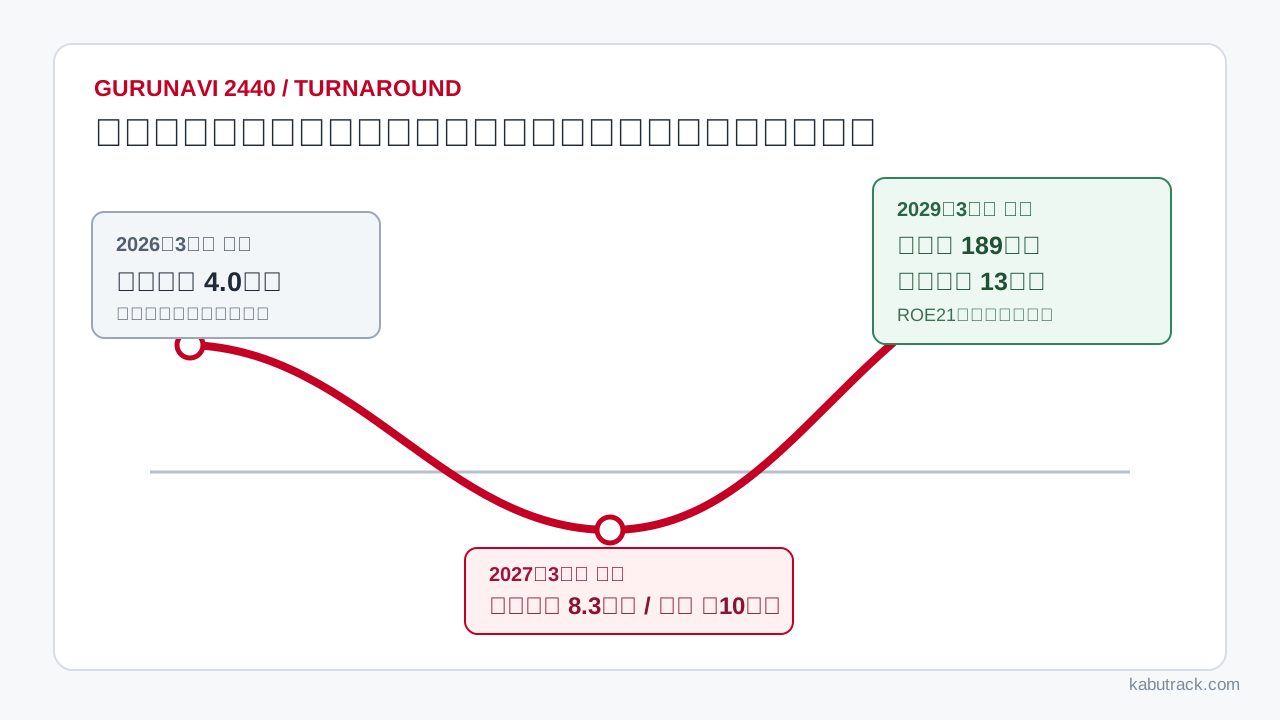
The next move is quite bold. The company plans to increase sales by 6.8% in the fiscal year ending March 2027, but will invest about 1 billion yen to increase sales staff by about 70 people, and is forecast to have an operating loss of 830 million yen. The company plans to temporarily reverse the recovery in profits and acquire the ability to acquire member stores and provide B2B services.
For this reason, the focus of investment decisions is not on the 52.7% increase in operating profit for the fiscal year ending March 2026. Is the deficit for the fiscal year ending March 2027 due to upfront costs to increase future stock sales, or is it just an accumulation of fixed costs? The market doubts this.
Financial results confirming “recovery” for the fiscal year ending March 2026
Consolidated business results for the fiscal year ending March 2026 were sales of 14.132 billion yen (up 5.0% year on year), operating income of 400 million yen (up 52.7% year on year), and net income of 236 million yen (up 11.9% year on year). Although the operating profit margin remains at 2.8%, the significance of securing a surplus following the operating profit of 262 million yen in the fiscal year ending March 2025 is significant.
Another change is the customer base. At the end of the fiscal year, the number of stock-type paid member stores was 33,881, an increase of 1.2% compared to the end of the previous fiscal year, and the number of stores that accepted online reservations was 36,000, an increase of 4.2% compared to the end of the previous fiscal year. There are signs that the recovery will shift from a recovery in which the decline in member stores is offset by an increase in ARPU to an increase in sales both in terms of number of stores and unit prices.
However, the amount of profit is still small. Operating income was 400 million yen on sales of 14.1 billion yen, a level that could be erased by a slight increase in personnel expenses or stronger sales promotions. Operating cash flow was also negative by 172 million yen. Profit over sales, cash over profit. If you're looking at it as a rebuilding stock, don't skip this.
Essence of business model transformation
From gourmet site to restaurant management platform
Gurunavi is moving away from the structure of online reservation media that competes solely on its ability to attract customers. In the medium-term management plan 2028, we focused on five priority areas: media and member services, agent business, affiliate value, sales structure, and AI and data infrastructure.
The main focus is the agent business, which acts on behalf of and supports restaurant operations. The scope will be expanded to support the operation of Google Business Profile, CRM operation, store information management for multiple media and SNS, and procurement support for equipment, tableware, etc. The idea is to not only sell advertising space, but also take on tasks that stores are unable to handle due to a lack of manpower, creating a relationship with monthly income that is difficult to cancel.
The direction makes sense. Restaurants are burdened not only with attracting customers, but also with hiring, reservation management, sales promotion, payments, customer management, and purchasing. Gurunavi has sales contacts with stores, and can identify issues and connect them to multiple products.
The difficulties are also clear. While it is easier to increase sales with escort support and operational agency services by increasing the number of people, there is a risk that profit margins will not increase as much as with SaaS. The term "restaurant DX" alone does not indicate profitability. Unless you look at the cost of acquiring one store, the number of man-hours required to provide the service, the churn rate, and the gross profit, sales growth will be absorbed by increases in personnel costs.
Increasing sales staff by 70 and using AI will be evaluated as a set
The strategic investment for the fiscal year ending March 2027 is to hire approximately 70 people, mainly to support restaurants, and to strengthen the sales structure. At the same time, the company says it will use AI to reduce negotiation preparation time by up to 80% and share the know-how of top salespeople to increase the number of deals and closing rates.
If you only increase the number of employees, you will end up paying fixed costs up front. Just using AI can easily become a slogan. Investment can only be recovered by combining the two and improving the number of new acquisitions per salesperson, startup period, and retention rate.
In the fiscal year ending March 2027, investment costs will appear in profit or loss first. Results need to be tracked at least by trends in the number of stock-type paid member stores, total number of paid member stores, sales of agent products, and ARPU.
Rakuten collaboration is both a strength and a dependency
Rakuten Group is Gurunavi's largest shareholder, holding 16.5% of shares as of the end of March 2026. Being able to utilize Rakuten ID, Rakuten Points, and membership base is a strong card in creating a store visit cycle that does not rely solely on Google search and SEO.
In the medium-term plan, the company outlined a plan to expand the scope of collaboration to include repeat usage by Rakuten members, CRM functions, and payment functions. Restaurants will have more reasons to continue becoming members if they can not only reward points when making online reservations, but also encourage repeat visits after visiting the store and support payments and financing for the store.
However, simply connecting to the Rakuten Economic Zone does not mean that the customer attraction power will exceed that of the competition. Point resources and promotional expenses can put pressure on profits. The value of collaboration will be limited unless Gurunavi can accumulate customer data and store contact points and use it to improve its own sales and products.
Medium-term management plan 2028 is quite a steep slope
When looking at the numbers provided by the company, there is a wide range of fluctuations from the deficit in the first year to the final year.
| Indicators | Results for the fiscal year ending March 2026 | Forecast for the fiscal year ending March 2027 | Plans for the fiscal year ending March 2029 |
|---|---|---|---|
| Sales | 14.132 billion yen | 15.1 billion yen | 18.9 billion yen |
| Operating income | 400 million yen | ▲830 million yen | 1.3 billion yen |
| Operating profit margin | 2.8% | ▲5.5% | Approx. 6.9% |
| Total number of paid member stores | Approx. 43,000 stores | Approx. 43,000 stores | 60,000 stores |
| Total number of member stores | Approximately 77,000 stores | 80,000 stores | 100,000 stores |
| ROE | 4.7% | Deficit forecast | 21% |
| Dividend | No dividend | No dividend forecast | Plan to resume dividend |
The plan period is three years from FY03/2027 to FY03/2029. "Resuming dividends in 2028" in company materials does not mean dividends in 2028, but refers to the plan to resume dividends in the final fiscal year ending March 2029.
Sales will increase by 4.768 billion yen over three years, and operating income will turn from a deficit of 830 million yen in the first year to a surplus of 1.3 billion yen. It is necessary to turn the hired sales staff into a force in a short period of time, increase sales to affiliated stores and agents, and reduce provision costs through AI and external collaboration. It is a plan that cannot be achieved by just one.
Interpretation in the stock market
The surplus for the fiscal year ending March 2026 is good. However, since the company's forecast for the fiscal year ending March 2027 is an operating deficit, this is not a situation where it can be honestly evaluated using PER. It is easier to price stock prices based on the probability of reaching 1.3 billion yen in operating income after investment, rather than current profits.
Low-ranking restructuring stocks tend to attract short-term funds with headlines such as `Net increase in member stores,'' Rakuten collaboration,'' and `Plan to resume dividends.'' However, one quarter's net increase in stores alone is unlikely to lead to a sustained reassessment. While hiring and personnel costs take precedence, the pace of store additions and stock sales need to accelerate every quarter.
The same goes for the resumption of dividends. The company does not expect to pay dividends until the fiscal year ending March 2027. The resumption of dividends in the fiscal year ending March 2029 is a result of achieving the medium-term plan, and is not a return of profits at this point. Expecting only a resumption of dividends without operating cash flow returning would be in the wrong order.
Bullish scenario
In the bullish scenario, the hiring of approximately 70 people will proceed as planned, and AI support will accelerate the startup of new hires. The number of stock-type paid member stores and stores that accept online reservations will increase, and management agency products such as GBP and CRM will grow into the second pillar of revenue.
Furthermore, repeat business using Rakuten ID and points stabilizes the number of reservations, and CRM and payment functions reduce cancellation rates. In this case, the deficit in the first year can be explained as an investment in customer acquisition, making it more likely that profits will recover from the fiscal year ending March 2028.
The market will be more likely to change its perspective when it sees not only an increase in sales, but also improvements in productivity per salesperson, growth in stock sales, and improvement in operating cash flow.
Bearish scenario
A bearish scenario is a case in which only recruitment and personnel costs increase first, and the acquisition of franchised stores falls short of plan. Labor shortages and high costs at restaurants create demand for support, but also reduce the ability to pay for monthly services. Customer distress poses both a tailwind for Gurunavi and the risk of bad debts and cancellations.
If management agency services remain labor-intensive, profit margins will not increase even if sales increase. If spending on Rakuten points and advertising is heavy and the reservation share does not increase, it will not be possible to convert B2C customer attraction into B2B contracts.
The company intended for the deficit in the fiscal year ending March 2027, but the meaning will change if the deficit continues into the next fiscal year and beyond. Although no capital increase plans have been announced at this time, if cash consumption exceeds expectations, there will be heightened concerns about increased borrowing and dilution.
Featured KPIs
| KPI | Reasons to check |
|---|---|
| Number of stock-type paid member stores | Did increased sales lead to expansion of customer base |
| Total number of paid member stores | Measuring progress toward 60,000 stores in the fiscal year ending March 2029 |
| ARPU | Is the quality of sales declining due to the increase in low-price stores |
| Agent business sales and gross profit | Does B2B support generate profits that exceed personnel costs |
| Number of new customers/churn rate | Measuring investment recovery period and stockability |
| Number of business deals and deals closed per salesperson | Measuring productivity of hiring 70 people and utilizing AI |
| Operating cash flow | Is accounting growth turning into cash? |
| Reservations and reuse of Rakuten ID linked members | Does Rakuten collaboration generate more customer referrals than promotional costs |
[Summary]
Gurunavi is not trying to regain its past status as a gourmet site. Using business contacts with restaurants and information assets, we are trying to transform it into a B2B platform that supports customer attraction, customer management, information management, payment, and procurement.
The increase in sales and profits and the increase in the number of affiliated stores in the fiscal year ending March 2026 showed that the foundation remains. However, the operating profit margin was 2.8% and operating cash flow was negative. The company will invest approximately 1 billion yen from this point and return to operating deficits in the next fiscal year. This is not the end of the rebuild, but rather the first big gamble since the rebuild.
Operating income of 1.3 billion yen, ROE of 21%, and resumption of dividends in the fiscal year ending March 2029 are attractive targets, but they are also far away. The first things you should look at are the number of stores, agent sales, sales productivity, churn rate, and cash. Only when these five factors improve each quarter can the ``planned deficit'' be evaluated as a growth investment.
Related pages
- Gurunavi (2440) stock analysis
- Gurunavi | Full-year financial results for the fiscal year ending March 2026
- Gurunavi (2440) Dividend Information
Source
- Gurunavi “Mid-term Management Plan” (Announced May 13, 2026)
- Gurunavi “Message from the President” (Posted in July 2026)
- Gurunavi "IR Library" (Check the financial results summary for the fiscal year ending March 2026, financial results briefing materials, and medium-term management plan)
- Gurunavi "Stock Information" (as of March 31, 2026)
- Gurunavi "Shareholder Returns/Dividends"