
What Drove the Collapse
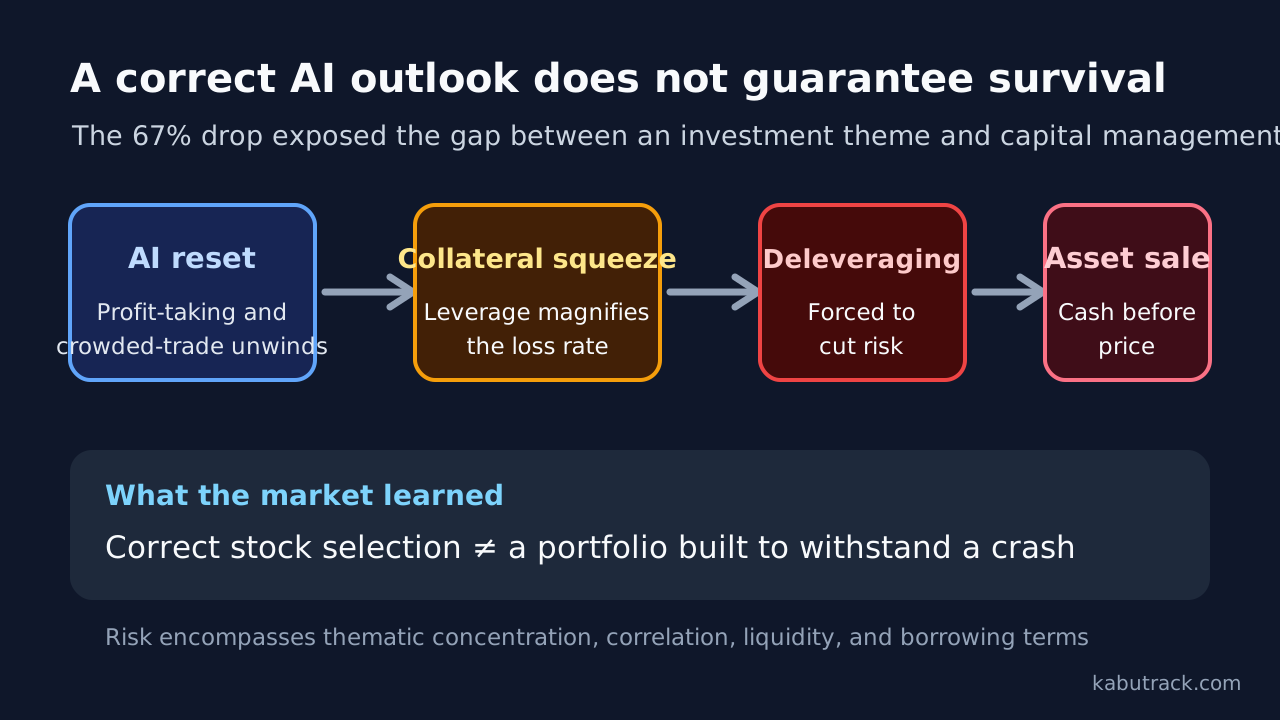
Viewed in isolation, the 67% figure makes the fund look like a failed bet on AI. But the public record suggests that the deeper problem was not its long-term AI thesis. It was a portfolio structure unable to withstand a decline.
Reuters reported on July 31, 2026, that Situational Awareness's portfolio had fallen about 67% in July. The report cited an investor letter and said the firm had unwound the leverage in its public-equity book. Reuters, The Wall Street Journal, and Axios also reported a transaction transferring the public-equity portfolio to Citadel.
What happened in July looked less like the disappearance of AI growth expectations and more like the unwinding of positions that had priced in too much optimism. With bullish assumptions about AI capital spending already reflected heavily in share prices, even small doubts about returns on that spending could readily trigger profit-taking. Expectations were marked down before earnings deteriorated—a familiar pattern in theme-driven markets.
The fund itself did not cease to exist. Reports indicate that it continued to operate and retained investments in private companies, among other assets. As of August 2, 2026, there was also no public evidence supporting the social-media narrative that Citadel had deliberately destroyed the fund.
The Losses Suffered by Late Investors Matter More Than the 67% Drop
According to Reuters, the portfolio had gained 439% year to date by the end of June and remained up about 80% for the year even after July's collapse. The figures are not contradictory.
If the portfolio began the year with assets of 100, a 439% gain would take them to 539. A subsequent 67% decline would leave roughly 178: 539 × 0.33 = approximately 178. That is still a gain of about 78% from the beginning of the year, broadly consistent with the reported figure of approximately 80%.
But that is the return for an investor who held from the start of the year. A fund's headline performance and the experience of investors who entered later are not the same. For anyone drawn in by the high returns near the June peak, the fact that the portfolio remained positive year to date would offer little comfort.
An asset that has fallen 67% from its peak must rise by about 203% from the remaining value of 33 to return to its previous level. The distance to recovery matters more than the 67% decline itself.
When the AI Trade Reversed
Leverage Took Away the Option to Wait
The danger of leverage is not simply that it magnifies losses. It can take away an investor's ability to wait for the market to recover.
When a large fund breaks down, capital management often reaches its limit before the investment thesis does. Falling asset prices reduce collateral headroom, prompting lenders to demand additional collateral or smaller positions. Even if a manager believes the assets have become undervalued, the fund cannot keep holding them if it cannot raise cash.
The exact borrowing multiple in this case has not been disclosed. Still, multiple reports point to the same broad sequence: a highly leveraged strategy collided with a sharp fall in AI-related stocks, forcing the fund to reduce its public-equity risk over a short period.
The Market Did Not Recognize Sector Diversification
Situational Awareness says on its official website that it invests not only in AI developers but also in companies across technology and energy, as well as businesses affected by AI. Semiconductors, power, data centers, and software may look diversified when viewed only by sector labels.
But once the market began to question whether AI capital spending had gone too far, those assets moved in the same direction. They had all been bought on a shared chain of expectations involving AI capital expenditure, semiconductor supply and demand, data-center demand, and high valuations for growth stocks. The portfolio may have held many securities, but in substance it remained concentrated in a single theme.
Long positions, options, and shorts on the other side of the book may look like separate trades in an accounting statement. In a crowded market, however, a momentum reversal can damage several of them at once. The market was looking past sector diversification to the common expectations underneath.
The Fund Sold What It Could, Not What It Wanted To
When a fund must meet collateral calls or reduce borrowing, the speed at which an asset can be converted into cash takes priority over expected returns. The assets sold first are not necessarily those the manager most wants to sell, but those for which a price can readily be found. That further worsens the supply-demand balance.
Declining prices, reduced collateral headroom, smaller positions, and more selling: this chain reaction can accelerate a market more than the negative catalyst itself. Once deleveraging begins, there is almost no time left to reassess the fundamentals.
Public Filings Cannot Reveal the Fund's Exact Leverage
Specific leverage multiples and loss figures have circulated on social media, but they should be treated with caution. SEC Form 13F shows holdings in US-listed equities and certain other securities at the end of each quarter. It does not include short positions, and written options generally are not reportable. Nor does it provide a complete picture of private investments, cash, or borrowings.
Adding up the securities and market values disclosed on Form 13F cannot reproduce a fund's net asset value, net exposure, effective leverage, or total losses. Multiple reports establish that the strategy used high leverage, but the precise multiple remains private.
Outsiders Cannot Know Whether This Was a Rescue or a Fire Sale
Two opposing views spread on social media: that Citadel had rescued the fund, and that it had acquired the assets at a steep discount. Public information supports neither conclusion.
Situational Awareness had reason to reduce risk quickly while avoiding the price deterioration that could result from selling positions piecemeal in the market. Citadel had an opportunity to acquire a block of assets after a correction. The most reasonable interpretation is that this was a large transaction in which the seller's and buyer's needs aligned. Any judgment beyond that remains speculation unless the transaction price and contractual terms are disclosed.
The large fund's selling may have worsened supply and demand for individual stocks. But there is no basis for attributing the entire July correction in AI stocks to one fund. Doubts about the returns on AI capital spending, elevated valuations, profit-taking, and the unwinding of crowded positions were all in play at the same time.
Lessons for Investors
| Easy-to-overlook issue | Question to ask |
|---|---|
| Soundness of the theme | How many years can you wait for the thesis to play out? |
| Stock-level diversification | Are the individual stocks all being bought on the same expectations? |
| Leverage | Can the portfolio avoid forced selling even after a 20–30% adverse move? |
| Liquidity | Can the asset be sold when needed without disrupting the price? |
| Track record | What are the maximum drawdown and the returns experienced by late entrants? |
Correct stock selection is not enough if capital management fails first. The key question in this case is not the long-term forecast for AI demand, but whether the portfolio was designed to withstand a severe reversal in a crowded market.
What the Market Will Watch Next
If Situational Awareness continues operating, the next question will not be whether it can produce spectacular returns. The focus will be on its plan for rebuilding the public-equity portfolio, limits on borrowing and derivatives, rules for reducing positions after losses, investor redemptions, and the valuation and liquidity of its private investments.
The market once rewarded the fund's exceptional returns. From here, the issue is less how much it can make from the same theme and more whether it can demonstrate safeguards against repeating the same damage. The basis for judgment has shifted from forecasting ability to risk control.
Conclusion
The precise leverage multiple and the terms of the sale to Citadel have not been disclosed, limiting what outsiders can reconstruct. Even so, one point is clear: the collapse cannot be explained by the long-term growth of AI alone.
When a market reverses, forecasting skill is not what ultimately determines investment performance. What matters is how much loss a portfolio can withstand—and how long it can wait without being forced to sell.
Sources
- Reuters, “Situational Awareness' portfolio sinks 67% in July on AI stock rout, letter shows” (July 31, 2026)
- Reuters, “With Situational Awareness AI deal, Citadel's Griffin rides to the rescue again” (July 31, 2026)
- Situational Awareness official website
- The Wall Street Journal, “Citadel Buys Situational Awareness’s Stock Portfolio After Big Losses in AI” (July 30, 2026)
- Axios, “AI-focused hedge fund sells all of its stocks” (July 30, 2026)
- US SEC, “Frequently Asked Questions About Form 13F”