
What is overseas remittance?
Overseas remittance is the movement of funds between Japan and a foreign country through a bank account, etc.
Typical uses include:
- Living expenses for family members living abroad
- Study abroad expenses and tuition fees
- Purchase cost of overseas real estate
- Price for goods and services
- Investment in overseas corporations
- Salaries and remuneration from overseas to Japan
- Investment funds from Japan to overseas
In Japan, as a general rule, foreign remittances and exchange of yen and foreign currencies are free. However, separate procedures are required for transactions that are subject to economic sanctions and transactions that are subject to permission and reporting under the Foreign Exchange Act.
Main methods of overseas remittance
There are two main ways to send money overseas:
1. bank overseas remittance
This is a method of sending money from a Japanese bank to an overseas bank account using the SWIFT network.
Bank transfers are often used for large-value remittances and transactions between corporations.
Benefits
- Easy to handle large remittances
- Suitable for corporations and real estate transactions
- Supports many countries and currencies
- You can consult at your bank counter.
Disadvantages
*Remittance fees are relatively high *Intermediary bank fees may apply *It may take several business days for the money to arrive.
- Advance registration and document submission may be required
2. Online overseas remittance service
This is a service that verifies your identity online and sends money at relatively lower fees than banks.
It is used for small to medium-sized living expenses, study abroad expenses, personal remittances, etc.
Benefits
*Procedures can be easily completed online
- Easy to understand exchange rates and fees
- May be cheaper than bank transfer
- Money may arrive relatively quickly
Disadvantages
- Remittance limits vary depending on country and currency *Additional screening will be conducted for large remittances.
- May not be compatible with some remittance purposes
- May not be available due to regulations in the destination country
3. Specialized remittance service
Even if the recipient does not have a bank account, there are services that allow them to receive cash at local stores or partner locations.
It is widely used in countries such as the Philippines where there is a high demand for remittances from overseas workers to their families.
However, there are issues with fraud and identity verification when receiving cash, so you need to carefully check the recipient information.
Basic procedures for overseas remittance
Overseas remittances generally follow the steps below.
Step 1. Confirm the required information with the recipient
First, obtain the necessary information for the transfer from the recipient or receiving bank.
The main information required is:
- Recipient name
- Recipient address
- Bank name
- Bank address
- Branch name
- Account number
- SWIFT code or BIC
- Bank code by country
- Remittance currency
- Recipient's phone number
- Purpose of remittance
It is important that the beneficiary name exactly matches the name registered on the bank account.
If the Roman letters are spelled incorrectly or the order of your first and last name is incorrect, your bank may ask you for confirmation or your transfer may be refunded.
Step 2. Choose a remittance method
Next, we will compare bank transfers and online money transfer services.
Items to compare are not just simple remittance fees.
- Remittance fee
- Exchange rate
- Exchange fee
- Intermediary bank fees *Recipient bank charges
- Expected date of payment
- Remittance limit
- Corresponding remittance purpose
Even if it is displayed as "free transfer fee", there may be a cost included in the exchange rate.
It is important to check how much money will ultimately be credited to the recipient's account.
Step 3. Verify your identity
For overseas remittances, identity verification is performed to prevent the transfer of criminal proceeds and to prevent money laundering.
Commonly used documents include:
- My number card
- Driving license
- Passport *Residence card *Residence card
- Bank account in your name
In the case of a corporation, a certificate of registration, documents confirming the effective controller, documents for transaction purposes, etc. may be required.
Step 4. Declare purpose of remittance
When making an overseas remittance, you will be asked to enter and declare the purpose of the remittance.
Typical remittance purposes are:
- Living expenses for family
- Study abroad expenses *Medical expenses *Product purchase price
- Service usage fee
- Real estate purchase cost
- Investment funds *Salary/Remuneration
- Dividend
- Intercompany transactions
If you choose a vague reason such as "Other", additional checks may be performed.
We will declare the actual transaction details as specifically as possible.
Step 5. Check the source of funds
If the transfer amount is large or the transaction is unusual, you may be asked to provide proof of the source of the funds.
Examples include documents such as:
- Pay slip
- Deposit passbook
- Final tax return *Tax payment certificate
- Real estate sales contract
- Stock sales details
- Inheritance documents *Bill
- Sales contract
- Gift contract
Banks and remittance services check whether there are any irregularities in the remittance amount and the user's income/asset status.
Step 6. Select how to pay fees
For overseas bank remittances, you have the following options for paying fees:
####OUR
This is a method in which the sender bears the remittance fee and intermediary bank fee.
This is used when you want to send the full amount of the specified amount to the recipient as much as possible. However, not all fees are completely fixed.
SHA
In this method, the sender and receiver pay the fees incurred by their respective banks.
The sender pays the sending bank's fees, and intermediary and receiving bank fees may be deducted from the amount received.
BEN
This is a method in which the recipient pays the fees associated with the remittance.
Since the fee will be deducted from the remittance amount, the amount you receive may be lower.
Step 7. Check and execute remittance details
After entering, double check the following items.
- Recipient name
- Account number *SWIFT code
- Country code such as IBAN
- Remittance currency
- Remittance amount
- Purpose of remittance
- Fee burden classification
If you enter the wrong account number or bank code, it will take time and money to reverse or remit money.
Step 8. Confirm payment
After remittance, save the transaction number and remittance receipt.
For bank transfers, a transaction reference number may be used to check the transfer status.
If the money has not arrived, check in the following order:
- Confirm the remittance completion with the remittance bank
- Check to see if there is a hold at an intermediary bank.
- Check the payment status with the receiving bank
- Check for errors in beneficiary name and account number
- Check whether there is a request to submit additional materials.
What is SWIFT code?
A SWIFT code is a code used to identify banks for international money transfers.
Also known as BIC, it typically consists of 8 or 11 alphanumeric characters.
The SWIFT code is information that identifies the bank and is not the recipient's account number. Transfers typically require both the SWIFT code and the recipient's account number.
What is IBAN?
IBAN stands for "International Bank Account Number" and is an international bank account number mainly used in Europe and parts of the Middle East.
IBAN incorporates country code, check digit, bank information, branch information, account number, etc.
The purpose is to standardize account information for international remittances, automate processing, and prevent input errors.
Japanese bank accounts usually do not have an IBAN.
Differences in overseas remittance procedures by country
Remittance from Japan to China
When sending money from Japan to China, the money will be sent to a bank account in China in renminbi, US dollars, Japanese yen, etc.
Mainly required information
- Recipient name *Address within China
- Bank name
- Branch name
- Account number *SWIFT code
- Recipient's phone number
- Purpose of remittance
- Bank name/branch name in Chinese in some cases
Points to note
In China, when receiving foreign currency or converting to Renminbi, the recipient's bank may check the purpose of the remittance.
In particular, the following types of transfers tend to be subject to additional confirmation:
- Large remittance *Product price
- Real estate related
- Investment related
- Frequent person-to-person transfers
- Remittances where the relationship between sender and recipient is unknown
Even if the money is for living expenses for a family member, the relationship with the sender and the purpose of the funds may be checked.
Even if the remittance is completed on the Japanese side, it may not be reflected in your account until the receiving procedure is completed on the Chinese side.
Remittance from China to Japan
Transferring money from China to Japan may be more complicated than sending money from Japan to China.
On the Chinese side, confirmation regarding foreign currency management will be conducted in order to convert the RMB into foreign currency and send it overseas.
Mainly required information
*Japanese beneficiary bank name
- Branch name
- Branch address *SWIFT code
- Account number in Japan
- Recipient name
- Recipient address
- Recipient's phone number
- Purpose of remittance
- Documents showing the source of funds
Documents that may be required depending on the purpose of remittance
Study abroad expenses
- Admission letter *Tuition bill *Certificate of enrollment
Living expenses
- Proof of kinship
- Documents related to recipient's residence/residence
Real estate sale proceeds
- Real estate sales contract *Tax payment certificate
- Ownership documents
Salary and compensation
- Employment contract
- Pay slip *Tax payment certificate
When sending a large sum of money from China, it is not a problem to divide it into multiple payments.
Splitting a remittance to avoid regulations or checks may result in the transaction being checked as a suspicious transaction.
Remittance from Japan to America
When sending money to the US, you may be asked for your ABA Routing Number in addition to your SWIFT code.
Mainly required information
- Recipient name
- Recipient address
- Bank name
- Bank address
- Account number *SWIFT code *ABA Routing Number
- Classification of Checking Account or Savings Account
- Purpose of remittance
The ABA Routing Number is a 9-digit number that identifies a bank or branch within the United States. Some banks use different numbers for international remittances than for domestic remittances such as ACH, so you need to check with the receiving bank. ABA is used as the US bank code, while IBAN is primarily used in Europe.
Difference between ACH and SWIFT
ACH is primarily used for interbank money transfers within the United States.
On the other hand, SWIFT transfers are used for cross-border bank-to-bank transfers. When sending money from Japan to the US, some remittance services may process the US domestic portion using ACH.
Remittance from America to Japan
When sending money from the US to Japan, Japanese banks usually do not have an IBAN or ABA Routing Number.
Provide the sender with the following information:
- Japanese bank name
- Branch name
- Bank address *SWIFT code
- Account number
- Recipient name
- Recipient address
- Recipient phone number
If the IBAN and Routing Number are required on the overseas remittance screen, the remittance method may not be compatible with international remittances to Japan.
You will need to check with the receiving bank in Japan and use the correct international remittance channel.
Remittance to Europe
Many European countries require an IBAN, including Germany, France, Italy, Spain, and the Netherlands.
Mainly required information
- Recipient name
- Recipient address *IBAN *SWIFT or BIC
- Bank name
- Purpose of remittance
If you enter even one incorrect IBAN, your transfer may be refunded or delayed.
It is safer to have the recipient copy the IBAN that appears on their bank app or account statement, rather than asking for the number verbally.
Sending money to the UK
In the UK, a Sort Code is used in addition to the account number.
Mainly required information
- Recipient name
- Bank name
- Account number
- Sort Code *SWIFT code *IBAN
- Recipient address
Although the UK has left the European Union, you may still have an IBAN assigned to your bank account.
The method of using IBAN and the method of using Sort Code differ depending on the remittance service.
Sending money to Australia
In Australia, BSB codes are used.
BSB is a 6-digit number that identifies a bank and branch.
Mainly required information
- Recipient name
- Bank name *BSB code
- Account number *SWIFT code
- Recipient address
Sending money to Canada
In Canada, you may be asked for a Transit Number, which consists of your financial institution number and branch number.
Mainly required information
- Recipient name
- Bank name
- Account number
- Transit Number *Institution Number *SWIFT code
- Recipient address
Sending money to India
In India, IFSC codes are used to identify bank branches.
Mainly required information
- Recipient name
- Bank name
- Branch name
- Account number *IFSC code *SWIFT code
- Purpose of remittance
- Recipient address
- Recipient phone number
Depending on the purpose of the remittance, the recipient may need to complete a tax declaration or perform additional verification.
Sending money to Mexico
Mexico uses an 18-digit CLABE.
Mainly required information
- Recipient name
- Bank name
- CLABE *SWIFT code
- Recipient address
Remittance to Brazil
In Brazil, you may be asked for the beneficiary's tax number, CPF, or for corporations, CNPJ.
Mainly required information
- Recipient name
- Bank name
- Branch number
- Account number *SWIFT code *CPF or CNPJ
- Purpose of remittance
After remittance, the money may not be credited until the recipient submits the purpose of remittance and the contract to the bank.
Remittance to Singapore
Singapore has a relatively well-developed international remittance infrastructure and is a country where bank remittances and online remittance services are easy to use.
Mainly required information
- Recipient name
- Bank name
- Account number *SWIFT code
- Recipient address
Remittance to the Philippines
In the Philippines, there are services that not only allow remittances to bank accounts, but also accept cash and electronic wallets.
Main receiving methods
- Bank account *Cash receipt
- Electronic wallet
- Affiliated stores
The required identity verification documents and the receiving limit vary depending on the receiving method.
Remittance to Vietnam
In Vietnam, the receiving procedure may differ depending on the purpose of remittance and the receiving currency.
Mainly required information
- Recipient name
- Bank name
- Branch name
- Account number *SWIFT code
- Recipient address
- Purpose of remittance
Even if you send money in US dollars, it may be converted to Vietnamese dong when you receive it.
Main bank codes required by country
| Country/Region | Main code | Purpose |
|---|---|---|
| Worldwide | SWIFT/BIC | Bank identification |
| Europe | IBAN | Identify your bank account |
| America | ABA Routing Number | Identify bank/branch |
| United Kingdom | Sort Code | Identify bank/branch |
| Australia | BSB | Identify bank/branch |
| Canada | Transit Number | Identify Branch |
| India | IFSC | Identify Bank Branch |
| MEXICO | CLABE | IDENTIFY YOUR BANK ACCOUNT |
| Brazil | CPF/CNPJ | Identify beneficiary/legal entity |
| Japan | SWIFT account number | Used for receiving money from overseas |
Fees for overseas remittances
There are mainly four types of costs incurred when sending money overseas.
1. Remittance fee
This is a fee paid to the sending bank or remittance service.
2. exchange fee
This is the cost incurred when exchanging yen to the US dollar, renminbi, euro, etc.
In some cases, currency exchange fees are not shown as a separate line item and are included in the applicable rate.
3. Intermediary bank fee
If there is another bank between the sending bank and the receiving bank, that intermediary bank may deduct the fees.
4. Receiving bank fee
The receiving bank may charge a receiving fee for international remittances.
Number of days required for overseas remittance
The number of days it takes to receive funds varies depending on the remittance method, currency, country, bank, and purpose of the remittance.
Here are some general guidelines:
| Remittance method | Estimated amount of money received |
|---|---|
| Online money transfer service | Same day to several business days |
| Bank overseas remittance | Approximately 2 to 7 business days |
| Cash pickup service | A few minutes to a few days |
| Large-value remittances/remittances subject to review | May take over a week |
Delays may occur due to weekends, holidays, time differences, intermediary banks, and recipient country screening.
Overseas remittance of over 30 million yen
Regarding remittances between Japan and overseas, if the remittance amount exceeds the equivalent of 30 million yen, a subsequent report may be required based on the Foreign Exchange Act.
According to the Bank of Japan, a "report on payment or receipt of payment" is, in principle, submitted after the transaction is executed. For individual reports via banks, etc., the submission deadline varies depending on the reporting method, such as within 10 days from the date of transaction for paper reports and 20 days for online reports.
Please note that the standard is not `30 million yen or more,'' but rather `cases in which the amount exceeds the equivalent of 30 million yen.''
However, different regulations and reporting standards may apply to specific countries/regions and the nature of transactions.
Points that are easy to check for large remittances
For high-value remittances, your bank or remittance service will check the following:
- Why send money?
- Who do you send money to? *Relationship with recipient
- How was the funding obtained?
- Is the remittance amount commensurate with your income and assets?
- Are there actual contracts and claims?
- Is it not related to sanctioned countries or sanctioned persons?
You should avoid artificially splitting your transfers to avoid verification.
If the transfer is legitimate, accurately explain the purpose of the transfer and the source of the funds, and provide the necessary documentation.
Common mistakes when sending money overseas
Beneficiary name does not match bank registration
Check the order of kanji, romaji, middle name, first and last name, etc.
I entered the wrong SWIFT code
Even within the same bank, codes may vary depending on branch or region.
Confused IBAN and account number
In Europe, you may be required to enter an IBAN instead of the usual national account number.
Fees were not taken into account
Intermediary bank fees etc. may be deducted and the amount received may be insufficient.
The purpose of the remittance was unclear
If you enter "Other," etc., the bank may request additional documents.
I did not check the regulations of the receiving country
Even if the procedure is completed at the remittance source, the remittance may be put on hold due to review by the recipient country.
Checklist before overseas remittance
Before sending money, please check the following:
- Does the beneficiary name match the bank account name?
- Are the beneficiary bank name and branch name correct?
- Is the account number correct?
- Is the SWIFT code correct?
- Is a country code such as IBAN or ABA necessary?
- Is the remittance currency correct?
- Does the receiving account support that currency?
- Can you explain the purpose of remittance?
- Can you prove the source of the funds?
- Are there any intermediary bank fees? *What is the final amount received?
- When is the expected date of payment?
- Are additional procedures required on the recipient side?
Summary
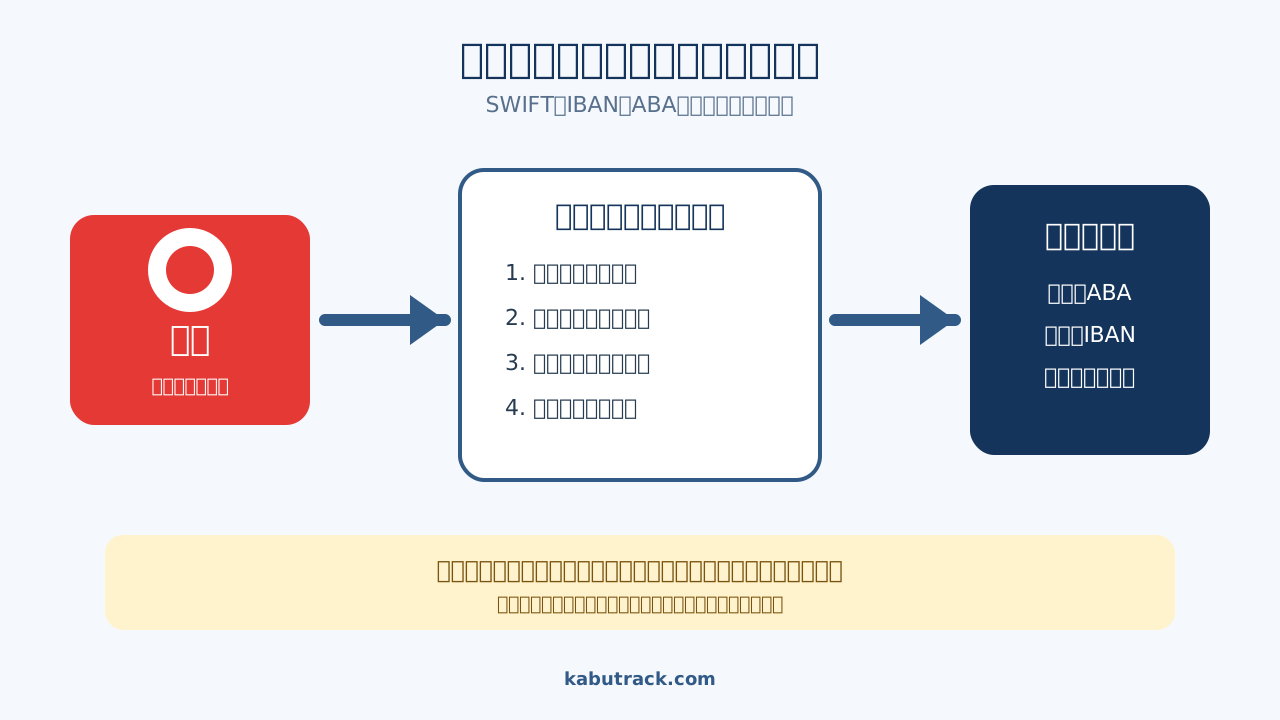
The basic flow of overseas remittance is to prepare recipient information, verify identity, enter the purpose and amount of the remittance, and send the remittance.
However, the information required varies by country.
- America: ABA Routing Number *Europe: IBAN
- UK: Sort Code
- Australia: BSB *Canada: Transit Number
- India: IFSC *Mexico: CLABE
- China: Foreign currency management and confirmation of remittance purpose
Documents certifying the source of funds and the purpose of the transaction are especially important for remittances from China to Japan or for high-value real estate/investment-related remittances.
When remittances abroad, it is important to check the exchange rate, intermediary bank fees, receiving fees, remittance limits, number of days for receiving funds, and regulations of the recipient country, rather than just making decisions based on the low fees.
*This article is a summary of general information. The actual required documents, remittance limits, and procedures under tax and foreign exchange laws will vary depending on the financial institution used, purpose of remittance, amount, and recipient country. Please check with your bank, remittance service, tax accountant, etc. before sending money.