
First, the conclusion
Calling Every a “recipe app company” misses its main business. Marketing Solution uses Delish Kitchen's audience to sell advertising, promotion and digital services to food makers and retailers. It accounted for 74% of revenue in the year ended June 2025; Consumer accounted for 10%.
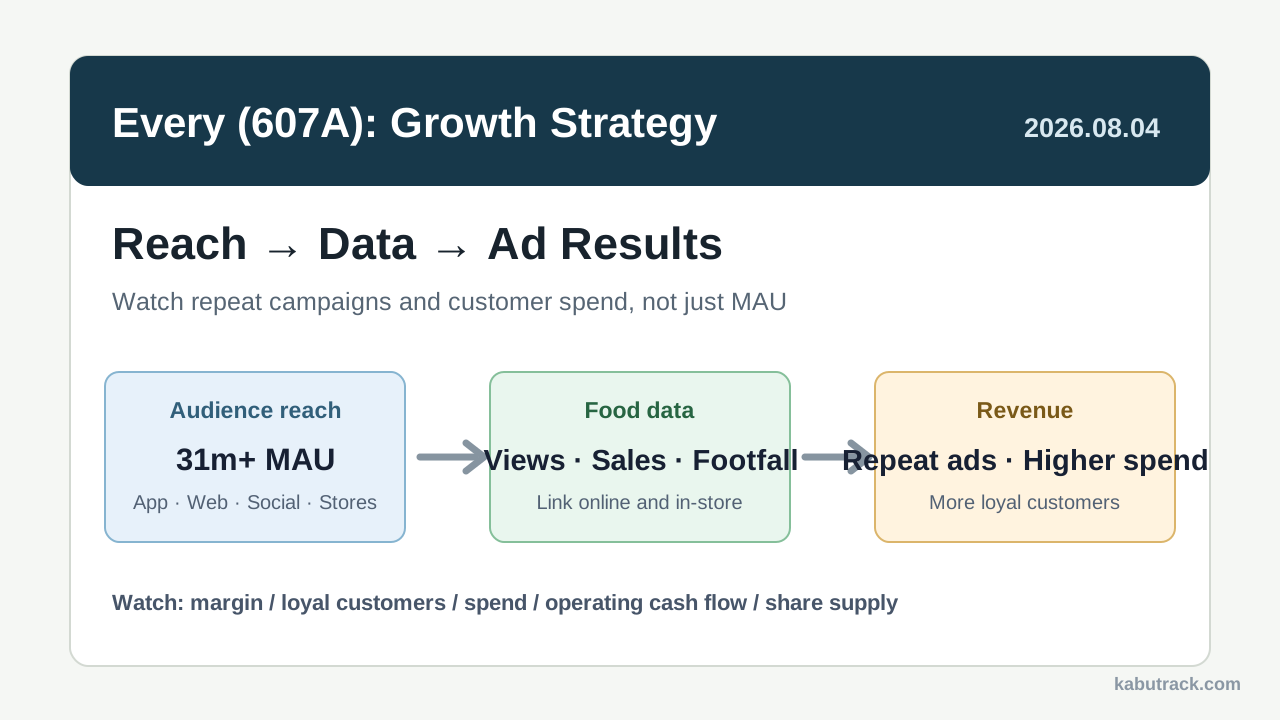
The growth case rests on connecting recipe searches and views with in-store signage, foot traffic and point-of-sale purchases. If advertisers can see that campaigns lead to sales, they may move from one-off projects to repeat campaigns across brands and services.
User reach alone is not a reason to buy. Advertising budgets move with the economy, and existing shareholders' sales can weigh on the stock after listing even when earnings improve. The harder test is whether margins and cash generation hold up after the turn to profit.
Company overview and profit model
Founded in 2015, Every uses Delish Kitchen as the hub of a food platform linking manufacturers, retailers and consumers.
| Business | Customers | Main revenue sources | Sales composition ratio for the fiscal year ending June 2025 |
|---|---|---|---|
| Marketing Solution | Food and beverage manufacturers, retail companies, etc. | Advertising distribution, content production, retail DX support | 74% |
| Consumer | Individual users | Premium members, EC/frozen home delivery meals | 10% |
| Others | Corporate customers | Contract production/development, etc. | 16% |
Marketing Solution provides tie-up advertisements for apps and SNS, display advertisements, and store vision advertisements for in-store signage. We also handle application development and maintenance operations for retail companies. In addition to distribution and production income from advertisers, this structure generates retail DX development and operation income.
Consumer earns subscription fees and sells frozen meals under the Meals brand. It helps Every maintain a direct consumer relationship, but growth in the business-to-business segment matters more to the current profit case.
Will business performance be able to shift from deficit reduction to profit expansion?
For the fiscal year ended June 2024, revenue was ¥3.359 billion and the operating loss was ¥642 million. Revenue rose to ¥4.25 billion in the year ended June 2025, while the operating loss narrowed to ¥24 million. In the first nine months of the year ended June 2026, Every reported revenue of ¥3.83 billion and operating profit of ¥323 million.
The company's forecast for the fiscal year ending June 2026 is as follows.
| Indicators | Results for the fiscal year ending June 2025 | Company forecasts for the fiscal year ending June 2026 | Changes and views |
|---|---|---|---|
| Sales | 4.25 billion yen | 5.016 billion yen | 18.0% increase compared to the previous period |
| Operating profit/loss | Loss of ¥24 million | Profit of ¥345 million | Operating margin of 6.9% |
| Ordinary profit/loss | Loss of ¥30 million | Profit of ¥335 million | Includes listing-related expenses |
| Net income/loss | Loss of ¥32 million | Profit of ¥331 million | Company forecast EPS of ¥16.88 |
Operating profit for the first nine months had reached 93.8% of the full-year forecast. Even so, the company expected fewer orders from major customers and higher personnel and listing costs in the fourth quarter. That progress rate alone was no guarantee of an earnings beat. The next test was whether profit would turn into cash.
Four mechanisms that support growth
Large-scale consumer contact points
At the end of April 2026, Delish Kitchen reported more than 31 million monthly active users across its app and website, over 13 million social-media followers and more than 57,000 pieces of professionally produced content. Its in-store signage network exceeded 11,000 screens nationwide.
The monthly active user count does not remove overlap between app and web users. It shows reach, not a count of distinct people or the value advertisers receive. Usage frequency, ad exposure and purchase conversion matter more to the earnings case.
Connecting online and in-store data
Every aims to connect recipe searches, browsing and food preferences with point-of-sale purchases, foot traffic and signage views. Because many food purchases still take place in stores, a credible link from ad view to purchase could help advertisers measure returns.
That could become an advantage, but the company's claims of uniqueness remain its own assessment. The proof would be repeatable campaign results, broad access to retail data and a lead that competitors cannot quickly close.
Upsell to loyal customers
Every calls customers with annual transactions of at least ¥10 million “loyal customers.” Their number rose from 42 in the year ended June 2024 to 62 in the year ended June 2025, reaching 66 in the first nine months of the year ended June 2026. Average customer spend also rose from ¥4.0 million to ¥5.3 million.
The stronger growth path is repeat spending by existing clients across brands and campaigns. It may improve sales efficiency, but it also makes results more sensitive to budget cuts by large advertisers.
Expanding to retail media and AI
The retail app is intended to bring payments, points, flyers and coupons together, creating more ad inventory and purchase data. Delish AI aims to respond to vague requests before users have decided what to cook.
An AI feature does not establish a profit case on its own. Look for higher search frequency and retention, more paid subscriptions, or insights advertisers will pay more for. Until those gains exceed development and inference costs, AI is a possible source of growth rather than proven earnings.
How durable is Every's competitive advantage?
Every can combine media, ad production, in-store distribution and purchase measurement. If it can show results from awareness through sale, it may compete on outcomes instead of ad-slot prices alone.
The Itochu Shokuhin partnership also matters. Itochu Shokuhin owns 11.98% of Every and works with it on signage sales, installation, maintenance and advertising. The wholesaler's retail network gives Every access to stores that an online platform would struggle to reach alone.
That access brings partner risk. Changes in the agreement or Itochu Shokuhin's priorities could slow signage deployment or reduce its profitability.
Evaluation of public price 230 yen
At the ¥230 offer price and 20,738,108 shares outstanding on listing, market capitalization was about ¥4.77 billion. Against the company's forecast for the year ended June 2026, that implied a forward P/E of about 13.6 and a price-to-sales ratio of about 1.0.
| Evaluation axis | Public price base | How to read |
|---|---|---|
| Market capitalization | Approximately 4.77 billion yen | Based on number of shares outstanding at time of listing |
| Forecast PER | Approximately 13.6 times | Based on company forecast EPS 16.88 yen |
| Forecast PSR | Approx. 1.0x | Based on company forecast sales of 5.016 billion yen |
| Expected operating profit margin | 6.9% | Focus on sustainability after profitability |
| Market capitalization target set by the company | Over 10 billion yen as soon as possible | Management goal, not performance forecast |
At the offer price, the multiples did not look stretched for an advertising and digital-services company turning profitable. But management's target of more than ¥10 billion in market value was about 2.1 times the offer-price valuation. If net income stayed at the forecast ¥331 million, a ¥10 billion valuation would imply a P/E near 30. Reaching that target on stronger fundamentals requires more loyal customers, higher spend per customer and rising operating profit.
The offering comprised 1,105,300 newly issued shares and 4,815,100 existing shares for sale, with an overallotment of up to 888,000 shares. Existing holders' sales and new investors' demand could dominate early trading even if the offer-price multiples looked modest.
Bullish scenario
The bullish scenario is for Marketing Solution sales to continue to grow at around 20% and increase operating profit margins while suppressing growth in SG&A expenses.
- Increase in loyal customers and shift from one-off ads to continuous ads
- The number of signage and retail apps increases, expanding the scope of measuring effectiveness with POS data
- Horizontal expansion to multiple brands and multiple solutions will increase unit price per customer
- Sales leverage is effective as labor costs grow more slowly than sales increase
- Consumer business and AI functions contribute to continued usage and billing
In this format, Every can change its reputation from a `well-known recipe media'' to a `food and retail sales promotion platform.'' What the market values highly is not MAU, but when data can be used to obtain recurring budgets from advertisers.
Bearish scenario
A bearish scenario is one in which Every's profits do not remain even if the advertising market grows.
- Advertising slows down due to economic slowdown and budget reviews by food manufacturers
- Quarterly sales fluctuate due to the completion of a major customer project
- Fees to advertising agencies, food wholesalers, and external media will increase, slowing gross profit growth
- Operating profit margin will decline due to upfront costs for servers, development, and human resources.
- Loss of trust due to personal information/purchasing data management accidents and advertising issues
- Collaboration conditions with Itochu Foods have changed, delaying signage deployment
- Selling pressure continues after listing, and stock price is difficult to react even with good performance
Visualizing advertising effectiveness is appealing, but one success story cannot be replicated with all customers. If outcome measurement varies from project to project, the premise of continued advertising and unit price increases will be undermined.
KPIs that investors should look at
| KPI | Current levels confirmed | What to watch next |
|---|---|---|
| Marketing Solution sales | Forecast for the fiscal year ending June 2026: 4.015 billion yen | Can we achieve a 27.7% increase compared to the previous fiscal year |
| Number of loyal customers | 66 companies (3Q total) | Will it increase for the full year and the next period? |
| Average customer spend | 5.2 million yen (3Q total) | Will it increase even after adjusting for period differences |
| Operating profit margin | Full-year forecast 6.9% | Can it grow further after turning profitable |
| MAU | Over 31 million | Look at usage frequency rather than size including duplication |
| In-store signage | Over 11,000 units | Does the number of installed signages lead to advertising sales and profits |
| Operating cash flow | 3Q cumulative total not disclosed | Does profit and cash income match? |
I would especially like to see the number of loyal customers and operating profit margin side by side. If the profit margin decreases even though the number of customers increases, the cost of acquiring projects and external distribution costs may be high. Conversely, if the cost per customer and profit margin increase at the same time, the value of the integrated solution is supported by the numbers.
Wrap-Up
Before the first trade, “Is Every a buy?” had no single answer. At the ¥230 offer price, the forecast P/E was about 13.6 and price-to-sales ratio about 1.0. Those figures were only a starting point.
The business case lies in linking online food interests with in-store purchases and reporting the results to advertisers. More loyal customers and a move into profit offered early evidence, but the full-year result and operating cash flow still needed checking.
The next checks were full-year earnings, operating cash flow, customer spend and margin after listing, and whether share supply settled. Improvement across those measures would support a profit-growth case. Without it, the valuation would lean heavily on audience size and market potential.
Related pages
- Every (607A) stock analysis
- Every (607A) IPO News
- 2026 IPO list
- Japanese stocks/IPO morning edition: 8/4 8 noteworthy items
Source
- Every Co., Ltd. “Matters related to business plans and growth potential”, published on August 4, 2026
- Every Co., Ltd. “Notice regarding approval of new listing on the Tokyo Stock Exchange Growth Market”
- Every Co., Ltd. “Regarding business forecasts for the fiscal year ending June 2026”, published on June 30, 2026
- Every Co., Ltd. “Company Information”
- Every Co., Ltd. "Services"
- Japan Exchange Group "Newly listed company information"
- Japan Exchange Group, “New Listing Company Outline: Every Co., Ltd.”, June 30, 2026
- Every Co., Ltd., fiscal year ending June 2026 third-quarter results, via JPX
*MAU, number of SNS followers, number of recipes, and number of in-store signage are as of the end of April 2026. Market size and competitive comparisons include estimates and evaluations of company materials.